 ZeroThreat Wins Bronze Stevie® Award in Tech Startup of the Year Read more

All Blogs
Quick Overview: Choosing the right AI pentesting tool can be challenging as new platforms continue to emerge. This guide covers the best AI penetration testing tools in 2026, their key capabilities, and ideal use cases. It also explains what features to prioritize when selecting a tool and why ZeroThreat is one of the ideal choices for your security and dev teams.
Most organizations are running penetration tests the same way they did a decade ago. Once or twice a year, a team comes in, tests what they can reach, and hands over a report. By the time the next engagement rolls around, the application has shipped dozens of new features. The attack surface has changed. The findings from last quarter are already stale.
That gap is exactly where breaches happen.
67% of U.S. enterprises experienced a breach in the previous 24 months despite having large security stacks and existing strong security measures. The tools were there. The testing was not continuous enough to keep up.
This is the problem advanced penetration testing solutions are built to solve. The best AI pentesting tools can automate reconnaissance, simulate attacker behavior, validate exploit paths, identify business logic weaknesses, and continuously assess web applications and APIs. They help security teams uncover real security risks faster while reducing the manual effort required to maintain strong security coverage.
In this guide, you'll discover the top tools, how they compare, and the features that matter so that you can choose the ideal AI pentesting tool. With that said, let’s get started!
Most breaches start with multi-step attack paths nobody tested. Close yours in minutes, not months. Sign Up Now!
ON THIS PAGE
- Best AI Pentesting Tools (2026): Quick Glance
- What are AI Pentesting Tools?
- What to Look for in an AI Penetration Testing Tool?
- Top 10 AI Penetration Testing Tools (2026)
- Why Choose ZeroThreat as Your AI Pentesting Solution?
- Final Thoughts
Best AI Pentesting Tools (2026): Quick Glance
| Tool | Primary Focus | AI Capability | Deployment Model | Best For |
|---|---|---|---|---|
| ZeroThreat | Web App & API Pentesting | Application-Aware AI Pentesting | Hybrid (SaaS & On-Prem) | SaaS, DevSecOps, Enterprises |
| XBOW | Autonomous Offensive Security | Autonomous Attack Execution | Cloud SaaS | Security Teams |
| Strix | Application & Cloud Security Testing | Multi-Agent Autonomous Testing | Open Source (Local) | Enterprises, DevSecOps |
| Mindgard | AI Application Security | AI Red Teaming & AI Security Testing | Enterprise SaaS | AI/LLM Applications |
| Horizon3.ai NodeZero | Network & Infrastructure Pentesting | Autonomous Attack Path Testing | Agentless Cloud SaaS | Enterprise Security Teams |
| Burp Suite | Web Application Security Testing | AI-Assisted Testing | Desktop Software | Pentesters & AppSec Teams |
| HexStrike | AI-Assisted Pentesting Workflows | Security Research Assistant | Open Source (Kali) | Kali Linux Users |
| Pentera | Security Validation & Attack Simulation | Automated Attack Emulation | Agentless Cloud SaaS | Large Enterprises |
| Escape | API & Web Application Security | AI Penetration Testing | Hybrid (SaaS & Local) | API-First Organizations |
| Transilience AI | Continuous Exposure Validation | Autonomous Security Agents | Cloud SaaS | Security Operations Teams |
What are AI Pentesting Tools?
AI pentesting tools are security testing platforms that use autonomous agents and artificial intelligence to automate, scale, and enhance ethical hacking. Unlike traditional pentest tools that follow static rules, these tools reason about application behavior, simulate real-world attacks, chain vulnerabilities together, and adapt their strategies to surface exploitable threats and prioritize the ones that matter most for your business, not just based on the CVSS score.
Modern AI pentesting platforms can help security teams:
- Discover vulnerabilities across web applications, APIs, and cloud environments
- Adapt attack paths based on application behavior
- Validate exploits and provide proof-based findings
- Continuously test applications as new code is released
- Detect deep business logic and workflow abuse vulnerabilities
- Uncover complex security flaws in UI & SPA
- Reduce manual effort spent on repetitive security assessments
As software development cycles become faster, many organizations are adopting AI pentesting tools to improve security coverage without increasing testing bottlenecks. Recent research also shows growing progress in autonomous penetration testing, where AI agents can identify, prioritize, and even validate attack paths with evidence-backed reproducible findings
The goal is not to replace human pentesters or ethical hackers. Instead, AI acts as a force multiplier that helps security teams test more frequently, identify risks earlier, and focus their expertise on complex security issues that require human judgment.
What to Look for in an AI Penetration Testing Tool?
Not all AI pentesting tools offer the same level of security coverage or automation. The best platforms provide continuous, validated security testing that helps teams identify real-world risks, reduce false positives, and improve remediation efficiency.
When evaluating an AI penetration testing tool, look for the following capabilities:
- Autonomous Exploit Validation: Look for tools that validate vulnerabilities by safely executing exploits rather than just guessing. This eliminates false positives and provides clear, proof-of-concept evidence for engineering teams.
- Complex Logic Flaw Detection: Ensure the tool can map multi-step business logic vulnerabilities like BOLA and IDOR. The platform must understand application context instead of just scanning for simple code bugs.
- Authenticated Flow Support: Choose a platform capable of handling complex authentication structures, including MFA and session refreshes. This allows the AI to thoroughly test deep, protected application states behind login walls.
- DevSecOps Pipeline Integration: The tool should integrate directly into your CI/CD workflows, ticketing systems, and developer tools. This enables continuous regression testing every time new code is deployed to production.
- Context-Aware Attack Chaining: Select an AI pentest platform that strings multiple low-severity findings together to achieve a broader exploit path. It is needed to mimic how actual threat actors compromise real-world production environments.
- Developer-Ready Remediation: Seek out reports that include specific code snippets and reproduction steps. That makes it much easier for engineers to fix issues without needing long security meetings.
ZeroThreat’s AI pentesting finds what traditional tools miss. Put your application through the real test today. Run AI Pentest
Top 10 AI Penetration Testing Tools (2026)
The AI pentesting solutions are evolving rapidly, with platforms offering everything from autonomous security testing to exploit validation and continuous assessment. Here are the best security testing tools to consider for securing modern web applications and APIs.
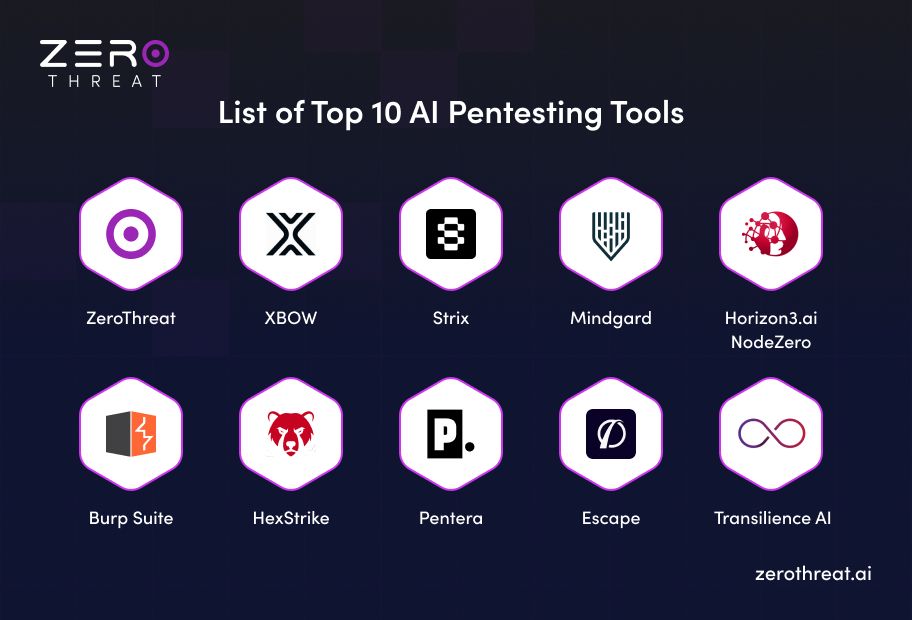
1. ZeroThreat
ZeroThreat is an AI pentesting tool that identifies and validates real, exploitable vulnerabilities across modern web applications and APIs. With its 80+ agents working in parallel, it allows organizations to discover and prioritize their business-specific security risks. You also have the flexibility to prioritize the compliance your application needs (e.g., if it’s a healthcare app, you might want to prioritize HIPAA over other compliance).
Instead of crawling for known CVEs and handing you a noisy report to triage, it runs AI agents that reason through your application the way a human pentester would, mapping attack surface, probing authenticated flows, chaining vulnerabilities, and validating which findings are actually exploitable.
That shift from detection to validation is what separates it from traditional DAST: every result comes with proof of exploitability, not a maybe. The agents understand application context, so they catch the business logic flaws, broken access controls, and shadow APIs that signature-based scanners simply can't see.
And because the testing is continuous and production-safe, you're not waiting on a quarterly pentest window to find out an attacker could already be inside, you find what they'd find first, on every release. With 130K+ vulnerability coverage and 99.9% detection accuracy across both web apps and APIs, ZeroThreat delivers the depth of a manual pentest at the speed and scale automation makes possible.
Key Features of ZeroThreat...
- Agentic AI Pentesting: Autonomous AI agents reason through your app like a human pentester, chaining vulnerabilities and validating which ones are actually exploitable.
- Exploit Validation, Not Just Detection: Every finding comes with proof of exploitability, cutting false-positive noise instead of dumping a list of maybes to triage.
- Business Logic Testing: Catches workflow-level flaws like price manipulation, privilege escalation, and broken access control that signature-based scanners miss.
- Web App + API Coverage: Full OWASP Top 10 and OWASP API Security Top 10 testing in one platform, including BOLA/BFLA, IDOR, broken auth, SSRF, and shadow API discovery.
- Authenticated Security Testing: Tests login flows, session logic, and access control to find vulnerabilities hidden behind authentication.
- Continuous & Production-Safe: Runs on every release without disruption, so you're not waiting on a quarterly pentest window to surface real risk.
- CI/CD-Native & On-Prem Ready: Integrates directly into your pipeline for shift-left security, with on-prem deployment for air-gapped and regulated environments.
- Compliance-Ready Reporting: Audit-ready reports with AI remediation guidance, mapped to OWASP, PCI-DSS, HIPAA, GDPR, and ISO 27001.
Best For: Security teams and DevSecOps engineers who need continuous, production-safe pentesting across web apps and APIs with built-in security compliance.
2. XBOW
XBOW is an autonomous offensive security platform designed to deliver the depth of a premium pentesting engagement at machine speed. It coordinates multiple AI agents that work together to execute targeted attack paths, validate findings through real exploitation, and surface only what is genuinely exploitable.
The platform has been independently validated through HackerOne bug bounty programs, where it demonstrated the ability to uncover original, exploitable vulnerabilities in production-grade applications. It is now powered by GPT-5.5, making it one of the more advanced autonomous pentesting systems available today.
Key Features of XBOW...
- Autonomous multi-agent attack execution across complex application surfaces
- Real exploit validation with reproducible proof of concept for every finding
- Deep attack path exploration, including chained and multi-step vulnerabilities
- Compliance framework support across 40+ standards with audit-ready reporting
- Continuous testing capability that scales without adding manual overhead
- Integration with compliance platforms like Vanta
Best For: Dedicated security and red teams that need adversarial depth, validated exploit chains, and proof-based findings without manual triage overhead.
3. Strix
Strix is an open-source autonomous security platform that deploys coordinated teams of AI agents to test code, APIs, web apps, cloud environments, and infrastructure. Rather than scanning for known signatures, it runs applications dynamically in an isolated container and probes them the way a real attacker would.
What sets Strix apart is its ability to generate fix PRs after validating a vulnerability. It does not just hand you a report. It closes the security loop inside your existing development workflow, making it a natural fit for teams that ship fast and want security embedded in every deploy.
Key Features of Strix...
- Autonomous AI agents that dynamically explore and exploit vulnerabilities in sandboxed environments
- Active exploit validation with proof-of-concept generation for every finding
- Full-stack coverage across code, APIs, web apps, cloud, and infrastructure
- CI/CD integration via GitHub Actions with pull request blocking on critical findings
- Automated fix PR generation submitted directly to the developer's workflow
- HTTP proxy toolkit for request interception and deep input manipulation testing
- Jira, Slack, and Linear integrations for team collaboration and issue tracking
Best For: Developer-led security teams and DevSecOps engineers who want autonomous, code-level security testing embedded directly into their CI/CD pipeline.
4. Mindgard
Mindgard is purpose-built for one problem that most pentesting tools do not address: securing AI systems themselves. It focuses on discovering, assessing, and red teaming AI models, agents, and applications using attacker-aligned techniques. The platform maps the AI attack surface the way a real adversary would approach it.
What makes Mindgard distinct is its research pedigree. The team has exposed real vulnerabilities in production AI systems including Google Antigravity, OpenAI Sora, and Grok. It operates across the full security lifecycle, from shadow AI discovery and reconnaissance to runtime threat detection and agent hardening.
Key Features of Mindgard...
- Automated AI red teaming against evolving attack vectors for LLMs and AI agents
- Shadow AI discovery and AI infrastructure crawling for unknown exposure
- Psychometric agent profiling and AI fingerprinting for recon-stage analysis
- AI attack surface enumeration across chatbots, applications, and infrastructure
- Runtime AI threat detection and response for live production environments
- AI model scanning for artifact-level vulnerabilities before deployment
- AI governance and compliance reporting mapped to security risk frameworks
Best For: Security teams responsible for protecting AI systems, LLM-powered applications, and AI agents where traditional pentesting tools offer no coverage.
5. Horizon3.ai NodeZero
Horizon3.ai's NodeZero is an autonomous pentesting platform built around a simple principle: show organizations exactly how an attacker would move through their environment, then help them verify the fix worked. It executes real attack techniques across internal networks, external perimeters, cloud environments, and Active Directory without requiring agents or causing disruption.
NodeZero has achieved zero downtime across all production tests, which speaks directly to how it is architected. It is trusted by government agencies, Fortune 10 companies, and healthcare providers, and serves as the offensive security engine behind the NSA's Continuous Autonomous Penetration Testing program.
Key Features of NodeZero...
- Agentless autonomous pentesting across internal, external, cloud, and hybrid environments
- Attack path chaining with lateral movement, credential compromise, and privilege escalation
- Active Directory password auditing and identity security validation
- Continuous find, fix, and verify loop with proof-of-exploit for every finding
- Kubernetes and cloud pentesting with IAM misconfiguration detection
- Rapid Response testing for newly disclosed CVEs and active threat intelligence
- FedRAMP High authorized deployment for government and regulated industry environments
Best For: Enterprise security and IT teams that need continuous, production-safe autonomous pentesting across complex hybrid environments with verifiable fix confirmation.
One breach costs more than a year of continuous security testing. See the numbers yourself. View Pricing
6. Burp Suite (with Burp AI)
Burp Suite Professional has been the standard web pentesting toolkit for over two decades. With the introduction of Burp AI, PortSwigger has embedded an AI-drivenassistant directly into the tool's core workflow, including the Repeater and Scanner. It is designed to reduce the repetitive parts of manual testing while keeping the pentester in full control.
Burp AI focuses on augmentation rather than automation. It helps testers understand unfamiliar HTTP artifacts in context, validates access control findings before they are reported, and generates AI-powered insights without turning the tool into a black box. The platform also supports a 3,000+ extension BApp Store, making it one of the most customizable environments in the industry.
Key Features of Burp Suite (Burp AI)...
- AI-powered Explainer built into Repeater for contextual HTTP artifact analysis
- AI-enhanced broken access control scanning with pre-report validation
- AI-generated login sequence recording for authenticated testing workflows
- Full intercepting proxy with HTTP, HTTPS, WebSocket, and HTTP/2 support
- Automated vulnerability scanner with CI/CD integration via DAST edition
- BApp Store with 3,000+ community-built extensions for custom testing scenarios
- Montoya API for integrating AI capabilities directly into custom Burp extensions
Best For: Individual pentesters, red teamers, and bug bounty hunters who want AI-assisted depth inside a battle-tested, fully customizable manual testing environment.
7. HexStrike
HexStrike AI is an open-source Model Context Protocol server that turns LLM agents like Claude, GPT, and Copilot into autonomous cybersecurity operators. Instead of building a standalone scanner, it bridges AI models directly to 150+ professional security tools, letting those agents plan, execute, and analyze real attacks without manual guidance.
The platform runs a multi-agent architecture where 12+ specialized AI agents handle different attack layers simultaneously. It has been officially packaged into Kali Linux, which signals its adoption among the professional security research and red team community.
Key Features of HexStrike AI...
- Autonomous AI agents with intelligent decision-making and vulnerability intelligence
- Blast-radius tiering that classifies tools into safe, intrusive, and destructive execution levels
- Session-scoped scope validator with CIDR, wildcard, and regex enforcement for out-of-scope blocking
- Automated payload generation and real-time result analysis across network and web targets
- MCP server architecture bridging LLMs to 150+ professional offensive security tools
- Kill switch per session for instant process termination during active engagements
- Native Kali Linux packaging with dependencies including mitmproxy, Selenium, and pwntools
Best For: Security researchers, red teamers, and bug bounty hunters who want to run LLM-driven autonomous pentesting using their own AI models and tool stack.
8. Pentera
Pentera is an AI-driven exposure validation platform built to test production environments safely and continuously. Its core focus is answering a specific question: of all the vulnerabilities your tools have flagged, which ones can an attacker actually exploit right now? The platform runs adversarial testing in live environments to answer that directly.
The platform covers internal networks, external attack surfaces, cloud identity, and hybrid environments through dedicated modules: Pentera Core, Surface, Cloud, and Resolve. Pentera Resolve adds automated remediation orchestration on top of the validation layer, closing the loop from finding to fix.
Key Features of Pentera...
- AI-driven adversarial testing in production environments with safe execution controls
- Pentera Core for internal network security validation and lateral movement simulation
- Pentera Surface for external attack surface discovery and exploitability validation
- Pentera Cloud for cloud identity and hybrid environment security assessment
- Pentera Resolve for automated remediation orchestration tied to validated findings
- Compliance-ready audit proof with controlled test execution and activity logging
- Integration with security ecosystems for connecting exposure validation to existing workflows
Best For: Enterprise security teams that need continuous, production-safe exposure validation across internal, external, and cloud environments with remediation orchestration built in.
9. Escape
Escape is an AI-powered offensive security platform trusted by over 2,000 security teams. It is built around a straightforward premise: legacy scanners cannot understand business logic, and most critical vulnerabilities live at that layer. Escape provides business-logic-aware DAST, AI pentesting, and attack surface management tools all under one platform.
Its newest capability, Cascade, is a multi-agent pentesting system that builds contextual knowledge of the application under test. It understands how the business operates, not just how the endpoints respond, which allows it to generate and execute attack scenarios that generic pentest tools would never produce.
Key Features of Escape...
- Business-logic-aware DAST for detecting BOLA, IDOR, privilege escalation, and workflow abuse
- Cascade multi-agent pentesting with application-specific context learning
- Attack surface management covering web apps, APIs, and infrastructure from code to cloud
- AI-powered proof of exploit with validated findings for every surfaced vulnerability
- Custom attack scenario generation derived from complex real-world bug bounty exploits
- Remediation guidance integrated directly into engineering workflows
- REST and GraphQL API coverage with shadow API detection and access control testing
Best For: Medium to large engineering and security teams that need continuous, business-logic-aware pentesting across modern web applications and APIs at scale.
10. Transilience AI
Transilience AI is a managed cloud security and compliance platform powered by AI agents. It is built for teams that are buried in CVEs, fragmented CSPM alerts, and the overhead of proving compliance. The platform operates as a Full Stack Security Operating System, replacing disconnected tooling with a unified agent-powered workflow from detection through to remediation.
What makes Transilience distinct is that it does not just surface findings. It drives remediation. Its AI agents run CSPM, CTEM, CNAPP, and CWPP workflows in a single place and combine automated scale with plain-English fix guidance for engineering teams. The goal is moving security posture from "Detected" to "Eliminated".
Key Features of Transilience AI...
AI agent-powered CSPM with cloud context-aware vulnerability prioritization and exploitability scoring
- CTEM workflows for continuous threat exposure management across cloud environments
- CWPP and CNAPP coverage for workload protection and cloud-native application security
- Compliance automation with audit certification support and on-schedule delivery
- Natural language security threads for querying risk posture without digging through dashboards
- Plain-English fix artifacts delivered directly to engineering teams for faster remediation
- Unified dashboard replacing fragmented tool sprawl across CSPM, CWPP, and CTEM
Best For: Cloud security teams and DevOps engineers managing complex, multi-tool cloud environments who need continuous exposure management and compliance in one platform.
Why Choose ZeroThreat as Your AI Pentesting Solution?
Choosing the right AI pentesting platform comes down to one question: can it identify real security risks instead of generating more alerts to review? ZeroThreat is designed to help organizations continuously discover, validate, and prioritize exploitable vulnerabilities across modern web applications and APIs through AI-driven security testing.
- Proof-Based Vulnerability Validation: Every finding is validated through controlled exploitation workflows before being reported. This approach helps eliminate false positives and ensures teams focus on confirmed security risks.
- Deep Business Logic Testing: ZeroThreat goes beyond traditional pentests by testing workflow abuse, authorization weaknesses, privilege escalation paths, and application-specific business logic vulnerabilities.
- Comprehensive Web Application and API Pentesting: The platform provides automated testing for modern web applications, REST APIs, GraphQL APIs, authenticated user journeys, and complex application workflows from a single platform.
- Attack Path Chaining: ZeroThreat chains individual weaknesses into multi-step attack paths, surfacing the access control flaws traditional tools overlook and provides the full route to your data exposure, not just the isolated vulnerabilities.
- Production-Safe Security Validation: Organizations can safely test live applications using production-safe scanning capabilities that are designed to identify vulnerabilities without disrupting application performance or user experience.
- Coverage for Emerging Threats and New CVEs: The platform continuously updates its attack logic and supports community-driven attack templates (Burp Suite and Nuclei), helping teams test for newly disclosed vulnerabilities and evolving attack techniques.
- Testing Across External Attack Surface: Its AI pentesting tool can test the full external attack surface, from exposed ports, SSL/TLS, DNS, and mail security configuration to authenticated areas, workflows, inputs, vulnerability detection, and reporting.
- Automated Remediation and Retesting: ZeroThreat provides contextual remediation recommendations, exploit evidence, and lets you retest the application to confirm the vulnerability has been eliminated.
Schedule a personalized, live exploit validation walkthrough designed for your engineering team. Contact Us
Final Thoughts
AI penetration testing is changing how organizations identify and validate security risks. Instead of relying solely on periodic assessments, security teams can continuously test applications, APIs, cloud environments, and infrastructure as their attack surface evolves. Continuous security validation is becoming a critical part of modern cybersecurity programs.
The most effective AI pentesting tools do more than detect vulnerabilities. They validate security even in complex workflows, check for exploitability, ranks risk based on business impact, support remediation efforts, and integrate into CI/CD pipelines. Features such as authenticated testing, business logic analysis, API security testing, and proof-based findings should be key evaluation criteria when comparing platforms.
At the end, human expertise remains essential, but AI is making security testing faster, more scalable, and more consistent. Organizations that combine an AI penetration testing tool with expert security oversight are better positioned to identify emerging threats, reduce exposure, and strengthen their overall security posture.
Frequently Asked Questions
How do AI pentesting tools work?
AI pentesting tools use machine learning and AI agents to map an application attack surface automatically. The core engine analyzes system responses in real time to plan adaptive exploit chains rather than relying on static scripts. It automatically generates authenticated payloads, executes production-safe attacks, and provides proof-of-concept evidence for confirmed vulnerabilities.
What is the difference of AI pentesting and manual pentesting?
Can AI replace human penetration testers?
How do I choose the right AI pentesting tool?
Which AI pentesting tools support API security testing?
Can AI pentesting tools identify business logic vulnerabilities?
Is AI pentesting better than annual penetration testing?
Related Articles
Explore ZeroThreat
Automate security testing, save time, and avoid the pitfalls of manual work with ZeroThreat.