 ZeroThreat Wins Bronze Stevie® Award in Tech Startup of the Year Read more

All Blogs
What is AI Pentesting? A Complete Guide to AI-Driven Security Testing
Quick Overview: AI penetration testing uses artificial intelligence to continuously discover, test, and validate security vulnerabilities before attackers exploit them. This blog explains what AI pentesting is, how it works, its benefits, limitations, and best practices for adoption. You’ll also learn how platforms like ZeroThreat help organizations strengthen security with autonomous, risk-focused penetration testing at scale.
One of the biggest shifts in cybersecurity today is how fast threats evolve. In 2025, 16% of all data breaches involved attackers using AI to scale attacks, highlighting how adversaries exploit automation and machine learning at speed.
As threats grow, traditional security tests are no longer enough. That’s where AI pentesting comes in. It’s a form of penetration testing powered by artificial intelligence and automation that continuously looks for weaknesses. It adds depth and context to security audits that manual scans can miss.
AI pentesting helps find vulnerabilities earlier and more reliably. With automated reconnaissance, intelligent scanning, and exploit validation, teams can focus on real risks rather than sifting through noise.
In this guide, you’ll learn what AI-driven penetration testing is, how it works, and why it’s becoming essential in cybersecurity. You’ll also see comparisons with traditional pentesting and understand how agentic AI penetration testing helps modern security teams protect APIs, apps, and cloud systems.
Start autonomous AI pentesting before attackers find your gaps. Get Started FREE
On This Page
- What is AI Pentesting?
- AI Pentesting vs Traditional Penetration Testing
- How AI-Powered Penetration Testing Works
- Benefits of Autonomous AI-Based Pentesting
- Limitations of AI Pentesting Tools
- What to Look for in an AI Pentesting Tool?
- Best Practices for Implementing AI-Driven Penetration Testing
- How Does ZeroThreat Support AI Penetration Testing?
- Wrapping Up
What is AI Penetration Testing?
AI pentesting is a security testing approach to automatically find, test, and validate security vulnerabilities across applications, APIs, and digital assets. It enhances traditional automated testing by adapting to application behavior, identifying potential attack paths, and prioritizing vulnerabilities based on contextual risk.
Unlike traditional pentesting, it can adapt to runtime behavior and assess how multiple weaknesses may be combined into realistic exploit scenarios. It analyzes assets, identifies exposed entry points, and performs autonomous vulnerability assessment without waiting for scheduled tests. That makes pentesting especially effective for fast-changing environments like cloud platforms, APIs, and CI/CD pipelines.
AI-powered penetration testing also focuses on attack context, not just raw findings. It uses techniques such as automated attack chaining and AI attack path discovery to understand how multiple weaknesses can be combined into real-world exploits. This helps security teams prioritize issues that actually increase risk.
Another key advantage of such penetration testing is speed and consistency. Manual pentesting depends heavily on time and human availability. AI pentesting tools can run continuously, detect new risks as they appear, and support continuous penetration testing without slowing development.
That said, AI pentesting does not replace human expertise. It works best as part of a hybrid model, where autonomous pentesting handles scale, while security experts validate complex logic. When used correctly, it becomes a practical way to keep security testing aligned with quickly changing systems.
AI Penetration Testing vs Traditional Penetration Testing
| Aspect | AI Pentesting | Traditional Pentesting |
|---|---|---|
| Core Approach | Uses machine intelligence to simulate and adapt attacks autonomously | Executes predefined scans and tests based on static rules |
| Coverage | Broad, continuous scanning of apps, APIs, and infrastructure | Limited to scheduled, point-in-time scans |
| Speed | Fast and ongoing, with real-time assessments | Slower; runs only when scheduled |
| Context Awareness | Prioritizes vulnerabilities based on risk and attack paths | Reports raw findings without deeper prioritization |
| Validation | Validates vulnerabilities by simulating exploits automatically | Identifies potential issues without confirming exploitability |
| False Positives | Lower with AI validation logic | Higher, requiring manual review to confirm issues |
| Adaptability | Updates with emerging vulnerabilities | Static and rule-based; zero adaptability |
| Human Involvement | Works continuously, with optional human oversight | Needs human effort for interpretation and deeper analysis |
How AI-Powered Penetration Testing Works
AI pentesting follows a structured process designed to continuously identify and validate security risks before attackers do. Instead of relying on periodic testing, it operates with speed, intelligence, and scale. In fact, it simulates real-world attack behavior while helping security teams focus on the risks that matter most.
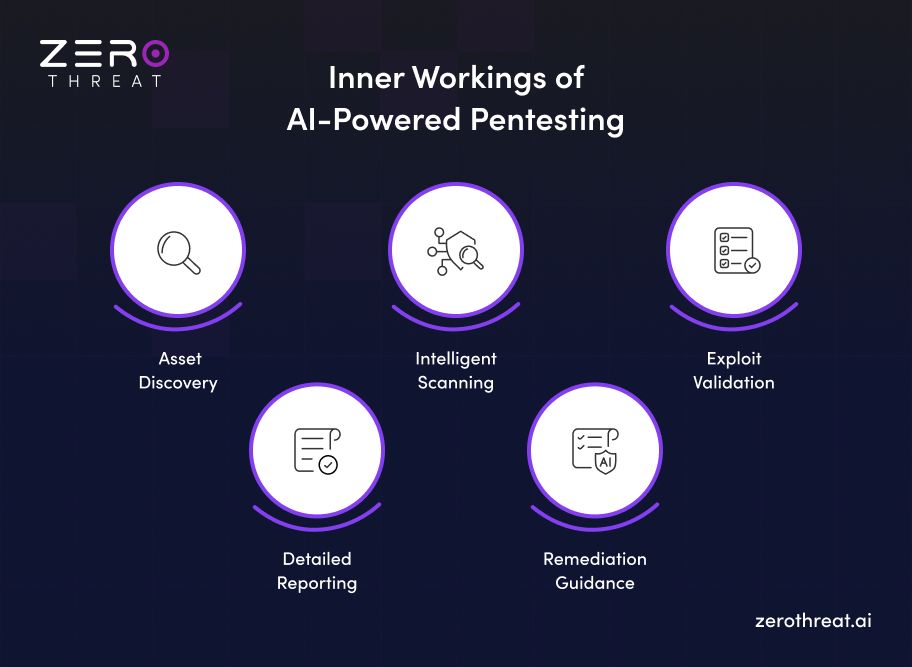
1. Asset Discovery
AI pentesting begins by identifying everything exposed to the internet or internal networks. This includes applications, APIs, cloud resources, domains, and shadow APIs that often go unnoticed. By automating asset discovery, organizations gain a real-time view of their attack surface.
Key outcomes include:
- Detection of unknown or forgotten assets
- Visibility into expanding cloud environments
- Reduced blind spots in security testing
2. Intelligent Scanning
Once assets are mapped, AI-driven pentesting uses intelligent scanning to analyze configurations, endpoints, and services for weaknesses. Unlike traditional scans, AI prioritizes vulnerabilities based on exploitability rather than listing raw findings. This approach supports continuous penetration testing and helps teams avoid alert fatigue.
What makes it effective:
- Context-aware vulnerability detection
- Faster identification of high-risk exposures
- Ongoing scanning as environments changes
3. Exploit Validation
Finding vulnerabilities is not enough. AI penetration testing safely validates them by attempting controlled exploitation. This confirms whether a weakness is actually actionable. Validation reduces false positives and ensures teams focus on real threats.
Benefits include:
- Proof-based security findings
- Clear understanding of attack paths
- Better risk prioritization
4. Detailed Reporting
AI-powered penetration testing converts technical results into structured, readable reports. These reports explain what was discovered, how it could be exploited, and the potential business impact. Strong reporting helps security and engineering teams align quickly.
Typical report insights:
- Severity-based vulnerability ranking
- Evidence-backed attack scenarios
- Clear technical details for faster fixes
5. Remediation Guidance
Modern pentesting tools go beyond detection by offering actionable remediation guidance. Instead of leaving teams with complex findings, they recommend practical steps to close security gaps. This shortens the time between discovery and resolution.
Why it matters:
- Speeds up vulnerability management
- Supports proactive security posture
- Enables smarter, risk-driven decisions
Together, these phases make AI pentesting a powerful approach for autonomous vulnerability discovery and continuous security testing. It allows organizations to move from reactive defense to a more proactive, intelligence-led security strategy.
Perform continuous, attacker-like pentesting to detect vulnerabilities with 99.9% accuracy. Perform AI Pentesting
Benefits of Autonomous AI-Based Pentesting
AI-based pentesting, specifically through the use of Agentic AI, offers several key benefits that enhance traditional security testing by introducing intelligent reasoning and adaptive workflows.
Adaptive Reasoning and Dynamic Attack Paths
Unlike [traditional automated pentesting that follows predefined workflows, AI-based pentesting uses intelligent reasoning to explore complex application behaviors. It can adapt attack paths in real-time based on live context and application responses, allowing it to sequence tests dynamically to find vulnerabilities that might be missed by static scripts.
Proof-Based Exploit Validation
A significant advantage is the ability to validate real exploit paths through controlled reasoning. This "proof-based" approach ensures that vulnerabilities are only reported after they have been reliably exploited and reproduced. For security teams, this means near-zero false positives, allowing them to focus on validated risks rather than a high volume of unverified alerts.
Safe and Governed Execution
AI-assisted pentesting is designed to be governance-ready for enterprise environments. It operates within user-defined boundaries and guardrails, ensuring it does not enter uncontrolled attack loops. Furthermore, it is restricted to staging and development environments, meaning it can validate real-world attack scenarios without risking production systems or impacting live users.
Coverage of Complex Logic and Workflow Abuse
AI pentesting is particularly effective at identifying logic-level and workflow abuse. It excels at the intelligent exploration of complex user journeys and chained exploit paths that only emerge during actual application interaction, extending the coverage provided by standard automated tools.
Increased Efficiency and Scalability
AI-driven testing reduces the manual effort required from engineering and AppSec teams. For Managed Security Service Providers (MSSPs), it offers a scalable way to perform in-depth testing across multiple client environments without the setup complexity typically associated with professional-grade testing tools.
Transparency and Flexibility (BYOM)
Many AI pentesting models, utilize a "Bring Your Own Model" (BYOM) approach. This provides several benefits:
- Cost and Policy Control: Customers have full transparency over token usage and costs while ensuring the AI aligns with internal governance policies.
- Model-Agnostic Flexibility: Teams can switch between different Large Language Models (LLMs) like ChatGPT, Gemini, or Claude, preventing vendor lock-in and future-proofing their security strategy.
Smart Orchestration with Existing Tools
Advanced pentesting does not necessarily replace existing tools; instead, it acts as a centralized control plane. It can be orchestrated with industry-standard templates to provide immediate coverage for emerging vulnerabilities as soon as new templates are released.
Limitations of AI Pentesting Tools
While AI brings incredible speed and scale to the table, it isn't a "set and forget" solution. Understanding the limitations of AI pentesting tools is crucial for any organization that wants to build a resilient security posture.
So, where exactly AI penetration testing hit the wall:
- Lack of Business Context: AI struggles to understand how your specific business operates. It can find a technical bug, but it doesn't always know if that bug actually puts your most sensitive data at risk or if it's a "known risk" mitigated by other controls.
- Challenges with Custom Logic: Modern apps often use unique, custom-built logic. AI is trained on historical patterns; if your application has a one-of-a-kind workflow, the AI might not reason its way through it as creatively as a human hacker would.
- The Problem of Hallucinations: Just like LLMs used for writing, security AI can sometimes "hallucinate" vulnerabilities that don't exist or generate non-deterministic results. This can lead to false positives that waste your team's time.
- Struggles with Complex Chaining: While AI is getting better at simple attack chains, it still finds it difficult to link three or four low-severity issues across different platforms (like cloud, web, and internal networks) to achieve a critical breach.
- Gap of Configuration Dependency: The performance of an AI tool often hinges on how well it is configured for your specific environment. A gap in these settings can lead to "blind spots" where the AI ignores certain attack vectors or fails to test your software.
- Poor Asset Inventory Input: AI testing is highly dependent on the quality of the data it starts with. If your asset inventory is incomplete, the AI may overlook disconnected microservices or shadow APIs, leaving parts of your attack surface completely untested.
In short, AI tools accelerate and scale penetration testing, but they aren’t substitutes for human expertise and careful validation.
Discover how ZeroThreat’s agentic AI pentesting simulates real attacks automatically. Explore Agentic AI
What to Look for in an AI Pentesting Tool?
Selecting the right AI pentesting tool is about finding a balance between advanced automation and practical usability. When evaluating a platform, focus on these five critical areas to ensure it meets the demands of modern application security:
- Exploit Validation and Low False Positives: Look for tools that don't just list potential issues. The best platforms use intelligent algorithms to verify vulnerabilities through safe exploitation, keeping false positive rates below 1%.
- Deep Business Logic Testing: Most basic scanners miss complex flaws like BOLA or IDOR. Ensure your tool can go beyond the OWASP Top 10 to probe custom business workflows and authorization paths.
- Authentication Resilience: Your tool must be able to test what’s behind the login screen. It should seamlessly handle modern authentication methods, including MFA, SSO, and rotating tokens.
- Seamless CI/CD Integration: To be truly effective, the tool must fit into your existing workflow. Look for one that integrates with your CI/CD pipeline to enable continuous testing every time code is updated.
- Agentic AI Pentesting: Use a tool that leverages agentic AI for independent reasoning and planning. It should adapt to attack paths in real time and prove exploitability to offer a deeper level of security validation.
- Developer-Ready Remediation: A good report should do more than point out a problem. It should provide specific evidence of vulnerability and offer tailored code snippets to help your developers fix the issue quickly.
Ultimately, the right tool should act as a force multiplier for your team, providing "high-signal" insights that allow you to focus on real risks rather than manual verification. Prioritizing these features will help you move to a proactive, continuous security posture.
Best Practices for Implementing AI-Driven Penetration Testing
Implementing AI pentesting isn’t just about turning on a tool. It works best when it’s part of a larger security strategy and follows structured practices. To get the most out of your AI-powered security approach, follow these core principles:
- Integrate Early with Shift-Left Security: Trigger lightweight AI scans during the build phase so developers can fix flaws before they ever reach production.
- Prioritize Exploit Validation: Use an automated pentesting tool that provide proof of exploit to ensure your team isn't buried under a mountain of theoretical false positives.
- Maintain Human Oversight: Leverage AI to handle the scale and repetition, but keep human experts in the loop to handle complex business logic and final risk validation.
- Implement Continuous Feedback Loops: Regularly feed findings from manual tests back into your AI models to improve their detection accuracy over time.
- Test in Isolated Staging Environments: Always run initial autonomous tests in a sandbox that mirrors production to prevent unintended disruptions to live services.
By treating AI penetration testing as a continuous activity rather than a one-off audit, you create a resilient security posture. With the human-in-loop model, AI handles repetitive work, allowing specialized teams to focus on high-level strategy and remediation.
How Does ZeroThreat Support AI Penetration Testing?
ZeroThreat simplifies security by moving beyond simple scanning to provide a fully automated, continuous pentesting experience. It uses agentic AI pentesting for reasoning application behavior, adapts attack paths, and chains sequence tests based on live context.
The platform identifies over 130,000 vulnerabilities, including deep business logic flaws like BOLA that traditional tools miss. This ensures your web apps and APIs are protected from sophisticated modern threats.
One of its biggest strengths is high-signal accuracy, with 99.9% rate that almost eliminates false positives. This allows your team to focus on fixing real risks rather than chasing ghosts.
Finally, ZeroThreat delivers AI-driven remediation reports with evidence-based payloads and custom code fixes and snippets. This accelerates your fix time and keeps your development pipeline moving without downtimes.
Find a plan that scales with your security needs of your project. Check Plans
Wrapping Up
AI penetration testing is reshaping how organizations approach security. Instead of relying only on periodic testing, it enables continuous visibility into vulnerabilities, attack paths, and real risk exposure. By combining artificial intelligence with penetration testing, teams can detect weaknesses earlier and respond faster.
However, the strongest security strategy is not AI alone. A balanced approach that mixes autonomous testing with human expertise delivers deeper context and smarter risk decisions. As web environments expand across APIs, cloud platforms, and applications, continuous pentesting becomes essential for staying resilient.
ZeroThreat makes this transition seamless by providing an AI-driven engine that uncovers complex flaws most scanners fail to detect. It’s the perfect solution for teams looking to scale their security and achieve audit-ready compliance without the traditional manual efforts.
If you are looking to simplify security testing, remediation, and maintain compliance, try ZeroThreat for free !
Frequently Asked Questions
How does AI-driven pentesting differ from traditional penetration testing?
AI-driven pentesting uses machine intelligence to adapt, prioritize risk, and validate exploits with adaptive attack-path reasoning. On the other hand, traditional automated testing relies on predefined rules and static scans that list potential vulnerabilities. AI focuses on exploitability and attack paths, while automated tools mainly report raw findings without deeper context.
Can AI-driven pentesting replace manual penetration testing?
Is AI-driven pentesting suitable for APIs and microservices?
Can ZeroThreat autonomously execute penetration testing without manual intervention?
How does AI-driven pentesting support compliance requirements?

Explore ZeroThreat
Automate security testing, save time, and avoid the pitfalls of manual work with ZeroThreat.