 ZeroThreat Wins Top InfoSec Innovators 2026 Award for Penetration Testing Read more
Production-Safe Security Testing
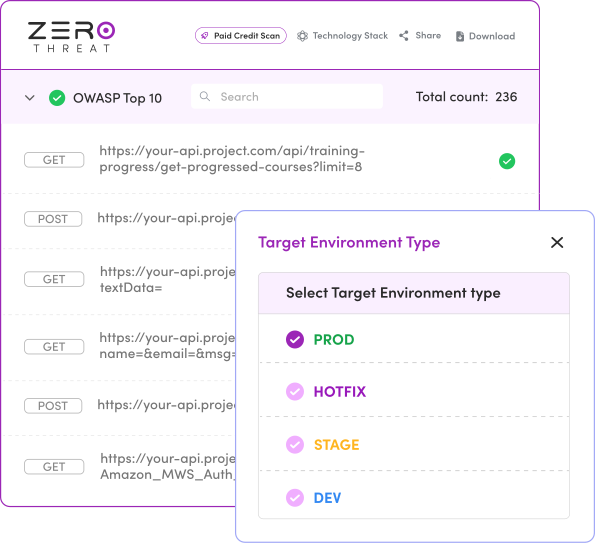
Safely test live web applications and APIs without downtime, data corruption, or operational risk. Validate real-world attack paths using non-intrusive, controlled testing designed for production environments.
- Test what attackers actually see in production
- No destructive actions or unsafe payloads
- Built-in safeguards for live environments
Why Pre-Production Testing Leaves Critical Risk Untested
Attackers target production environments, yet most security testing avoids them due to operational risk. As a result, critical security gaps often remain unvalidated.
Live applications behave differently once real users, real data, and real integrations are in place. Configuration drift, feature flags, and runtime controls can change exposure after deployment, which introduces risks that pre-production testing cannot capture.
Here’s what pre-production testing misses:
- Production configurations that differ from staging
- Real user roles and permission models
- Live integrations and active data flows
- Environment drift over time
- Attack paths only visible in production
Why Production-Safe Testing Requires a Different Approach
| Aspect | Traditional Tools |  ZeroThreat (Production-Safe) ZeroThreat (Production-Safe) |
|---|---|---|
 Testing Approach Testing Approach | Aggressive payload execution designed for test environments |  Non-intrusive, validation-first testing Non-intrusive, validation-first testing |
 Application Context Application Context | Limited understanding of workflows, roles, or state | Context-aware analysis of sessions, roles, and flows |
 Payload Behavior Payload Behavior | Exploit-oriented and potentially destructive | Designed to confirm risk without altering state |
 Traffic & Execution Traffic & Execution | High request volume, limited control | Rate-limited with execution safeguards |
 False Positives False Positives | Requires significant manual review | Validated findings with reduced noise |
 Production Readiness Production Readiness | Typically avoided or heavily restricted | Designed to run safely in live environments |
How ZeroThreat Works for Production Safe Penetration Testing
Context-Aware Request & Workflow Analysis
Our AI-powered pentesting analyzes authentication state, user roles, request sequences, and app workflows before testing. This ensures security checks are executed only when they are valid, which avoids unintended interactions with sensitive functionality.
Non-Intrusive Validation Techniques
Instead of executing destructive exploits, ZeroThreat validates whether a vulnerability is exploitable using controlled, read-only, or reversible techniques. The goal is to confirm risk without triggering data modification, deletion, or business-impacting actions.
Controlled Payload Execution
Attack payloads are selected and tailored based on endpoint behavior, request structure, and observed application responses. Payloads designed to cause instability or irreversible side effects are intentionally excluded from production scans.
Validation Before Reporting
Findings are reported only after they are validated in context. Our AI engine prioritizes exploitability and impact over theoretical issues, reducing false positives and unnecessary remediation work, especially critical when testing live systems.
Execution Safeguards & Rate Controls
ZeroThreat controls scan execution using rate limits, concurrency thresholds, and safety boundaries designed for live environments. Testing activity is automatically adjusted or stopped to prevent performance impact or unintended behavior.
Environment & Tenant Isolation
All scans run in isolated execution contexts with strict separation between customers, environments, and scan data. This ensures testing activity and results remain fully contained within the intended target environment.
Test Apps in Production Without the Risk
Validate real-world exposure in live apps using built-in guardrails that protect uptime and data.