 ZeroThreat Wins Bronze Stevie® Award in Tech Startup of the Year Read more
Discover ZeroThreat
ZeroThreat is an AI-powered, autonomous pentesting platform that continuously discovers, exploits, and validates real vulnerabilities across web applications and APIs, with no manual effort or expertise required.



What is ZeroThreat?
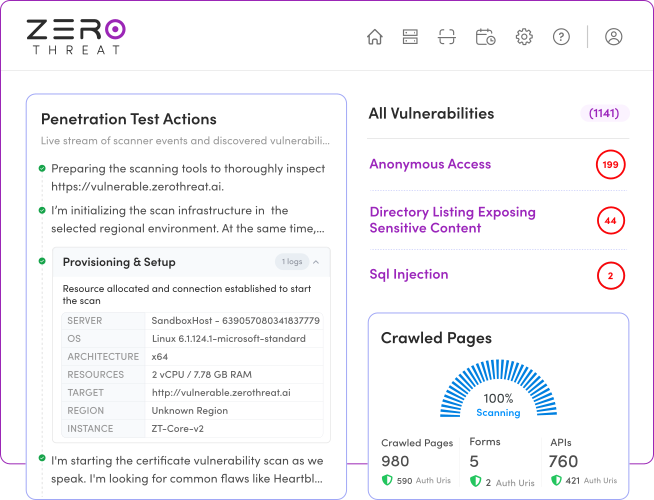
ZeroThreat is an automated penetration testing platform designed to emulate how real attackers identify and exploit weaknesses in web applications and APIs. Instead of static vulnerability detection, it autonomously analyzes application behavior, maps attack paths, and confirms security impact.
Unlike traditional tools that rely on static signatures, ZeroThreat understands app behavior. It interacts with your apps the way users and attackers do, which navigates workflows, tests authorization boundaries, analyzes transactional logic, and validates exploitability before reporting risk.
What Makes ZeroThreat Different
ZeroThreat goes beyond traditional tools by performing autonomous, attacker-like penetration testing. It validates exploitability in real time, adapts to dynamic attack surfaces, and continuously simulates real-world attack paths. The platform delivers risk-prioritized findings aligned with modern CI/CD-driven engineering workflows.
How ZeroThreat Delivers Continuous Pentesting
ZeroThreat runs as a persistent security testing engine embedded into your development lifecycle. It automatically discovers new assets, maps application logic, and re-tests environments as code changes.
Discover the Real Attack Surface
Continuously map assets from web apps and APIs, identifying exposed endpoints, authentication flows, parameters, and hidden entry points. This ensures no externally reachable asset is overlooked.
Simulate Real-World Attack Paths
The AI engine chains vulnerabilities together, mimicking adversarial behavior such as privilege escalation, auth bypass, injection exploitation, and business logic abuse.
Validate Exploitability
Findings are not theoretical. ZeroThreat’s Agentic AI pentesting confirms whether a vulnerability can be practically exploited. This reduces false positives and eliminates alert fatigue.
Prioritize by Business Risk
Issues are ranked based on exploit impact, data exposure risk, and severity alignment (OWASP, CWE/SANS), enabling focused remediation.
Fix and Rescan
Get remediation guidance with exploit proof. It also allows you to rescan particular fixes after deployment to verify resolution and prevent regressions. This ensures vulnerabilities are fully eliminated, not just patched.
How ZeroThreat Differs from Traditional Pentesting
| Capability | Traditional Tools |  ZeroThreat ZeroThreat |
|---|---|---|
 Testing Model Testing Model | Rule-based scanning using predefined payloads |  AI-driven pentesting combining Agentic AI capability with adaptive attacker workflows AI-driven pentesting combining Agentic AI capability with adaptive attacker workflows |
 Exploit Validation Exploit Validation | Detects signals, often unverified | Hybrid - On-Prem and Cloud-based (SaaS) |
 Deployment Model Deployment Model | Primarily SaaS-based deploymen | Hybrid - On-Prem and Cloud-based (SaaS) |
 False Positives False Positives | High manual triage required | 99.9% accuracy with near-zero noise |
 Business Logic Testing Business Logic Testing | Limited, rule-based checks | Deep workflow abuse detection and logic flaw analysis |
 Authenticated Testing Authenticated Testing | Basic login support | Role-aware, session-aware, permission-aware testing |
 SPA & Modern UI Coverage SPA & Modern UI Coverage | Weak or inconsistent | Playwright-powered deep SPA navigation |
 API Coverage API Coverage | Endpoint scanning, limited context | Context-aware API exploration and abuse testing |
 Data Exposure Validation Data Exposure Validation | Reports potential injection points | Extracts and proves exposed data (tokens, PII, credentials) |
 Fix Validation Fix Validation | Requires full re-scan | Re-scan individual issues instantly |
 Scan Speed Scan Speed | Hours for deep scans | Up to 10× faster with validated attack paths |
 Production Safety Production Safety | Risk of disruption in live apps | Designed for continuous production-safe testing |
 Emerging Threat Coverage Emerging Threat Coverage | Requires tool updates | Continuously evolving attack logic with Burp Suite and Nuclei attack templates |
 Manual Pentest Reduction Manual Pentest Reduction | Minimal | Significant reduction through autonomous attacker simulation |
 Enterprise Controls Enterprise Controls | Basic | Regional scan control, data residency options, governance-ready reporting |
Real Results from Modern Engineering Teams


ZeroThreat.ai exceeded my expectations with its lightning-fast scan, detailed remediation, and easy-to-use interface. It’s perfect for both developers and security teams.
Web Developer
After using ZeroThreat.ai multiple times, I can say it makes my work much easier. The scans are deep, reports are clear, and it works perfectly for client projects.
Cybersecurity Expert

The setup was super smooth; we just integrated ZeroThreat into our CI/CD once, and now every build gets scanned automatically, allowing my team to fix security issues early on.
DevSecOps Lead
ZeroThreat.ai has been a game-changer for our team. It is effortless to use; the scans are quick, and it fits perfectly into our development pipeline for detecting vulnerabilities.
VP of Product Development
It made vulnerability testing across our systems effortless, and the results are quite accurate. Plus, the DevOps integration was simple, and it’s saving our engineers hours every week.
President
I’ve tried many scanners, but ZeroThreat.ai stood out instantly. It’s accurate, catches real logic flaws, and saves me hours by cutting out the usual false-positive noise.
Security Engineer
Who Benefits from ZeroThreat?
Our automated, point-and-click interface lets any industry secure applications without extensive expertise.






Frequently Asked Questions
Is ZeroThreat a DAST tool or an autonomous pentesting platform?
ZeroThreat goes beyond traditional DAST scanning. While it uses dynamic testing techniques, it autonomously simulates attacker behavior, chains vulnerabilities, and confirms exploitability. It functions as a continuous offensive security engine rather than a signature-based scanner.
How does ZeroThreat validate real-world exploitability?
What types of vulnerabilities does ZeroThreat detect?
Can ZeroThreat integrate with CI/CD pipelines?
Does ZeroThreat replace manual pentesting?
How does ZeroThreat reduce false positives?
Is ZeroThreat suitable for API-heavy architectures?
Does ZeroThreat support compliance requirements?
How quickly can teams get started with ZeroThreat?
Ready to Get Started?
Experience the future of AppSec with ZeroThreat—secure your apps and APIs with intelligence, speed, and simplicity.