 ZeroThreat Wins Bronze Stevie® Award in Tech Startup of the Year Read more

All Blogs
How ZeroThreat Tests an Application in Production Without Breaking It: A Technical Deep-Dive
Quick Overview: Production-safe security testing is becoming essential for modern applications that cannot afford downtime or disruption. This blog explains how ZeroThreat safely tests live production environments using AI-powered pentesting, controlled exploitation, runtime-aware validation, and non-intrusive testing techniques to identify exploitable vulnerabilities, reduce false positives, maintain compliance, and validate real attack paths without disrupting applications or users.
One production outage can cost enterprises millions, yet most security testing still happens outside the environments attackers actually target. Modern applications change too quickly for periodic scans and staging-only validation to keep up.
According to Splunk and Oxford Economics, unplanned downtime costs Global 2000 companies nearly $400 billion every year. Another report found that high-impact outages can cost businesses up to $2 million per hour. These numbers clearly show the security gap most organizations have because they tested the staging and not what is on live production.
So, what’s the best solution to verify security while ensuring no disruptions happen? Using ZeroThreat’s production-safe security testing capability that can detect real attack paths directly in production using controlled, non-intrusive testing techniques.
In this blog, we’ll see how ZeroThreat safely tests live environments, controls operational risk, and continuously validates exploitable vulnerabilities without causing downtime or disrupting users. With that said, let’s get started.
Testing your staging environment is not enough. Switch to ZeroThreat for pentesting the production site. Sign Up Now!
ON THIS PAGE
- What is Production-Safe Security Testing?
- Why Pre-Production Security Testing Leaves Critical Risk Untested
- How ZeroThreat Performs Production Safe Penetration Testing
- Traditional Tools Vs ZeroThreat (Production-Safe)
- Benefits of Using ZeroThreat for Production-Safe Security Testing
- ZeroThreat’s Production Testing for Compliance and Audit Readiness
- Wrapping Up
What is Production-Safe Security Testing?
Production-safe security testing is the practice of validating application security in live environments without causing downtime, performance degradation, or service disruption. It uses controlled, non-intrusive testing methods to simulate real attack behavior while maintaining application stability. This approach helps organizations identify runtime risks, exposed attack paths, and exploitable weaknesses safely in production environments.
Unlike traditional point-in-time assessments, production-safe testing focuses on continuous security validation and runtime-aware testing.
The modern pentest tools use risk-aware execution, intelligent throttling, and controlled payload delivery to reduce operational impact during live testing. This allows security teams to validate defenses continuously without interrupting users, deployments, or business operations.
Why Pre-Production Security Testing Leaves Critical Risk Untested
Pre-production testing creates a staging gap by missing risks found only in live systems. Because attackers target production, avoiding these environments leaves critical vulnerabilities unvalidated and your application exposed.
Environment Configuration Drift
Production settings often differ from staging environments over time. These discrepancies mean that a secure sandbox does not guarantee a safe live application. Environment drift introduces unique vulnerabilities that traditional pre-production scans simply cannot identify or validate before deployment.
Complex Live Integrations
Live applications interact with real data flows and third party integrations. Sandbox environments lack these active connections, which often hide critical flaws. Testing in production reveals how these live components interact and where potential security breaches actually occur.
Real User Permissions
Authentication flows and user roles are much more complex in a live environment. Pre-production tests frequently miss broken object level authorization and session hijacking risks. Only live testing can accurately validate how real permissions function under actual user traffic.
Unique Attack Paths
Attackers see things in production that do not exist in staging. Runtime controls and feature flags can create new exposure after deployment. Validating these real-world attack paths is the only way to ensure your security posture is truly robust.
There's a good chance your production app has vulnerabilities you've never tested for. Check My App Now
How ZeroThreat Performs Production-Safe Penetration Testing?
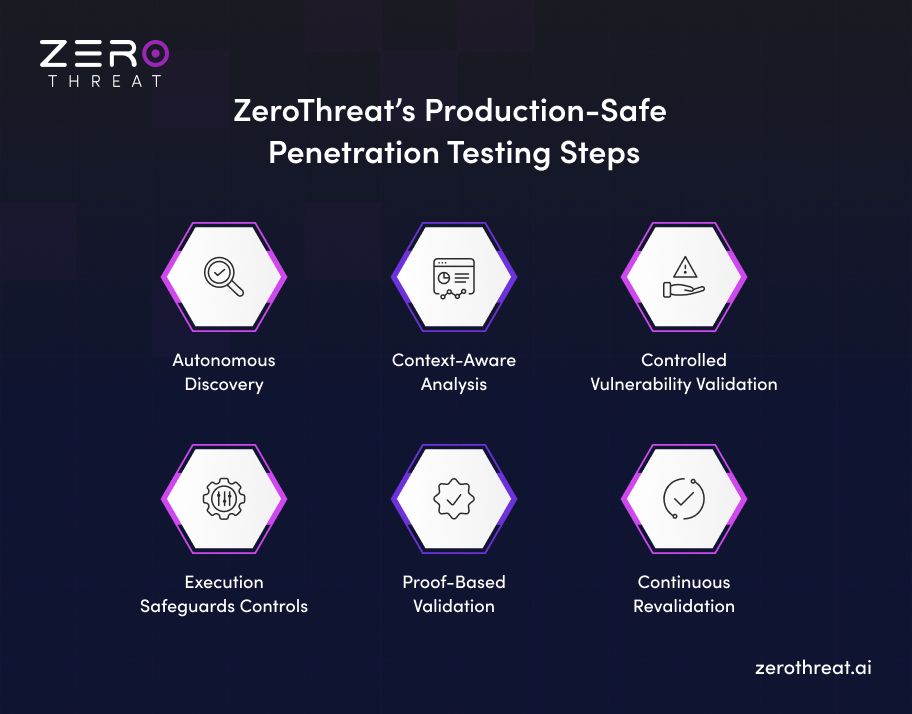
ZeroThreat performs production-safe penetration testing by combining AI-driven attack simulation, runtime-aware validation, and controlled exploit execution to identify real security risks in live applications without causing downtime, disruption, or data corruption.
1. Autonomous Discovery
ZeroThreat begins by autonomously discovering web applications, APIs, authenticated workflows, and hidden endpoints across the production environment. This creates a real-time attack surface map that reflects actual runtime behavior instead of relying on incomplete staging visibility. The platform also identifies shadow APIs and complex application flows automatically.
2. Context-Aware Analysis
After discovery, ZeroThreat analyzes how the application behaves in production. It evaluates authentication states, role-based access, request flows, and business logic paths to understand how attackers could realistically interact with the environment. This runtime-aware analysis helps uncover vulnerabilities that traditional scanners often miss.
3. Controlled Vulnerability Validation
ZeroThreat safely validates vulnerabilities using controlled and non-intrusive exploitation techniques. Instead of executing destructive payloads, the platform confirms exploitability through read-only validation, reversible actions, and safety-controlled testing methods. This allows security teams to verify real risk exposure without affecting application stability or user operations.
4. Execution Safeguards Controls
To prevent operational disruption, ZeroThreat applies intelligent rate limiting, concurrency thresholds, and production-safe execution safeguards during testing. These controls continuously monitor application behavior and automatically adjust testing intensity to maintain service performance and avoid downtime in live environments.
5. Proof-Based Validation
Every validated vulnerability includes exploit evidence, request-response traces, affected workflows, and business impact analysis. This proof-based validation reduces false positives and helps security teams focus only on exploitable risks that matter in production environments.
6. Continuous Revalidation
ZeroThreat continuously retests applications as deployments, APIs, and configurations change over time. This continuous security validation model helps organizations detect newly introduced vulnerabilities, configuration drift, and runtime risks without interrupting development or affecting production systems.
Traditional Tools Vs ZeroThreat (Production-Safe)
| Aspect | Traditional Tools | ZeroThreat (Production-Safe) |
|---|---|---|
| Testing Approach | Broad, aggressive scanning built for isolated test environments | Controlled, non-intrusive testing designed to run safely in live systems |
| Application Context | Treats every endpoint the same regardless of role or session state | Understands auth flows, user permissions, and request behavior before testing |
| Payload Behavior | Sends destructive or exploit-grade payloads without environment checks | Uses safe, targeted payloads that validate risk without modifying application state |
| Traffic and Execution | Floods targets with high request volumes and minimal throttling | Runs within defined rate limits and concurrency boundaries to protect uptime |
| False Positives | Produces noisy output that requires heavy manual triage | Reports only validated findings, cutting unnecessary remediation effort |
| Production Readiness | Built for staging; avoided in production due to operational risk | Purpose-built to test live environments without causing disruption or data loss |
| Finding Validation | Flags potential issues based on pattern matching, not confirmed exploitability | Confirms each finding against real application behavior before surfacing it |
| Environment Isolation | No guaranteed separation between scan targets or customer data | Enforces strict execution boundaries between environments, tenants, and scan results |
| Compliance Support | Outputs generic reports with limited traceability for auditors | Generates evidence-backed, audit-ready documentation tied to live environment testing |
Benefits of Using ZeroThreat for Production-Safe Security Testing
ZeroThreat delivers advanced security validation for live environments without risking operational stability. It allows teams to identify critical runtime vulnerabilities while maintaining 100% uptime for all your users.
- Zero Downtime Guarantee: Use non-intrusive checks and execution safeguards like rate-limiting to protect system performance. This ensures your live applications remain fully stable and accessible during the scan.
- Superior Detection Accuracy: Achieve a 99.9% accuracy rate using AI-powered exploit validation to find real risks. This significantly reduces false positives and eliminates the need for manual review.
- Audit-Ready Compliance: Generate professional reports that meet global standards like GDPR, HIPAA, and PCI DSS. These detailed findings provide the proof needed to satisfy strict regulatory requirements.
- Bridges the Staging Gap: Identify configuration drift and runtime risks that only exist in your live environment. You can validate real attack paths that traditional sandbox testing often misses.
- Accelerated Security Workflows: Automate your testing process to identify vulnerabilities 10x faster than manual methods. This efficiency allows your team to fix issues quickly without slowing down development.
Hidden vulnerabilities don't stay hidden for long. Discover them first. Pentest My App
How ZeroThreat’s Production Testing Supports Compliance and Audit Readiness
ZeroThreat’s production security testing is not just a technical exercise. It generates the validated, environment-specific evidence that compliance frameworks require and that auditors increasingly expect to see.
Evidence From Real Environments
Frameworks like PCI DSS and ISO 27001 require security testing against systems that reflect actual production conditions. Testing only in staging does not satisfy this requirement. Production testing produces findings tied to live configurations, real data flows, and active integrations, which gives auditors verifiable evidence rather than approximations.
Audit Trails and Logging
Every test action in production needs to be traceable. ZeroThreat’s production-safe testing maintains detailed audit logs that record what was tested, when it was tested, and what the outcome was. This documentation is essential during audits, as it demonstrates that security controls were actively validated and not just assumed to be working.
Continuous Validation Over Point-in-Time Testing
Annual or quarterly penetration tests create compliance gaps between assessment cycles. Production testing supports continuous security validation, which means controls are verified on an ongoing basis. This aligns with the continuous monitoring requirements found in NIST SP 800-137 and the risk management expectations within ISO 27001 Annex A.
Access Control and Permission Verification
Compliance requirements under HIPAA, GDPR, and PCI DSS include verifying that access controls function correctly in live environments. ZeroThreat’s live application testing validates role-based access control, privilege boundaries, and session management against real user roles and active permission models. This is something staging environments rarely replicate accurately.
Risk-Based Reporting for Governance Teams
Governance frameworks require that security risks be communicated clearly to decision-makers. Production testing generates validated, prioritized findings based on real exploitability in live systems. This gives security leadership and compliance teams accurate risk data to act on, rather than theoretical vulnerability lists that need further filtering.
Explore how ZeroThreat validates vulnerabilities safely across production environments. Book a Demo
Wrapping Up
Validating security in live environments is the only way to close the staging gap. It ensures that configuration drift and data flows do not leave applications vulnerable to attackers.
ZeroThreat offers an AI-powered production safe pentesting tool that provides exploitable, validated vulnerability reports through non-intrusive checks, ensuring your systems remain stable and fully functional.
This controlled approach maintains strict compliance while identifying real risks without disruption. Start testing your live applications today to achieve high detection accuracy and professional audit-ready results.
Frequently Asked Questions
How to test an application in production without breaking it?
Production environments can be tested safely using controlled, non-intrusive security testing methods. Modern platforms apply intelligent rate limiting, runtime-aware validation, and safe exploit simulation to verify vulnerabilities without disrupting applications, users, or business operations.
Is it safe to test applications in production?
How do companies test live systems without downtime?
How to avoid outages during security testing?
How to control risk in live testing?
How does ZeroThreat test the application in production safely?



Explore ZeroThreat
Automate security testing, save time, and avoid the pitfalls of manual work with ZeroThreat.