 ZeroThreat Wins Bronze Stevie® Award in Tech Startup of the Year Read more

All Blogs
GraphQL APIs vs REST APIs: Security Design Differences Explained
Quick Overview: This blog breaks down how GraphQL and REST APIs differ in security design, risks, and strengths. It explains common vulnerabilities, attack surface differences, and security trade-offs in a practical way. You’ll learn when each API style is easier to secure, what challenges teams face, and how to choose the right architecture based on real security needs.
Today's APIs are the front door to your most valuable data. In 2026 alone, API-related breaches continued to rise as applications exposed more data through APIs than ever before. That makes it important to understand how the API design impacts security for developers and cybersecurity experts.
The most dominant API architecture styles currently used by web applications are REST and GraphQL. Although GraphQL APIs and REST APIs have strong security strengths, they come with vulnerability risks too. The choice between them defines your entire security strategy. Picking the wrong architecture style can leave your project vulnerable from the start.
GraphQL offers flexibility and performance, but it also introduces new risks around query abuse, authorization gaps, and schema exposure. REST feels more predictable, but misconfigured endpoints still lead to serious data leaks. This is where GraphQL security testing and REST API security testing plays a critical role.
In this guide, we break down the security risks, strengths, and design trade-offs of GraphQL and REST APIs. The goal is simple: help you design, test, and secure APIs with clarity and fewer blind spots. With that said, let’s get started!
Start securing your REST and GraphQL APIs with automated security testing. Get Started Free
On This Page
- Understanding GraphQL API
- Understanding REST API
- REST APIs vs GraphQL APIs: Quick Overview
- How GraphQL and REST APIs Differ in Security Design
- GraphQL API Security
- REST API Security
- Best Practices of GraphQL and REST APIs
- GraphQL vs REST APIs: Which One is Better
- ZeroThreat’s Role in Securing REST and GraphQL APIs
- Final Thoughts
Understanding GraphQL API: A Query Language for API
GraphQL is a query language for APIs that allows clients to request exactly the data they need in a single call. Instead of relying on multiple endpoints, GraphQL exposes one endpoint where the client defines the response structure. This design improves flexibility and reduces common issues like overfetching and underfetching seen in traditional REST API security models.
At its core, GraphQL shifts more control to the client side. Developers can fetch related data in one request and shape responses based on real use cases. While this improves performance and developer experience, it also changes how API security design must be handled. Each query can be unique, which means the server must validate, authorize, and control every request carefully to avoid security gaps.
GraphQL APIs are built around a strongly typed schema that defines available queries, mutations, and data relationships. This schema makes APIs easier to understand and maintain, but it can also expose valuable information if not protected correctly. Poor schema protection can lead to GraphQL security issues, including unintended data access and misuse of API capabilities.
Because GraphQL supports deep and nested queries, it introduces new API security risks compared to REST. Complex queries can stress backend systems, bypass authorization logic, or expose sensitive data if limits are not enforced. Traditional REST API security testing does not always translate directly, which is why GraphQL API security practices need their own controls, validation rules, and testing strategies.
Detect hidden GraphQL risks with deep security testing. Test GraphQL APIs
Understanding REST API: Representational State Transfer API
A REST API is an application programming interface that uses the design principle of the REST architectural style. REST APIs can enable two systems to communicate using standard HTTP methods like GET, POST, PUT, and DELETE. It is built around resources, where each resource is accessed through a unique URL and returns a fixed structure of data. This simplicity is why REST remains one of the most widely used approaches in web API security and modern application design.
REST APIs follow clear design rules. Each request is stateless, meaning the server does not store client context between calls. This makes REST easier to scale and reason about from a secure API design perspective. When every request is independent, it becomes simpler to apply authentication, authorization, and logging consistently.
From a security standpoint, REST APIs rely heavily on well-defined endpoints. This makes REST API security more predictable. Developers can apply controls like token-based authentication, role-based access, and resource-level authorization with clarity. When implemented correctly, REST API authentication best practices and REST API authorization best practices help reduce common OWASP API vulnerabilities.
However, REST APIs are not risk-free. Exposed endpoints can be abused if access checks are weak or inconsistent. Poor input validation, excessive data exposure, and missing rate limits can lead to REST API security risks such as data leaks and abuse by bots. This is why REST API security testing and regular vulnerability scanning are critical parts of API cybersecurity.
REST APIs vs GraphQL APIs: Key Differences
| Aspect | GraphQL APIs | REST APIs |
|---|---|---|
| API Structure | Single endpoint with flexible queries | Multiple endpoints mapped to resources |
| Data Fetching | Client controls exactly what data is returned | Server defines fixed response structures |
| Overfetching Risk | Low when the schema is well designed | Common due to fixed responses |
| Underfetching Risk | Rare, data is fetched in one request | Common, often needs multiple calls |
| Schema Definition | Strongly typed schema defines data access | No strict schema enforcement by default |
| Attack Surface | Query-based, expands with schema complexity | Endpoint-based, easier to map and monitor |
| Authorization Model | Field and resolver-level authorization required | Endpoint and resource-level authorization |
| Rate Limiting | Requires query complexity and depth controls | Easier to apply per endpoint |
| Introspection Exposure | Schema may be exposed if introspection is open | No built-in introspection mechanism |
| Best Fit Use Case | Flexible, data-heavy client applications | Structured APIs with predictable access |
REST APIs vs GraphQL APIs: Security Design Principles Differences
Below are the key security design principles where GraphQL and REST differ in practice. Each point reflects how security is handled at the design level, not just at the tooling layer.
Access Control
GraphQL API
GraphQL exposes a single endpoint that handles all queries and mutations. This design requires access control to be enforced inside resolvers rather than at the edge. Each request can touch multiple resources, which increases the risk if authorization is missed at any level. Strong resolver-level checks are essential for secure GraphQL API design.
REST API
REST APIs use multiple endpoints, each tied to a specific resource or action. This allows access control rules to be applied directly at the endpoint level. Security policies are easier to reason about and audit. This structure supports clearer REST security design principles.
Response Control
GraphQL API
GraphQL allows clients to define exactly what data they want in the response. Without strict field-level authorization, sensitive data can be exposed unintentionally. Overly permissive schemas are a common cause of GraphQL security issues. Careful response control is critical to prevent data leakage.
REST API
REST APIs return predefined response structures controlled by the server. This limits unexpected data exposure by default. Developers can tightly control which fields are returned per endpoint. This reduces REST API security risks related to excessive data disclosure.
Authentication Handling
GraphQL API
Authentication usually happens once per request, but authorization must be evaluated for every resolver. This separation increases flexibility but also complexity. Missing checks can lead to broken access control. Consistent authentication logic is a key part of GraphQL API security.
REST API
REST APIs often tie authentication directly to endpoints. Tokens, API keys, or OAuth scopes are validated before processing the request. This approach aligns well with REST API authentication best practices. It simplifies enforcement and reduces security gaps.
Authorization Granularity
GraphQL API
GraphQL requires fine-grained authorization (FGA) at the query, mutation, and field level. A single query can request multiple objects with different permission needs. Without careful design, authorization logic becomes fragmented. This increases the likelihood of API vulnerabilities.
REST API
Authorization in REST APIs is typically resource-based. Each endpoint enforces permissions for a single object or operation. This makes policies easier to maintain and review. It also supports consistent REST API authorization best practices.
Query Complexity
GraphQL API
GraphQL supports nested queries and complex input structures. Without depth limits and query cost controls, attackers can overload backend services. Input validation must go beyond basic checks to ensure security. This is a major security challenge of GraphQL APIs.
REST API
REST APIs accept simpler request patterns with predictable inputs. Validation rules can be applied per endpoint with clarity. This makes REST API security testing easier and more reliable. Risks related to malformed inputs are easier to contain.
Rate Limiting
GraphQL API
Traditional rate limiting is difficult due to the single endpoint design. A single request can be cheap or very expensive to execute. Query complexity analysis is needed to prevent abuse. This adds extra responsibility to GraphQL security design.
REST API
REST APIs support rate limiting at the endpoint or resource level. Limits can be applied based on request count, user, or IP. This helps protect REST APIs from bots and abuse. It aligns well with common API threat protection models.
Attack Surface Visibility
GraphQL API
GraphQL schemas can reveal available queries and mutations through introspection. If not restricted, attackers can map the API quickly. This increases exposure during reconnaissance. Securing introspection is a core GraphQL security best practice.
REST API
REST endpoints are visible, but easier to monitor and log. Each endpoint represents a clear attack path. This predictability helps security teams detect misuse. It also simplifies API penetration testing.
GraphQL offers flexibility but demands stricter security discipline. REST offers a structure that simplifies enforcement and testing. The right choice depends on how well your team can design, monitor, and test API security at scale.
Continuously test REST and GraphQL APIs for vulnerabilities and fix them. Run API Security Tests
GraphQL API Security: Vulnerability Risks and Strengths
GraphQL API security focuses on protecting a highly flexible query system that gives clients deep access to application data. While this flexibility improves performance and developer experience, it also introduces unique API security risks. That’s why GraphQL security is important and is a real concern in modern API cybersecurity.
Common Vulnerability Risks in GraphQL APIs
- Missing field-level authorization leading to unintended data exposure
- Excessive query depth causing denial-of-service attacks
- Complex nested queries that exhaust server resources
- Unrestricted introspection revealing schema and internal API structure
- Broken object-level authorization in resolvers
- Weak input validation in query arguments and mutations
- Lack of query cost analysis and execution limits
- Insecure file uploads handled through GraphQL mutations
- Overly permissive schemas exposing sensitive relationships
Security Strengths of Using GraphQL APIs
- Strongly typed schemas that clearly define what data can be accessed
- Fine-grained, field-level authorization for better access control
- Reduced data overfetching, limiting unnecessary exposure of sensitive fields
- Centralized input validation through a single API endpoint
- Clear schema documentation that improves secure API design decisions
- Ability to enforce query depth and complexity limits
- Easier detection of abnormal query behavior through structured queries
- Better control over data relationships using schema constraints
REST API Security: Vulnerability Risks and Strengths
REST API security focuses on protecting clearly defined endpoints that expose application data and actions. While REST offers structure and predictability, security issues arise when access controls are weak or inconsistently applied. Poor design and missing validation can quickly turn simple APIs into easy targets for attackers. That makes REST API security testing and strong design principles essential.
Common Vulnerability Risks in REST APIs
- Broken object-level authorization allowing access to other users’ data
- Missing or weak authentication on sensitive endpoints
- Misconfigured CORS exposing APIs to untrusted origins
- Excessive data exposure through poorly designed responses
- Inadequate input validation leading to injection attacks
- Lack of rate limiting enabling brute-force and bot abuse
- Insecure direct object references (IDOR) in resource URLs
- Outdated or shadow APIs that are left publicly accessible
- Unprotected admin or internal endpoints exposed to the internet
Security Strengths of Using REST APIs
- Clear endpoint-based access control that simplifies authorization
- Predictable request and response structures that reduce attack complexity
- Strong support for standard authentication methods like OAuth and API tokens
- Easier implementation of REST API authentication best practices
- Straightforward rate limiting and throttling at the endpoint level
- Mature ecosystem of API security tools and scanners
- Well-documented REST API security best practices and standards
- Strong compatibility with OWASP API testing guidelines
- Simpler automation for REST API security testing and vulnerability scanning
Best Practices for Securing GraphQL and REST APIs
Securing APIs is about design first, not just tools. Both GraphQL and REST APIs need strong controls to prevent data exposure, abuse, and unauthorized access. These best practices help reduce API security risks and build a safer API security design from the start.
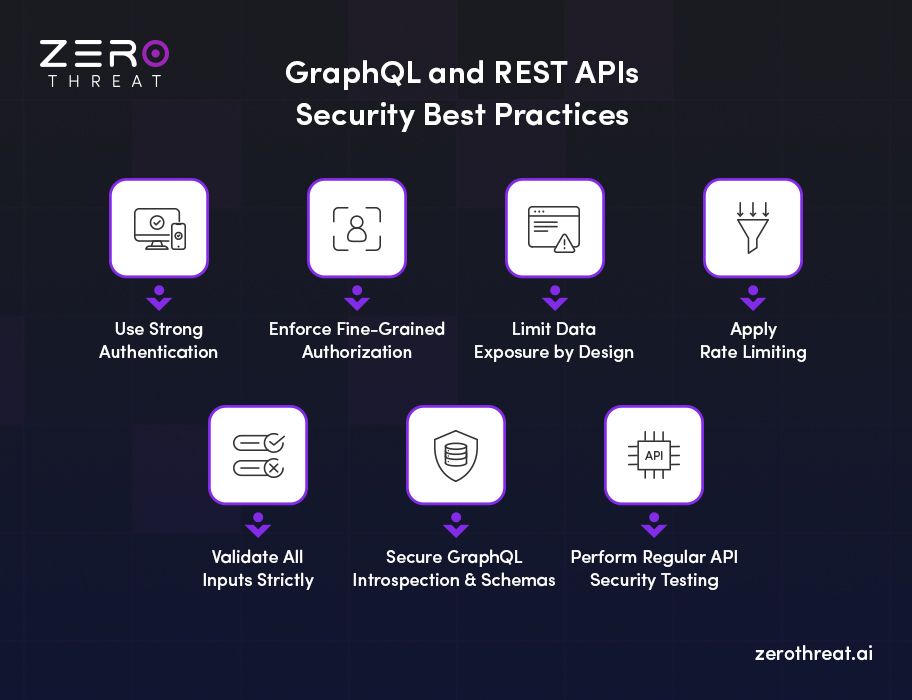
Use Strong Authentication
Always authenticate every API request, not just sensitive ones. Use proven methods like OAuth, JWTs, or API keys with rotation. This applies equally to REST API security and GraphQL API security. Weak or missing authentication is a common cause of API breaches.
Enforce Fine-Grained Authorization
Authorization should be checked at the right level. In REST, protect each endpoint and resource. In GraphQL, enforce authorization at resolver and field level. Strong API authorization best practices prevent broken object-level access.
Limit Data Exposure by Design
Only return the data that is truly needed. Avoid exposing internal fields or relationships by default. This reduces API vulnerabilities caused by excessive data exposure. Clear response control is a core part of secure API design.
Apply Rate Limiting
Protect APIs from bots and brute-force attacks. Use rate limits, throttling, and request quotas. For GraphQL, include query depth and complexity limits. These controls reduce denial-of-service and abuse risks.
Validate All Inputs Strictly
Never trust client input. Validate parameters, request bodies, and query arguments. Schema-based validation in GraphQL and input checks in REST help prevent injection attacks. Strong validation improves overall API cybersecurity.
Secure GraphQL Introspection and Schemas
Disable or restrict introspection in production where possible. Exposed schemas can help attackers map your API. Treat schema design as part of your security layer. This is a key GraphQL security best practice.
Perform Regular API Security Testing
Test APIs continuously, not just before release. Use vulnerability scanners, API penetration testing tools, and OWASP API testing techniques. Automated API security testing helps catch issues early.
GraphQL vs REST APIs: Which One is Better
Choosing between GraphQL and REST is largely a security-driven decision. Each architecture has strengths, but only when its security model matches your application needs. Use the guidance below to decide which API style fits your API security design requirements best.
Choose GraphQL API Architecture Style if...
- You need flexible data access and can enforce strict GraphQL API security controls.
- Your team can implement field-level and resolver-level authorization consistently.
- You are able to limit query depth, complexity, and execution cost.
- You have monitoring in place for abnormal query patterns and abuse.
- Your use case benefits from reduced data overfetching without exposing sensitive fields.
- You are prepared to handle GraphQL security risks through testing and validation.
Choose REST API Architecture Style if...
- You need clear, predictable REST API security enforcement at the endpoint level.
- Your application relies on resource-based access control and simple authorization rules.
- Your top priority is protecting APIs from bots, brute force, and abuse.
- Your team uses mature API security tools and automated REST API security testing.
- You want easier alignment with OWASP API testing guidelines.
- You prefer proven REST API security best practices with lower operational complexity.
How ZeroThreat Can Help You with GraphQL and REST API Security Testing
ZeroThreat is an automated API security testing platform built to help teams find real vulnerabilities early. It helps teams identify common and complex API vulnerabilities with deep, context-aware testing. ZeroThreat goes beyond surface checks to uncover issues like broken authorization, sensitive data exposure, and logic flaws, making it effective for both REST endpoints and GraphQL resolvers.
For GraphQL APIs, ZeroThreat understands schemas, queries, and mutations. It tests for GraphQL security risks such as introspection abuse, deep query attacks, and missing field-level authorization. This helps teams secure flexible APIs without slowing down development.
For REST APIs, ZeroThreat focuses on real-world abuse scenarios. It detects REST API vulnerabilities like BOLA, weak authentication, and rate-limit gaps. By integrating into CI/CD, it supports continuous API vulnerability testing and helps teams reduce risk with every release.
With ZeroThreat, security becomes part of the build process, not a separate task at the end. Teams get clear findings, actionable fixes, and better visibility into their API attack surface. That makes securing GraphQL and REST APIs more practical and scalable.
Discuss your API security challenges with the ZeroThreat team. Talk to an Expert
Final Thoughts
GraphQL and REST APIs solve different problems, but their security challenges start at the design level. REST offers structure and predictability, which makes access control and testing easier. GraphQL offers flexibility, but that same flexibility demands stricter authorization, query control, and deeper security planning from day one.
There is no universally safer choice between GraphQL and REST. Security depends on how well teams understand the architecture, enforce controls, and test continuously. Clear schemas, strong authentication, proper authorization, and regular security testing are essential to reducing API vulnerabilities in both models.
This is where ZeroThreat adds real value. ZeroThreat helps teams detect API vulnerabilities, security misconfigurations, and abuse patterns across both REST and GraphQL APIs. By automating security testing and providing AI-powered actionable insights, it enables developers and security teams to fix issues early and build secure APIs.
Frequently Asked Questions
What security controls should be prioritized when migrating from REST to GraphQL?
When moving to GraphQL, prioritize field-level authorization, query depth limits, and query complexity controls. Unlike REST endpoints, GraphQL queries can access multiple resources at once. Without these controls, the API becomes easier to abuse and harder to secure.
How does resource exposure differ between REST endpoints and GraphQL schema queries?
How can organizations validate user permissions effectively in GraphQL to avoid overexposure?
Does GraphQL require different API security testing techniques than REST?
How can ZeroThreat help detect excessive query complexity and schema-level vulnerabilities?
Can ZeroThreat continuously monitor both REST and GraphQL APIs for misconfigurations and exposure risks?

Explore ZeroThreat
Automate security testing, save time, and avoid the pitfalls of manual work with ZeroThreat.