 ZeroThreat Wins Bronze Stevie® Award in Tech Startup of the Year Read more

All Blogs
AI Pentesting vs Traditional Penetration Testing: What Security Teams Need to Know in 2026
Quick Overview: Speed, cost, coverage, and compliance, a research-driven breakdown of where AI pentesting genuinely outperforms manual testing, where human pentesters still matter, and how to choose between them.
A new vulnerability surfaces every few minutes. Engineering teams ship code multiple times a day. Attackers have started using the same AI tooling that powers modern software development to scale their own reconnaissance and exploitation. Meanwhile, the average organization still tests its applications the way it did a decade ago: once or twice a year, for several weeks at a time, at a cost that runs into the tens of thousands of dollars.
That mismatch is the reason "AI pentesting vs traditional penetration testing" has become one of the most searched questions in AppSec. It's not an academic debate, but security leaders are being asked to defend release-cycle speeds that traditional, point-in-time pentesting was never built to support, while still meeting the bar that frameworks like PCI-DSS, HIPAA, and SOC 2 require.
This guide breaks down how traditional penetration testing and AI pentesting actually differ, in methodology, cost, coverage, what each is genuinely good (and not good) at, and how ZeroThreat’s AI pentesting platform enables enterprises to keep up with modern AppSec needs.
Be first to experience the next generation of AI pentesting Join the Waitlist
ON THIS PAGE
- What Is Traditional Penetration Testing?
- What Is AI Pentesting?
- Comparison Between AI Pentesting and Traditional Pentesting
- Where AI Pentesting Genuinely Outperforms Traditional Testing
- Where Human-Led Testing Still Matters
- Where Compliance Frameworks Stand on AI Pentesting
- How to Choose: A Practical Decision Framework
- How ZeroThreat Approaches AI Pentesting
- Key Takeaways
What Is Traditional Penetration Testing?
Traditional penetration testing is a manual, human-led security assessment. A pentester, usually a certified consultant holding credentials like OSCP or CREST, is scoped onto an engagement, given a target (a web app, an API, a network range), and spends days to weeks attempting to break in the way a real attacker would: probing inputs, chaining misconfigurations, testing authentication and access control, and writing up findings with proof-of-concept evidence.
It remains the gold standard for a reason. Human testers bring contextual judgment, creativity, and an understanding of business logic that's genuinely hard to encode into rules. A skilled tester doesn't just run a scanner, they notice that a discount-code workflow can be replayed, or that an admin panel is reachable through a parameter most scanners would never think to manipulate.
Where traditional pentesting struggles:
- Cost: Industry pricing guides put the average web application or API pentest in the $5,000–$35,000 range, with a commonly cited average around $18,000 per engagement, and complex enterprise scopes running well past $50,000.
- Speed: A typical engagement runs three to five weeks from scoping to final report, sometimes longer for complex environments.
- Point-in-Time Coverage: A pentest is a snapshot. The moment a new endpoint ships or a workflow changes, the report is out of date. Most organizations only test once or twice a year.
- Inconsistent Depth: Quality depends entirely on the individual tester's skill, available hours, and how much of the budget gets eaten by reconnaissance versus actual exploitation.
None of this makes traditional pentesting obsolete. It means it wasn't designed for the release cadence modern software teams operate at, and that's precisely the gap AI pentesting was built to close.
What Is AI Pentesting?
AI pentesting applies AI, typically a system of purpose-built agents, to the same job a human pentester does: discovering attack surface, identifying weaknesses, and attempting to prove they're actually exploitable, not just theoretically present. Done well, it's not "a scanner with a chatbot bolted on." It's a system that can crawl modern applications the way a browser-driven user would, reason about what a discovered behavior implies, and chain multiple low-severity issues into a single validated attack path.
The "AI" label gets used loosely across the market right now, so it's worth being specific about what good AI pentesting actually does:
- Maps the real attack surface, including client-side JavaScript routes and SPA/API endpoints that never appear in a sitemap or static crawl.
- Operates authenticated, multi-step flows, login, checkout, admin actions, the way a logged-in user would, not just unauthenticated pages.
- Validates exploitability, attempting to prove a vulnerability is real rather than flagging every anomaly as a finding.
- Prioritizes by business impact, not just a generic severity score, so teams fix what actually matters first.
- Runs on demand or continuously, instead of being locked to an annual calendar slot.
AI Pentesting vs Traditional Pentesting: Side by Side Comparisons
| Criteria | Traditional Pentesting | AI Pentesting |
|---|---|---|
| Speed | Weeks (scoping → testing → report) | Hours to a few days for a full pass |
| Cost | $5K–$50K+ per engagement | A fraction of manual cost per cycle |
| Frequency | Annual or semi-annual (compliance-driven) | On-demand, or alongside every CI/CD release |
| Coverage | Limited by tester hours and scope | Scales across the full app/API surface every run |
| Business Logic & Chained Attacks | Strong with human creativity and context | Improving fast; strongest with purpose-built agents |
| Consistency | Varies by individual tester | Repeatable, same depth every run |
| Best For | Deep, context-heavy, compliance-mandated work | Frequent validation across fast-shipping environments |
Neither column "wins" outright, but they're optimized for different constraints. The honest framing, and the one most credible vendors above have converged on, is that AI pentesting is what makes frequent testing financially and operationally possible, while human-led testing still earns its place for engagements where regulatory mandates or genuinely novel business context call for it.
Discover ZeroThreat uncovers test applications with the depth of a human pentest and the speed of automation. Explore AI Pentesting
Where AI Pentesting Genuinely Outperforms Traditional Testing
Modern Application Architecture
Most legacy pentest methodology, and most legacy DAST tooling, was built for server-rendered websites with discoverable links. Today's applications are single-page apps where the real routes live inside compiled JavaScript bundles, not a sitemap. A pentest scoped for "two weeks of manual crawling" often simply doesn't have the hours to reverse-engineer every client-side route by hand. AI agents that extract routes directly from JS bundles and replay them as live requests close a coverage gap that's invisible until something behind an unlisted route gets breached.
Authenticated, Multi-Step User Flows
Modern apps gate almost everything behind login, role, or workflow state. Reconstructing those flows manually with hand-written Playwright or Selenium scripts eats a meaningful share of a pentester's billable hours before the actual security testing even starts. AI-driven flow generation collapses that setup time, which means more of the engagement goes to testing, not scripting.
Authorization Logic - IDOR, BOLA, BFLA
Broken Object Level Authorization and Broken Function Level Authorization (both top-ranked in the OWASP API Security Top 10) require systematically testing whether User A can touch User B's data or functions across every endpoint and every role. That's a combinatorial problem, exactly the kind of exhaustive, repeatable testing AI agents handle better than a time-boxed human engagement ever could.
Frequency
This is the structural advantage. A multi-million-dollar average breach cost, IBM's widely cited Cost of a Data Breach research has put the global figure above $4.4M, doesn't wait for your next annual pentest window. Testing that runs every sprint, or every time a new build ships, catches regressions before they reach production — something an annual engagement structurally cannot do.
Where Human-Led Testing Still Matters
It would be dishonest to write this as "AI wins everywhere." A few things still lean human:
Genuinely Novel Business Logic
AI agents are very good at testing known patterns, auth bypass, IDOR, price manipulation, exhaustively. A human tester can still notice an entirely new abuse case nobody anticipated, particularly in unusual, highly specific business workflows.
Social Engineering and Physical Security Testing
Phishing simulations, vishing, badge-cloning, and similar engagements remain fundamentally human disciplines.
Regulatory Mandates That Name "Manual" Testing
Some compliance frameworks and contracts still explicitly require manually-attested testing by a named, credentialed individual, a paperwork reality, not a technical one, but a real constraint nonetheless.
Most mature security programs in 2026 aren't choosing one over the other, they're layering AI-powered pentesting for continuous, frequent coverage and reserving human-led engagements for deep, periodic assessments and the scenarios above.
Where Compliance Frameworks Stand on AI Pentesting
This is the part most "AI penetration testing vs Traditional pentesting" comparisons skip, and it matters: compliance frameworks don't all treat AI-driven testing the same way.
PCI-DSS 4.0
PCI-DSS is the most prescriptive of the major frameworks, and it's the one place where this comparison isn't really a choice. Requirement 11.4 calls for a documented, industry-standard methodology (NIST SP 800-115, OWASP Testing Guide, or PTES), annual internal and external testing, retesting of fixes, and, critically, testers who are independent and demonstrably go beyond running automated tools.
A report that reads like scanner output with a cover page gets rejected by a Qualified Security Assessor (QSA), regardless of how the tool generated it. For the annual, QSA-facing engagement, PCI DSS still expects a qualified human tester in the loop.
HIPAA
HIPAA takes the opposite approach. The current Security Rule doesn't mandate a fixed pentest cadence or method at all, it requires ongoing risk analysis and periodic technical evaluation, leaving organizations to determine frequency and methodology based on their own risk profile. (A 2024 proposed rule from HHS would introduce explicit minimums, vulnerability scanning every six months and penetration testing every twelve, but as of this writing that's not yet final.) That risk-based structure leaves real room for AI-driven testing to run frequently between or alongside annual assessments.
SOC 2 and ISO 27001
These two sit closer to HIPAA: auditors expect evidence of regular testing and a sound methodology, but neither framework names a required testing method the way PCI DSS does.
The Practical Takeaway: If PCI DSS Requirement 11.4 applies to you, budget for an annual human-led engagement, that's not optional, and no AI platform should claim otherwise. For everything else, the dozens of releases between that annual test, your API surface, your staging environment, your day-to-day authorization logic, AI pentesting is what makes frequent validation financially realistic instead of a once-a-year event.
When to Choose: A Practical Decision Framework
Rather than treating this as an either/or decision, it helps to map the choice against what you're actually trying to accomplish:
Choose human-led pentesting when:
- A framework explicitly requires manual testing by a qualified, independent tester (PCI DSS 11.4 is the clearest example)
- You're testing a genuinely novel workflow with no established attack pattern
- The engagement involves physical security or social engineering
- You need a named tester's attestation for a contract or security questionnaire
Choose AI penetration testing when:
- You ship weekly or more often, and an annual test can't keep pace
- Your attack surface is API- and SPA-heavy, with routes that live in JavaScript
- You need to test authorization logic exhaustively across every role and endpoint
- Budget or headcount makes frequent manual engagements impractical
Use both when:
- You're under PCI DSS and want AI-driven testing to cover the gaps between annual manual engagements
- You're scaling fast and want continuous coverage feeding into a less frequent, deeper human-led assessment
- You want AI agents to handle the exhaustive, repeatable work so human testers can focus their limited hours on the business-logic edge cases that benefit most from human creativity
For most SaaS companies, fintechs, and API-first businesses in 2026, that last category, both, with AI doing the heavy lifting between periodic human-led assessments, is where security programs are actually landing.
Focus on validated risks ranked by exploitability and business impact. Prioritize Real Risk
How ZeroThreat Approaches AI Pentesting
ZeroThreat's AI Pentesting capability was built around the gaps that show up most often in the comparison above, depth of reach and what actually gets tested, not just how fast a scan finishes.
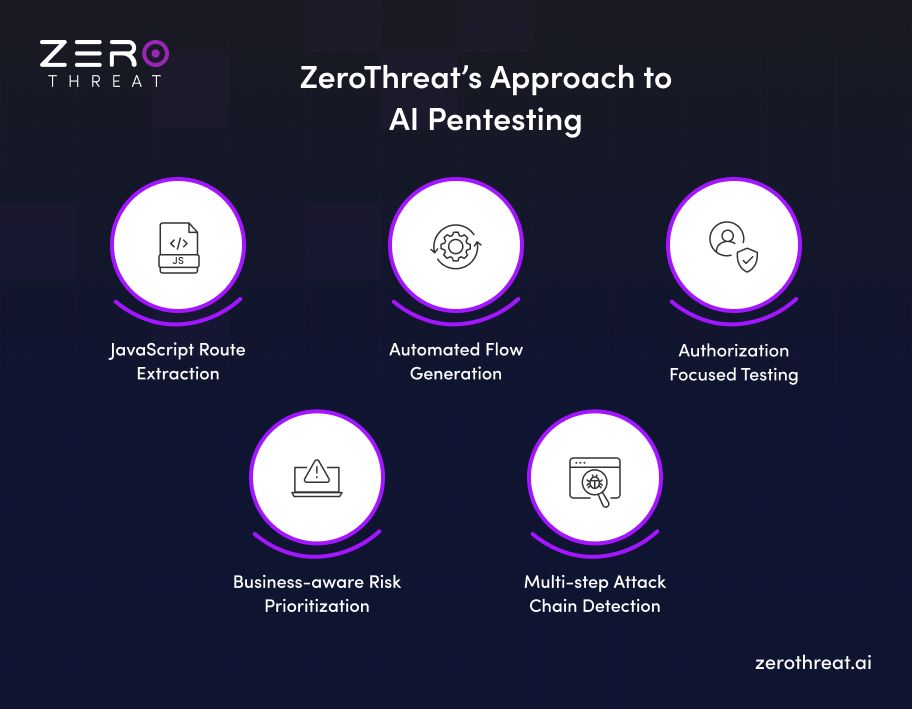
A few specifics worth knowing if you're evaluating this category:
JavaScript Route Extraction
ZeroThreat parses compiled JS to surface routes and parameters that never appear in a traditional crawl, then tests them as part of the same authenticated session, closing the SPA coverage gap described above.
Automated Flow Generation for Complex UI
Multi-step user journeys (login → action → checkout, for example) are mapped and exercised automatically, without a tester or developer having to hand-write and maintain Playwright specs for every flow.
Authorization-focused Testing
IDOR and BOLA/BFLA testing is built around systematically varying user, role, and object context across every discovered endpoint, the exhaustive, repeatable work that authorization flaws require.
Business-aware Risk Prioritization
Findings are ranked by business impact rather than a flat CVSS score alone, so a critical-but-low-traffic endpoint doesn't crowd out a medium-severity issue sitting on your checkout flow.
Multi-step Attack Chain Detection
Rather than reporting isolated findings, the engine looks for sequences of individually low-risk issues that combine into a real exploit path, closer to how a chained attack actually unfolds.
This sits alongside ZeroThreat's broader platform, Agentic AI Pentesting for how the underlying engine reasons through and validates exploit paths, and Automated Pentesting for how that translates into raw speed against manual testing. Across the platform, ZeroThreat is built on 130K+ vulnerability checks with a 99.9% detection accuracy rate, and customers typically see around a 90% reduction in manual testing effort.
None of this is positioned as a replacement for human pentesters. It's positioned the same way the rest of the credible market frames it: removing the bottleneck so the kind of testing depth normally reserved for an annual engagement can run continuously, with human expertise focused on the cases that genuinely need it.
If you want the deeper architectural view, how the agent reasoning and exploit-validation layer actually works, What Is Agentic Pentesting covers that ground in detail. And for the full data picture behind the cost and frequency numbers cited here, ZeroThreat's penetration testing statistics roundup goes deeper into market sizing, breach costs, and adoption trends.
Discover how AI-powered pentesting fits your environment. Schedule a Call
Key Takeaways
AI pentesting and traditional pentesting aren't rivals fighting for the same job, they're built for different parts of the same problem. Traditional testing still earns its place wherever deep human judgment or a compliance mandate like PCI DSS 11.4 calls for it. But for everything else, the daily releases, the API sprawl, the authorization logic that needs exhaustive testing, the old once-a-year model simply can't keep up.
This is the gap ZeroThreat is built for. Instead of waiting months for a single snapshot, ZeroThreat's AI Pentesting maps your real attack surface, including authenticated flows that traditional scans miss, then validates what's actually exploitable and ranks it by business impact, not just a generic severity score. It's testing depth that used to need a calendar slot, now available whenever your team needs it, so the gaps between your human-led engagements don't quietly turn into your next breach.
Frequently Asked Questions
What is the difference between AI pentesting and traditional penetration testing?
AI pentesting automates security testing using artificial intelligence to continuously discover, validate, and prioritize vulnerabilities across web applications and APIs. Traditional penetration testing relies on human security experts to perform manual assessments at specific points in time. While traditional pentests provide deep expert analysis, AI pentesting enables continuous testing, faster vulnerability discovery, and scalable security coverage between manual engagements.
How does ZeroThreat approach AI Pentesting differently?
Is AI pentesting more effective than traditional penetration testing?
Which organizations should use AI pentesting?
How often should organizations perform AI pentesting?
Why are organizations adopting AI pentesting over traditional security testing?

Explore ZeroThreat
Automate security testing, save time, and avoid the pitfalls of manual work with ZeroThreat.