 ZeroThreat Wins Bronze Stevie® Award in Tech Startup of the Year Read more

All Blogs
AI Pentesting vs AI-powered DAST: Which One Does Your App Security Program Need?
Quick Overview: This blog breaks down the real difference between AI-powered DAST and AI pentesting, two tools that get used interchangeably but solve different problems. You will learn how each one works, where they overlap and diverge, what independent data says about cost and frequency, and a practical framework for deciding which one (or both) your application security program needs. We close with where ZeroThreat fits and answers to the most common questions teams ask.
Every security team evaluating tools in 2026 runs into the same wall of marketing language. Vendors call themselves "AI pentesting," "AI-powered DAST," "agentic pentesting," and "autonomous offensive security," often to describe products that work in fundamentally different ways. The terms get used interchangeably in pitch decks, but they are not the same category of tool, and choosing the wrong one for the wrong job leaves real gaps in your application security program.
This confusion has a cost. Teams either end up paying for two overlapping tools that test the same surface twice, or they pick one tool assuming it covers everything, only to discover months later that an entire class of vulnerability was never being tested at all. Given how much venture funding has poured into AI driven offensive security platforms recently, and how fast the underlying agent technology is moving, it is worth slowing down and asking a simple question: what is actually different between AI penetration testing and AI-powered DAST, and which one (or both) does your application security program need?
This is a long read, but the goal is to leave you with a clear mental model rather than another comparison table to bookmark and forget. We will define both categories precisely, walk through where they overlap and where they diverge, look at what independent industry analysis says about the distinction, and explain where ZeroThreat fits into this picture as an AI penetration testing tool built to close the gap between the two rather than force you to choose.
Every day without testing is an opportunity for attackers. Start scanning before hidden vulnerabilities become incidents. Find Hidden Risks
ON THIS PAGE
- Definition of AI-Powered DAST
- Definition of AI Pentesting
- Where the Confusion Comes From
- How AI-Powered DAST Actually Works
- How AI Pentesting Actually Works
- AI Pentesting vs AI Powered DAST: Comparison
- The Real Differences That Matter
- How AI Pentesting and AI Powered DAST Work Together
- Why Teams Choose ZeroThreat for Both
- Key Takeaways
What Is AI-Powered DAST?
AI-powered DAST is Dynamic Application Security Testing, a runtime, black box testing method, enhanced with AI for smarter crawling, payload generation, and false positive reduction. It tests a running web application or API the same way an external attacker would: sending requests, observing responses, and flagging exploitable weaknesses without needing access to source code. The OWASP Foundation describes DAST as a non functional testing process built specifically to identify these runtime security weaknesses, and it has been a staple of application security programs for over a decade.
What is AI Pentesting?
AI pentesting (sometimes called agentic pentesting or autonomous pentesting) uses AI agents that take multi step, goal oriented actions across an environment, chaining individually minor findings into full exploit paths the way a human red teamer would during a structured engagement. Instead of simply flagging "this endpoint accepts unsanitized input," an AI pentesting agent tries to prove that the input flaw, combined with a session handling weakness and an overly permissive role check, actually lets an attacker reach sensitive data or escalate privilege.
Both categories use AI. Both test running systems. That overlap is exactly why the terms get confused, and why the rest of this article matters.
Where the Confusion Comes From
Part of the problem is that the cybersecurity industry has not settled on consistent terminology, and different vendors stake out different definitions for their own positioning reasons. A few examples illustrate how wide the spread is.
StackHawk, a developer first DAST platform, argues in a widely shared comparison piece that AI pentesting is essentially a faster, cheaper substitute for periodic manual penetration testing engagements, while DAST remains the tool that runs on every commit. In their framing, AI pentesting happens a few times a year, infrastructure wide, and DAST happens continuously, application layer only.
Escape, a business logic aware DAST and AI pentesting vendor, takes the opposite position on cadence. Their AI pentesting product page explicitly markets continuous, agentic attack chain testing that runs "on every release cycle," directly contradicting the idea that AI pentesting must be a quarterly, point in time exercise.
XBOW, an autonomous offensive security platform, frames the distinction differently again in its own DAST comparison, arguing that traditional DAST tools struggle to identify business logic vulnerabilities like IDOR and BOLA at all, and that AI driven, adaptive testing is required to close that gap, regardless of how often it runs.
So even among vendors building these tools, there is no industry wide agreement on whether AI pentesting is periodic or continuous, narrow or broad, infrastructure focused or application focused. What is consistent across every credible source, including the OWASP DevSecOps Guideline, is the underlying mechanism each category uses. That mechanism, not the marketing label, is what should drive your evaluation.
How AI-Powered DAST Actually Works
Modern AI-powered DAST platforms follow a structured pipeline, refined over the better part of a decade of DAST tooling evolution.
Crawling and Discovery
The scanner maps the application's attack surface, following links, parsing JavaScript heavy single page applications, and discovering API routes that a naive crawler would miss entirely. This is where AI adds the most obvious lift over legacy scanners: older tools choked on modern SPAs built with React, Angular, or Vue, while AI driven crawlers can extract routes directly from compiled JavaScript bundles and understand client side routing logic.
Authenticated Testing
Because so much of an application's attack surface sits behind a login, modern DAST tools record or replay authentication flows, including multi-factor authentication, so the scanner can test as a logged-in user rather than an anonymous visitor. This matters enormously, since unauthenticated scanning alone misses the majority of meaningful vulnerabilities in any application with user accounts.
Payload Generation and Contextual Analysis
Instead of firing the same static payload list at every input field, AI-assisted DAST tools adjust their approach based on the technology stack, response patterns, and parameter context, reducing both scan time and false positive volume.
Validation, Not Just Detection
This is the area where the line between DAST and pentesting starts to blur. The strongest automated DAST platforms do not just flag a suspicious response and move on. They attempt to confirm exploitability, extracting actual evidence such as a database version string rather than relying on a guess.
Reporting Mapped to Standards
Findings get tied back to the OWASP Top 10, the OWASP API Security Top 10, and CWE categories, which matters enormously for compliance heavy industries working toward PCI DSS, HIPAA, or ISO 27001 certification.
The defining characteristic of this entire pipeline is speed and repeatability. A well-built DAST scan is designed to run inside a CI/CD pipeline on every pull request, every staging deploy, every nightly build, without a human scheduling it or reviewing the setup each time.
Traditional scanners miss exploitable vulnerabilities. Discover what your current DAST isn't finding. See What You're Missing
How AI Pentesting Actually Works
AI pentesting platforms are built around a different goal: simulating the judgment and persistence of a skilled human attacker across a longer, more exploratory engagement.
Goal Oriented, Multi-step Reasoning
Rather than testing each endpoint in isolation, an AI pentesting agent sets a goal, such as reaching an administrative function or exfiltrating a specific data type, and plans a sequence of actions to get there. This is what the industry now calls agentic AI: AI that takes autonomous, multi-step actions rather than simply classifying a single input as risky.
Attack Chain Construction
A low severity finding that looks harmless on its own, such as a verbose error message or a predictable identifier, can become a critical risk when combined with a second and third weakness. AI pentesting agents are specifically built to discover and prove these chains, the kind of complex, multistage exploit path that a single point scanner is structurally unable to find because it never connects finding A to finding B to finding C.
Adaptive Exploitation
Because the agent observes how the application responds to each action, it can change its approach mid attack rather than blindly cycling through a fixed payload list. This adaptive quality is what makes AI pentesting feel closer to a real adversary than a scripted scan.
Proof of Exploit, Not Just a Finding
A pentesting report built for engineers and auditors typically includes the exact request chain, the reasoning trace, and a working proof of concept, which is far more actionable than a generic "Broken Object Level Authorization possible" alert.
The tradeoff is breadth versus depth. Building and validating multi step attack chains takes more time and computational reasoning than checking a single endpoint for SQL injection. That is part of why some vendors position AI pentesting as a periodic, deep dive exercise, while others have invested heavily in making it fast and continuous enough to run far more often than a traditional quarterly engagement.
AI Pentesting vs AI-Powered DAST: Key Differences
Here is the direct comparison, with both categories measured against the same set of criteria, so you can see exactly where they diverge.
| Dimension | AI Pentesting | AI-Powered DAST |
|---|---|---|
| Core question asked | Can multiple weaknesses be chained into a working exploit path | Is this specific input, parameter, or response vulnerable |
| Unit of analysis | Full attack path across several steps | Single endpoint or request |
| Typical speed per run | Hours to days, depending on scope and depth | Minutes to roughly two hours for a full pass |
| Best fit cadence | Periodic deep dives, or continuous if the platform is built for it | Every build, every pull request, every deploy |
| CI/CD integration | Limited on legacy platforms, native on agentic first platforms | Native, runs as a pipeline step |
| Authorization and business logic flaws (BOLA, BFLA, IDOR) | Strong, this is the category it is purpose built to chain and prove | Partial, depends on contextual rules and multi role test setup |
| False positive handling | Reduced further through full exploitation before a finding is reported | Reduced through contextual analysis and proof-based scanning |
| Output format | Reasoning trace, request chain, and working proof of concept | Ticketed findings with request and response evidence |
| Primary audience | Auditors, boards, and security leadership | Developers triaging inside a sprint |
| Cost profile | Higher per engagement, though far cheaper than manual pentesting | Low per run, included in a platform subscription |
The table above is the part most comparison articles gloss over. Notice that DAST and AI pentesting are not weaker and stronger versions of the same tool. They are optimized for opposite ends of the speed versus depth spectrum, and the row that should worry most security teams is authorization and business logic coverage, since that is where a fast, shallow tool and a slow, narrow engagement both tend to fall short in different ways.
The Real Differences That Matter for AI-Driven DAST and AI Penetration Testing
Strip away the marketing and a handful of genuine, durable differences remain, regardless of how individual vendors frame cadence.
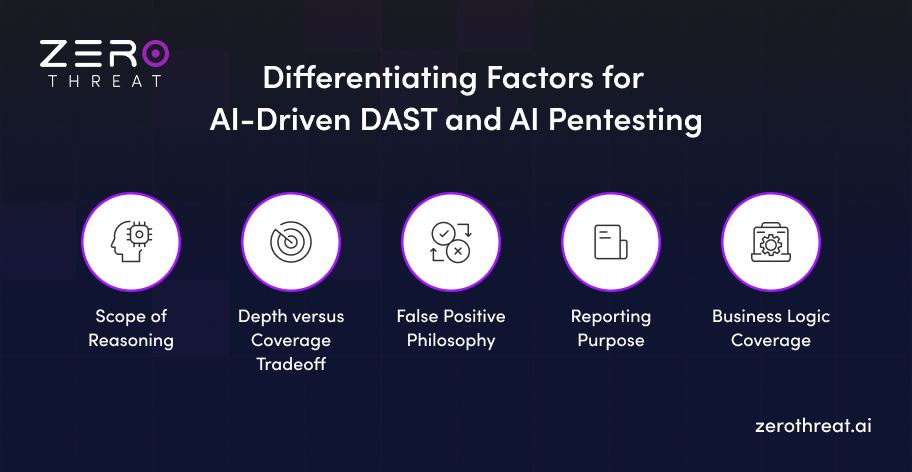
Scope of Reasoning
DAST, even AI-enhanced DAST, is fundamentally endpoint centric. AI pentesting is path centric. A DAST scan checks each input in relative isolation. An AI pentesting agent deliberately links finding A to finding B to finding C, the way an attacker actually thinks. This is the single biggest structural difference between the two categories, and it explains nearly every other row in the table above.
Depth versus Coverage Tradeoff
Because each DAST check is self-contained, a scan can realistically cover thousands of endpoints in a single pass. An AI pentesting engagement spends more reasoning effort per attack path it builds, which historically meant covering less ground per unit of time, though this gap is closing fast as agentic platforms mature and run with less human scheduling overhead.
False Positive Philosophy
Legacy DAST earned a reputation for flooding teams with unconfirmed findings. Modern dynamic application security testing closes much of that gap through contextual validation, but a true pentesting agent goes one step further by attempting full exploitation before a finding is ever reported, which is why proof backed findings from agentic platforms tend to carry more weight with engineering teams who are tired of chasing theoretical risk.
Reporting Purpose
DAST output is built to be triaged inside a sprint, ticketed in Jira or GitHub Issues, and fixed before the next deploy. Pentest style output is built to satisfy an auditor or a board, and answer the question "what would a determined attacker actually be able to do to us right now."
Business Logic Coverage
This is the category where the line genuinely matters most. Authorization logic flaws such as Broken Object Level Authorization (BOLA, mapped under CWE 284 for improper access control, part of the broader CWE Top 25 and SANS Top 25 most dangerous weakness lists) and Broken Function Level Authorization (BFLA) rarely show up as a single suspicious response. They show up as a sequence: a user accesses a resource that belongs to someone else, or a low privilege account reaches a function meant for admins only.
Catching that sequence requires the kind of business logic testing and multi-step, role aware reasoning that pure single endpoint scanning was never designed to do, and it is exactly where AI pentesting earns its place even on top of a strong DAST program.
Attackers continuously evolve. Your security testing should too. Stay ahead with AI pentesting. See AI in Action
How AI Pentesting and AI-Powered DAST Work Together
The most useful way to think about these two categories is not as competitors but as layers. The OWASP DevSecOps Guideline and most mature application security programs treat dynamic testing methods as complementary rather than interchangeable, deploying each where it is strongest across the software development lifecycle.
AI-powered application security testing is the layer that runs constantly. It belongs inside your CI/CD pipeline, firing on every pull request, every staging deploy, and every nightly build, so a newly introduced injection flaw or broken authentication check is caught within minutes of the commit that created it. This is the shift left, DevSecOps friendly layer that keeps pace with teams shipping multiple times a day.
AI pentesting is the layer that reasons deeply. It picks up where endpoint level scanning stops, chaining a low severity information leak, a predictable identifier, and a weak authorization check into a single provable attack path. These multi-step exploit chains, especially authorization flaws like BOLA, BFLA, and IDOR, are precisely the class of vulnerability that a fast per endpoint scan is structurally unable to assemble on its own.
Let’s consider a concrete example here.
A developer ships a new API endpoint on Monday. The automated DAST tool scans in the pipeline immediately flags that the endpoint reflects unsanitized input, and the developer fixes it before it merges. What that per endpoint scan does not surface is that the same endpoint also returns another user's record when the object identifier is incremented.
An agentic AI pentesting tool, reasoning across multiple requests and user roles, recognizes that sequence as a BOLA chain and proves it with a working request trace. One layer caught the injection at commit speed. The other caught the authorization chain that only becomes visible when you reason across several steps. Neither layer alone would have covered both risks.
This is why, for most teams, the real question is not "which one" but "how do I get both without running two disconnected tools and reconciling two separate reports." That question is exactly where platform consolidation starts to matter.
Why Teams Choose ZeroThreat for Both
If you have read this far, you already know the trap: a fast scanner that misses chained authorization flaws, or a deep engagement that runs too rarely to keep up with how often you ship. ZeroThreat collapses that choice into one platform.
Its agentic AI engine reasons across multiple requests, roles, and responses the way a human tester pivots through an app, so the Broken Object Level Authorization paths and privilege escalations that no single request reveals get assembled and proven rather than missed.
And because it extracts routes straight from JavaScript bundles and builds the authenticated, multi step flows on its own, the logged in parts of your product where the real risk lives get tested without an engineer scripting every journey by hand.
What you get in return is a report you can act on, not one you have to clean up. Every finding is confirmed through controlled exploitation before it reaches you, which is how ZeroThreat sustains a stated 99.9% detection accuracy across more than 130,000 vulnerability checks, and each issue arrives ranked by business impact rather than raw severity.
A full pass finishes in roughly half an hour to two hours and runs natively inside CI/CD, so depth never costs you the release cadence your team depends on.
Sign up now, run a scan and see what gets tested with AI pentesting page.
The longer unknown vulnerabilities remain, the greater the risk. Let's identify them together. Talk to an Expert
Conclusion
The honest answer to "AI pentesting or AI powered DAST" is that the better question is rarely which one. DAST gives you continuous, endpoint level coverage that fits inside every build, and AI pentesting gives you the multi step reasoning that turns scattered low severity findings into a proven exploit path, especially the authorization and business logic flaws that single endpoint scanning was never built to connect.
Treating them as rivals leads teams to either overpay for two overlapping tools or quietly leave an entire class of risk untested. The smarter move is to look past the label on a vendor's homepage and ask what the engine actually does: how it discovers your real attack surface, whether it tests authenticated and role aware workflows, and whether findings are validated through real exploitation or just pattern matched and handed off for your team to confirm.
ZeroThreat was built to answer all three in a single platform, pairing the speed your pipeline needs with the depth your application security program cannot afford to skip, so you stop choosing between fast and thorough and simply get both.
Frequently Asked Questions
Is AI pentesting the same as AI powered DAST?
No. AI powered DAST is continuous, endpoint level dynamic application security testing enhanced with AI for crawling and false positive reduction. AI pentesting uses AI agents to chain multiple weaknesses into a full, multi-step exploit path, closer to how a human penetration tester works during a structured engagement.
Does AI pentesting replace manual penetration testing?
Does AI pentesting replace DAST?
Can AI powered DAST find business logic vulnerabilities like BOLA and IDOR?
How long does an AI pentest tool with CI/CD integration take to run?
What is agentic AI security testing?
Do I need an on prem penetration testing tool for compliance?


Explore ZeroThreat
Automate security testing, save time, and avoid the pitfalls of manual work with ZeroThreat.