 ZeroThreat Wins Bronze Stevie® Award in Tech Startup of the Year Read more

All Blogs
What is Automated Penetration Testing? How it Works, Benefits, and Best Tools

Quick Overview: Securing modern applications requires shifting from manual testing to automated penetration testing. This guide explains what automated penetration testing is, how it works, its key benefits, important features to look for, and how it compares with manual pentesting. It also covers popular automated pen testing tools, implementation best practices, and when you should automate penetration testing.
Most organizations discover they have a security vulnerability after something goes wrong. A breach, an alert, an incident report. By then, the damage is already done.
If we look into the numbers, the financial impact of a breach is quite expensive. According to IBM’s Cost of a Data Breach Report 2025, the global average cost of a data breach reached $4.44 million, while organizations using AI and automation in security reduced breach costs by nearly $1.9 million on average. The same report also showed that the average breach lifecycle still takes 241 days to identify and contain.
This is exactly why automated penetration testing has become an important part of modern cybersecurity strategies. Instead of relying only on periodic manual assessments, organizations are now moving toward continuous security validation that can identify exploitable vulnerabilities across web applications, APIs, and cloud environments.
But automated pentesting is often misunderstood. Many teams confuse it with vulnerability scanning, while others assume automation can fully replace ethical hackers. In reality, an automated penetration testing tool combines attack simulation, exploit validation, continuous testing, and DevSecOps integration to help security teams detect real risks faster and at scale.
In this guide, you will learn what automated penetration testing actually is, how it works, its key benefits, how it compares with manual pentesting, and which tools organizations use to continuously validate their security posture.
Tired of testing your application manually? ZeroThreat’s automated pentest tool has got you covered. Begin My Free Trial
ON THIS PAGE
- What is Automated Penetration Testing?
- Automated vs. Manual Penetration Testing: Key Differences
- How Automated Penetration Testing Works: The 5-Stage Process
- Benefits of Automated Penetration Testing
- Key Features to Look for in an Automated Pentesting Tool
- Top Automated Penetration Testing Tools (2026)
- When Should You Use Automated Penetration Testing?
- Best Practices for Implementing Automated Penetration Testing
- Why You Should Choose ZeroThreat for Automated Pentesting?
- Wrapping Up
What is Automated Penetration Testing?
Automated penetration testing is a cybersecurity process that uses specialized tools to identify, validate, and assess security weaknesses across applications, APIs, networks, and cloud environments. It helps organizations detect exploitable vulnerabilities faster through continuous and repeatable security testing workflows.
Unlike traditional pentesting, automated pentesting simulates real attack techniques to understand how attackers could exploit identified flaws. Modern automated penetration testing tools can perform reconnaissance, exploit validation, privilege escalation checks, and risk prioritization with minimal manual involvement from security teams.
Organizations use automated penetration testing to strengthen DevSecOps practices, improve continuous security validation, and reduce exposure to cyber threats from the very start.
Automated vs Manual Penetration Testing: Key Differences
| Aspect | Automated Penetration Testing | Manual Penetration Testing |
|---|---|---|
| Testing Approach | Tool-driven security assessment | Human-led offensive testing |
| Execution Speed | Fast and repeatable | Time-intensive process |
| Testing Frequency | Continuous or scheduled | Periodic engagements |
| Scalability | High-scale environment coverage | Limited by tester resources |
| Vulnerability Detection | Detects known vulnerabilities and misconfigurations | Detects complex and chained attack paths |
| False Positives | Possible without human review | Human-verified findings |
| Attack Simulation | Automated exploit execution | Adaptive real-world attack simulation |
| DevSecOps Integration | Native CI/CD integration support | Limited automation capabilities |
| Reporting | Instant risk-based reporting | Detailed contextual analysis |
| Human Expertise | Minimal manual involvement | Requires skilled ethical hackers |
| Cost | Lower operational cost | Higher engagement cost |
| Best Use Case | Continuous security validation | Deep security assessments |
How Automated Penetration Testing Works: The 5-Stage Process
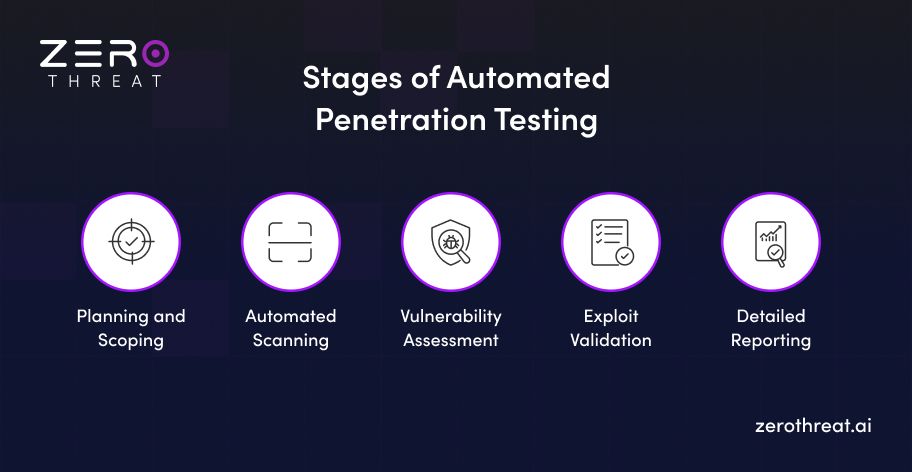
Automated penetration testing follows a structured process. It simulates real-world attacks across your systems, identifies exploitable vulnerabilities, and delivers actionable findings, all without manual intervention at every step.
1. Planning and Scoping
The process starts with defining the testing scope, target assets, environments, and security objectives. Security teams identify applications, APIs, cloud resources, and infrastructure components that need assessment. Proper scoping ensures accurate testing coverage while preventing disruption to production systems.
2. Automated Scanning
Automated pentesting tools perform reconnaissance and attack surface discovery to identify exposed endpoints, open ports, APIs, authentication flows, and hidden assets. The system continuously scans for known Common Vulnerabilities and Exposures (CVEs), insecure configurations, outdated components, and weak security controls across the environment.
3. Vulnerability Assessment
After scanning, the platform analyzes detected weaknesses to determine exploitability and business impact. Advanced tools correlate vulnerabilities, security misconfigurations, and exposed services to identify potential attack paths, privilege escalation risks, and security gaps that attackers could realistically abuse.
4. Exploit Validation
The system safely simulates real attack techniques to validate whether identified vulnerabilities are actually exploitable. This step helps reduce false positives by confirming real-world impact through controlled exploitation, proof-of-concept generation, and attack chain validation without damaging production environments.
5. Detailed Reporting
Once testing is complete, the platform generates detailed security reports with validated findings, risk severity, and remediation guidance. Some automated pen testing tools also map findings to security compliance frameworks like PCI DSS, ISO 27001, and GDPR for audit readiness.
Your application's attack surface is bigger than you think. Find out what is exposed now. Pentest My Apps
Benefits of Automated Penetration Testing
Automated penetration testing gives security teams a faster, more consistent way to find and fix vulnerabilities. It reduces manual effort while keeping your attack surface continuously monitored and validated.
- Faster Vulnerability Detection: Automated pentesting rapidly identifies security weaknesses, exposed services, insecure configurations, and outdated components across large environments. That helps security teams reduce exposure and respond to threats before attackers can exploit them.
- Continuous Security Validation: Unlike periodic assessments, automated penetration testing enables continuous testing across applications, APIs, and cloud assets. Organizations gain real-time visibility into evolving attack surfaces and newly introduced vulnerabilities after deployments or infrastructure changes.
- Scalable Security Testing: Automated security testing can assess thousands of assets simultaneously without requiring large manual security teams. This makes it effective for enterprises managing distributed environments, SaaS applications, microservices, and hybrid cloud infrastructure.
- Improved DevSecOps Integration: Automated penetration testing tools integrate directly into CI/CD pipelines and development workflows. Security checks can run during builds, deployments, and updates, helping developers detect vulnerabilities earlier within the software development lifecycle (SDLC).
- Reduced Manual Effort: Automation handles repetitive reconnaissance, scanning, and exploit validation tasks, allowing security professionals to focus on advanced attack analysis, business logic testing, and remediation strategy instead of manual verification processes.
- Better Risk Prioritization: Modern automated pentesting platforms validate exploitability and identify realistic attack paths instead of generating large volumes of unactionable findings. That helps teams prioritize critical vulnerabilities based on actual business impact and exposure risk.
- Cost-Effective Security: Continuous automated testing reduces the operational cost of frequent security assessments while maintaining broader coverage. Enterprises can test more frequently without relying entirely on time-intensive manual penetration testing engagements.
Key Features to Look for in an Automated Pentesting Tool
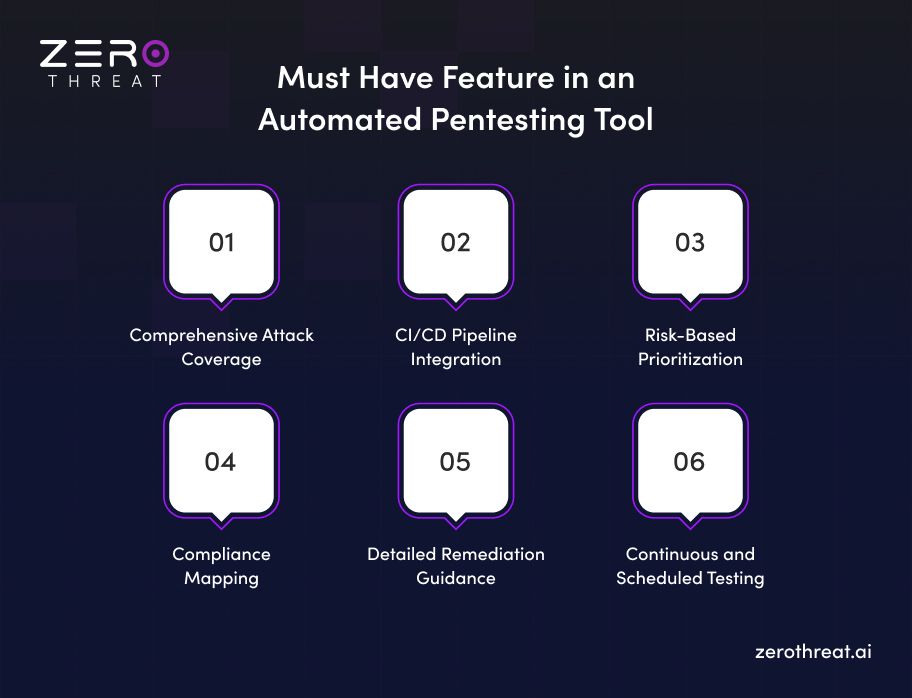
An effective automated penetration testing tool should provide continuous security validation, accurate exploit detection, scalable testing coverage, and seamless DevSecOps integration. Here is a dive into each of the features you must check for.
Comprehensive Attack Coverage
The tool should test across web applications, APIs, network infrastructure, and cloud environments. Limited coverage means blind spots. Look for platforms that simulate a wide range of attack techniques, including those mapped to the OWASP Top 10 and MITRE ATT&CK framework.
CI/CD Pipeline Integration
Security testing should happen automatically with every code push. A good automated pentesting tool integrates directly with Azure pipelines, GitHub Actions, AWS CI/CD or similar platforms. This keeps security embedded in the development process rather than bolted on at the end.
Risk-Based Prioritization
Every scan will surface multiple findings. The platform should rank them by severity, exploitability, and business impact. Without prioritization, teams waste time fixing low-risk issues while critical vulnerabilities sit unpatched and exposed.
Compliance Mapping
If your organization operates under PCI DSS, GDPR, ISO 27001, or HIPAA, the tool should map findings directly to those frameworks. It can save hours of manual work when preparing audits and simplifies demonstrating your security controls to stakeholders.
Detailed Remediation Guidance
A vulnerability report without fix guidance puts the burden back on your team. Look for tools that provide step-by-step remediation guidance alongside each finding. This bridges the gap between security and development teams and speeds up the fix cycle.
Continuous and Scheduled Testing
Point-in-time testing misses vulnerabilities introduced between scans. The tool should support both continuous monitoring and scheduled test runs. It ensures your attack surface stays validated as your infrastructure evolves and new deployments go live.
Enterprise-grade automated security validation at a price you won’t believe. Check Out Plans
Top Automated Penetration Testing Tools (2026)
There are plenty of automated pentesting tools available in the market, but not all provide what they promise. Here are a few of the best pentest tools we have used:
ZeroThreat
ZeroThreat is an automated pentesting platform that identifies and validates real, exploitable vulnerabilities across modern web applications and APIs. Using Agentic AI, it executes adaptive attacker workflows to simulate real-world attack paths, proving impact and eliminating false positives.
The platform leverages continuously updated vulnerability checks with real-time CVE coverage and Application Journeys (Playwright-powered) to test authenticated flows, APIs, and complex business logic beyond traditional crawling.
By focusing on validated findings, ZeroThreat reduces manual triage by over 90% and enables security teams to prioritize and remediate actual risk, while maintaining continuous, production-safe testing across environments.
Burp Suite
PortSwigger’s Burp Suite is one of the most widely used web application security testing platforms among penetration testers and security researchers. It combines automated vulnerability scanning with advanced manual testing capabilities for identifying web application security flaws.
Burp Suite is known for its powerful crawler, proxy inspection features, active scanning engine, and extensive testing extensions. Security professionals commonly use it for detecting vulnerabilities such as SQL injection, XSS, authentication weaknesses, and API security issues during web application assessments.
Nessus
Nessus by Tenable is a widely adopted vulnerability assessment tool used for identifying security weaknesses, configuration issues, missing patches, and exposed services across networks, systems, and enterprise infrastructure environments.
Nessus is commonly used for automated vulnerability scanning, compliance auditing, asset discovery, and continuous vulnerability management. Its large plugin ecosystem and broad vulnerability coverage help organizations detect known CVEs, misconfigurations, and infrastructure security risks at scale.
Rapid7
Rapid7 provides vulnerability management and automated security validation capabilities through platforms like InsightVM and Metasploit. The platform focuses on continuous attack surface visibility, risk-based vulnerability prioritization, and remediation workflows designed for enterprise security operations and DevSecOps environments.
Rapid7 is widely used for vulnerability assessment, exploit testing, and security analytics across hybrid infrastructures. Its integration between vulnerability management and penetration testing workflows helps organizations validate exploitable risks, streamline remediation, and improve continuous security monitoring across distributed environments.
Pentera
Pentera is an automated security validation platform that safely simulates real-world cyberattacks across internal networks, cloud environments, and external attack surfaces. The platform validates exploitability through production-safe adversarial testing and helps organizations identify realistic attack paths continuously.
The platform emphasizes automated remediation workflows, attack chain validation, credential exposure testing, and AI-driven exposure prioritization. Pentera is designed for organizations seeking continuous penetration testing, ransomware resilience validation, and scalable security assessments without relying entirely on manual testing engagements.
When Should You Use Automated Penetration Testing?
Automated penetration testing is not a one-size-fits-all solution. Knowing when to use it helps you get real security value rather than just checking a compliance box.
- Before Every Major Release: If your team ships code frequently, run automated pentests before each release. It catches security regressions introduced during development before they reach production.
- After Significant Infrastructure Changes: Added a new cloud environment, API endpoint, or authentication layer? That changes your attack surface. Automated testing helps you validate that new additions do not introduce exploitable gaps.
- When Continuous Security Validation is a Priority: If your security team cannot afford quarterly manual engagements, automated pentesting fills that gap. It keeps your defenses tested on a regular cadence without the recurring cost.
- During CI/CD Pipeline Integration: Teams running DevSecOps workflows should trigger automated security tests with every code push. This shifts vulnerability detection left, catching issues early when they are cheapest to fix.
- When Scaling Across Large Attack Surfaces: Manual testing cannot realistically cover hundreds of endpoints, APIs, and microservices. Automated pentesting scales across your entire environment without missing assets due to time or resource constraints.
- For Compliance Validation: Frameworks like PCI DSS, GDPR, and ISO 27001 require regular security testing. With pentesting tools, you can generate the audit-ready evidence your compliance team needs without rebuilding reports from scratch each time.
- When You Need Faster Remediation Cycles: Automated tools surface findings with severity ratings and fix guidance immediately. Your development team gets actionable results faster, which shortens the time between discovery and remediation significantly.
Best Practices for Implementing Automated Penetration Testing
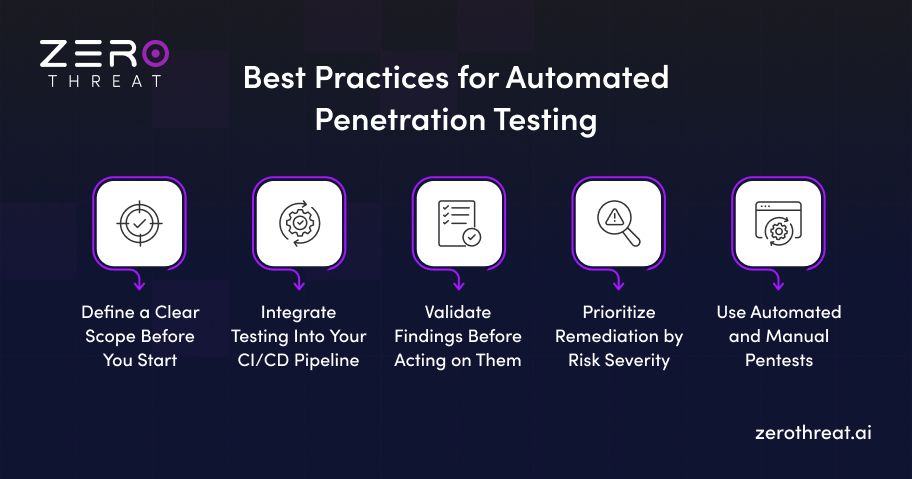
Getting value from automated penetration testing depends on how well you implement it. Following the right practices ensures your testing is accurate, consistent, and actually improves your security posture over time.
Define a Clear Scope Before You Start
Rushing into scanning without proper scoping creates noise and risk. Define exactly which systems, IP ranges, APIs, and web applications are in scope. Clear boundaries prevent accidental testing of out-of-bounds assets and keep results focused on what actually matters to your organization.
Integrate Testing Into Your CI/CD Pipeline
Automated pentesting delivers the most value when it runs as part of your development workflow. Connect your pentesting platform to your CI/CD pipeline so security tests trigger automatically with every deployment for continuous security validation. This catches vulnerabilities at the code level before they ever reach production environments.
Validate Findings Before Acting on Them
Not every flagged vulnerability is a confirmed risk. Always run exploit validation to separate real exposures from false positives. Acting on unvalidated findings wastes your remediation resources and pulls developers away from work that actually reduces your attack surface and security exposure.
Prioritize Remediation by Risk Severity
Automated scans will surface multiple findings at once. Use the severity ratings and exploitability scores your tool provides to build a prioritized remediation queue. Fix critical and high-severity vulnerabilities first, especially
those tied to publicly known CVEs or active threat intelligence feeds.
Combine Automated Testing with Manual Pentesting
Automated tools are strong at scale and consistency but limited in depth. Schedule manual penetration testing engagements periodically to cover business logic flaws, complex attack chains, and areas where human creativity is essential. The two approaches together give you far more complete security coverage than either one alone.
Why You Should Choose ZeroThreat for Automated Pentesting?
ZeroThreat finds real security risk in your web apps and APIs within minutes, that too with no configuration required. It leverages agentic AI to test business logic and detect exploitable attack paths that other tools can’t even scan.
Here are a few standout features that make ZeroThreat trusted by 5,000+ security teams:
- Agentic Al Pentesting: ZeroThreat’s Agentic AI executes controlled, adaptive attack workflows to validate real exploit paths using customer-managed Al models like GPT, Gemini, and Grok.
- Regional Scan & Data Storage Control: The tool allows you to select where scans run and where security data is stored to meet regional compliance and its requirements.
- Production-Safe Scanning: It runs safely in live production environments. This enables security teams to test without worrying about disrupting live applications or triggering outages during active business operations.
- Open Attack Template Support: ZeroThreat enables teams to extend coverage instantly with custom, Burp and Nuclei-based attack templates to access thousands of continuously updated attack templates covering CVEs, misconfigurations, and emerging threats.
- SPA Scanning Via Playwright: It navigates modern SPAs, authenticated flows, and multi-step journeys to detect vulnerabilities in the UI that might not be visible.
- Compliance-Ready Reporting: ZeroThreat generates reports mapped to OWASP, PCI DSS, HIPAA, GDPR, and ISO standards, making the audit preparation faster and easy.
Got questions about getting started with automated penetration testing? Let’s help! Contact Us
Wrapping Up
Automated penetration testing has become an essential part of modern cybersecurity because organizations can no longer rely only on periodic security assessments. Continuous testing helps identify exploitable vulnerabilities faster across applications, APIs, cloud environments, and rapidly changing infrastructure.
The real value of automated pentesting comes from continuous validation, exploit verification, and scalable testing workflows that support DevSecOps and faster release cycles. At the same time, human expertise remains critical for uncovering complex business logic flaws and advanced attack paths.
Organizations that combine an advanced automated pentesting tool with targeted manual assessments build stronger visibility into their security posture and reduce exposure to evolving cyber threats. A balanced approach improves detection accuracy, remediation prioritization, and long-term resilience against real-world attacks.
Frequently Asked Questions
What is AI-driven penetration testing?
AI-driven penetration testing uses artificial intelligence to automate security testing, simulate attacker behavior, and validate exploitable vulnerabilities across applications, APIs, and infrastructure. It helps organizations identify real attack paths faster through continuous and context-aware security assessments.
Can automated penetration testing replace ethical hackers?
What vulnerabilities can automated pentesting tools detect?
What is continuous penetration testing?
Is automated pentesting better than vulnerability scanning?
What are the limitations of automated pentesting?
How often should automated penetration testing be performed?
What industries use automated penetration testing?



Explore ZeroThreat
Automate security testing, save time, and avoid the pitfalls of manual work with ZeroThreat.