 ZeroThreat Wins Bronze Stevie® Award in Tech Startup of the Year Read more

All Blogs
Quick Overview: This blog explores the top penetration testing use cases that strengthen SaaS application security. It covers key areas like tenant isolation, API protection, business logic testing, and compliance-driven pentesting to help SaaS teams identify vulnerabilities, reduce risks, and maintain customer trust through smarter, targeted security testing.
SaaS has become the foundation of modern business operations. From finance platforms like NetSuite to communication tools like Slack and Zoom, companies today run on SaaS to stay agile and competitive. According to Gartner forecasts, global spending on SaaS is projected to reach $299B billion by 2025, showing how deeply cloud applications are woven into business strategy.
But as adoption grows, so does the risk. Every integration, API, and tenant connection expands the attack surface. In fact, nearly 43% of SaaS apps are misconfigured or exposed to unauthorized access, according to the 2024 SaaS Security Posture Report by Adaptive Shield. Missteps in authentication, tenant isolation, or API protection can open serious backdoors for attackers.
That’s where pentesting for securing your SaaS app becomes crucial. In this blog, we’ll explore the top 5 penetration testing use cases in SaaS application security and how each one helps identify blind spots and protect customer trust.
Ensure 10x better security for your SaaS application with ZeroThreat’s pentest tool. Try for Free
On This Page
- Why Pentesting is a Must for SaaS Application Security?
- Penetration Testing Use Cases for SaaS Application Security
- Best Practices to Follow for SaaS App Pentesting
- Simplify SaaS Penetration Testing with ZeroThreat
- Let’s Summarize
Why Pentesting is a Must for SaaS Application Security?
Penetration testing helps SaaS companies stay ahead of threats, not chase them. It gives real insight into how secure your platform truly is, beyond what vulnerability scanners can tell. Let’s look at why it matters so much.
Finds what automated scanners miss
Automated scans catch surface-level flaws. Pentesting goes deeper and uncovers chained attacks, business logic issues, and privilege gaps that tools often overlook. This helps you understand not just what exists, but what’s truly exploitable.
Builds customer trust through proof
SaaS customers hand you their data and expect proof that it’s safe. Regular pentests show clients and auditors that you take protection seriously, not just security compliance. That transparency builds lasting credibility and confidence.
Keeps up with fast-moving releases
SaaS products evolve quickly, sometimes with new updates every week. Each release can introduce hidden risks or security misconfigurations. Pentesting validates security before attackers find an opening, helping you stay one step ahead.
Strengthens compliance posture
Frameworks like SOC 2 and ISO 27001 expect regular pentests as proof of real-world security. Testing shows that your controls actually work when put to the test. This not only makes audits smoother but also reinforces your compliance credibility.
Supports continuous improvement
SaaS security isn’t a one-time project but an ongoing process. Each pentest provides new insights, benchmarks, and lessons for your SaaS teams. Over time, you’ll see fewer critical issues, faster fixes, and a stronger overall security posture.
Penetration Testing Use Cases for SaaS Application Security
Penetration testing for SaaS isn’t one-size-fits-all. Each test targets a specific weakness that could put customer data or app integrity at risk. Below are the key use cases that show how pentesting helps uncover hidden vulnerabilities, allowing you to strengthen SaaS application security.
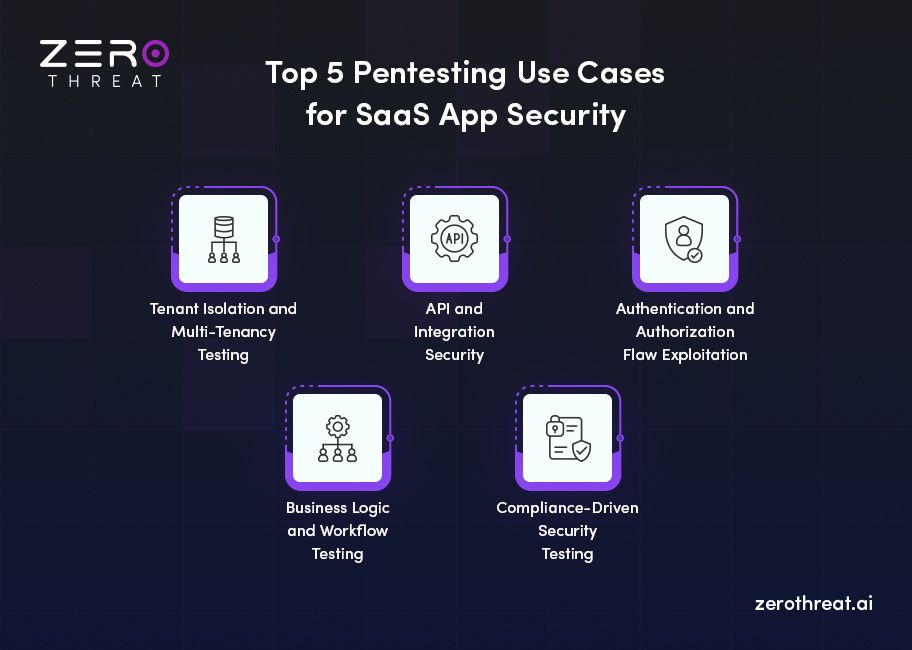
1. Tenant Isolation and Multi-Tenancy Testing
The Goal: Ensure that each customer’s data and environment remain completely isolated from others within the shared SaaS infrastructure.
In a multi-tenant SaaS model, hundreds of customers share the same application and database. A single misconfiguration or business logic flaw in SaaS can allow one tenant to access another’s data. Tenant isolation testing validates that every access control, API, and data boundary works as intended, keeping customer environments truly separate.
What Testers Do:
- Attempt to manipulate tenant identifiers in requests to access other users’ data (IDOR vulnerability).
- Review API calls, backend queries, and authorization logic for cross-tenant data leaks.
- Simulate privilege escalation from one tenant to another through misconfigured roles or shared resources.
SaaS-Specific Focus: Testing API endpoints, database queries, and file storage paths for tenant segregation failures. Here, we validate role-based access and session handling to confirm proper isolation.
2. API and Integration Security
The Goal: Validate that all APIs and third-party integrations handle data securely and cannot be exploited to gain unauthorized access or expose sensitive data.
APIs power the core of every SaaS product, connecting users, services, and external tools. Weak API controls or insecure integrations can become a direct entry point for attackers. API penetration testing ensures that communication between systems is properly authenticated, validated, and protected from misuse or data leakage.
What Testers Do:
- Inspect API endpoints for improper authentication, missing authorization checks, and insecure parameters.
- Perform fuzzing and injection tests to uncover input validation issues and data exposure flaws.
- Analyze integration points like webhooks, OAuth flows, and third-party SDKs for weak tokens or misconfigurations.
SaaS-Specific Focus: Testing REST APIs and GraphQL APIs for access control enforcement. Plus, validating token management, rate limiting, and encryption is carried out in API security testing.
Validate your security program with pentesting built for SaaS applications. Test for SaaS Threats
3. Authentication and Authorization Flaw Exploitation
The Goal: Confirm that only the right users and services can access protected data and actions.
Authentication and authorization are the gatekeepers of your SaaS app. Flaws here let attackers impersonate users or perform actions they should not. Testing these areas ensures login flows, token handling, and permission checks are solid and cannot be bypassed.
What Testers Do:
- Test login flows for weak passwords, brute force protections, and account lockout behavior.
- Probe token handling and session controls for reuse, fixation, or insecure storage.
- Attempt role escalation and unauthorized access by manipulating requests and role parameters.
SaaS-Specific Focus: Validating Single Sign-On (SSO) and OAuth flows. It checks role-based access controls across tenants and services.
4. Business Logic and Workflow Testing
The Goal: Expose flaws in workflows that allow attackers to abuse legitimate features for fraud, data theft, or escalation.
Business logic flaws are not about code bugs. They are about how features behave when used in unexpected ways. Testers look for ways to manipulate flows like billing, provisioning, or promo redemptions to create real-world impact. These issues often slip past scanners but can be easily detected if you are using an automated pentesing tool.
What Testers Do:
- Map critical workflows and try alternative sequences to bypass checks or gain value.
- Manipulate state transitions, inputs, and timing to trigger unintended behavior.
- Test edge cases around billing, discounts, onboarding, and account lifecycle for abuse potential.
SaaS-Specific Focus: Examining subscription, billing flows, and API sequences that change account state. It allows you to verify rate limits and audit trails.
5. Compliance-Driven Security Testing
The Goal: Provide evidence that your security controls meet regulatory and audit requirements.
Compliance-driven pentesting proves controls work under real attack scenarios. It aligns testing with standards like SOC 2, PCI DSS, or HIPAA. Test results become part of your audit trail and help demonstrate security to customers and regulators.
What Testers Do:
- Execute tests mapped to specific control objectives and document findings with clear evidence.
- Validate that encryption, access controls, logging, and data handling meet the required standards.
- Produce auditor-friendly reports, remediation steps, and retest criteria for verification.
SaaS-Specific Focus: Scope tests to include tenant data separation, API handling of regulated data, and cloud configuration controls. It ensures that reporting formats and evidence meet auditor expectations for SaaS environments.
Best Practices to Follow for SaaS App Pentesting
The right pentesting approach helps you uncover core issues, validate fixes faster, and strengthen your SaaS security posture. Here are some best practices to make your pentests more effective and value-driven.
- Define Your Scope Clearly: Decide what needs testing before you start. Identify critical assets like APIs, data storage, and user flows. When your scope is clear, your tests become more focused and meaningful.
- Focus on High-Risk Areas: Not every endpoint needs equal attention. Target and test areas where a breach would cause the most business damage, such as customer data, billing systems, and admin interfaces.
- Use Automation with Manual Testing: Automate for scale, but don’t rely on it completely. Manual testing reveals logic flaws and chaining exploits that tools miss. Combine both for complete coverage.
- Integrate Security into CI/CD: Include pentesting in your release cycle to catch new issues early. Continuous validation keeps your SaaS product secure and reduces remediation costs.
- Validate Fixes and Retest Often: Always recheck your SaaS application after remediation. A fix that isn’t verified isn’t secure. Continuous retesting ensures your defenses stay strong over time.
By focusing on high-value areas, integrating testing early, and validating improvements continuously, you turn pentesting into a lasting strength for your SaaS security.
How ZeroThreat Simplifies Pentesting for SaaS Applications
ZeroThreat is built to match the security needs of modern SaaS applications. It removes the complexity of traditional pentesting and makes continuous security testing practical, scalable, and actionable for SaaS teams.
Automated Multi-Tenant Isolation Testing
ZeroThreat goes beyond surface scans by simulating real-world attacks to verify logical boundaries between users. It identifies tenant leaks that traditional tools miss, ensuring your customer data remains strictly isolated and secure in the multi-tenant SaaS model.
Continuous CI/CD Security Integration
By embedding directly into your development pipeline, ZeroThreat triggers automated pentests with every code push or deployment. This shift-left approach catches exploitable risks in minutes, eliminating the need for slow, manual security reviews that often delay critical SaaS feature releases.
MFA-Aware Authenticated Scanning
Most SaaS vulnerabilities hide behind login screens and complex authentication layers that standard scanners can't touch. ZeroThreat seamlessly navigates Multi Factor Authentication and token-based flows to test your app’s internal logic, providing 99.9% accuracy.
High-Signal Exploit Validation
Instead of making a long list of theoretical or potential issues, ZeroThreat validates every vulnerability through active exploit simulation. This ensures near-zero false positives with evidence, allowing your team to prioritize fixes based on real-world risk rather than static severity scores.
AI-Powered Actionable Remediation
ZeroThreat reduces mean-time-to-remediate (MTTR) by providing developers with clear, code-level remediation guidance. These AI-driven reports bridge the gap between security and engineering, enabling teams to resolve critical vulnerabilities 5x faster without needing deep security expertise.
Need help with your SaaS application security? Let’s get connected. Contact Us
Let’s Summarize
With sensitive customer data and critical business operations depending on SaaS platforms, penetration testing has become essential to maintain security. From testing tenant isolation and API security to uncovering business logic flaws and compliance gaps, each use case plays a vital role in SaaS application security.
As threat variables grow, relying on basic security is no longer enough. Regular, focused pentesting helps security teams stay proactive, identifying weaknesses before they become exploits.
If you want to simplify security, try ZeroThreat’s pentesting tool; it helps you continuously test your SaaS environment for real-world threats. It goes beyond traditional scanners by validating exploits and providing an actionable remediation report to keep your SaaS secure.
Frequently Asked Questions
What are the most common penetration testing use cases for SaaS apps?
The most common SaaS pentesting use cases include testing tenant isolation, validating API security, checking authentication and authorization flaws, uncovering business logic issues, and ensuring compliance with standards like SOC 2 or GDPR. These focus areas protect user data and maintain trust across shared cloud environments.
Which SaaS vulnerabilities are most often exploited by hackers?
Can penetration testing help SaaS startups gain investor trust?
What is the difference between SaaS vulnerability scanning and penetration testing?
How often should SaaS applications undergo penetration testing?
Explore ZeroThreat
Automate security testing, save time, and avoid the pitfalls of manual work with ZeroThreat.