 ZeroThreat Wins Bronze Stevie® Award in Tech Startup of the Year Read more

All Blogs
Reducing Mean Time to Remediate Security Vulnerabilities: Proven Strategies

Quick Overview: Reducing Mean Time to Remediate (MTTR) starts with faster detection, smarter prioritization, and streamlined remediation workflows. This guide breaks down the key factors that keep MTTR high and offers practical strategies to fix vulnerabilities faster. You’ll learn how better processes, automation, and continuous improvement can significantly strengthen your security posture.
Modern teams are developing faster than ever with the AI and automation available. New features roll out weekly, sometimes daily. But the same speed that helps businesses move faster can have security mistakes that can become potential threats.
A recent IBM report found that the average organization takes 204 days to identify a vulnerability and an additional 73 days to remediate it. That delay is where most breaches happen and are left undetected until an attack happens.
This is where Mean Time to Remediate (MTTR) becomes a crucial metric. It shows how quickly your team can go from detection to fix, and how efficiently your security and engineering teams work together. When MTTR drops, the risks go down, and teams can focus more on development.
In this blog, we’ll break down what MTTR really means and practical ways to reduce it across your security workflows. You’ll see where delays happen and how an AI-powered pentesting tool can help you respond faster with less effort.
Try ZeroThreat and detect 10× faster with near-zero false positives. Begin Your Trial
On This Page
- What is MTTR in Cybersecurity?
- How to Calculate Mean Time to Remediate?
- Top Reasons MTTR Stays High in Most Organizations
- How to Reduce Mean Time to Remediate Security Vulnerabilities
- How ZeroThreat Can Help You Reduce MTTR Security Vulnerabilities?
- Wrapping Up
What is MTTR in Cybersecurity?
MTTR in cybersecurity stands for Mean Time to Remediate. It’s a simple metric, but it tells you something important: how long it takes your team to fix a security vulnerability from the moment it’s found.
In security, MTTR is often confused with other terms like Mean Time to Repair, Mean Time to Response, or Mean Time to Recovery. They sound similar, but MTTR in cyber security is all about reducing the time it takes to remediate vulnerabilities, not just repair systems.
When your MTTR is low, it means you detect, prioritize, and fix issues quickly. When it’s high, it usually points to slow workflows, manual processes, or too many vulnerabilities with no clear priority. This is why teams focus so much on how to reduce MTTR and why automated vulnerability detection tool and remediation is becoming a major part of modern security programs.
How to Calculate Mean Time to Remediate?
Calculating Mean Time to Remediate (MTTR) is easier than most teams expect. The goal is to measure how long it takes for your team to fix security vulnerabilities from the moment they’re found to the moment they’re fully resolved.
Here’s the simple formula:
MTTR = Total Time Spent Remediating Vulnerabilities ÷ Number of Vulnerabilities Fixed
To understand the same with an example, let’s say your security team discovers 4 vulnerabilities a week.
Here’s how long each one took to fix:
- Issue 1: 10 hours
- Issue 2: 20 hours
- Issue 3: 06 hours
- Issue 4: 14 hours
Total remediation time = 50 hours. Now apply the formula:
MTTR = 50 hours ÷ 4 vulnerabilities = 12.5 hours
This means your mean time to remediate is 12.5 hours. In cybersecurity terms, that’s your average “Window of Exposure (WoE).”
Top Reasons MTTR Stays High in Most Organizations
MTTR often stays high because teams struggle with slow detection, more alerts, and workflow issues. Many organizations also lack clear ownership and rely on manual steps that delay remediation. These gaps keep vulnerabilities open longer than they should.
Here are the key reasons why MTTR stays high in most organizations:
- Slow Detection: When issues aren't spotted early, the remediation clock keeps running. A high MTTD directly leads to a higher MTTR.
- Too Many Alerts: Teams get lots of unnecessary fixes and miss what actually matters. Important vulnerabilities get delayed because they don’t stand out.
- Manual Prioritization: Sorting vulnerabilities manually takes time and often leads to poor focus. Slow prioritization slows down every step that follows.
- Lack of Ownership: When no one knows who should fix a vulnerability, it sits unattended. Clear ownership is one of the fastest ways to reduce MTTR.
- Complex Workflows: Complicated approval steps and tool-hopping slow down remediation. Simpler workflows help teams fix issues faster with fewer delays.
- Limited Automation: Without automated remediation or triage, everything takes longer. Manual steps increase effort and time required, keeping MTTR higher than necessary.
Run ZeroThreat’s automated pentesting to spot vulnerabilities before attackers do. Start Testing
How to Reduce Mean Time to Remediate Security Vulnerabilities
Reducing MTTR starts with strengthening the entire vulnerability lifecycle, from how fast you detect issues to how quickly teams can act on them. Here are the key practices that help teams fix vulnerabilities faster and more consistently.
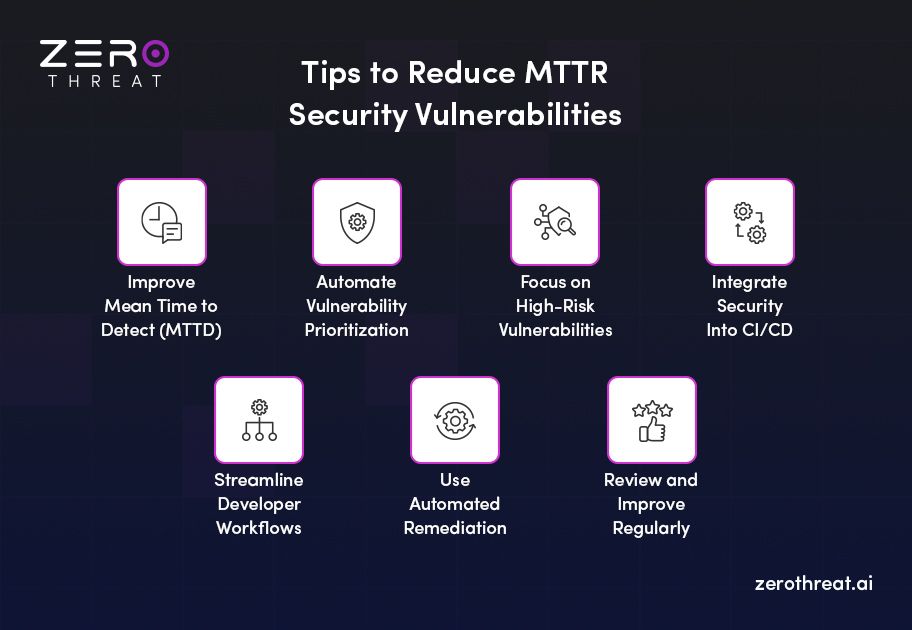
Improve Mean Time to Detect (MTTD)
A lower MTTR starts with faster detection. The sooner you spot a vulnerability, the sooner the fix begins. Reducing MTTD cuts down the window where attackers can take advantage of issues.
- Use continuous scanning instead of periodic checks.
- Set up alerts for high-risk changes in configurations.
- Monitor cloud, code, and configurations together.
- Reduce false positives so critical alerts stand out.
- Keep detection tools tightly integrated with your pipeline.
Automate Vulnerability Prioritization
Automation helps you quickly identify what needs attention and what can be delayed. It provides clarity and keeps teams focused on the risks that matter most.
- Use tools that rank risk based on impact.
- Auto-group duplicate or related issues.
- Push prioritized items directly into dev workflows.
- Mark low-impact issues for later.
- Keep your prioritization logic updated as your environment changes.
Focus on High-Risk Vulnerabilities
Not all vulnerabilities demand the same urgency. Focusing on high-risk issues helps you reduce exposure faster and lowers your overall MTTR. It's about fixing the vulnerabilities that actually put your system at risk.
- Evaluate risk using real-world exploitability.
- Consider business impact, not just severity.
- Highlight vulnerabilities exposed to the internet.
- Fix issues in critical systems first.
- Review high-risk findings daily to prevent delays.
Integrate Security Into CI/CD
When security becomes part of the CI/CD pipeline, issues get caught earlier and fixed faster. This removes back-and-forth delays and helps developers address vulnerabilities while the context is still fresh. Early detection in the pipeline directly lowers MTTR.
- Add automated security checks to every build.
- Block risky deployments before they reach production.
- Surface findings in the tools developers already use.
- Run lightweight scans to avoid slowing pipelines.
- Make security feedback clear, actionable, and fast.
Streamline Developer Workflows
Developers fix vulnerabilities faster when the process feels simple and friction-free. Clear steps, fewer tools, and better guidance eliminate unnecessary delays. A smooth workflow leads to a steady drop in MTTR.
- Provide clear remediation instructions with each finding.
- Reduce tool-hopping by centralizing reports.
- Assign vulnerability owners automatically.
- Remove extra approval layers when safe.
- Keep documentation short, updated, and easy to follow.
Use Automated Remediation
Some fixes are predictable and safe to automate. Automated remediation closes gaps quickly, especially for routine patches or security misconfigurations. It frees teams from repetitive tasks and speeds up the entire remediation lifecycle.
- Auto-apply patches for low-risk issues.
- Fix known misconfigurations with predefined scripts.
- Trigger remediation workflows based on severity.
- Validate results automatically after execution.
- Allow manual review for high-impact vulnerabilities.
Review and Improve Regularly
Reducing MTTR isn’t a one-time effort. Regular reviews help you find bottlenecks, fine-tune processes, and make meaningful improvements. Small changes made consistently can dramatically improve your remediation speed.
- Analyze trends in MTTR and MTTD monthly.
- Identify where fixes slow down most often.
- Update workflows based on lessons learned.
- Expand automation as your process matures.
- Keep teams aligned through regular retrospectives.
How ZeroThreat Can Help You Reduce MTTR Security Vulnerabilities?
Reducing MTTR becomes far easier when you have a platform that automates manual work. ZeroThreat is built to speed up detection, simplify analysis, and automate the parts of remediation that slow teams down. Here’s how it helps you fix vulnerabilities with far less effort.
Automated Penetration Testing
ZeroThreat runs automated penetration testing on every build, so you catch issues before they slow your team down. It removes the wait time of manual pentests and turns testing into a continuous flow. This helps you spot real vulnerabilities early and cut your MTTR without extra effort.
AI-Powered Remediation Reports
It gives you clean, actionable remediation guidance written in a way developers actually understand. With near-zero false positives and clear fixes, you can fix issues right away. This shortens the back-and-forth and helps your team close vulnerabilities much faster.
CI/CD & DevOps Integration
Security fits directly into your pipeline, not around it. ZeroThreat sends instant feedback inside the CI/CD process, so developers see problems at the exact moment they matter. That tight loop keeps releases moving and prevents MTTR from stretching across multiple sprints.
Broad Vulnerability Coverage
ZeroThreat supports web app and API security testing and detects vulnerabilities from OWASP Top 10 to business logic issues. With everything in one place, you find the root cause faster and resolve security issues without slowing the business.
Smart Risk Prioritization
Not every vulnerability carries the same weight, and ZeroThreat makes that clear upfront. It ranks issues by real-world impact, so development teams know where to start without hesitation. Prioritizing the right work is one of the simplest ways to bring MTTR down.
Compliance-Ready Reporting
ZeroThreat generates clean, compliance-friendly reports that leaders can use immediately for reviews or certifications. With documentation handled automatically, developers stay focused on resolving issues instead of ensuring security compliance, such as GDPR, HIPAA, and PCI-DSS.
Get expert help to streamline your remediation process. Contact Us
Wrapping Up
Reducing MTTR is a sign of how quickly your organization can respond, adapt, and stay resilient in the modern threat landscape. When teams fix vulnerabilities faster, they cut down the attacker’s opportunity window and strengthen overall security.
If you start detecting, prioritizing, and remediating security vulnerabilities quickly, you reduce the attack surface and reduce the exposure window. With a clear workflow and an automated penetration testing tool like ZeroThreat, this process can be easy and efficient. So, start measuring your MTTR, optimizing it, and turn speed into your strongest layer of defense.
Frequently Asked Questions
Why does reducing Mean Time to Remediation (MTTR) matter for modern businesses?
Reducing MTTR matters because the longer a vulnerability stays open, the higher the risk of an actual breach. Faster remediation helps teams limit exposure windows and maintain stronger security across their applications. It also improves operational trust, supports compliance, and keeps development cycles running smoothly without long security bottlenecks.
Which factors most commonly delay vulnerability remediation and increase MTTR?
How can security teams use MTTR metrics to assess operational maturity?
Why do manual vulnerability management workflows often fail to reduce MTTR effectively?
How does ZeroThreat’s automated vulnerability management improve response times?
How does ZeroThreat ensure data security and privacy during automated remediation?


Explore ZeroThreat
Automate security testing, save time, and avoid the pitfalls of manual work with ZeroThreat.