 ZeroThreat Wins Bronze Stevie® Award in Tech Startup of the Year Read more

All Blogs
SOC 2 Penetration Testing Requirements Made Simple: A Guide for Audit Readiness
Quick Overview: Understanding SOC 2 penetration testing requirements helps organizations validate their security controls and maintain compliance with AICPA’s Trust Services Criteria. This blog explains what SOC 2 expects from penetration testing, key requirements, common vulnerabilities uncovered, and the benefits of pentesting for SOC 2 compliance.
In 2024, the global penetration testing market was valued at $2.45 billion and is projected to reach $6.25 billion by 2032, growing at a CAGR of 12.5%. This surge shows us the increasing demand for penetration testing as a critical component of cybersecurity strategies.
For organizations pursuing SOC 2 compliance, penetration testing has evolved from a mere checkbox activity to a strategic necessity. While SOC 2 doesn't explicitly mandate penetration testing, auditors and clients increasingly expect it to be part of the compliance process. A well-conducted SOC 2 penetration testing identifies vulnerabilities and demonstrates a proactive approach to security, aligning with the Trust Services Criteria.
This blog dives into the SOC 2 penetration testing requirements, providing clarity on scope, frequency, and reporting standards. By understanding these requirements, organizations can maintain their security compliance and build trust with clients and stakeholders.
Achieve security compliance effortlessly with our AI-powered pentesting tool to uncover hidden threats. Try It for Free
On This Page
- What is SOC 2 Compliance?
- AICPA’s SOC 2 Trust Services Criteria
- SOC 2 Pentesting: Type I vs Type II Audits
- Does SOC 2 Require Penetration Testing?
- Common Vulnerabilities Uncovered in SOC 2 Penetration Testing
- SOC 2 Penetration Testing Requirements
- Benefits of Penetration Testing for SOC 2 Compliance
- How Much Does SOC 2 Penetration Testing Cost?
- Summing Up
What is SOC 2 Compliance?
SOC 2 compliance is a security framework developed by the American Institute of Certified Public Accountants (AICPA) that establishes standards for how organizations should manage customer data securely. SOC stands for Systems and Organization Controls. The “2” relates to the focus on the Trust Service Criteria (security, availability, processing integrity, confidentiality, and privacy).
It was developed to give customers and partners assurance that a service organization is managing their data responsibly. Having an SOC 2 compliance report showcases that your organization has designed and maintained controls around how you process, store, and manage customer data.
A SOC 2 report is not a one-size-fits-all certification. Instead, you tailor your controls to your business, and then an independent auditor verifies it, depending upon your SOC 2 report type (Type I or Type II).
While it’s not a legal requirement in most jurisdictions, your customers or enterprise buyers may demand it. If you don’t have it, you might miss out on potential business deals.
AICPA’s SOC 2 Trust Services Criteria
The AICPA defines five Trust Services Criteria that form the backbone of a SOC 2 audit. These criteria help you build and assess controls that align with your customer promises and system risks. You choose which ones apply to you, but Security is always mandatory.
Security
Security focuses on protecting systems and data from unauthorized access, misuse, or disruption. Strong access controls, continuous monitoring, and incident response planning are key to meeting this criterion. In practice, it’s about proving your environment is secure by design.
Availability
The availability criteria ensure that your services stay up and running as promised. Controls around uptime, backup, failover, and disaster recovery show that your systems can handle disruption and maintain business continuity. Organizations use this criterion to demonstrate they can meet service level agreements (SLAs) and minimize downtime.
Processing Integrity
Processing integrity is all about accuracy and consistency. It ensures data is processed correctly, completely, and within the expected time frame. Companies that handle transactions or real-time data must show their systems can detect errors, validate inputs, and produce dependable outputs. The goal is to build trust in the data flowing through your platform.
Confidentiality
Confidentiality protects information that isn’t meant for public access, such as internal reports, client records, or intellectual property. Encryption, strict access permissions, and secure disposal methods help enforce it. In other words, you’re showing that sensitive data exposure is handled with discretion and protected at every stage of its lifecycle.
Privacy
Privacy goes a step further by focusing on personal information. It requires organizations to collect, use, and store personal data in line with their stated privacy commitments. Policies for consent, retention, and data deletion demonstrate respect for user privacy. It’s about proving that privacy isn’t just part of compliance; it’s part of your company’s culture.
SOC 2 Pentesting: Type I vs Type II Audits
Many people get confused about how penetration testing fits into different SOC 2 report types. The key difference isn't the test itself, but when it's performed and what the auditor is checking.
Type I is about the design of your security controls on a single date. Type II is about how effectively those controls operate over a period of time.
| Feature | Type I | Type II |
|---|---|---|
| Audit focus | Reviews the design of controls at a specific point in time. | Reviews both the design and operating effectiveness of controls over a period. |
| Time-window / observation period | Snapshot on a given date (e.g., “as of June 30”). | Covers control operation over time (often 3-12 months). |
| Depth of evidence | Evidence around whether controls are suitably designed. Less sample testing. | Much more comprehensive: control operation is tested by sampling actual events and logs during the period. |
| Typical use-case | Early-stage companies or when you need to show controls quickly. | Organizations with mature controls or those dealing with enterprises requiring strong assurance. |
| Cost and time investment | Lower cost, shorter audit timeline. | Higher cost, longer timeframe (more resources required). |
For a Type I report, a completed penetration test report is often sufficient evidence. For a Type II report, you must show that you not only did the test but also managed the vulnerabilities effectively.
Does SOC 2 Require Penetration Testing?
In simple terms, no. The American Institute of Certified Public Accountants (AICPA) does not explicitly mandate a penetration test as part of SOC 2 compliance. But here’s the catch, while it is not mandatory, penetration testing is very often treated as a best practice and default expectation by auditors.
Two controls in particular often drive the discussion around penetration testing:
- CC4.1: requires an entity to select, develop, and “perform ongoing and/or separate evaluations” of controls.
- CC7.1: requires detection and monitoring procedures to identify configuration changes or new vulnerabilities.
Because penetration testing offers direct evidence of control effectiveness (especially unauthorized access or misuse of data), many organizations choose to include it to strengthen their documentation and audit readiness.
Avoid costly data breaches and penalties by pentesting and detecting vulnerabilities in minutes. Do a Quick Test
Common Vulnerabilities Uncovered in SOC 2 Penetration Testing
A SOC 2 pen test uncovers the real-world risks that could compromise your system's security. Seeing these common findings helps you understand exactly what auditors and testers are looking for. Here are the vulnerabilities you may find consistently.
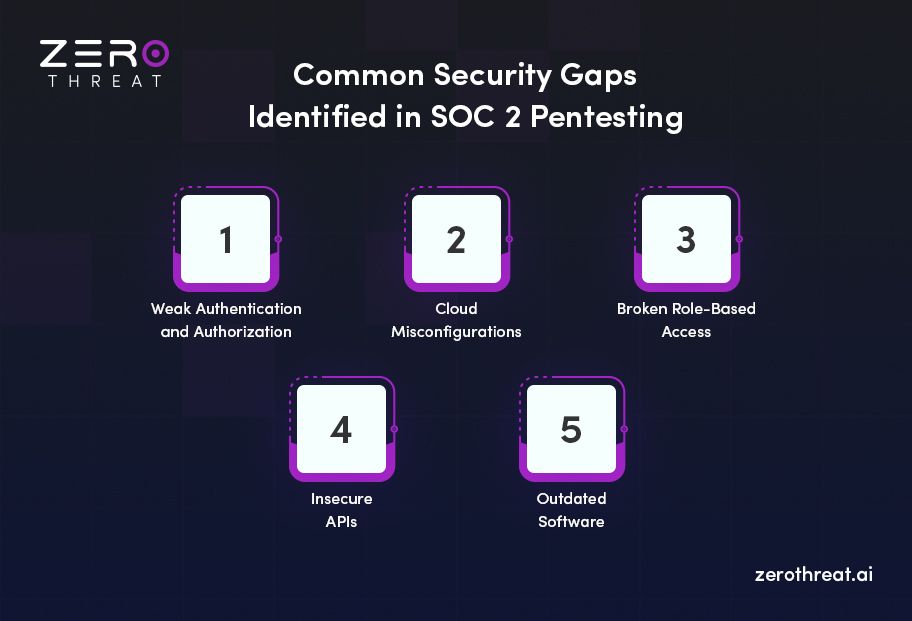
Weak Authentication and Authorization
Poorly configured login systems or broken authentication let attackers test credentials, elevate privileges, or move laterally. If authorization checks are missing or misapplied, users may gain access to data and systems they shouldn’t. Penetration testing for SOC 2 compliance surfaces these issues, showing whether access controls actually hold up.
Cloud Misconfigurations
Cloud resources left open (e.g., storage buckets, mis-set IAM roles) create easy entry points for attackers. Misconfigurations undermine both the Security and Availability criteria of SOC 2, exposing systems to unauthorized changes or downtime. A targeted pentest highlights these risks and helps companies align with SOC 2 penetration testing requirements.
Broken Role-Based Access
When roles don’t match real-world job functions, or when former employees retain high privileges, the risk of misuse spikes. Auditors look for evidence that role-based access controls work over time, not just on paper. Penetration testing reveals broken access controls and predicts privilege escalations that could happen.
Insecure APIs
APIs with weak authentication, excessive permissions, or exposed endpoints can be exploited to access or manipulate sensitive data. Since SOC 2 compliance touches on processing integrity and confidentiality, API testing becomes crucial.. Pentesting identifies endpoints that weren’t hardened or were overlooked in your SOC 2 audit scope.
Outdated Software
Running legacy or unpatched software opens the door to known exploits and makes proving control effectiveness harder. SOC 2 pentesting uncovers these outdated components and shows whether patches or updates are missing, helping you justify your remediation tracking to auditors.
SOC 2 Penetration Testing Requirements
SOC 2 doesn’t prescribe a fixed penetration testing checklist, but it does expect organizations to demonstrate that their security controls work effectively under real-world conditions. The goal is to ensure your systems are secure, your controls are validated, and your audit evidence is credible.
Here’s what that means in practice.
1. Scope & In-Scope Systems (Apps, APIs, Network, Cloud)
SOC 2 penetration testing should cover all systems that store, process, or transmit customer data. This includes web app security testing, APIs, internal networks, and cloud environments. If a system supports any Trust Services Criteria (like Security or Availability), it must be tested. Missing key assets can weaken your audit evidence.
2. Frequency and Timing of Penetration Tests
Most SOC 2 auditors expect penetration testing at least once a year or after any major infrastructure change. Regular testing shows that your security posture is continuously validated, not just during audit season. It also provides ongoing assurance that new risks are identified and managed before they affect compliance.
3. Use of Qualified Independent Testers
AICPA recommends using an independent third-party testing firm or a qualified internal team separate from daily operations. Independence ensures objectivity and credibility in results. Auditors look for evidence that the test was conducted by professionals with the right certifications and methodologies, not an internal IT checkup.
4. Reporting Standards and Evidence for Auditors
Penetration test reports should include an executive summary, detailed vulnerability assessment, risk prioritization, and remediation steps. Auditors use this as proof that identified vulnerabilities were analyzed and addressed. Clear, structured reporting also helps non-technical stakeholders understand the severity and business impact of each issue.
5. Alignment with SOC 2 Trust Services Criteria
The testing scope and methods should align with the applicable Trust Services Criteria, typically Security, Availability, and Confidentiality. For example, testing access controls supports the Security principle, while simulating data exposure validates Confidentiality. This mapping helps auditors see how your test supports specific SOC 2 requirements.
6. Remediation and Retesting Requirements
Finding vulnerabilities isn’t enough; auditors expect proof that you’ve fixed them. After addressing critical and high-severity findings, a retest confirms that fixes were effective. This process demonstrates a closed feedback loop and reinforces that your organization continuously improves its security posture.
Benefits of Penetration Testing for SOC 2 Compliance
Penetration testing brings real, tangible value to your SOC 2 compliance journey. It lets you test your systems like an attacker would, uncover hidden weaknesses, and show your clients and auditors that your controls actually work. Here’s how pentest for SOC 2 benefits you.
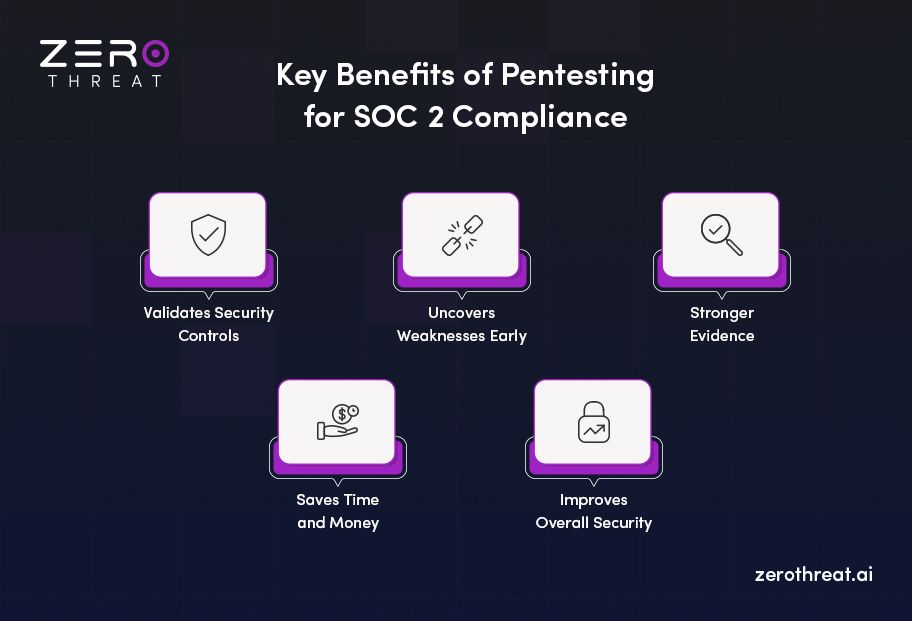
Validates Security Controls
SOC 2 requires organizations to demonstrate that their systems are secure and well-protected. Penetration testing helps you validate that claim by simulating real attack scenarios. It identifies how well your preventive and detective controls hold up, giving both your team and auditors tangible evidence that your environment is secure in practice, not just on paper.
Uncovers Weaknesses Early
Regular penetration testing exposes security misconfigurations, outdated systems, or weak access controls that might otherwise go unnoticed until audit time. By finding and fixing these issues early, you prevent last-minute surprises during the SOC 2 audit and improve your readiness score. It’s a proactive way to show continuous improvement rather than reactive compliance.
Stronger Evidence
The AICPA’s Security principle, which is the core of SOC 2, focuses on protecting systems from unauthorized access and breaches. A penetration test directly supports this requirement by showing how your systems perform under simulated attacks. It’s concrete, risk-based evidence that auditors can rely on to assess control effectiveness.
Saves Time & Money
Fixing vulnerabilities early is always cheaper than dealing with a breach or failed audit. Pen testing helps you prioritize critical issues and avoid the costly downtime, remediation, and reputational damage that can occur.
Improves Overall Security
SOC 2 compliance is a snapshot in time, but security is ongoing. Penetration testing helps you move beyond the minimum audit requirements by uncovering security flaws, business logic risks, and evolving threat patterns. It turns compliance into a continuous security practice, improving resilience long after the audit ends.
How Much Does SOC 2 Penetration Testing Cost?
When you’re pursuing SOC 2 compliance, allocating the budget for pentesting as part of your audit preparation is a smart move. The cost of SOC 2 pentesting varies based on scope, complexity, and timing. Understanding what drives that cost helps you plan effectively.
Key Cost Drivers of SOC 2 Pentesting
- Audit type (Type I vs Type II): Type II audits usually cost more because they review controls over time.
- Scope of systems and applications tested: The more IPs, apps, endpoints, and cloud infrastructure you include, the higher the cost.
- Maturity of your environment and controls: If you’re already hardened, the pen test may be more straightforward. If you need remediation first, costs will rise.
- Vendor/firm quality and reputation: A top-tier pen-testing firm brings higher fees but may offer more credible evidence for the audit.
- Frequency and inclusiveness of testing: One-off tests cost less than recurring or full-stack tests (network + cloud + API + web).
Cost of SOC 2 Penetration Testing
| Category | Startups <100 employees | Mid-Market 100–1,000 employees | Enterprise 1,000+ employees |
|---|---|---|---|
| Penetration Testing Cost | $10K – $20K | $25K – $40K | $50K – $100K+ |
| Full SOC 2 Audit (Type II) | $15K – $50K | $50K – $85K | $85K – $150K+ |
| Readiness Assessment | $10K – $15K | $15K – $20K | $20K – $30K |
| Annual Maintenance & Retesting | $20K – $30K | $50K – $130K | $130K – $250K+ |
Note: These cost ranges are based on averages from trusted industry resources. Real-world pricing depends on your audit type (Type I vs Type II), testing scope, and the maturity of your existing security controls.
Including a quality penetration test in your SOC 2 compliance plan is smart budgeting. Yes, it adds cost, but it eliminates the risk of compliance and offers you stronger evidence.
Need help with security and compliance? Let’s talk. Contact Us
Summing Up
SOC 2 penetration testing is a crucial part of validating security controls. It helps organizations identify vulnerabilities in applications, networks, APIs, and cloud environments before auditors or attackers do. Following SOC 2 penetration testing requirements ensures that your systems align with the Trust Services Criteria.
By defining scope clearly, using qualified independent testers, and maintaining structured reporting, companies can strengthen their compliance posture. Remediation and retesting of identified vulnerabilities provide concrete evidence for auditors and demonstrate an active approach to risk management.
In simple words, SOC 2 penetration testing is more than a compliance activity. It is a strategic practice that improves overall security posture and builds confidence with clients, auditors, and stakeholders.
You can use our automated penetration testing tool to identify and validate vulnerabilities faster. It will simplify continuous testing, reduce manual effort, and keep your enterprise audit-ready.
Frequently Asked Questions
Does SOC 2 require penetration testing in 2026?
While SOC 2 doesn’t mandate penetration testing explicitly, it’s strongly recommended to validate your security controls. Auditors often expect recent pentest results as supporting evidence for the Security Trust Services Criteria.
Is vulnerability scanning enough for SOC 2 compliance?
How does penetration testing fit into a SOC 2 audit?
What is the recommended frequency of penetration testing for SOC 2?
How does SOC 2 penetration testing differ from standard penetration testing?


Explore ZeroThreat
Automate security testing, save time, and avoid the pitfalls of manual work with ZeroThreat.