 ZeroThreat Wins Bronze Stevie® Award in Tech Startup of the Year Read more

All Blogs
Quick Overview: As organizations increasingly rely on cloud-native platforms, securing SaaS applications becomes essential to protect data and ensure compliance. This blog explores the top SaaS security tools, outlining their core features, benefits, and differentiators. It guides businesses in choosing the right solution to reduce risks, prevent breaches, and build stronger, more resilient SaaS environments.
Software as a Service (SaaS) is now the default delivery model for core business systems. From CRM platforms like Salesforce to collaboration tools like Slack and Microsoft 365, organizations rely heavily on cloud-based software to drive productivity, scalability, and innovation.
According to the latest forecast from Gartner, worldwide end-user spending on public cloud services is forecast to total $723.4 billion in 2025, up from $595.7 billion in 2024.
However, with great convenience comes great responsibility — and risk. As businesses adopt more SaaS applications, the attack surface expands. The 2023 SaaS Security Posture Report by Adaptive Shield revealed that the average organization uses 178 SaaS applications, with 30% of them posing medium to high security risks due to misconfigurations, overprivileged access, or lack of visibility.
The growing reliance on SaaS has created an urgent need for robust SaaS security tools. In this blog, we are going to explore what SaaS security services are, why SaaS security matters, and top SaaS security tools.
Keep pace with evolving SaaS threats using smarter security tools. Start Now
On This Page
- What is SaaS Security?
- Why SaaS Security Matters: The Hidden Risks
- Top SaaS Security Platforms Comparison
- Top 7 SaaS Application Security Tools (2026)
- SaaS Security Tools Feature Comparison
- Features to Consider While Choosing The Right SaaS Security Tools
- Final Thoughts
What is SaaS Security?
SaaS security refers to the strategies, tools, and practices used to protect cloud-based applications and the data they process from cyber threats. It addresses shared security responsibilities between SaaS providers and customers.
SaaS security is vital because these platforms often power core business operations and store sensitive data, any compromise can lead to severe financial losses and long-term reputational damage.
Why SaaS Security Matters: The Hidden Risks
Before we dive into the tools, let’s understand why SaaS security is no longer optional.
Unlike traditional on-premises software, SaaS applications operate under a shared responsibility model. While the provider secures the infrastructure, the customer is responsible for securing data, access, configurations, and compliance. This often leads to gaps in visibility and control.
Key risks include:
- Shadow IT: Employees using unauthorized apps.
- Misconfigurations: 73% of cloud breaches are caused by misconfigured settings (McAfee Cloud Adoption and Risk Report).
- Overprivileged Access: Users with excessive permissions - a major contributor to insider threats and data exfiltration.
- Lack of Visibility: 60% of IT leaders admit they don’t know how many SaaS apps their employees use (Bitglass).
Consider SaaS Security Posture Management (SSPM) and Cloud Access Security Brokers (CASB). These are two emerging categories of tools designed to address these challenges.
Top SaaS Security Platforms Comparison
| Feature / Tool | ZeroThreat | Cloudflare | Orca Security | Wiz | Palo Alto (Prisma) | Netskope One | CrowdStrike |
|---|---|---|---|---|---|---|---|
| SaaS Vulnerability Testing | ✅ (DAST, MFA, AI-driven) | ❌ | ❌ | ❌ | ⚠️ (partially, via Prisma Access) | ❌ | ❌ |
| False Positive Reduction | ✅ (AI-powered, near-zero) | ❌ | ⚠️ | ⚠️ | ❌ | ❌ | ⚠️ |
| Cloud Security Posture Mgmt (CSPM) | ❌ | ❌ | ✅ | ✅ | ✅ | ⚠️ | ✅ |
| CNAPP (Cloud-Native App Protection) | ❌ | ❌ | ❌ | ✅ | ✅ | ❌ | ⚠️ |
| CASB (Cloud Access Security Broker) | ❌ | ❌ | ❌ | ❌ | ⚠️ | ✅ | ❌ |
| ZTNA (Zero Trust Network Access) | ✅ (Zero Trust model) | ⚠️ (limited) | ❌ | ❌ | ✅ | ✅ | ❌ |
| DLP (Data Loss Prevention) | ❌ | ❌ | ❌ | ❌ | ⚠️ | ✅ | ❌ |
| Endpoint / Workload Security | ❌ | ❌ | ❌ | ❌ | ✅ | ❌ | ✅ |
| Compliance Reporting (SOC 2, HIPAA, GDPR, PCI DSS) | ✅ (built-in) | ❌ | ✅ | ✅ | ✅ | ✅ | ⚠️ |
| Ease of Deployment | ✅ (no configuration) | ✅ | ✅ | ⚠️ | ❌ (complex) | ⚠️ | ✅ |
| Best Fit Audience | SaaS-first, DevSecOps, Startups | Perimeter defense & API security | Multi-cloud enterprises | Cloud-native enterprises | Large enterprises | SaaS-heavy orgs (data governance) | Security-first orgs |
Top 7 SaaS Application Security Tools (2026)
Here are the top 10 SaaS app security tools, selected based on market adoption, technical capabilities, independent research, and real-world impact.
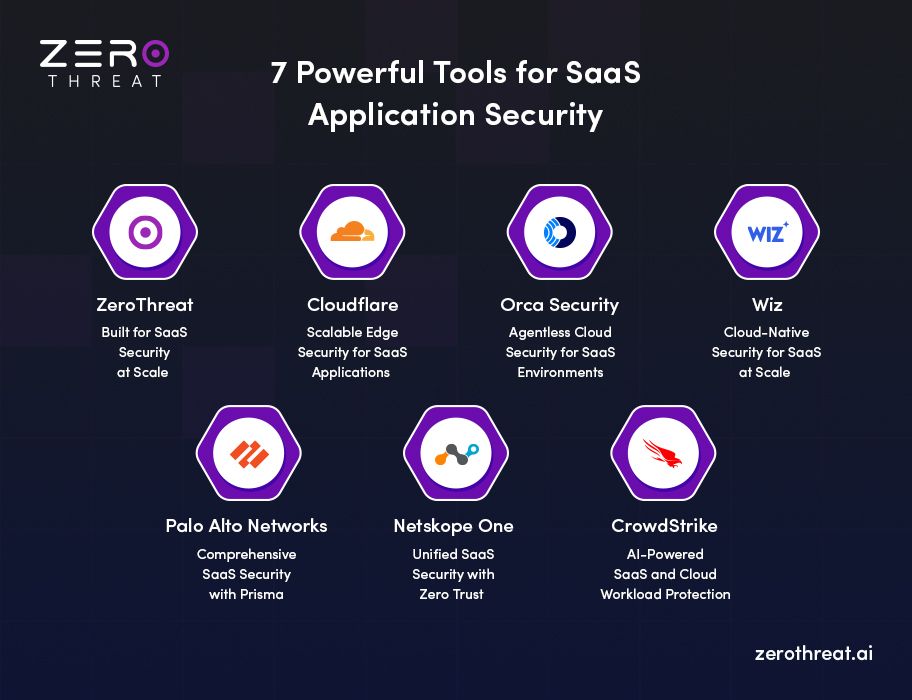
1) ZeroThreat: Built for SaaS Security at Scale
ZeroThreat is an emerging SaaS cybersecurity tool helping SaaS companies secure applications without adding friction to growth. Its AI-driven vulnerability detection finds risks 5x faster with near-zero false positives, cutting down wasted hours on noisy alerts.
With MFA-ready, authenticated scanning and seamless CI/CD integration, security becomes a natural part of your development workflow, but not an afterthought. ZeroThreat also delivers actionable, prioritized reports that guide teams from detection to resolution, ensuring faster fixes and reduced risk.
By aligning with zero-trust principles and compliance needs, ZeroThreat enables SaaS providers to protect sensitive data, maintain customer trust, and keep shipping innovation at speed.
Key Features and Benefits:
- AI-Powered Vulnerability Detection – Finds threats 5x faster with near-zero false positives.
- MFA & Authenticated Scanning – Secures even complex, login-protected SaaS environments.
- Seamless CI/CD Integration – Embeds security testing directly into DevOps workflows.
- Actionable, Prioritized Reports – Guides teams with clear remediation steps for faster fixes.
- Zero Trust Architecture – Aligns with modern compliance and ensures data protection.
- Developer-Friendly – Reduces manual effort by 90%, letting teams focus on innovation.
Unsure which SaaS tool is right for you? Let’s talk. Contact Us
2) Cloudflare: Scalable Edge Security for SaaS Applications
Cloudflare is one of the popular SaaS security platforms, delivering enterprise-grade protection at the edge. It helps SaaS providers secure their apps against evolving cyber threats while maintaining high performance and availability. Its global network ensures security and speed go hand in hand.
Key Features and Benefits:
- Global CDN + DDoS Protection – Shields SaaS apps from large-scale attacks while improving latency.
- Web Application Firewall (WAF) – Mitigate OWASP Top 10 threats like XSS, SQLi, and CSRF in real time.
- Zero Trust Network Access – Provides secure, identity-based access to internal and external apps.
- Bot Management – Detects and mitigates malicious bot traffic without disrupting legitimate users.
- Always-On Availability – Ensures continuous uptime and performance across 300+ global data centers.
3) Orca Security: Agentless Cloud Security for SaaS Environments
Orca Security provides a comprehensive, agentless cloud security platform tailored for modern SaaS environments. It ensures targeted visibility to AWS, GCP, and Azure. By connecting directly to cloud infrastructure, it delivers complete visibility across workloads, containers, and serverless applications, without the operational burden of installing agents.
Key Features and Benefits:
- Agentless Full-Stack Visibility – Instant coverage across cloud assets, workloads, and APIs without deployment complexity.
- Risk Prioritization – Identifies and prioritizes vulnerabilities based on exploitability and business impact.
- Compliance & Governance – Ensures continuous alignment with security compliance frameworks like SOC 2, ISO 27001, PCI DSS, and HIPAA.
- Rapid Remediation – Provides actionable insights and integrates seamlessly into CI/CD pipelines and ticketing systems.
- Multi-Cloud Coverage – Supports AWS, Azure, GCP, and hybrid setups, making it ideal for SaaS providers scaling globally.
4) Wiz: Cloud-Native Security for SaaS at Scale
Wiz is a cloud-native application protection platform (CNAPP) that helps SaaS companies secure applications and infrastructure with deep visibility and risk context. As SaaS security software, Wiz scans across cloud environments without agents. It also empowers teams to detect vulnerabilities, security misconfigurations, and identity risks before they escalate.
Key Features and Benefits:
- Agentless Cloud Scanning – Covers workloads, containers, and serverless apps with zero deployment friction.
- Contextual Risk Prioritization – Correlates vulnerabilities, secrets, and network exposure to highlight what truly matters.
- Identity & Access Security – Detects risky permissions and misconfigured IAM roles across SaaS and cloud platforms.
- Shift-Left Security – Integrates into CI/CD pipelines, enabling DevOps teams to catch issues early in development.
- Unified Risk Dashboard – Provides a single pane of glass for security posture management across multi-cloud SaaS environments.
5) Palo Alto Networks: Comprehensive SaaS Security with Prisma
Palo Alto Networks is one of the most popular SSPM tools that provides a cloud-native platform to protect against cyber threats, including network, cloud, and endpoint security.
Palo Alto Networks, through its Prisma Cloud and Prisma SaaS solutions, delivers a full spectrum of SaaS security capabilities to protect modern applications and data. Its platform focuses on reducing SaaS risks with continuous visibility, data protection, and threat prevention.
Key Features and Benefits:
- SaaS Security Posture Management (SSPM) – Monitors configurations across SaaS apps to identify and fix misconfigurations before they become attack vectors.
- Advanced Threat Protection – Uses machine learning to detect malware, phishing, and zero-day attacks targeting SaaS applications.
- Data Loss Prevention (DLP) – Secures sensitive data across SaaS platforms with automated classification and compliance enforcement.
- CASB Integration – Offers granular control over SaaS usage with inline and API-based Cloud Access Security Broker (CASB) features.
- Continuous Compliance – Ensures adherence to regulatory frameworks (GDPR, HIPAA, PCI DSS) with real-time monitoring and reporting.
6) Netskope One: Unified SaaS Security with Zero Trust
Netskope One is unified SaaS security software built on a Zero Trust framework, designed to secure SaaS applications, cloud services, and remote work environments. It combines visibility, control, and real-time threat defense to help businesses securely embrace SaaS at a scale.
Key Features and Benefits:
- Deep SaaS Visibility – Identifies sanctioned and unsanctioned SaaS usage, enabling IT teams to monitor shadow IT and eliminate blind spots.
- Cloud Access Security Broker (CASB) – Provides granular access policies, risk scoring, and control over sensitive data in SaaS environments.
- SaaS Security Posture Management (SSPM) – Detects and remediates misconfigurations across multiple SaaS applications automatically.
- Real-Time Threat Protection – Stops malware, phishing, and insider threats before they impact SaaS platforms.
- Data-Centric Security – Enforces DLP policies with contextual understanding, ensuring sensitive data stays compliant with regulations.
7) CrowdStrike: AI-Powered SaaS and Cloud Workload Protection
CrowdStrike extends its industry-leading Falcon platform to SaaS environments, offering real-time detection, prevention, and response against sophisticated cyber threats with best SaaS security practices. Built on AI-driven threat intelligence, it helps organizations protect SaaS workloads, endpoints, and cloud-native applications with speed and precision.
Key Features and Benefits:
- AI-Driven Threat Detection – Identifies zero-day exploits, credential abuse, and SaaS-targeted attacks with advanced machine learning.
- SaaS Application Protection – Monitors user behavior across popular SaaS apps to detect anomalies and stop account takeovers.
- Identity Threat Protection – Defends against lateral movement by securing SaaS logins, APIs, and privileged access.
- Cloud Workload Security – Protects SaaS workloads and containerized applications across multi-cloud environments.
- Centralized Visibility – Delivers unified dashboards to track SaaS security events alongside endpoint and network data.
SaaS Security Tools Feature Comparison
| Feature / Tool | ZeroThreat | Cloudflare | Orca Security | Wiz | Palo Alto (Prisma) | Netskope One | CrowdStrike |
|---|---|---|---|---|---|---|---|
| SaaS Vulnerability Testing | ✅ (DAST, MFA, AI-driven) | ❌ | ❌ | ❌ | ⚠️ (partially, via Prisma Access) | ❌ | ❌ |
| False Positive Reduction | ✅ (AI-powered, near-zero) | ❌ | ⚠️ | ⚠️ | ❌ | ❌ | ⚠️ |
| Cloud Security Posture Mgmt (CSPM) | ❌ | ❌ | ✅ | ✅ | ✅ | ⚠️ | ✅ |
| CNAPP (Cloud-Native App Protection) | ❌ | ❌ | ❌ | ✅ | ✅ | ❌ | ⚠️ |
| CASB (Cloud Access Security Broker) | ❌ | ❌ | ❌ | ❌ | ⚠️ | ✅ | ❌ |
| ZTNA (Zero Trust Network Access) | ✅ (Zero Trust model) | ⚠️ (limited) | ❌ | ❌ | ✅ | ✅ | ❌ |
| DLP (Data Loss Prevention) | ❌ | ❌ | ❌ | ❌ | ⚠️ | ✅ | ❌ |
| Endpoint / Workload Security | ❌ | ❌ | ❌ | ❌ | ✅ | ❌ | ✅ |
| Compliance Reporting (SOC 2, HIPAA, GDPR, PCI DSS) | ✅ (built-in) | ❌ | ✅ | ✅ | ✅ | ✅ | ⚠️ |
| Ease of Deployment | ✅ (no configuration) | ✅ | ✅ | ⚠️ | ❌ (complex) | ⚠️ | ✅ |
| Best Fit Audience | SaaS-first, DevSecOps, Startups | Perimeter defense & API security | Multi-cloud enterprises | Cloud-native enterprises | Large enterprises | SaaS-heavy orgs (data governance) | Security-first orgs |
From compliance to threat detection—see where your SaaS stands. Assess Today
Features to Consider While Choosing the Right SaaS Security Tools
We all know that not all SaaS security solutions are created equal. With countless options in the market, ranging from posture management to data protection and runtime testing, it’s essential to know which features deliver real value.
The right SaaS application security tool should not only identify risks but also help you remediate them quickly without adding complexity to your workflow.
Let’s go through some major SaaS security tool features:
Data Security & Exposure Management
First, when you choose the SaaS security tool, you have to consider its data safety features. The right tool should prevent overexposure of sensitive data through DSPM or DAG (Data Access Governance). Some of the major critical SaaS security tool features include link-sharing restrictions, file classification, and DLP policies for large enterprises.
Another effective approach is giving SaaS customers full control of their encryption keys, preventing server-side employees from accessing sensitive data. Alongside this, continuous vulnerability assessments are essential to quickly identify and remediate risks, ensuring data remains secure at all times.
Secrets & API Security
Most SaaS applications are powered by APIs and automated processes relying on tokens and secrets. Hence, a strong SaaS security platform should detect exposed secrets in code, monitor key usage, enforce regular rotation, and perform API security testing for critical OWASP Top 10 API threats like logic flaws or broken authentication.
This secures integrations and automations that underpin SaaS workflows, ensuring attackers can’t exploit weak or unmanaged machine identities.
Compliance Readiness
We all know that compliance is the most important aspect of SaaS. Therefore, when you choose a SaaS vulnerability scanning tool, it’s essential to know what compliance and security standards they adhere to and whether they align with regulatory compliance, such as HIPAA, GDPR, PCI-DSS, and ISO 27001.
SaaS security tools should simplify compliance by offering audit-ready reports, evidence collection, and automated policy enforcement. Instead of scrambling before audits, organizations can continuously prove adherence to frameworks. Compliance readiness not only prevents fines but also builds trust with customers and partners, demonstrating a commitment to secure handling of sensitive data.
Breadth of SaaS Coverage
The SaaS landscape is diverse. Your teams may use multiple platforms daily, from collaboration tools like Slack to CRMs like Salesforce. A good SaaS penetration testing tool must support a broad set of integrations across these systems.
Without wide coverage, organizations risk blind spots where misconfigurations, data leaks, or unauthorized access could go unnoticed. Comprehensive SaaS coverage ensures consistent visibility and protection across all business-critical applications, no matter how fast your stack evolves.
Final Thoughts
Choosing the right SaaS security tool depends on your organization’s size, risk profile, and cloud maturity. While Cloudflare, Orca, Wiz, Palo Alto, Netskope, and CrowdStrike bring strong capabilities in cloud and endpoint domains, they often lack SaaS-native testing depth. ZeroThreat stands out with AI-powered DAST, near-zero false positives, and Zero Trust architecture—making it ideal for SaaS-driven businesses. For teams prioritizing speed, accuracy, and compliance without heavy setup, ZeroThreat delivers specialized protection that others leave uncovered.
Now, what’s next?
Secure your SaaS applications with confidence. Check the best suitable plan and start scanning with ZeroThreat.
Frequently Asked Questions
What are the best SaaS app security tools available today?
Top SaaS app security tools include ZeroThreat, Wiz, Orca Security, Netskope, Palo Alto Prisma, and Cloudflare. ZeroThreat stands out for SaaS-native vulnerability testing with AI-driven accuracy, while others focus on cloud posture, CASB, and endpoint protection.
How do SSPM tools compare with WAF and CASB solutions?
Which tools help SaaS platforms meet regulatory compliance (HIPAA, PCI-DSS, GDPR)?
What’s the role of continuous security scanning for SaaS?
How should companies choose between manual vs automated SaaS security tools?


Explore ZeroThreat
Automate security testing, save time, and avoid the pitfalls of manual work with ZeroThreat.