 ZeroThreat Wins Bronze Stevie® Award in Tech Startup of the Year Read more

All Blogs
When Do You Need API Penetration Testing for Your Applications?
Quick Overview: Learn when API penetration testing becomes necessary to protect modern applications. Understand key scenarios such as new releases, API updates, third-party integrations, and sensitive data exposure. The article also explains common API vulnerabilities, testing triggers, and how proactive API security testing helps organizations identify risks early and strengthen overall application security.
Modern applications run on APIs. Every login, payment, mobile request, or data exchange often passes through an API endpoint. But this growing dependence has also turned APIs into one of the most targeted entry points for cyberattacks.
In fact, security reports show that attackers are increasingly focusing on APIs. Between 2023 and 2024 alone, researchers recorded 150 billion API attacks, highlighting how quickly the API attack surface is expanding.
At the same time, many organizations still struggle to secure their APIs properly. Studies show that 94% of organizations experienced API security issues, and 57% reported an API-related data breach in the past two years.
This is why API penetration testing has become a critical security practice. It helps organizations identify vulnerabilities in authentication, authorization, and business logic before attackers can exploit them. But the key question many teams ask is simple: when do they need to perform API penetration testing?
Most breaches start with APIs. Make sure yours are secure with ZeroThreat. Begin Free Trial
ON THIS PAGE
- Why is API Penetration Testing Important?
- How to Know that API Pentesting is Required?
- Common API Vulnerabilities Pentesting Detects
- When to Perform API Penetration Testing for Applications?
- Recommended Frequency to Perform API Penetration Testing
- Best Practices for Implementing API Penetration Testing
- How ZeroThreat Simplifies API Penetration Testing?
- Wrapping Up
Why is API Penetration Testing Important?
API pentesting is essential because APIs now handle over 83% of web traffic and are the top target for hackers. This specialized testing finds logic flaws that automated tools miss, ensuring your most sensitive data stays protected.
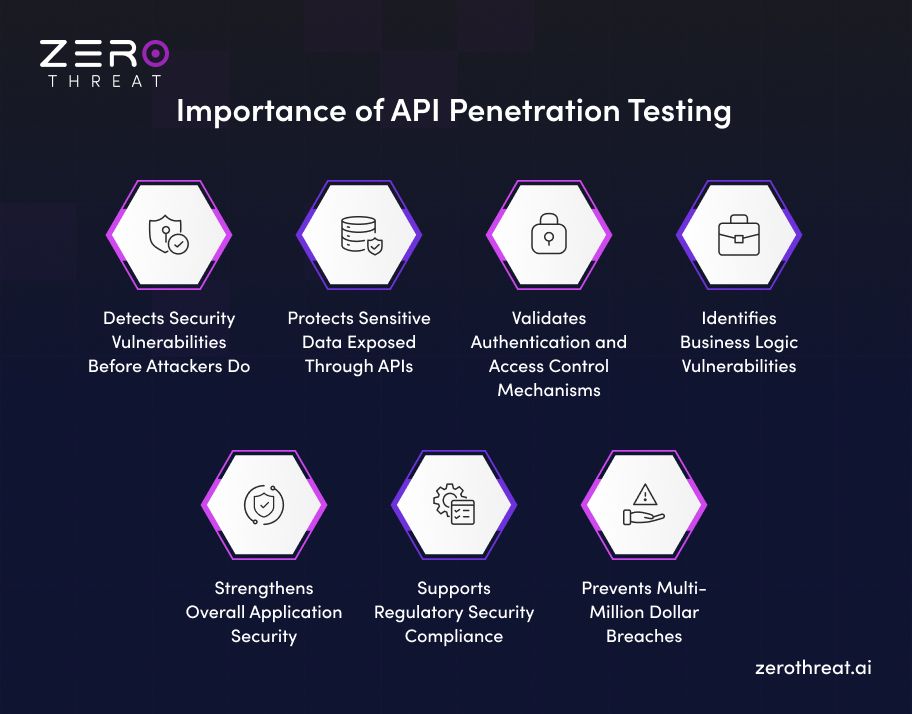
Detects Security Vulnerabilities Before Attackers Do
API penetration testing helps uncover real security weaknesses that automated scans often miss. This includes broken authentication, authorization flaws, and input validation issues. By identifying these vulnerabilities early, security teams can fix them before attackers exploit them to gain access or manipulate data.
Protects Sensitive Data Exposed Through APIs
Many APIs handle sensitive information such as user data, financial records, or internal system details. If security controls are weak, attackers may access or extract this data. Penetration testing verifies that APIs properly protect sensitive information and enforce strong access controls.
Validates Authentication and Access Control Mechanisms
Authentication and authorization are critical for API security. A penetration test checks whether users can bypass login systems, manipulate tokens, or access resources they should not see. This ensures APIs enforce strict access rules and prevent unauthorized actions.
Identifies Business Logic Vulnerabilities
Some of the most dangerous API issues occur in business logic. These flaws allow attackers to abuse legitimate functionality, such as manipulating transactions or bypassing workflows. Penetration testing simulates real attacker behavior to uncover these complex vulnerabilities.
Strengthens Overall Application Security
APIs often act as the gateway to backend systems and databases. If an API is compromised, attackers may gain deeper access into the application environment. Testing APIs regularly helps organizations secure this critical entry point and strengthen overall application security.
Supports Regulatory Security Compliance
Major frameworks like PCI DSS, HIPAA, and SOC 2 recommend regular security testing, including penetration testing. API penetration testing helps organizations demonstrate that their systems are tested for vulnerabilities and aligned with recognized security best practices.
Prevents Multi-Million Dollar Breaches
The average cost of an API-related security breach is now over $4 million. This does not even include the long-term damage to your brand’s trust. Regular penetration testing acts as a preventive defense that saves your company from a financial disaster.
How to Know that API Pentesting is Required?
Don’t know if you need to perform penetration testing? Here are the clear signs that will tell you whether API pentesting is required or not.
Do it if your web application or API is:
- Handling sensitive or regulated data
- Store users' data and have role-based access control
- Integrated with public endpoints or third-party tools
- Undergoing a major infrastructure update
- Supporting other partner applications
Common API Vulnerabilities Pentesting Detects
API penetration testing helps uncover security weaknesses that attackers commonly exploit in modern applications. These vulnerabilities often appear in authentication, authorization, input validation, or business logic. Identifying them early helps organizations prevent data breaches, unauthorized access, and API abuse.
| Vulnerability Type | Description | Potential Impact |
|---|---|---|
| Broken Object Level Authorization (BOLA) | Occurs when an API does not properly validate if a user has permission to access a specific object ID. | Unauthorized access to sensitive data belonging to other users. |
| Broken User Authentication | Weaknesses in login mechanisms, such as poor token management or lack of multi-factor authentication. | Complete account takeover and unauthorized access to administrative functions. |
| Excessive Data Exposure | APIs that return more data than necessary, relying on the client-side to filter out sensitive information. | Exposure of PII, financial details, or internal system configurations to attackers. |
| Mass Assignment | Allowing users to update sensitive object properties (like is_admin) that should be restricted. | Privilege escalation or unauthorized modification of critical account settings. |
| Security Misconfiguration | Improperly configured headers, unpatched systems, or unnecessary open ports and services. | Information leakage or providing an easy entry point for automated exploit kits. |
| Injection Attacks | Failing to sanitize user input, allowing malicious code to be executed via SQL, NoSQL, or OS commands. | Data theft, database corruption, or full remote code execution on the server. |
| Improper Rate Limiting | Absence of restrictions on the frequency or size of requests an API can handle. | Denial of Service (DoS) attacks or automated data scraping and brute-forcing. |
Eliminate vulnerabilities in logic flaws and shadow APIs 10X faster than traditional tools. Pentest My APIs
When to Perform API Penetration Testing for Applications?
API penetration testing is most effective when integrated into your SDLC rather than being treated as a one-time event. Aligning testing with major releases and infrastructure changes ensures your sensitive data stays protected against evolving threats.
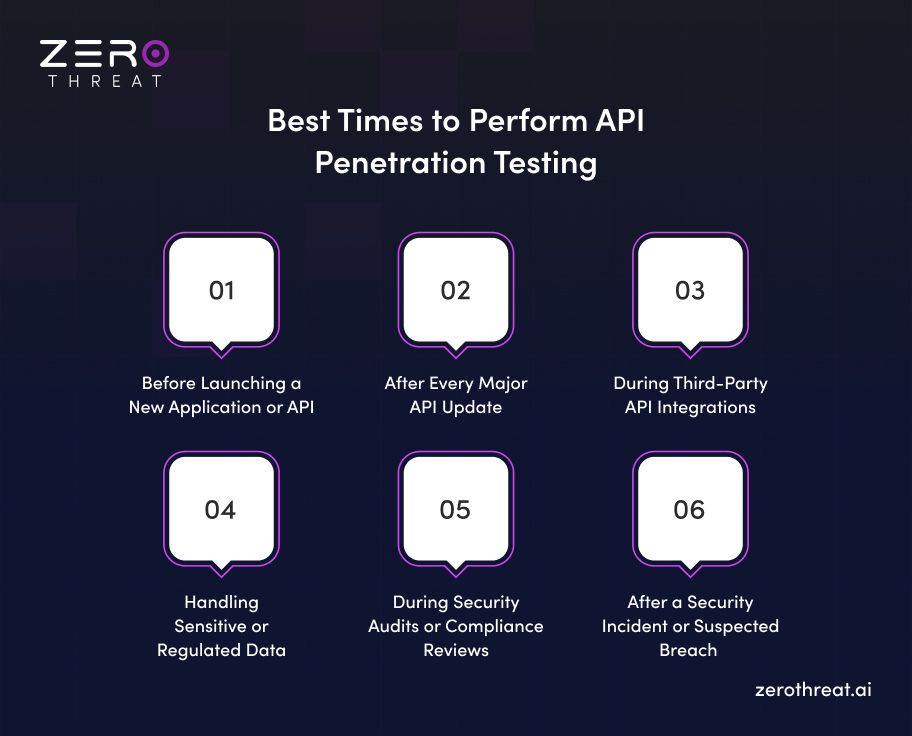
Before Launching a New Application or API
Before an application goes live, its APIs should be tested for security weaknesses. At this stage, penetration testing helps identify issues in authentication, access control, and input validation. Fixing vulnerabilities before launch prevents attackers from discovering them once the API becomes publicly accessible.
After Every Major API Update
New API versions, endpoint changes, or feature updates can introduce security gaps. Even small modifications in request handling or authorization logic may create vulnerabilities. Performing penetration testing after significant updates ensures that new code does not expose the application to security risks.
During Third-Party API Integrations
Many applications integrate with payment gateways, identity providers, analytics tools, or partner services. These integrations expand the attack surface. Testing APIs during integration ensures that authentication tokens, data exchanges, and permissions are handled securely without exposing sensitive information.
Handling Sensitive or Regulated Data
APIs that process financial data, personal information, or internal business records require stronger security validation. Penetration testing ensures that attackers cannot access or manipulate sensitive data through API endpoints, and that strong access controls are properly enforced.
During Security Audits or Compliance Reviews
Organizations often perform penetration testing as part of internal security reviews or compliance assessments. Testing APIs during these audits helps identify vulnerabilities that could impact regulatory requirements and demonstrates that the organization actively validates the security of its applications.
After a Security Incident or Suspected Breach
If an application experiences unusual activity or a suspected security breach, API penetration testing can help investigate potential weaknesses. Testing helps determine whether attackers could exploit API endpoints and allows teams to address vulnerabilities before further damage occurs.
Recommended Frequency to Perform API Penetration Testing
Determining the right frequency for API penetration testing is critical because static security cannot protect dynamic, evolving systems. Your testing schedule should balance risk exposure with operational resources to ensure continuous protection against emerging threats.
- Annual Pentesting: This serves as the minimum baseline for major compliance frameworks. It is best suited for smaller organizations with low risk levels and stable infrastructures.
- Quarterly Pentesting: This is the recommended minimum for high-risk sectors like finance and healthcare. It ensures that production systems handling sensitive data remain validated regularly.
- Event-Driven Pentesting: Schedule these tests after major infrastructure upgrades, new feature rollouts, or breaches. This helps catch vulnerabilities introduced by significant code or environment changes.
- Continuous Pentesting: Integrated directly into CI/CD pipelines, this serves as a security counterpart to agile development. It identifies business logic flaws and exploits early in the lifecycle.
- Monthly Pentesting: Often necessary for high-risk APIs in financial or healthcare contexts. This intensive cadence addresses the most sensitive data environments and rapidly emerging threats.
Best Practices for Implementing API Penetration Testing
Implementing a successful API penetration testing strategy requires moving beyond simple automated scans. By combining specialized tools with expert manual analysis, you can identify hidden logic flaws and ensure your applications remain resilient against evolving real-world threats.
- Maintain a Complete API Inventory: Start by cataloging all public, internal, and partner-facing APIs. You cannot secure what you don’t track, so visibility across all environments is the first step.
- Adopt a Hybrid Testing Model: Combine continuous automated scanning for broad coverage with periodic manual penetration tests for depth. This ensures you catch both common bugs and complex logic flaws.
- Integrate Testing into CI/CD: Embed automated API security testing tools directly into your development pipeline. This "shift-left" approach identifies vulnerabilities early, reducing risk and remediation costs before code reaches production.
- Define Precise Scope and Objectives: Clearly outline which endpoints and credentials will be tested. Proper scoping ensures testers prioritize high-risk paths while keeping sensitive data isolated and secure.
- Focus on Remediation and Verification: Use risk-based reports to fix the most critical flaws first. Always perform retesting after patching to confirm that vulnerabilities are fully resolved and no new issues exist.
- Align with Standard Security Frameworks: Ensure your testing methodology covers the OWASP API Top 10. Aligning with standards like NIST or PCI DSS helps maintain both security and regulatory compliance.
How ZeroThreat Simplifies API Penetration Testing?
ZeroThreat simplifies API penetration testing by replacing complex, manual workflows with intelligent, automated exploit validation. By focusing on proven exploitability rather than just listing potential bugs, it allows security teams to identify and fix critical vulnerabilities like BOLA and broken authentication with high speed and accuracy.
| Feature | How it Supports API Pentesting... |
|---|---|
| Out-of-Band (OOB) Exploit Validation | Automatically confirms if a vulnerability is truly exploitable, eliminating the need for manual verification and reducing false positives to near-zero. |
| Agentic AI Pentesting | Uses intelligent agentic AI to explore complex business logic and multi-step attack paths, finding flaws that traditional scanners consistently miss. |
| Shadow API Discovery | Automatically identifies undocumented or "forgotten" endpoints, ensuring your entire API attack surface is visible and protected. |
| Authenticated Scanning | Seamlessly handles complex login flows and MFA, allowing the tool to test deep within protected application layers without manual intervention. |
| AI-Powered Reporting | Provides clear, actionable evidence and context for every finding, allowing developers to prioritize fixes based on real-world risk rather than a long list of theories. |
| Production-Safe Testing | Conducts deep-dive security assessments on live applications without the risk of causing downtime or data corruption, ensuring continuous safety. |
| Continuous CI/CD Integration | Embeds security testing directly into your CI/CD, catching vulnerabilities as code is written to prevent security debt before production. |
Not sure when to pentest APIs? Our security experts can help. Contact Us
Wrapping Up
Knowing when to perform API penetration testing is just as important as performing the test itself. Regular testing helps organizations identify weaknesses early, validate security controls, and ensure APIs do not become an entry point for data breaches or system abuse.
In most cases, API penetration testing should be performed when:
- Launching a new application or API before it becomes publicly accessible
- Releasing major updates or new API versions that change functionality or access controls
- Integrating third-party services or external APIs that expand the attack surface
- Handling sensitive or regulated data such as financial records or personal information
- Preparing for security audits or compliance assessments
- Investigating unusual activity or potential security incidents
Shifting security left and testing APIs continuously enables organizations to validate their security posture. Using ZeroThreat's AI-driven API pentesting tool, combining exploit validation and agentic AI simplifies this process, making security effortlessly accurate at scale.

Explore ZeroThreat
Automate security testing, save time, and avoid the pitfalls of manual work with ZeroThreat.