 ZeroThreat Wins Bronze Stevie® Award in Tech Startup of the Year Read more

All Blogs
Quick Overview: A clear guide to building and implementing an effective API security checklist. Covers key risks, essential security controls, and practical testing methods to identify vulnerabilities. Also explains how to secure authentication, data, and access while using continuous testing to keep APIs protected against real-world attacks.
Most APIs don’t get hacked because of complex zero-day exploits; they fail due to simple, overlooked security gaps. A missing authorization check or exposed endpoint is often all it takes for attackers to gain access.
This is not a rare case. Reports show that over 99% of organizations have faced API security issues, many tied to broken access control and data exposure. As APIs power modern applications, these risks continue to grow.
That’s where an API security checklist becomes critical. It helps teams systematically identify weaknesses, enforce security controls, and continuously pentest APIs to stay ahead of real-world threats.
Stop guessing your API risk, automate your entire security checklist with ZeroThreat. Start For FREE
ON THIS PAGE
- What is API Security Testing?
- API Security Testing Checklist 2026
- How ZeroThreat Simplifies API Security Testing
- Final Thoughts
What is API Security Testing?
API security testing is the process of identifying vulnerabilities in APIs to ensure they do not expose sensitive data or allow unauthorized access. It focuses on validating authentication, authorization, input handling, and data flow between systems.
Unlike traditional testing, API security testing targets how APIs behave under real attack conditions. It helps detect issues like broken access control, excessive data exposure, and injection risks before attackers can exploit them in production environments.
Key Types of API Security Testing
API security testing includes different approaches that help uncover how attackers exploit weaknesses, especially in business logic. These methods simulate real-world abuse scenarios where APIs are used in unintended ways to bypass controls.
- Functional Security Testing: Ensures API functions behave securely under expected conditions by validating authentication, authorization, and data handling, helping identify logic flaws that may allow unintended actions during normal usage.
- Penetration Testing: Simulates real-world attacks to uncover vulnerabilities like broken access control, injection flaws, or authentication bypass, giving a deeper understanding of how attackers can exploit API weaknesses.
- Fuzz Testing: Sends unexpected or malformed inputs to APIs to identify crashes, errors, or unhandled exceptions, helping detect input validation issues and hidden vulnerabilities that may not appear in standard testing.
- Validation Testing: Focuses on verifying input and output data against expected formats and rules, ensuring APIs do not accept malicious payloads or expose sensitive information due to improper validation controls.
- Business Logic Testing: Examines how APIs handle workflows and processes to detect logic flaws, such as bypassing payment steps or abusing workflows, which attackers often exploit without triggering traditional security defenses.
API Security Testing Checklist 2026
A well-defined API security testing checklist helps identify vulnerabilities before attackers do. It ensures consistent validation of authentication, access control, and data protection across all API endpoints. So, let’s start with the first one.
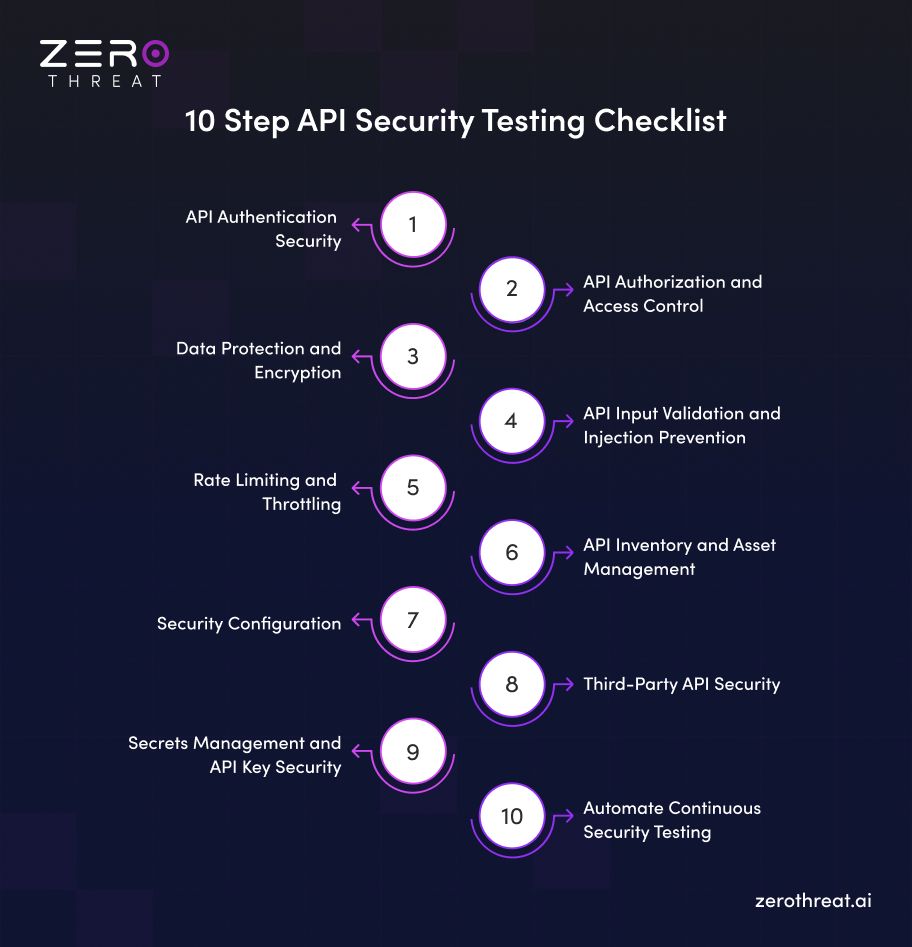
1. API Authentication Security
API authentication security ensures that only verified users, systems, or services can access your APIs. It is the first line of defense and, if weak, can expose the entire application. Strong authentication helps prevent unauthorized access, token abuse, and identity-based attacks that are commonly seen in modern API breaches.
- Use strong authentication mechanisms: Avoid basic authentication methods. Use industry-standard protocols like OAuth 2.0 and securely implement JWT tokens. Ensure tokens are signed, validated, and not easily forgeable.
- Implement secure token handling and expiration: Always set token expiration and avoid long-lived tokens. Use refresh tokens where needed and ensure tokens are revoked immediately after logout or suspicious activity.
- Protect against credential stuffing and brute force attacks: Enable rate limiting on authentication endpoints. Add multi-factor authentication (MFA) where possible to reduce the risk of compromised credentials.
- Validate authentication on every request: Do not assume a session is always valid. Each API request should be properly authenticated to prevent session hijacking or unauthorized reuse of tokens.
2. API Authorization and Access Control
API authorization and access control ensure that authenticated users can only access what they are allowed to. Even with strong authentication, weak authorization can expose sensitive data and functions. This is one of the most common API security gaps, often leading to serious breaches.
- Enforce object-level authorization (prevent BOLA): Every request that accesses an object (user data, order, record) must be validated. Never rely on client-side checks. Always verify ownership or permissions on the server side.
- Apply role-based and least privilege access: Assign roles based on actual needs. Avoid giving broad permissions by default. Each user or service should only access what is necessary for their function.
- Validate authorization on every API endpoint and method: Do not assume access rights remain consistent across endpoints. Each API function (GET, POST, DELETE) should have its own access control checks in place.
- Avoid relying on hidden parameters or IDs for access control: Attackers often manipulate IDs or parameters to access other users’ data. Always enforce strict server-side validation instead of trusting request inputs.
3. Data Protection and Encryption
Data protection and encryption ensure that sensitive information handled by APIs remains secure, both in transit and at rest. APIs often carry user data, tokens, and business-critical information, making them a prime target for interception and leakage if not properly secured.
- Enforce HTTPS and strong TLS configurations: All API communication should happen over HTTPS. Disable outdated protocols and weak ciphers. This prevents attackers from intercepting data through man-in-the-middle attacks.
- Encrypt sensitive data at rest and in transit: Critical data such as passwords, tokens, and personal information should always be encrypted. Use strong encryption standards and avoid storing sensitive data in plain text.
- Limit data exposure in API responses: Only return the data that is necessary. Avoid sending full objects when only a few fields are required. This reduces the risk of accidental data leaks.
- Protect secrets and sensitive fields: Never expose API keys, tokens, or credentials in responses, logs, or client-side code. Mask or remove sensitive fields wherever possible.
4. API Input Validation and Injection Prevention
API input validation and injection prevention focus on ensuring that all incoming data is properly checked before it is processed. APIs accept data from multiple sources, and without strict validation, attackers can inject malicious payloads to manipulate queries, execute commands, or access unauthorized data.
- Validate all inputs at the server side: Never trust client-side validation alone. Check every parameter, header, and request body against expected formats, types, and allowed values before processing.
- Use strict schema validation: Define and enforce request schemas (e.g., JSON schema). This ensures only expected data structures are accepted and reduces the risk of malformed or malicious inputs.
- Sanitize and encode user inputs: Clean inputs before using them in queries or commands. Use parameterized queries and avoid directly injecting user input into the database or system calls.
- Protect against common injection attacks: Specifically test for SQL injection and command injection vulnerabilities. Ensure APIs do not execute unintended operations due to crafted inputs.
5. Rate Limiting and Throttling
Rate limiting and throttling control how often users or systems can interact with your APIs. Without these controls, APIs are vulnerable to abuse, including brute force attacks, denial-of-service attempts, and misuse of business logic through excessive requests.
- Define request limits per user, IP, or API key: Set clear thresholds for how many requests can be made within a specific time window. This helps prevent automated attacks and ensures fair usage across all users.
- Apply dynamic throttling based on behavior: Adjust limits based on user activity. For example, stricter limits for login endpoints or suspicious traffic patterns can help reduce attack impact in real time.
- Protect critical endpoints with stricter controls: Endpoints like authentication, payment, or data retrieval should have tighter limits. These are often targeted by attackers and need stronger protection.
- Return proper error responses and enforce delays: Use standard HTTP responses (like 429 Too Many Requests) and introduce delays or temporary blocks to discourage repeated abuse attempts.
Secure your endpoints with ZeroThreat’s high-signal API penetration testing. Pentest My APIs
6. API Inventory and Asset Management
API inventory and asset management focus on knowing exactly what APIs exist, where they are exposed, and how they are being used. Without clear visibility, organizations often leave behind shadow or outdated APIs that become easy entry points for attackers.
- Maintain a complete and up-to-date API inventory: Track all APIs, including internal, external, and third-party endpoints. Ensure every API is documented with its purpose, owner, and access level to avoid unmanaged exposure.
- Identify and manage shadow and deprecated APIs: Regularly scan for undocumented or forgotten APIs. Remove or secure outdated versions that are no longer in use but still accessible.
- Implement proper API versioning and lifecycle management: Control how APIs evolve over time. Clearly define versioning strategies and ensure older versions are retired securely to reduce attack surface.
- Monitor API usage and exposure continuously: Track which APIs are actively being used and detect unusual access patterns. This helps identify unauthorized or risky endpoints early.
7. Security Configuration
Security configuration focuses on ensuring that APIs and their underlying systems are set up securely from the start. Misconfigurations are one of the most common causes of API breaches, often exposing sensitive data or allowing unintended access without any complex attack.
- Disable unnecessary endpoints and services: Remove or restrict unused API endpoints, debug routes, and default services. Every exposed endpoint increases the attack surface and creates potential entry points for attackers.
- Configure CORS policies correctly: Avoid overly permissive CORS settings like allowing all origins. Define trusted domains carefully to prevent unauthorized cross-origin access to your APIs.
- Secure headers and error responses: Implement proper security headers and avoid exposing detailed error messages. Error responses should not reveal internal system details, stack traces, or sensitive information.
- Avoid default credentials and insecure settings: Change default usernames, passwords, and configurations immediately. Ensure production environments are hardened and not running with development-level settings.
8. Third-Party API Security
Third-party API security focuses on managing the risks introduced when your application depends on external APIs. These integrations extend functionality but also expand your attack surface. If a third-party API is compromised or misused, it can directly impact your system.
- Validate and trust only reliable API providers: Before integrating, assess the provider’s security practices, reputation, and compliance standards. Avoid using APIs that lack proper documentation or security controls.
- Limit access and permissions for external APIs: Grant only the minimum required access. Avoid sharing full data sets or unrestricted permissions with third-party services to reduce potential impact.
- Monitor third-party API usage and behavior: Continuously track how external APIs interact with your system. Look for unusual patterns, excessive requests, or unexpected data flows.
- Handle failures and responses securely: Do not blindly trust third-party responses. Validate incoming data and ensure your system can handle failures without exposing sensitive information or breaking workflows.
9. Secrets Management and API Key Security
Secrets management and API key security focus on protecting sensitive credentials such as API keys, tokens, and private keys. If exposed, these secrets can give attackers direct access to your APIs, often without needing to bypass other security controls.
- Store secrets securely, never in code: Avoid hardcoding API keys or credentials in source code or configuration files. Use secure vaults or secret management tools to store and access them safely.
- Rotate and expire API keys regularly: Do not rely on long-lived keys. Implement key rotation policies and ensure old or unused keys are revoked to reduce the risk of misuse.
- Limit access and scope of API keys: Assign minimal permissions to each key. Use scoped access so that even if a key is compromised, its impact remains limited.
- Monitor and audit key usage continuously: Track how and where API keys are used. Detect unusual activity such as unexpected locations or spikes in usage, which may indicate a compromise.
10. Automate Continuous Security Testing
Continuous and automated API security testing ensures that vulnerabilities are identified early and consistently across the development lifecycle. APIs change frequently, and one-time testing is not enough. Ongoing testing helps catch new risks before they reach production.
- Integrate security testing into CI/CD pipelines: Automate API security tests during build and deployment stages. This helps detect issues early and prevents vulnerable code from being released.
- Use automated tools for vulnerability detection: Leverage DAST, API scanners, and fuzzing tools to continuously test for common vulnerabilities like injection flaws, broken authentication, and misconfigurations.
- Continuously validate authentication and access controls: Run automated tests to ensure authentication and authorization mechanisms remain secure as APIs evolve and new endpoints are added.
- Monitor APIs in production for real-time threats: Combine testing with runtime monitoring to detect suspicious behavior, unusual traffic patterns, or newly emerging attack vectors.
How ZeroThreat Simplifies API Security Testing
ZeroThreat is an AI-driven pentesting platform designed to help teams identify API vulnerabilities early. It continuously scans applications to detect real-world risks and security gaps before attackers can exploit them.
Built for modern applications, ZeroThreat enables safe, production-ready security testing without disrupting live environments. It helps teams strengthen API security while maintaining speed, reliability, and development efficiency.
- Automated AI-driven vulnerability detection: ZeroThreat uses agentic AI to simulate real attack patterns and automatically uncover vulnerabilities in APIs, reducing manual effort and improving the accuracy of security testing.
- Production-safe security testing: It allows testing directly on live applications without causing downtime or disruption, ensuring continuous security validation in real-world environments.
- Comprehensive API coverage: The platform scans all API endpoints, including hidden and undocumented ones, helping teams identify shadow APIs and reduce unknown attack surfaces.
- Continuous security testing integration: ZeroThreat integrates into CI/CD pipelines, enabling ongoing API security testing as part of the development lifecycle, ensuring vulnerabilities are caught early.
- Actionable insights and reporting: It provides clear, developer-friendly reports with prioritized vulnerabilities, making it easier for teams to understand risks and fix issues quickly.
Struggling to secure a complex API architecture? Let our experts help you out. Contact Us
Final Thoughts
API security is no longer optional. As APIs continue to handle critical data and business logic, even small gaps can lead to serious risks. A structured API security checklist helps you stay consistent, reduce blind spots, and build a stronger security foundation over time.
- Focus on strong authentication and strict access control to prevent unauthorized access
- Validate all inputs and protect against injection attacks
- Limit data exposure and enforce encryption across all API communications
- Apply rate limiting to prevent abuse and ensure availability
- Maintain clear API inventory to avoid shadow or unmanaged endpoints
- Continuously test APIs to detect and fix vulnerabilities early
Managing all of this manually can be challenging, especially as APIs grow. This is where ZeroThreat’s automated API pentesting tool makes a real difference. It helps teams continuously test APIs, detect vulnerabilities in real time, and simplify security without slowing down development.
Frequently Asked Questions
How can organizations implement an API security testing checklist effectively?
Start by mapping every API in your environment; you cannot test what you haven't documented. From there, assign checklist ownership to specific teams, integrate security tests directly into your CI/CD pipeline, and run both automated scans and manual reviews on a defined schedule.
What are the most critical security checks every API security checklist should cover?
How does an API penetration testing checklist help identify hidden vulnerabilities?
How often should organizations run an API security testing checklist across their APIs?
How can security teams validate that their APIs meet enterprise security checklist standards?


Explore ZeroThreat
Automate security testing, save time, and avoid the pitfalls of manual work with ZeroThreat.