 ZeroThreat Wins Bronze Stevie® Award in Tech Startup of the Year Read more

All Blogs
Why Automated API Testing Tools Are Better Than Manual Testing

Quick Overview: This guide compares automated API testing and manual testing with clear, practical insights. It explains the limitations of manual testing, the advantages of API testing automation, and when each approach fits best. It also talks about how ZeroThreat’s security solution supports scalable, continuous, automated API security testing.
As applications grow more complex, traditional manual API testing struggles to keep up. In fact, nearly 46% of teams have replaced half or more of their manual testing with automation, highlighting a clear industry shift toward automated processes.
Automated API testing delivers faster validation cycles and broader coverage than manual methods. Research shows that automation reduces testing cycles by up to 60% and increases coverage by over 50%. That means teams can shift-left security without the effort it takes when tested with manual methods.
Another key benefit of security testing automation is improved defect identification. Automated security testing can boost defect detection rates by up to 90% compared to manual approaches because of consistent execution and repeated validation. Plus, automation supports continuous integration and continuous delivery (CI/CD), reducing human error, and scales testing in ways manual efforts cannot.
In this blog, we’ll dive into more detail about why exactly automation is needed to keep up with modern release frequency. We’ll also cover when using an automated API pentesting tool is better than manual testing. With that said, let’s start with getting an overview of automated and manual API testing.
Test your APIs within minutes with 99.9% accuracy using ZeroThreat. Start Free Trial
On This Page
- TL;DR: Why Choose Automated API Testing Over Manual Testing
- What is Automated API Testing?
- What is Manual API Testing?
- Limitations of the Manual API Testing Approach
- Benefits of Using Automated API Testing Tools
- Why Automated API Testing is Better than Manual Testing
- Choosing the Right Testing Approach: Automated Vs Manual
- Combining Automated and Manual Testing for Complete Coverage (Hybrid Testing)
- How ZeroThreat Simplifies API Testing Automation at Scale
- Final Thoughts
TL;DR: Why Choose Automated API Testing Over Manual Testing
Choosing automated API testing is a need rather than an option. According to Gartner, API-related breaches will account for over 50% of all web application attacks in 2026, largely due to the inability of manual testing to keep pace with modern release cycles.
The reason to go with automation over manual is quite simple. Automation enables fast execution, scales, is efficient, and offers accurate outcomes.
- 10x Faster Execution: Automation reduces testing cycles from weeks to minutes, enabling secure, daily deployments within CI/CD pipelines.
- Scalability & Coverage: While manual testers can only cover limited endpoints, automated tools provide 100% visibility, discovering hidden "shadow APIs" across thousands of endpoints.
- Cost Efficiency: Organizations report a significant reduction in long-term costs by replacing expensive, repetitive manual testing with automation.
- Precision Security: Automation is a credible way to detect complex BOLA vulnerabilities, simulating "attacker-like" unauthorized access attempts with 99% accuracy.
What is Automated API Testing?
Automated API testing is the process of using tools and scripts to automatically test APIs for security vulnerabilities and business logic flaws. It helps detect issues like broken authentication, injection flaws, and security misconfigurations early in the SDLC.
In simple terms, API testing automation checks whether an API behaves exactly the way it is supposed to, without human intervention. Instead of manually sending requests and validating responses, automated API testing tools handle the entire process in seconds.
Here’s what it typically covers:
- Functional validation of endpoints
- Request and response verification
- Authentication and authorization checks
- Data validation and schema testing
- Automated API security testing for vulnerabilities
- Regression testing during updates
- Performance and load validation
One of the biggest advantages of API testing automation is repeatability. Tests can run every time code changes, making it ideal for CI/CD pipelines and DevSecOps environments.
What is Manual API Testing?
Manual API testing is the process of testing APIs by sending requests and verifying responses without using automation scripts. A tester interacts with the API using tools like Postman or curl and validates the output step by step. There is no automation framework running in the background.
Manual API testing usually involves:
- Sending HTTP requests (GET, POST, PUT, DELETE)
- Checking status codes and response times
- Validating response data and JSON structure
- Testing authentication and authorization
- Verifying error messages and edge cases
This approach works well in early development stages. When an API is new or still changing, manual testing helps understand how it behaves. It is also useful for exploratory testing, where testers intentionally try unexpected inputs.
However, manual API testing has limits:
- It takes time.
- It depends heavily on human attention.
- It is hard to repeat the same tests consistently across every build.
Manual API testing is valuable, especially for discovery and validation. But when APIs become complex and release cycles become faster, complete reliance only on manual testing is like trying to win a Formula 1 race on a bicycle because you’re afraid to trust the engine.
Limitations of the Manual API Testing Approach
The manual API testing approach is great for exploring new features, but it creates a massive gap in speed and accuracy as your web application scales.
Here are the primary limitations of the manual API testing approach.
1. Time-Consuming and Resource-Intensive
Manual API testing takes time because every request must be sent and verified by a person. Each endpoint, parameter, and edge case needs attention. As APIs grow, the effort increases quickly and demands more testers.
2. Inconsistency and Lack of Repeatability
Manual testing depends on human execution. Different testers may validate responses differently. Even the same tester may miss steps over time. This lack of repeatability creates gaps in API testing and affects reliability.
3. Limited Scalability and Coverage
Modern applications can have hundreds of API endpoints. Testing all of them manually is difficult. It becomes almost impossible to maintain full coverage, especially when APIs are updated frequently. This limits visibility into hidden bugs and security risks.
4. Regression Testing Burden
Every new release requires retesting existing endpoints. Manually repeating the same API tests again and again is exhausting. Over time, regression testing becomes a bottleneck and slows down release cycles.
5. Cost at Scale
Manual API testing may seem affordable at first. But as the product scales, costs rise. More testers are needed. More time is spent. At scale, the operational cost becomes significantly higher compared to automated API testing tools.
See how ZeroThreat’s automated API security testing works in real environments.Explore API Security Testing
Benefits of Using Automated API Testing Tools
Moving from a manual process to using automated tools is the single most effective way to secure your application at scale. It transforms testing from a one-time project at the end of development to a continuous security practice.
Here is why API security testing automation is essential for modern software delivery.
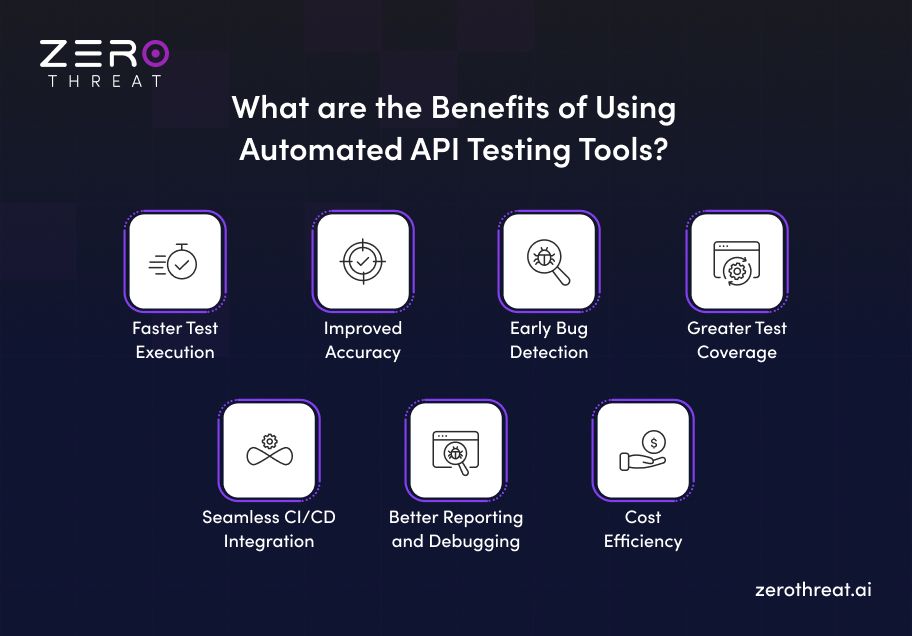
1. Faster Test Execution
Automated API testing tools execute large test suites within minutes. Entire endpoint collections can be validated in one run. This matters when releases happen weekly or even daily. Fast feedback allows developers to fix issues immediately instead of discovering them days later.
2. Improved Accuracy
Automation follows defined assertions and validation rules without deviation. Status codes, headers, payload schemas, and data integrity checks are verified precisely as configured. There is no chance of inconsistent outcomes. Over time, this level of accuracy allows you to be sure about API security.
3. Early Bug Detection (Shift Left)
When API testing automation is integrated during development, defects surface before deployment. Business logic flaws, authentication flaws, and validation gaps are caught during build cycles. Fixing issues early reduces security exposure and avoids expensive post-release patches.
4. Greater Test Coverage
Automation makes it practical to test edge cases, negative scenarios, and complex workflows that manual testing often skips. Large API ecosystems with thousands of endpoints can be validated regularly. Broader coverage reduces blind spots and strengthens overall API security posture.
5. Seamless CI/CD Integration
Automated security testing tools integrate directly into CI/CD pipelines Tests run automatically on every commit, pull request, or deployment trigger. APIs are validated continuously without slowing development. This aligns testing with modern continuous delivery models.
6. Better Reporting and Debugging
Structured logs, response traces, and failure reports provide clear visibility into what failed and why. Instead of re-running tests manually, teams can pinpoint broken endpoints quickly. Plus, some tools offer remediation guidance, shortening the time to fix security issues.
7. Cost Efficiency
Manual testing effort increases linearly as APIs expand. Automation does not. Once test suites are built, they can run repeatedly without additional human involvement. That means with scale, the operational cost decreases and removes dependency on scaling QA teams.
Why Automated API Testing is Better than Manual Testing
Automated API testing delivers several measurable benefits over manual testing. Teams that adopt test automation often cut testing effort by 90% while improving quality and speed.
Automated tests run hundreds of checks in parallel and around the clock. A Capgemini report found automation can reduce testing time by up to 60%–75% compared to manual approaches. That means faster execution, shorter release cycles, and more frequent validation. Automated suites also improve reliability for known vulnerabilities, eliminating the chance of human error.
Research shows automation increases test coverage by up to 80% and improves accuracy by up to 90% compared to manual testing. These gains save time and uncover defects that might otherwise slip through. And while the initial adoption of tools might seem unconventional, the long-term cost savings are significant as labor costs and efforts drop.
Verdict: Automated API testing enhances speed, accuracy, coverage, and cost efficiency, offering a clear green signal as to why it is a better option.
Find the right plan for automated API security testing.Check Plans
Choosing the Right Testing Approach: Automated Vs Manual
Choosing the right strategy is about understanding where each adds the most value. While automated API testing is a need for frequent deployments, manual testing remains the "human compass" for complex, creative problem-solving.
Below is a clear breakdown to help you decide.
When to Use Automated Testing
Automated API testing is the go-to choice for repetitive, high-volume tasks that require absolute precision and speed.
- Regression Testing & CI/CD Pipelines: Every time code changes, automated suites ensure that existing features haven't broken. Integrating these into your pipeline allows for shift-left security, catching bugs before they ever reach production.
- High-Scale Endpoint Validation: If you have 50+ endpoints, manual checking is impossible. Automated tools can scan 10,000+ permutations of inputs and user roles in minutes.
- BOLA and Logic Flaws at Scale: To effectively test for broken object level authorization in APIs, you must cycle through thousands of resource IDs across different privilege levels. Automated API pentesting for BOLA handles this depth perfectly.
- Compliance & Certification: Certain high-stakes industries (like Finance or Healthcare) often require a certified penetration test report to meet specific security compliance or "Point-in-Time" audit requirements.
- Performance and Load Testing: Simulating thousands of concurrent users to find breaking points is a task only a machine can perform accurately.
When to Use Manual Testing
Manual testing is best reserved for scenarios where human intuition and creative edge-case detection are required. It is an investment for thorough testing rather than covering a broader range of vulnerabilities
- Exploratory & Ad-Hoc Testing: When you need to test a new feature to see how it behaves under weird, unscripted conditions, a human tester’s curiosity is irreplaceable.
- Complex Business Logic Chains: While tools are getting better at logic, humans are still superior at chaining multiple unrelated vulnerabilities together to see if they create a larger exploit path.
- Initial Feature Validation: For brand-new code that is changing by the hour, writing automation scripts can be a waste of resources. Manual testing is often faster until the feature stabilizes.
Combining Automated and Manual Testing for Complete Coverage (Hybrid Testing)
Using a hybrid approach for API testing ensures scale, repeatability, and human insight where scripts fall short. A balanced approach improves coverage, reduces blind spots, and strengthens API security.
Some of the key strategies for combining both testing approaches are:
1. Automate What Is Repetitive and Critical
Automate regression tests, authentication checks, schema validation, and high-risk endpoints. These tests must run on every build. API testing automation ensures consistent validation across environments.
2. Use Manual Testing for Exploration and Edge Cases
Manual API testing is ideal for testing new features, unusual workflows, and unexpected user behavior. It helps identify logic gaps before converting scenarios into automated scripts.
3. Integrate Automation into CI/CD Pipelines
Automated API testing tools should run within CI/CD. Every code change should trigger validation. This reduces production risks and supports continuous delivery.
4. Convert Manual Discoveries into Automated Tests
If a bug is found manually, convert it into an automated test case. This prevents the manual effort of finding that vulnerability again and strengthens long-term test coverage.
5. Align Testing With Risk Levels
High-risk APIs, such as payment or authentication endpoints, require both automated API security testing and targeted manual review. Low-risk endpoints may rely mostly on automation.
How ZeroThreat Simplifies API Testing Automation at Scale
ZeroThreat makes automated API testing easier and more effective for teams of any size. Its platform discovers, tests, and secures APIs without complex setup or deep security expertise. Whether you work with REST, SOAP, GraphQL, or gRPC APIs, ZeroThreat runs automated API security tests continuously.
ZeroThreat also integrates with CI/CD pipelines, enabling security checks at every stage of development and deployment. It gives teams continuous visibility into risk and AI-powered actionable remediation guidance to fix vulnerabilities faster.
Here’s how ZeroThreat supports automated API testing:
- Automated API discovery maps all endpoints, including shadow APIs and undocumented APIs.
- Detects OWASP Top 10 and CWE Top 25 vulnerabilities automatically.
- Simulates real-world attack paths to uncover business logic flaws.
- Integrates seamlessly with CI/CD for continuous API validation.
- Generates context-rich, actionable remediation reports.
- Reduces manual effort by up to 90% with automated workflows.
- Provides near-zero false positives for focused security work.
Need help securing complex APIs? Let’s discuss your setup. Contact Us
Final Thoughts
Manual API testing still has its place. It helps during early development and exploratory validation. But as APIs grow and release cycles become faster, manual testing alone cannot keep up. Automated API testing tool provides the speed, coverage, and consistency required in modern CI/CD and DevSecOps environments.
Here’s what automation brings to the table:
- Faster execution across large API ecosystems
- Reliable regression testing without human dependency
- Broader functional and security coverage
- Continuous validation integrated into CI/CD pipelines
- Lower long-term operational cost
The purpose of API security automation is to remove repetitive effort and improve reliability. This is where ZeroThreat turns out to be a go-to tool. By combining automated API testing with continuous security validation, it helps teams detect vulnerabilities early and ensures better visibility of the security posture.
If you are someone finding it difficult to detect and manage security vulnerabilities in your web app or APIs, try using ZeroThreat for free. It will support testing by reducing 90% of manual effort so that you can keep focusing on developing more.
Frequently Asked Questions
What makes automated API testing more effective than manual testing?
Automated API testing runs faster, executes consistently, and scales across hundreds of endpoints without extra effort. It reduces human error, supports CI/CD integration, and improves regression coverage. Unlike manual testing, it delivers repeatable validation with measurable speed and accuracy.
Who benefits most from using ZeroThreat for automated API testing?
Can automated API testing tools completely replace manual testing?
Why is manual API testing difficult to scale in enterprise environments?
When should organizations transition from manual to automated API testing?
Can ZeroThreat replace repetitive manual API testing tasks?


Explore ZeroThreat
Automate security testing, save time, and avoid the pitfalls of manual work with ZeroThreat.