 ZeroThreat Wins Bronze Stevie® Award in Tech Startup of the Year Read more

All Blogs
Cloud Security Statistics 2026: Breaches, Challenges and Vulnerabilities
Blog Overview: Cloud environments are increasingly targeted by cyber threats, from misconfigurations and exposed secrets to identity mismanagement and unpatched vulnerabilities. This blog explores the latest 2026 statistics on cloud security breaches, highlights common vulnerabilities, and provides insights into strategies organizations can adopt to strengthen defenses, minimize risks, and ensure data protection.
Cloud security has become a top priority for organizations as businesses increasingly rely on cloud infrastructure to run applications, store sensitive data, and support AI-driven workloads. While cloud adoption continues to accelerate, cybercriminals are exploiting cloud environments through compromised identities, software vulnerabilities, misconfigurations, exposed APIs, and increasingly sophisticated attack techniques.
So, how secure is the cloud in 2026?
According to Gartner, global end-user spending on public cloud services is projected to reach $723.4 billion in 2025, up from $595.7 billion in 2024, a staggering 14.8% year-over-year growth.
The above statistics reveal a concerning reality: cloud breaches remain common, identity-based attacks are rising, software vulnerabilities have become a leading cloud attack vector, and misconfigurations continue to expose critical business assets. At the same time, organizations face growing challenges securing multi-cloud environments, cloud-native applications, containers, and AI services.
Understanding these trends is essential for security leaders, cloud architects, DevSecOps teams, and business decision-makers. Data-driven insights help organizations prioritize security investments, reduce risk, and strengthen their cloud security posture.
In this report, we analyze the latest cloud security statistics and research findings, covering cloud adoption trends, breach rates, vulnerability data, identity security risks, cloud attack patterns, AI-related threats, and the most significant challenges affecting cloud security today. Whether you're evaluating cloud security risks or building a cloud security strategy, these statistics provide a clear view of the current threat landscape and what organizations should prepare for next.
The cost of finding vulnerabilities today is lower than a breach tomorrow. Create Free Account
On This Page
- Cloud Security Statistics 2026: Overview
- Top Cloud Security Breaches Statistics
- Cloud Security Challenges Statistics
- Cloud Security Vulnerabilities
- Zero Trust Approach in Cloud Security
- What These Cloud Security Statistics Mean for Organizations?
Cloud Security Statistics 2026: Overview
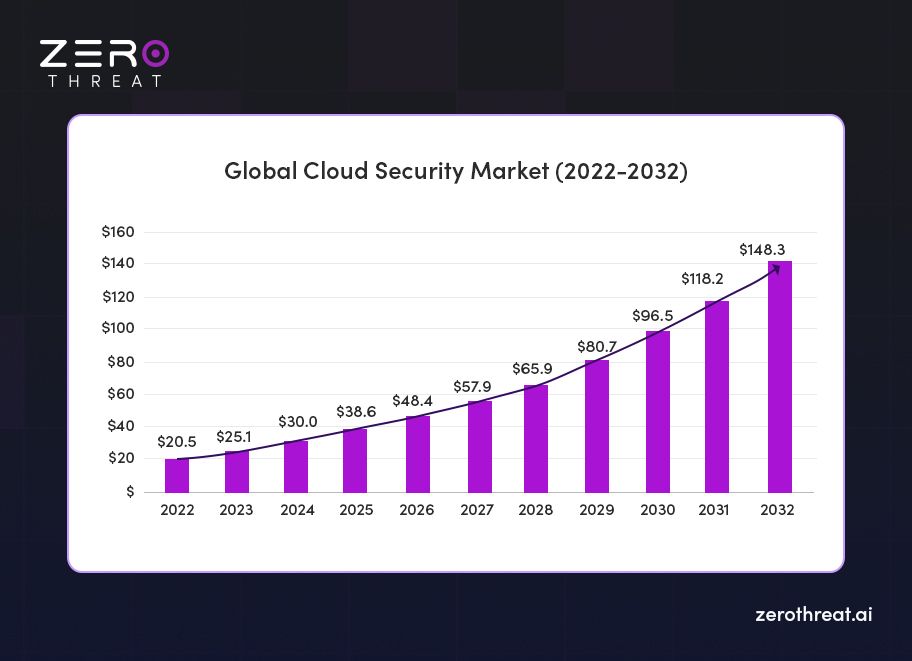
A recent report shows that the global cloud security market was valued at $20.54 billion in 2022. It is projected to increase by $148.3 billion by 2032, with a CAGR of 22.5%.
- As per the report, the global Cloud Security Market was valued at USD 45.9 billion in 2024 and is projected to reach USD 270.5 billion by 2035, expanding at a CAGR of nearly 17.5% from 2026 to 2035.
- Gartner projects that global spending on public cloud services will rise by 20.7% in 2024, reaching USD 591.8 billion. This surge is fueled by inflationary pressures and broader macroeconomic conditions. All cloud segments are expected to expand, with Infrastructure-as-a-Service (IaaS) forecasted to lead growth.
- According to IBM’s cloud security research, the average cost of a data breach now stands at USD 4.35 million. In response, over 51% of organizations worldwide plan to increase their investments in cloud security, covering areas such as incident planning, threat detection, and response.
- Despite this momentum, the greatest challenge remains the skills gap. Many enterprises lack sufficient training and cybersecurity expertise to effectively manage deployments across complex, multi-cloud environments, making human factors a critical vulnerability in cloud security posture management.
- 70%+ of companies have moved at least part of their workloads to public cloud environments.
- 78% use two or more cloud providers, and 54% are leveraging hybrid-cloud setups.
- 69% depend on three or more separate security tools to manage cloud security.
- 81% have fully or partially implemented a Zero Trust model.
- Over 64% have adopted Zero Trust architectures to counter insider threats and data exfiltration risks.
- 67% utilize Cloud Security Posture Management (CSPM) tools; 62% adopt CNAPP platforms.
- More than 82% of organizations have shifted over half of their workloads to cloud environments.
- 74% prioritize cloud-native security platforms in their IT budgets.
- Gartner predicts, 99% of cloud security failures will be due to customer misconfiguration.
- 68% of security breaches involve misconfigured cloud storage, highlighting this as a recurring cloud risk.
- 88% of cloud data breaches are attributed to human error.
- 59% of attacks involving encrypted data occurred in the public cloud.
- On average, 47% of data stored in the cloud is classified as sensitive.
- Yet under 10% of enterprises encrypt at least 80% of their sensitive data.
- 53% of organizations use five or more different encryption key management systems.
- Cloud security incidents impacted nearly 80% of businesses within the past year, underscoring the scale of ongoing vulnerabilities.
- Over 60% of enterprises reported security incidents tied to public cloud usage, highlighting persistent risks in cloud adoption.
- Human error continues to dominate the threat landscape, contributing to 88% of all reported data breaches.
- Phishing emerged as the leading cloud security threat, with 73% of organizations falling victim to such attacks.
- For more than half of companies, preventing cloud misconfigurations ranked as the top security priority.
- 72% of security professionals identified infrastructure compromise as one of their most pressing cloud security concerns.
- Nearly 70% of enterprises report concerns about keeping pace with evolving compliance requirements in cloud environments, reflecting the growing complexity of global data protection regulations.
- Even as 95% of organizations expand cloud adoption, around 60% admit to significant security gaps in their infrastructures, underscoring the urgent need for stronger cloud security protocols and governance.
- 69% of organizations are investing in AI and machine learning-based cloud threat detection tools.
- AI-driven threat response platforms have improved detection speed by over 59% while reducing false alarms by 62%.
- Additionally, 71% deploy AI-based behavioral analytics to detect anomalous access patterns and insider threats.
Get enterprise-grade security testing without enterprise complexity. View Plans
Top Cloud Security Breaches Statistics
- Loud breaches remain widespread: In the past year, 80% of companies reported experiencing at least one cloud security breach.
- Public cloud risks on the rise: 27% of organizations faced a public cloud security incident last year, marking a 10% increase from the previous year.
- Massive data exposure continues: In just the fourth quarter of 2023, more than 8 million records were exposed globally due to cloud-related security issues.
- Cloud strategies still struggling: An overwhelming 96% of organizations admitted to encountering challenges with their cloud security strategies.
- Multiple incidents are the norm: Nearly 45% of companies dealt with four or more cloud security incidents over the last year alone.
- 79% of companies experienced at least one cloud breach in the past 18 months.
- 43% reported facing more than 10 breaches during the same period.
- The average cost of a breach in a hybrid cloud environment reached $3.61 million.
- Breaches in public cloud setups proved 28.3% costlier compared to hybrid environments.
- Nearly half of all data breaches, about 45; now occur in cloud environments.
- 83% of organizations have suffered at least one cloud security breach within the past 18 months.
- 80% of companies reported a cloud breach in just the last year alone.
- Lack of visibility in hybrid setups is a major challenge, contributing to 82% of reported breaches.
- One in four organizations suspect they may have already been breached without realizing it.
- 58% of developers anticipated higher risks of cloud breaches in 2024.
- 31% of enterprises are spending more than $50 million each year to secure their cloud infrastructure.
- One in four organizations (25%) worry they may have already suffered a cloud data breach without knowing it.
- Public sector entities and startups were among the hardest hit by cloud security breaches in the past year.
- 58% of developers believe that the risk of cloud security breaches will continue to rise in the coming year.
- 34% of all identity-related breaches in the last two years were linked to compromised privileged accounts.
- A staggering 90% of cloud identities utilize less than 5% of the permissions they are granted, leaving massive security gaps.
- Only 38% of organizations secure privileged accounts with multi-factor authentication (MFA).
- 32% of companies reported incidents where the wrong users were granted privileged access.
- 25% of organizations experienced cases of unauthorized users gaining access.
- Nearly a third of companies (31%) report spending over $50 million annually on securing their cloud infrastructure and preventing data breaches.
Based on industry surveys and reports, here’s a snapshot of current trends:
- Widespread Breach Exposure
- 80% of companies experienced at least one cloud security breach in the past year.
- 27% reported a public cloud incident, a troubling 10% rise from the previous year.
- 4Q 2023 alone saw over 8 million records exposed worldwide.
- Breakdown of Incident Type
Most common cloud incidents included runtime issues (34%), unauthorized access (33%), misconfigurations (32%), unpatched vulnerabilities (24%), and failed audits (19%). - Who’s Most Targeted?
The public sector (88%) and startups (89%) were the primary victims of cloud security breaches in 2023. - Rising Cloud Breach Risk
Cloud breaches rose by 75% in the past year.
A separate study by StrongDM shows that 98% of companies experienced at least one cloud data breach over a two-year period; 43% reported 10 or more breaches. - Phishing & Identity Failures
In 2024, 73% of organizations were impacted by phishing-related cloud breaches. - Multi-Cloud Management Struggles
56% of organizations find it tough to secure data across multiple cloud platforms.
45% lack skilled professionals to manage multi-cloud security effectively.
Broader Industry Patterns
| Metric | Statistic |
|---|---|
| Breached orgs (past year) | 80% |
| Public cloud incidents | 27% (+10% YoY) |
| Runtime issues | 34% |
| Unauthorized access | 33% |
| Misconfigurations | 32% |
| Startups hit | 89% |
| Public sector hit | 88% |
| Human error contribution | 88% |
| Phishing cloud attacks | 73% |
| Multi-cloud security struggle | 56% |
| Skilled staff shortage | 45% |
Cloud Security Challenges Statistics
Shifting to the cloud brings a constantly evolving set of challenges for organizations. At the forefront is security, as businesses accustomed to on-premises environments must adapt to entirely new security and compliance demands during cloud migration.
- 55% of organizations report that cloud environments are harder to secure than traditional on-premises infrastructure.
- Security teams now use an average of 85 SaaS applications, contributing to tool sprawl and inconsistent controls.
- 61% of organizations rely on five or more tools for data discovery, monitoring, or classification; 57% use five or more encryption key management systems, further fragmenting visibility.
- 68% of organizations report access-based attacks, reflecting vulnerabilities in credential and access control governance.
- Human error, ranging from misconfigurations to poor credential handling, continues to drive significant security failures.
- Compounding this, 58% of developers expect increased breach risks.
- The lack of qualified personnel is a top obstacle, 45% of organizations cite insufficient skilled staff as a major challenge; 69% struggle to secure data in multi-cloud environment.
- 71% of organizations report a shortage of skilled cloud security professionals.
- A further 35% say their security teams lack visibility and control within the development process.
- 91% of IT and security leaders admit they are forced to make compromises, sacrificing visibility, data quality, and tool integration, in their security strategies.
- Nearly half report insufficient visibility across hybrid environments and poor data quality to support AI-secured workloads.
- The average organization now manages 15 security tools across hybrid environments, yet 55% find them ineffective.
- 75% of surveyed businesses identify cloud security as their top concern.
- 33% are extremely concerned, 42% very concerned, and 25% moderately concerned about cloud security risks.
- 68% of cybersecurity experts view misconfigured cloud infrastructure as a critical issue.
- 58% cite unauthorized access as a major challenge in securing cloud environments.
- 52% highlight insecure APIs as a pressing vulnerability.
- 50% point to account, service, and traffic hijacking as a key risk.
- 43% see external data sharing as a serious concern.
- 42% of enterprises struggle most with data privacy and protection.
- 39% of large enterprises report compliance and governance difficulties.
- 37% of large enterprises face challenges in controlling cloud costs.
- 31% identify securing cloud assets and resources as a significant hurdle.
- 30% of enterprises cite lack of cloud security expertise as a major challenge.
- 43% of SMBs rank cost control as their biggest cloud issue.
- 36% of SMBs list data security and privacy as their top concern.
- 28% of SMBs struggle most with secure migration of assets and workloads.
- 69% of companies rank data loss and leakage as a top concern.
- 66% express significant worries around data privacy and confidentiality.
- 44% view accidental exposure of sensitive information as a critical risk.
- 26% identify data breaches as their primary security concern.
- 93% of organizations fear human error leading to accidental data exposure.
- A study by Google Cloud reveals:
- 61% of security staff are overwhelmed by alert volume.
- 60% cite inadequate staffing levels.
- 53% of alerts are false positives, causing sluggish responses and confusion.
- As a result, 92% find securing cloud environments difficult.
- 47% of organizations consider advances in AI-generated attacks (like phishing) a primary concern; 42% report a sharp increase in social engineering the last year.
- Generative AI enables highly targeted, scalable phishing campaigns, outpacing traditional defenses
Not sure where to start? Talk to our security experts and get answers tailored to your environment. Contact Us
Cloud Security Vulnerabilities
Where do most cloud security threats originate? While cyberattacks and advanced technologies are becoming more sophisticated, human error remains the leading cause of data breaches, both in general and within cloud environments.
Misconfigurations Remain the Most Prevalent Vulnerability
- Nearly 23% of cloud security incidents result directly from misconfigured settings.
- A significant 82% of these misconfigurations stem from human error, not software flaws.
- Startups are particularly affected, 89% of organizations impacted by misconfigurations are startups.
- Human error drives 88% of all data breaches.
- In cloud security breaches, the leading causes include:
- Misconfigurations or human error (31%)
- Exploitation of known vulnerabilities (28%)
- Exploitation of zero-day vulnerabilities (24%)
- Lack of Multi-Factor Authentication (MFA) for privileged accounts (17%)
- 35% of security professionals point to limited visibility and control during development as a major risk factor in cloud environments.
- 31% highlight persistent misconfigurations and vulnerabilities in production builds as a critical concern.
- Phishing accounts for 25% of all data breaches.
The global cost of cloud misconfigurations is estimated at $10.3 billion, with key contributors including:
- $4.7B from S3 storage misconfigurations
- $2.8B from IAM failures
- $1.9B due to network security misconfigurations
- $0.9B stemming from container and Kubernetes issue
- 9% of public cloud storage holds sensitive data, and 97% of that is flagged as restricted or confidential.
- A striking 54% of organizations are storing secrets (like passwords or API keys) directly within cloud workloads:
- 54% in AWS ECS task definitions
- 52% in GCP Cloud Run
- 31% in Azure Logic Apps
- Additionally, 3.5% of AWS EC2 instances contain secrets in user data field, an alarming vector for exploitation
- 32% of cyberattacks in 2026 exploit vulnerabilities in outdated or unpatched software components. Older issues like Log4Shell still pose widespread risk; notably, 93% of enterprise cloud environments were vulnerable to Log4Shell when the bug surfaced.
- 33% of identity-related breaches stem from compromised privileged accounts.
- 37% of organizations reported breaches caused by stolen credentials.
- 80% of data security incidents involve compromised or misused privileged credentials.
- 74% of organizations express concern about insider threats.
- 53% of businesses say detecting insider threats has become harder since moving to the cloud.
- 48% of IT professionals report an increase in ransomware attacks over the past year.
- Among ransomware incidents, 29% originated from malicious file downloads or email attachments, while 21% were linked to remote server attacks.
- Data security breaches represented 21% of all reported incidents in 2024.
- 94% of businesses experienced security issues with production APIs.
- 55% of HTTP malware downloads last year came from cloud apps, up from 35% the year prior.
- 98% of organizations are concerned about supply chain compromises.
- 95% of businesses view VPN exploitation as a leading threat.
- 82% are most concerned about credential stuffing attacks.
- 52% of organizations see insecure interfaces in public cloud environments as a major security risk.
Zero Trust Approach in Cloud Security
Zero Trust is often associated with network security, where firewalls separate internal and external networks and no implicit trust is granted. Today, a similar approach is gaining traction in cloud environments, with many organizations actively exploring and implementing Zero Trust architecture.
- The global zero-trust cloud security market is expected to be valued at USD 60 billion by 2027.
- A study by Google Cloud reveals:
- 61% of security staff are overwhelmed by alert volume.
- 60% cite inadequate staffing levels.
- 53% of alerts are false positives, causing sluggish responses and confusion.
- As a result, 92% find securing cloud environments difficult.
- Generative AI enables highly targeted, scalable phishing campaigns, outpacing traditional defenses
- 80% of enterprises are either considering, evaluating, or actively deploying Zero Trust strategies.
- 30% of companies say Zero Trust concepts are significantly shaping their cloud strategies, while 48% are applying some aspects of Zero Trust.
- Only 22% of organizations report that their cloud strategy remains unaffected by Zero Trust principles.
- The global Zero Trust market is projected to pass $38 billion, growing to $86.6 billion by 2030 at a CAGR of 17.7%.
- In the Zero Trust sphere, cloud security is the fastest-growing segment, expanding at around 22% CAGR and expected to reach $7.4 billion in coming years.
- Organizations adopting Zero Trust report 50% faster threat detection and response times.
- On average, Zero Trust implementation leads to a 50% reduction in security incidents and up to 30% lower breach costs.
- 87% of organizations using Zero Trust report a significant reduction in security incidents.
- 63% of organizations are adopting Zero Trust primarily to enhance cloud security.
- 52% of organizations currently use mixed tool sets for Zero Trust, but only 30% rely on unified solutions, highlighting integration challenges.
Get actionable security insights powered by ZeroThreat’s AI platform.Download Report
What These Cloud Security Statistics Mean for Organizations ?
The latest cloud security statistics reveal a clear trend: attackers are increasingly targeting identities, software vulnerabilities, exposed assets, and misconfigurations to gain access to sensitive systems and data. As organizations expand their cloud footprint and deploy more applications, APIs, and AI-powered services, the attack surface continues to grow.
The challenge is no longer just securing cloud infrastructure, but it's continuously identifying and validating the vulnerabilities that attackers can actually exploit. Security teams must move beyond periodic assessments and adopt a proactive approach to vulnerability management, exposure validation, and risk reduction. This is why many organizations are complementing traditional security programs with automated pentesting to uncover exploitable weaknesses before attackers do.
Organizations that continuously discover, prioritize, and remediate security weaknesses are better positioned to reduce breach risk, maintain compliance, and protect critical business assets. In an environment where attackers move faster than ever, visibility and continuous security testing have become essential components of a resilient security strategy.



Explore ZeroThreat
Automate security testing, save time, and avoid the pitfalls of manual work with ZeroThreat.