 ZeroThreat Wins Bronze Stevie® Award in Tech Startup of the Year Read more

All Blogs
How AI Pentesting Understands Application Context to Find Real Attack Paths
Quick Overview: Modern attackers exploit application workflows, not just individual vulnerabilities, making application context essential for finding real attack paths. This blog explores how AI understands authentication, APIs, user journeys, business logic, and application behavior to uncover exploitable attack chains. You'll also learn why application-aware AI delivers more accurate, proof-based security testing for modern web applications and APIs.
Traditional scanners detect vulnerabilities. They fire payloads at endpoints, match responses against a signature library, and hand back a list. That list tells you what is broken, but it does not tell you how an attacker actually gets in, because attackers do not exploit endpoints in isolation. They exploit application context: the way a workflow flows, the way one object references another, the way a role boundary is supposed to hold.
Modern AI pentesting works differently. Before it attempts a single exploit, it learns how the application behaves. It maps the surface, interprets authentication, follows user journeys, and models the relationships between users, objects, and permissions. Then it reasons over that model to discover real attack paths: the chained, multi-step routes that lead to account takeover, data exfiltration, or full compromise.
This shift, from detecting isolated findings to discovering exploitable attack paths, is the difference between a report you have to triage and a route you can defend against. This guide explains how application-aware AI builds context, reasons like an attacker, and surfaces the chains that traditional tools walk straight past.
Every release teaches attackers something new. Make sure your security learns faster Join ZeroThreat
On This Page
- Why Traditional Scanners Miss Real Attack Paths?
- What "Application Context" Actually Means?
- How AI Builds an Understanding of Your Application?
- How AI Finds Attack Paths?
- Real Example to Find Application Context Attacks
- Why Context Produces Fewer False Positives?
- Business-aware Risk Prioritization
- Application-aware AI Pentesting Vs Traditional DAST
- What Makes Modern AI Pentesting Different?
- How Zerothreat Uses Application Context?
- Best Practices for Organizations
- Conclusion
Why Traditional Scanners Miss Real Attack Paths?
Traditional scanners miss real attack paths because they test endpoints in isolation, statelessly, with no model of how the application behaves. They crawl URLs, match signatures, and stop. The path an attacker takes lives in the relationships between endpoints, and relationships are exactly what a signature scanner cannot see.
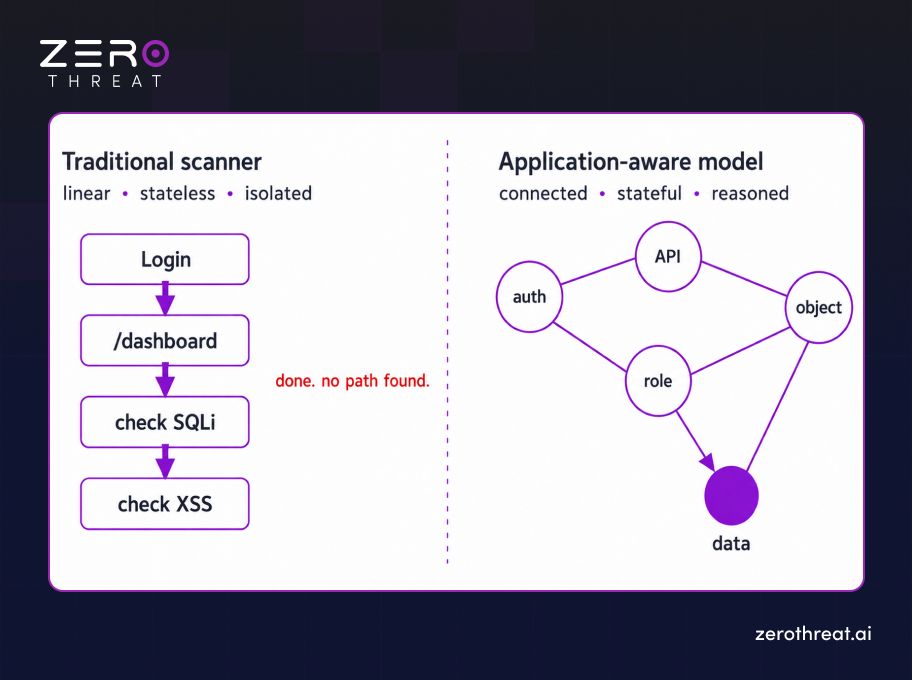
Legacy DAST and SAST tools were built for a simpler web. Their core loop is mechanical: crawl the site, enumerate URLs, fire a catalogue of payloads at each one, and flag responses that look like known-bad patterns. That loop has real strengths for well-signatured classes like reflected cross-site scripting or obvious injection. But its blindness is structural, and it compounds in modern applications.
- URL crawling misses the real surface. Single-page apps render routes in JavaScript and talk to APIs that never appear as crawlable links, so a crawler sees a fraction of the true attack surface.
- Signature matching has no meaning. Matching a response against a pattern tells you something looks wrong; it never tells you what the endpoint is for or whether the finding is exploitable here.
- Authenticated workflows are skipped. Most real risk lives behind login, across MFA, OAuth, and session handling that a signature scanner cannot reliably navigate.
- No business logic awareness. Skipping a payment step or replaying a one-time token has no signature, so a pattern scanner is blind to it by design.
- Stateless, isolated testing. Each request is tested on its own, with no memory of the sequence, so multi-step abuse is invisible.
- No attacker reasoning. The tool runs a fixed plan instead of asking, given what I just learned, what can I reach next.
What is Application Context in Security?
Application context in security is the structured understanding of how an application actually behaves, its endpoints and parameters, its authentication and authorization logic, its session handling and user roles, its data flows, and its intended workflows. Context turns a raw list of routes into a map of how the system works and, therefore, how it can be abused.
Think of the difference between a photograph of a building and its blueprints. The photograph shows you doors and windows. The blueprint shows you which door opens onto the vault, which corridor connects two secure zones, and which window is load bearing.
The same way, application context AI security is the blueprint. It captures not just that an endpoint exists, but what it is for, who is supposed to reach it, what data passes through it, and what state it changes.
Concretely, a useful context model captures several dimensions at once. It knows the attack surface: every reachable endpoint, parameter, header, and hidden route across the app, its APIs, and its auth surface. It knows the identity model: which roles exist and what each is entitled to do. It knows the data flow: where user input enters, how it moves, where it is trusted, and where it lands. And it knows the intended workflow: the legitimate order of operations, such as add to cart, then checkout, then pay, then fulfil. With those four dimensions modeled together, a weakness stops being an isolated fact and becomes a move in a larger game.
This is why attack surface mapping AI is a foundation rather than a feature. You cannot reason about a path you never mapped. But mapping alone is not enough. The context has to be interpreted, which is where semantic understanding enters.
Security is no longer about scanning harder. It's about thinking smarter. Discover the Shift
How AI Builds an Understanding of Your Application?
AI builds application understanding by learning the surface, interpreting authentication, observing user journeys, and modeling object relationships, then combining them into a context model it can reason over. This is application behavior analysis, and it is what a fixed-plan scanner never performs.
1) Learning the Application Surface
The first job is source-aware reconnaissance of the true surface, not just the crawlable one. That means discovering routes, parsing JavaScript bundles to extract SPA routes, and performing API discovery to surface documented, undocumented, and shadow endpoints. Where a crawler stops at links, application-aware AI reads the client the way a browser does, so hidden endpoints and API calls that only appear at runtime become part of the map. You cannot reason about a path you never discovered.
2) Understanding Authentication
Most real risk sits behind login, so the engine has to interpret authentication rather than stop at it. It handles login flows, multi-factor steps, OAuth handshakes, JWT issuance and validation, session handling, and token refresh.
Understanding the identity model is what lets the AI later ask the crucial question of whether a lower-privileged identity can reach a higher-privileged function. Authenticated security testing is not a bonus feature here; it is the entry ticket to where attacks actually happen.
3) Learning User Journeys
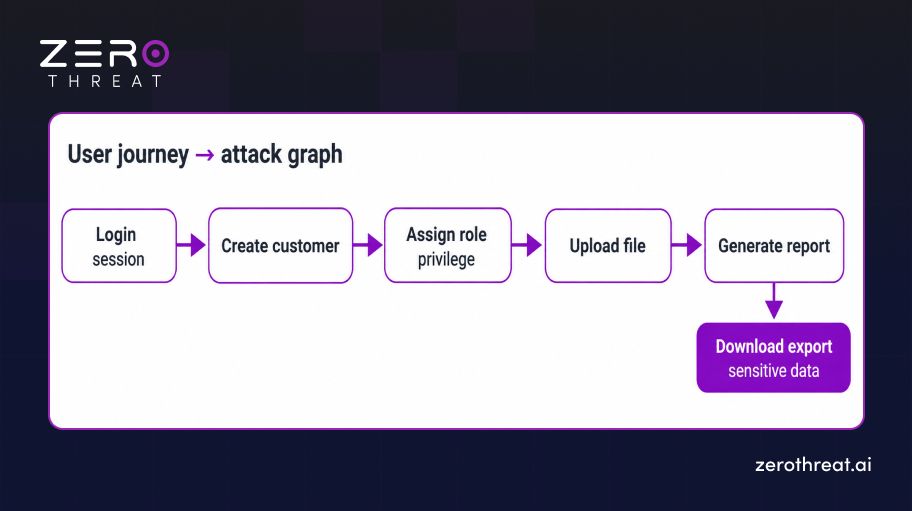
Instead of crawling pages, application-aware AI observes workflows. It watches how a legitimate user threads a multi-step action and records the sequence, not just the endpoints. A journey like log in, create a customer, assign a role, upload a file, generate a report, and download the export is captured as an ordered chain of state transitions. That ordered chain is the raw material for an attack graph, because every step is a place where the intended order can be broken.
4) Understanding Relationships
The final piece is relationships, and it is where attack paths are born. The engine models how objects and identities relate: a customer owns projects, projects own files, files are shared with teams, teams carry permissions, and permissions expose admin APIs. That relationship graph is not decoration. It is the map that reveals how reaching one object grants reach to the next. When an attacker abuses an object reference, they are walking this graph, and modeling it is what lets the AI walk it first.
How AI Finds Attack Paths?
AI finds attack paths by running a reasoning loop over application context: it maps the surface with source-aware reconnaissance, models behavior and data flow, forms hypotheses about how an attacker would move, executes those hypotheses safely, and validates the results, feeding each new fact back into the model so the picture compounds toward a real, multi-step attack path.
The loop is what separates reasoning from scanning. A scanner runs a fixed plan; a reasoning engine adapts its next move based on what it just learned, exactly as a human tester does. Five stages define it.
Source-aware Reconnaissance
Reconnaissance sets the board. Source-aware reconnaissance maps the full external attack surface, ports, TLS and DNS posture, mail configuration, then the apps, APIs, authentication surfaces, and workflows, and interprets what it finds. When a response reveals a framework, an object naming scheme, or a hidden parameter, the engine uses that meaning to decide what to test next. This is context building penetration testing in action: every observation sharpens the next probe instead of adding to an undifferentiated pile.
Data Flow Analysis
Data flow analysis security is the practice of following untrusted input from where it enters the application to where it is trusted or where it lands. The AI traces a value across requests and endpoints, asking where validation happens, where it does not, and where a value crosses a trust boundary. A user-supplied identifier that flows unchecked into a database lookup is not just an input; it is a candidate for an access control bypass. Tracking that flow is how the engine turns a parameter into a hypothesis.
Auth Chain Tracing
Auth chain tracing follows an identity through login, session issuance, token handling, and every authorization decision that gates a sensitive action. By modeling which roles should reach which resources, the engine can deliberately test whether a lower-privileged identity reaches a higher-privileged function. This is where broken access control lives, and it is the number one risk in the OWASP Top 10:2025, present in 100% of applications tested and now expanded to absorb server-side request forgery. Auth chains are also where isolated weaknesses most often connect into privilege escalation.
Business Logic Flaw Detection
Business logic flaw detection AI is the stage that pattern scanners cannot reach. By modeling the intended workflow, add to cart, checkout, pay, fulfil, the engine can reason about deviations an attacker would abuse: skipping the payment step, replaying a one-time token, manipulating a price parameter, or escalating a role through a workflow gap. None of these have a signature. They are only visible to a system that understands what the workflow is for and can therefore recognize when the rules are broken.
Multi-step Attack Path Discovery
Finally, multi-step attack path discovery is the correlation stage where the engine connects validated weaknesses into a single route to impact. This is the payoff of everything before it. An information leak that exposes an identifier, an IDOR that accepts it, and a privilege gap that trusts the resulting session are individually minor. Correlated, they are an account takeover. The engine ranks the resulting path by the impact at its end, not by the severity of any single link.
Real Example to Find Application Context Attacks
Abstractions convince no one, so here is a concrete chain of the kind an application-aware engine surfaces every day. Imagine a customer portal. A scanner tests it and returns four findings, none of them critical.
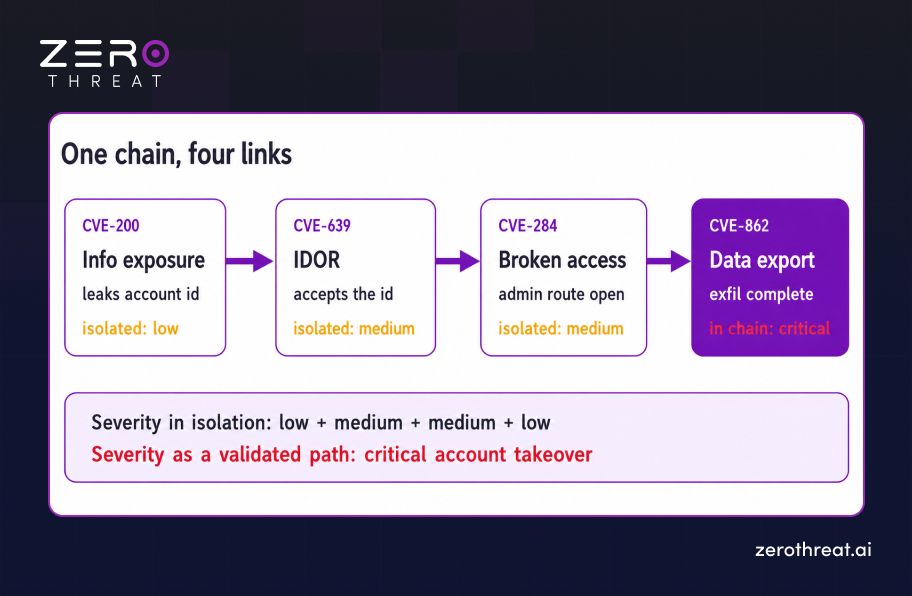
First, a profile endpoint returns slightly too much data, including an internal account identifier (an information exposure, CWE-200). On its own: low severity.
Second, an order lookup endpoint accepts an account identifier as a parameter and returns that account's orders, without confirming the requester owns it (an insecure direct object reference, CWE-639). On its own: medium.
Third, an administrative report route relies on the front end to hide it rather than enforcing a server-side role check (broken access control, CWE-284). On its own: medium, and easy to dismiss because "no normal user would find it."
Fourth, a data export function trusts the current session's context without re-checking entitlement (missing authorization, CWE-862). On its own: low.
A pattern scanner lists these four and moves on. A context-aware engine reasons about them together. The information leak supplies the account identifier. The IDOR accepts that identifier to enumerate another user's data. The broken access control on the report route, reachable because the front end never truly gated it, exposes an administrative function. And the export function, trusting the session it now holds, completes the exfiltration.
Four findings that each earned a shrug become one validated path from an anonymous entry point to a full data breach. That is multi-step attack path discovery, and it is the exact behavior threat reports describe when they note that most modern intrusions involve no malware at all, just valid access and lateral movement.
Upgrade your security approach—not just your security budget. See Pricing
Why Context Produces Fewer False Positives?
Context produces fewer false positives because exploitability is validated with proof before anything is reported. A stateless scanner flags a "potential" issue and leaves you to confirm it. An application-aware engine attempts the exploit safely, collects evidence, and only reports what it proved.
The difference is easiest to see side by side. A traditional scanner observes a suspicious response and reports "potential SQL injection," passing the burden of confirmation to you. Multiply that across a large application and you get a backlog of unverified alerts, most of which are noise. An application-aware engine takes the opposite path: it forms the hypothesis, safely exercises it against the live behavior, confirms that a database was actually reachable, captures the proof, and only then records a real finding.
Proof-based validation is not just cleaner reporting; it is what makes the output trustworthy enough to act on immediately. It is also the mechanism behind ZeroThreat's zero false positives across 130K+ vulnerability checks at 99.9% detection accuracy. Nothing unproven reaches the report, so engineering time goes to fixing rather than triaging.
Business-aware Risk Prioritization
Business-aware risk prioritization ranks findings by the impact of what they reach, not by a generic score in isolation. The same technical flaw can be trivial or catastrophic depending on where it lives, and only application context can tell the two apart.
Consider identical cross-site scripting in two places. On a static marketing page, it is a low-impact nuisance. On an authenticated admin dashboard, the very same flaw becomes a route to session theft and full compromise. Or consider SSRF: pointed at a dead internal endpoint it is noise, but pointed at a cloud metadata service it can surrender credentials to your entire environment. The payload is the same. The risk is not.
Context is what supplies the missing variable. Because an application-aware engine knows which route reaches customer data, which reaches admin control, and which reaches nothing exploitable, it can prioritize by business impact instead of CVSS alone. That directly shapes the economics: IBM's 2025 Cost of a Data Breach Report put the global average breach at $4.44 million and the United States average at a record $10.22 million, while organizations using AI and automation extensively in security saved an average of $1.9 million per breach. Fixing the right path first is where that saving comes from.
Application-aware AI Pentesting vs traditional DAST
Application-aware AI pentesting differs from traditional DAST in almost every dimension that decides whether real attack paths are found: discovery, authentication, workflow learning, business logic, attack chaining, proof validation, and prioritization. The table below sets them side by side.
| Capability | Traditional DAST | Application-aware AI |
|---|---|---|
| Discovery | URL crawling only | Routes, SPA, and API discovery |
| Authentication | Often stops at login | Login, MFA, OAuth, JWT, sessions |
| SPA support | Limited, misses JS routes | Parses JS and renders like a browser |
| Workflow learning | None, stateless | Observes user journeys as sequences |
| Business logic | Invisible, no signature | Modeled and tested for abuse |
| Attack chaining | Isolated findings | Multi-step attack graph |
| Proof validation | Flags "potential" | Exploits safely, collects proof |
| Risk prioritization | CVSS in isolation | Business impact aware |
| Continuous learning | Fixed rule set | Adapts to each response |
| False positives | High, unvalidated | Removed by validation |
What Makes Modern AI Penetration Testing Different?
Modern AI penetration testing is different because it reasons, plans, and adapts across a remembered context rather than running a fixed catalogue of checks. Reasoning, planning, adaptive testing, context memory, multi-step exploitation, exploit chaining, and true application understanding are what separate it from a faster vulnerability scanner.
The word "AI" is now attached to nearly every security tool, so the meaningful question is what the intelligence actually does. Modern application-aware pentesting carries several properties that a rules engine simply does not have. It reasons about intent instead of matching syntax. It plans a route toward an objective rather than iterating a list. It performs adaptive testing, changing its next move based on the last result.
Many AI pentesting tools maintain context memory, so a fact learned in step two informs the hypothesis in step seven. And they perform multi-step exploitation and exploit chaining, correlating validated weaknesses into the routes that actually reach impact. Together, these amount to genuine application understanding rather than accelerated scanning.
How ZeroThreat Uses Application Context?
As a popular AI-powered pentesting tool, ZeroThreat is built around application context as the substrate for everything else, and it packages that understanding into a workflow security and application teams can act on. In practice, that means several capabilities working as one engine.
- Application-aware AI reasoning over a context graph of routes, roles, sessions, journeys, and object relationships, so testing follows the application rather than a checklist.
- Real-user application journeys that drive complex, authenticated workflows the way an actual user would, reaching the behavior where logic flaws live.
- Business-aware prioritization that ranks validated paths by the sensitivity of what they reach, not by CVSS in isolation.
- Exploit validation that proves each step before reporting, which is how ZeroThreat sustains zero false positives at 99.9% of detection accuracy.
- Broad coverage and mapping across 130K+ vulnerability checks, CVE and CWE mapping, and OWASP alignment, with API discovery and authenticated testing built in.
- Real attack chain discovery that correlates findings into the multi-step routes that reflect how attackers actually operate.
The output is deliberately split by audience along one validated path. ZeroThreat’s automated penetration testing puts this on a continuous schedule, and AI-driven remediation reports hand security teams the full attack path, impact, and priority while giving application teams the reproduction steps, endpoints, parameters, evidence, and targeted fixes, all mapped to OWASP, PCI DSS, HIPAA, GDPR, and ISO 27001.
Best Practices to Implement Application-aware to Find Attack Paths for Organizations
Whatever tooling you use, the principles that expose real attack paths are consistent. Applied together, they move a program from counting vulnerabilities to defending against routes.
- Test Authenticated Applications: Most real risk lives behind login, so testing that stops at the front door misses the parts attackers care about.
- Map Business Workflows: Give your testing the intended sequences so deviations, the raw material of logic abuse, become detectable.
- Include Your APIs: Shadow and undocumented endpoints are prime targets; discover and test them alongside the web surface.
- Test Role Transitions: Deliberately check whether a lower-privileged identity can reach a higher-privileged function, since that is where escalation paths open.
- Validate Exploitability: Insist on proof, not "potential," so remediation effort goes to real risk.
- Discover Attack Paths Continuously: Applications change constantly, and a new deploy can open a new chain, so run testing continuously rather than once a quarter.
- Prioritize Business Impact Over CVSS Alone: Rank work by what a path reaches, not by an abstract score in isolation.
Security leaders aren't asking for more alerts, but they're asking for more certainty. Talk to Experts
Conclusion
Attackers do not exploit isolated vulnerabilities. They exploit application context: the workflows, relationships, and trust boundaries that give an application its behavior. Traditional scanners, built to crawl URLs and match signatures, see the endpoints but not the connections between them, which is exactly why they hand back lists instead of routes.
The next generation of AI pentesting tool works the way an attacker does. It does not simply detect issues; it builds an understanding of how an application behaves, reasons across its workflows, assembles that understanding into an attack graph, and identifies the exploitable attack paths that reflect real-world attacker behavior.
In a landscape where adversaries move from access to impact in under half an hour, understanding your own attack paths first is no longer optional, and application-aware AI pentesting is how you get there before they do.
Frequently Asked Questions
Can AI test authenticated applications?
Yes. Application-aware AI handles login, multi-factor flows, OAuth, JWT and session handling, and token refresh, so it can test behind authentication where most real risk lives. It drives the application through complex authenticated workflows the way a real user would, rather than stopping at the login page.
How does AI discover hidden APIs?
How does ZeroThreat discover real attack chains?
Explore ZeroThreat
Automate security testing, save time, and avoid the pitfalls of manual work with ZeroThreat.