 ZeroThreat Wins Bronze Stevie® Award in Tech Startup of the Year Read more

All Blogs
Application-Aware AI Pentesting: The Future of Offensive Security
Quick Overview: Application-aware AI pentesting goes beyond traditional vulnerability scanning by understanding how your application works before testing it. This guide explains how AI discovers exploitable attack chains, validates findings, uncovers business logic flaws, and delivers continuous, context-aware security testing for modern web applications.
Modern applications are no longer a handful of forms behind a login. They are sprawling systems of single-page frontends, dozens of APIs, third-party integrations, multi-tenant data models, and workflows that assume users behave the way designers intended.
Attackers know this, and they no longer bother probing for a lone SQL injection when they can abuse the logic of a checkout flow, a password reset, or an object reference to walk straight into another tenant's data. The defensive tooling most teams rely on was built for the older world.
Signature-based scanners look for known-bad request patterns, and manual penetration tests, however skilled, happen once or twice a year against a frozen snapshot of a system that ships new code every week.
That mismatch is expensive. According to IBM's 2025 Cost of a Data Breach Report, the global average breach now costs USD 4.44 million, rising to USD 10.22 million in the United States, and organizations still take an average of 241 days to identify and contain an incident. The same research found that teams using AI and automation extensively in security detect breaches roughly 190 days faster and save close to USD 1.9 million per incident. The lesson is blunt: attackers already reason and automate, and defenders who only scan are testing yesterday's app against yesterday's playbook.
This is the space that application-aware AI pentesting tool fills. Rather than treating an application as a list of URLs to fuzz, it treats the application as a system to understand. It builds context, reasons about attack paths, executes autonomous exploit validation, and returns a short list of proven, prioritized risks.
In the sections that follow, we will define the approach precisely, contrast AI pentesting with traditional pentesting, open up the engine that makes it work, and lay out the concrete benefits for the security engineers and developers who have to act on the results.
Tomorrow's attacks demand more than yesterday's testing. Make AI part of your security strategy today. Get Started for Free
ON THIS PAGE
- Why Traditional Pentesting Is Reaching Its Limits
- What Application-Aware AI Pentesting Actually Means
- AI Pentesting vs Traditional Pentesting
- Inside The Engine: Autonomous, Multi-agent Testing
- Business Logic Testing AI And the Bugs Scanners Miss
- Proof-Based Exploitation: Why Every Finding Comes with Evidence
- Context-aware Vulnerability Prioritization
- How Zerothreat Delivers Application-aware AI Pentesting
- User Benefits for Security and Application Teams
- Conclusion
Why Traditional Pentesting Is Reaching Its Limits
Traditional penetration testing has been a cornerstone of application security for decades. Skilled security professionals manually assess applications using reconnaissance, vulnerability identification, exploitation, and reporting techniques.
While this methodology remains valuable, today's application architectures introduce challenges that make periodic manual testing increasingly insufficient.
Several limitations have become evident.
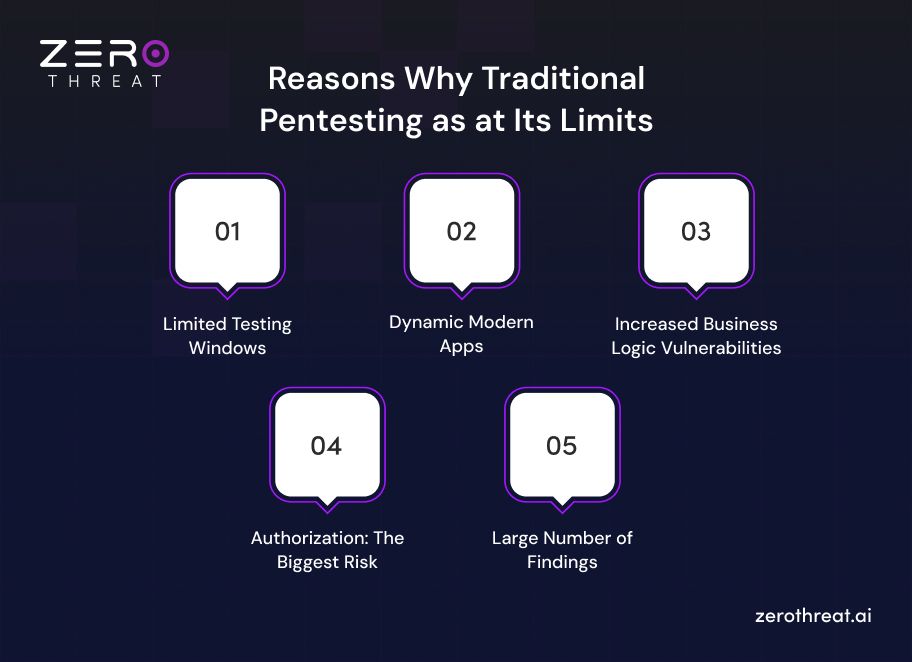
Limited Testing Windows
Most organizations conduct penetration tests quarterly or annually.
However, according to GitLab's Global DevSecOps Report, high-performing engineering teams deploy production code multiple times every day.
Security assessments performed every few months cannot adequately cover continuously changing applications.
Modern Applications Are Dynamic
Applications constantly generate new attack surfaces.
These include:
- Client-side JavaScript routes
- Hidden API endpoints
- Dynamic authentication flows
- Multi-step checkout processes
- Role-based dashboards
- Mobile APIs
- Third-party integrations
- Background services
Many of these workflows are difficult for conventional scanners to discover.
Business Logic Vulnerabilities Are Increasing
OWASP continues to emphasize that business logic flaws remain among the most difficult security issues to identify because they require understanding intended application behavior rather than detecting known technical weaknesses.
Unlike SQL Injection or Cross-site Scripting, business logic vulnerabilities often appear perfectly legitimate to automated scanners.
Examples include:
- Coupon abuse
- Payment bypass
- Inventory manipulation
- Loyalty reward exploitation
- Race conditions
- Multi-account abuse
- Subscription bypass
- Workflow manipulation
These vulnerabilities frequently lead to substantial financial losses without triggering traditional security controls.
Authorization Is Still One of the Biggest Risks
Broken Access Control ranked as the number one risk in the OWASP Top 10.
Attackers increasingly target authorization weaknesses because they enable access to sensitive business functions without requiring sophisticated exploits.
Examples include:
- Insecure Direct Object References (IDOR)
- Horizontal privilege escalation
- Vertical privilege escalation
- Role confusion
- Tenant isolation failures
- Workflow authorization bypass
These vulnerabilities typically require understanding application relationships, user roles, and business context rather than simply detecting vulnerable code.
Traditional Testing Produces Large Numbers of Findings
Security teams often receive hundreds of vulnerability reports.
However, many findings:
- Cannot be exploited
- Have minimal business impact
- Represent duplicate issues
- Lack reproduction steps
- Are difficult to prioritize
This creates alert fatigue while genuinely exploitable attack paths remain hidden.
What Is Application-Aware AI Pentesting?
Application-aware AI pentesting is a form of autonomous application security testing in which AI agents first build a working model of how an application behaves, its roles, objects, workflows, and trust boundaries, and then reason about attack paths the way a real attacker would.
Unlike conventional scanners that primarily inspect endpoints individually, application-aware AI analyzes how the entire application behaves.
Instead of matching requests against a fixed signature list, it discovers weaknesses, chains them into real attack paths, and confirms each one through autonomous exploit validation, so every finding arrives with proof. That reasoning is what lets AI pentesting for web applications catch business logic and authorization flaws that pattern-matching scanners cannot see.
The word doing the heavy lifting is aware. A conventional scanner is application-blind. It sees requests and responses, matches them against rules, and reports anything that looks like a known bad pattern. It does not know that /api/orders/1043 belongs to a different customer, that a coupon field is supposed to be validated server side, or that a two-step approval workflow can be collapsed into one. Application-aware AI pentesting closes that gap by building a working model of the application first, then testing against that model.
Concretely, an application-aware engine learns four things before it attacks: the roles and identities in the system, the objects those roles are allowed to touch, the workflows that connect actions into meaningful sequences, and the trust boundaries where one component assumes another has already done its job. With that context in hand, AI-driven vulnerability discovery stops being a guessing game. The engine can ask a human-style question, such as "can a standard user reach an administrative object by tampering with an identifier," and then answer it by trying, safely, and checking the result.
The future of offensive security belongs to AI that understands applications—not just vulnerabilities. Explore AI Pentesting
AI Pentesting vs Traditional Pentesting for Application-Aware Testing
The core difference is cadence, context, and validation: traditional pentesting is a periodic, manual assessment limited by tester hours, while application-aware AI pentesting runs continuously, reasons about application context at machine scale, and validates its own exploits autonomously. The two are complementary rather than rivals. AI handles continuous coverage and proof-based findings, and human experts focus on novel, high-context adversarial work.
As we know, the application keeps changing. New endpoints ship, a refactor alters an authorization check, a feature flag exposes a workflow that did not exist during the test. By the time the next annual assessment arrives, the app under review is effectively a different application.
Human testing capacity is finite and expensive, so most organizations can only afford to test their most critical applications, and only occasionally. Everything else is left to a scanner that, without application awareness, produces long lists of unvalidated findings that engineers must triage by hand. The result is a backlog of theoretical issues and a persistent blind spot around the logic flaws that scanners cannot see.
AI pentesting vs traditional pentesting is therefore less a rivalry than a division of labor. Autonomous application security testing runs continuously, reasons about context at machine scale, validates its own findings, and hands humans in a clean, proven short list. That frees expert testers to do what they can: novel, high-context, adversarial work. The table below summarizes where each approach is located.
| Dimension | Traditional Pentest | Legacy Scanner | Application-aware AI Pentesting |
|---|---|---|---|
| Cadence | Once or twice a year | Continuous | Continuous |
| Application context | Yes, human | No | Yes, modeled |
| Business logic coverage | Strong | Minimal | Strong |
| Exploit validation | Manual | Rarely | Autonomous, proof-based |
| False positive rate | Low | High | Near zero |
| Scale across apps | Limited by hours | High | High |
| Cost to repeat | High | Low | Low |
Inside the Engine: Autonomous, Multi-Agent Testing
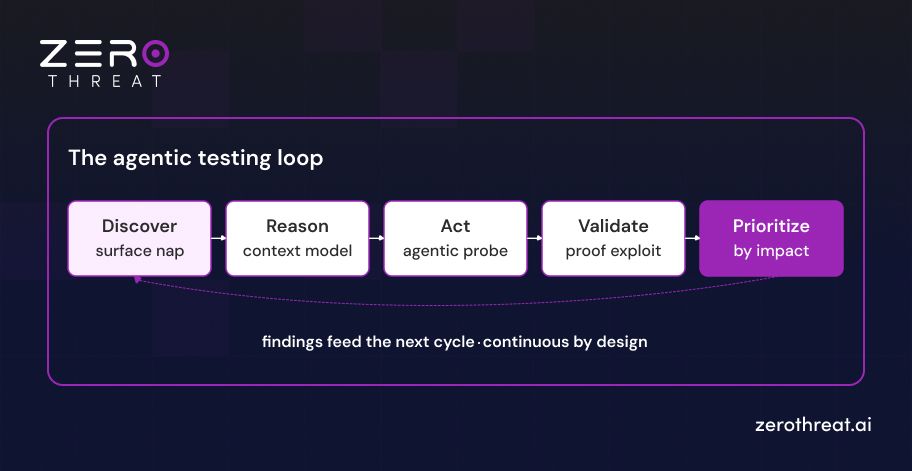
Application-aware AI pentesting works by running a continuous loop across specialized AI agents: discovery maps the attack surface, a reasoning core builds the application context model, agentic workflows act on attack hypotheses, autonomous exploit validation proves them, and a correlator links weaknesses into end-to-end attack chains. This mirrors how a human red team operates, then runs the process autonomously and in parallel across every application.
The reason multi-agent design matters is that academic research over the past two years has converged on a clear insight: single-shot prompting is not enough for real offensive work, but multi-agent penetration testing that decomposes the task across specialized agents handles complex, multi-stage attacks far more reliably.
Frameworks described in the literature, such as agentic offensive security systems surveyed in RedTeamLLM and related work, split reconnaissance, planning, exploitation, and validation into cooperating roles that plan actions, share findings, and avoid the aimless behavior that undermines naive automation.
In practice, an application-aware engine runs a loop that looks like this.
First, discovery and mapping enumerate the full external attack surface, from ports, SSL, and DNS through applications, APIs, authentication, and multi-step workflows.
Second, a reasoning core builds the context model, roles, objects, and trust boundaries, and forms hypotheses about where the logic can be abused.
Third, agentic pentesting workflows act on those hypotheses, driving the application the way a real user would, including complex flows that require login, navigation, and state.
Fourth, autonomous exploit validation attempts a controlled, non-destructive exploit and captures evidence. Fifth, an attack chain correlator links individual weaknesses into end-to-end paths and hands up the result to prioritization.
How Business Logic Testing AI Catches What Scanners Miss
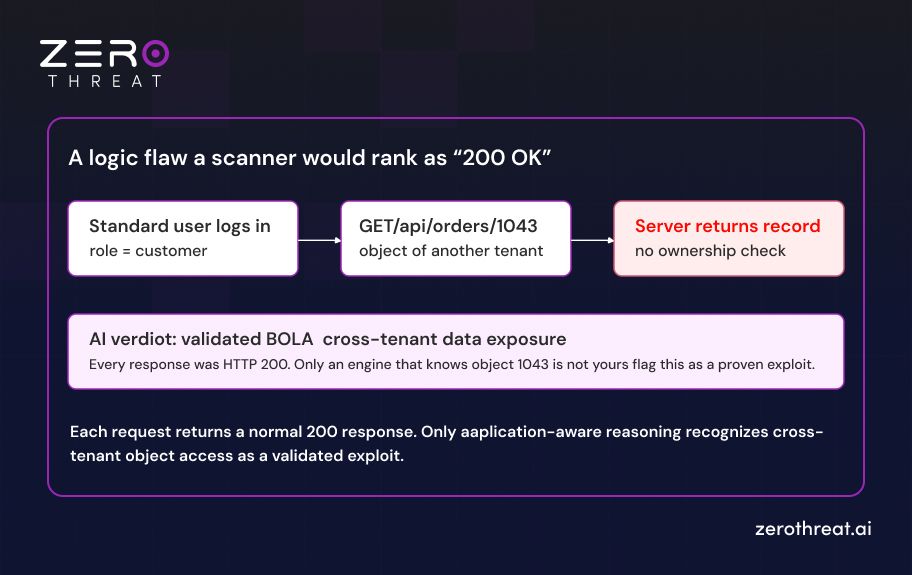
Business logic vulnerabilities are flaws that appear when an application does exactly what its code says, but its code was never supposed to allow that outcome, and business logic testing AI finds them by modeling the intended workflow, then deliberately deviating from it to see what breaks.
The request looks legitimate, until a standard user approves their own refund, changes a price, or reads another customer's invoice by incrementing an object ID. A pattern-matching scanner cannot see this, because catching it requires understanding intent.
The stakes are well documented. Broken access control tops the OWASP Top 10, and broken object level authorization is the number one API risk. Both are authorization failures: the system knows who you are but fails to check what you may touch. Business logic testing AI attacks this directly, modeling the intended workflow then deliberately deviating, calling step two before step one, toggling a role, submitting another tenant's object ID. That is authorization testing automation in action, and it only works when the engine understands context well enough to know what abuse means.
Upgrade from periodic testing to continuous AI-powered protection with a plan built for your team. Explore AI Pentesting
Proof-Based Exploitation: Why Every Finding Comes with Evidence
Autonomous exploit validation is the step where an AI pentesting engine safely proves that a suspected vulnerability is actually exploitable, executing a controlled, non-destructive proof-based exploitation attempt and only reporting the issue if the exploit succeeds. A suspected weakness is not a finding until the exploit is reproduced, which is exactly what drives proof-based results and the near elimination of false positives.
Legacy scanners treat validation as optional, reporting anything that might be a vulnerability and leaving the burden of proof on the human. That is the false-positive epidemic that trained engineers to distrust security tools. Validation flips it: when the engine forms a hypothesis, say an object reference looks tamperable, an agent attempts a controlled proof and records what happened. If the exploit succeeds, it captures the request, response, and repro steps. If it fails, the hypothesis is dropped silently.
Nothing theoretical reaches the report, which is why every issue arrives with proof attached. Engineers stop debating whether a finding is real and start fixing it, because the exploit is right in front of them.
Context-Aware Vulnerability Prioritization: Fixing What Matters First
Context-aware vulnerability prioritization ranks each validated finding by the business value of the affected asset, the reachability of the attack path, and its role in a larger attack chain, rather than by a generic severity score in isolation. The result is a short, ordered list of what to fix first, instead of an unranked flood of alerts that all claim to be critical.
A CVSS score describes a vulnerability in the abstract. It does not know whether the asset holds regulated data, whether the path is reachable given to your controls, or whether the flaw chains into something catastrophic. So, a medium-severity object reference that, when chained, exposes an entire customer database is not a medium risk in your environment, it is the first thing to fix. An engine that already built the context model and validated the chain is uniquely placed to make that call and explain it.
The payoff is operational, because dwell time is money. IBM's 2025 report shows teams leaning on AI and automation cut their breach lifecycle by roughly 80 days on average. Prioritization tied to real impact is how you turn a wall of alerts into a plan.
- 241 days Average time to identify and contain a breach in 2025
- $1.9M Average saving per breach for teams using AI and automation extensively
- 3x Lower breach likelihood Gartner links to continuous exposure programs
How ZeroThreat Delivers Application-aware AI Pentesting
ZeroThreat delivers application-aware AI pentesting as a single engine that maps the full attack surface, builds an application context graph, runs agentic exploit workflows, validates every finding with proof, correlates weaknesses into critical attack chains, and prioritizes them by business impact. It is built as an application-aware engine from the ground up, not a scanner with an AI label bolted on.
In practice, it maps the surface from ports, SSL, DNS, and mail through apps, APIs, auth, and workflows, then runs agentic pentesting against complex authenticated flows with no hand-written Playwright specs. Every suspected weakness passes autonomous exploit validation before it is reported, gets correlated into critical attack chains, and is ranked by business impact and mapped to OWASP, PCI DSS, HIPAA, GDPR, and ISO 27001.
Output is split for two audiences: security teams get the full attack path, impact, and priority; application teams get repro steps, endpoints, parameters, evidence, and AI-driven remediation reports. One validated path, two reports, nothing lost in translation.
User Benefits for Security and Application Teams
The value is concrete for the two groups who live with application risk. Security teams move from triage to decision-making; engineering teams move from vague tickets to fixable, evidence-backed work.
For Security Teams
- Continuous coverage instead of point-in-time snapshots. Continuous penetration testing runs as code ships, so the window between "we changed something" and "we know it is safe" collapses from months to hours.
- A queue of proven risk, not noise. Autonomous exploit validation and near-zero false positives mean the findings that reach you are real, freeing analyst hours for judgment rather than verification.
- Prioritization that reflects your business. Context-aware vulnerability prioritization ranks by asset value, reachability, and attack chain impact, so you fix what actually matters first.
- Audit-ready evidence. Proof-based findings mapped to OWASP, PCI DSS, HIPAA, GDPR, and ISO 27001 turn a scramble before an audit into a report you already have.
For Application and Engineering Teams
- Tickets you can actually action. Every issue ships with reproduction steps, the affected endpoint and parameters, and the evidence, so there is nothing to reverse engineer.
- Guided remediation. AI-driven remediation guidance explains not just what is wrong but how to fix it, shrinking mean time to remediate.
- Fewer false alarms interrupting your sprint. Because only validated issues surface, engineers stop losing time to security tickets that turn out to be nothing.
- Security that fits DevSecOps. Offensive security automation slots into the pipeline, supporting shift-left practice without a manual bottleneck.
Together, these are why autonomous application security testing is moving from experiment to expectation: it gives small teams the reach of a large one, and large teams a way to cover the long tail human testing could never afford.
If you're rethinking how offensive security should work, let's show you what's possible with application-aware AI. Book a Strategy Demo
Final Takeaways
For years defenders had to choose between the depth of human pentesting and the scale of scanning, and both left the same gap: the reasoning attackers use to abuse application logic.
Application-aware AI pentesting closes it, putting attacker-style reasoning on the defender's side continuously and at machine scale, understanding the app, proving real attack paths, and prioritizing them by business impact. It does not replace your experts, it multiplies them, handling continuous coverage and proof-based exploitation while humans focus on the creative edge.
The future of offensive security is not more scanning or more headcount, it is engines that reason about your applications the way attackers already do, and ZeroThreat is built to be exactly that. The fastest way to see it is to run one against a target and read the proof for yourself.
Frequently Asked Questions
Can application-aware AI pentesting identify business logic vulnerabilities?
Yes. Because it understands how an application is intended to function, Application-Aware AI Pentesting can identify business logic flaws such as authorization bypasses, workflow manipulation, privilege abuse, payment validation issues, and multi-step attack scenarios that traditional scanners often fail to detect.
Why is application context important in offensive security?
How does ZeroThreat perform application-aware AI pentesting?
What makes ZeroThreat different from traditional DAST and vulnerability scanners?
Explore ZeroThreat
Automate security testing, save time, and avoid the pitfalls of manual work with ZeroThreat.