 ZeroThreat Wins Bronze Stevie® Award in Tech Startup of the Year Read more

All Blogs

Quick Summary: This article will provide deep insights into the cost of data breaches, helping you understand the financial implications of a cybersecurity breach. You will also get the understanding of the financial impact of a data breach by industry, country, and company size. Read on to get all the insights.
Data breach is a term that haunts even large conglomerates like Google, Microsoft, and Meta. As cyberattacks become more sophisticated, data breach incidents are going to be even worse. Every year companies face heavy losses due to data breaches.
These losses are termed as the costs of data breaches. They are the financial implications that companies incur after a cybersecurity incident. This cost depends on factors such as the type of data breached, severity of the incident, number of records compromised, and more.
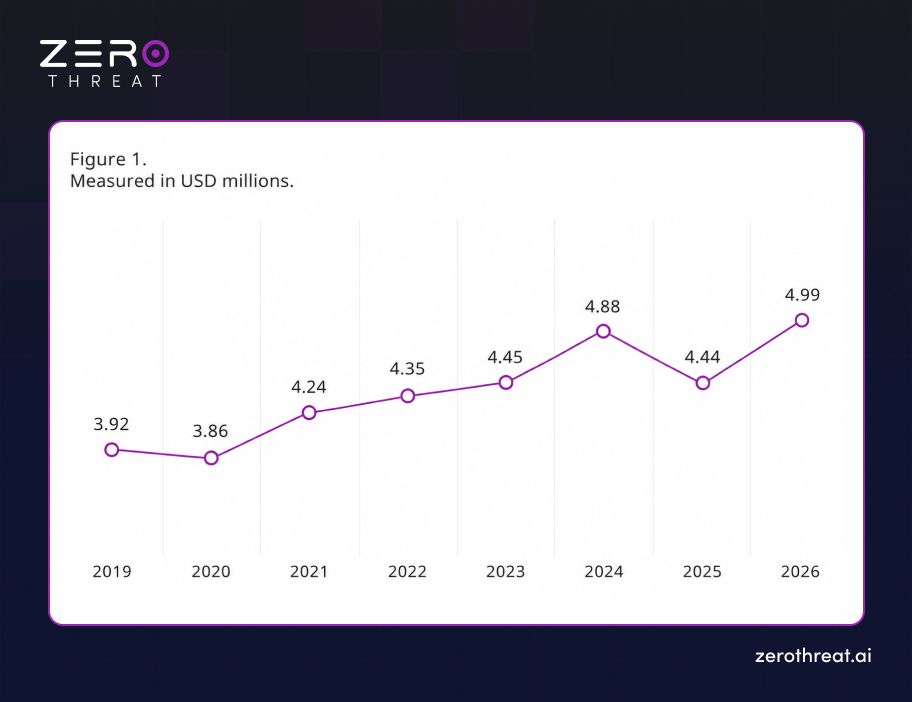
Data breach costs have increased over time as new attack methods, risks, and vulnerabilities appear every year. Indeed, as per an IBM report, the global average cost of a data breach climbed 12% over last year, reaching a record USD 4.99 million.
Keep reading this article for more information about the cost of a data breach.
Your next breach could cost millions. Take the first step toward reducing your exposure today. Start Securing Now
Table of Contents
- Cost of a Data Breach Over the Years
- The Cost of a Data Breach by Country
- The Cost of a Data Breach by Industry
- Data Breaches Costs by Company Size
- Factors That Increase and Decrease Breach Costs
- How Has AI Changed the Economics of Data Breaches?
- What Determines the Cost of Data Breach?
- How to Calculate the Cost of Data Breach?
- How to Avoid Costly Data Breaches?
- In Conclusion
An Overview of the Cost of a Data Breach Over the Years
Calculating the exact cost of a data breach can be tricky. It depends on many factors. Plus, every breach is unique making it difficult to assess the loss. It is also difficult because this process involves assessing the total cost related to all the consequences that are hard to determine.
Generally, estimating the cost includes expenses of incident response and recovery, penalties by legal authorities, loss from business disruptions, amount paid as extortion, etc. These are the common elements to calculate the cost.
However, there are other elements as well that are not directly visible but will impact your business in the long run. For example, the incident of a data breach will affect your brand reputation. It could lead to a decrease in revenues due to customers switching to competitors.
Nevertheless, many reports provide estimates for data breach costs based on their research. One of these reports includes the one provided by IBM which is based on the Ponemon Insititute's research. The report provides data on the cost of a data breach annually.
The table below shows the global average cost of a data breach over the years.
| Year | Average Cost of a Data Breach in USD | Percentage Increase from Previous Year |
|---|---|---|
| 2026 | $4.99 million | 12.00% |
| 2025 | $4.44 million | -9.00% |
| 2024 | $4.88 million | 9.66% |
| 2023 | $4.45 million | 2.30% |
| 2022 | $4.35 million | 2.59% |
| 2021 | $4.24 million | 9.84% |
| 2020 | $3.86 million | -1.53% |
| 2019 | $3.92 million | 1.55% |
| 2018 | $3.86 million | 6.62% |
| 2017 | $3.62 million | - |
As we can see from the above table the cost of data breaches is increasing with varied rates over the year. But why is it increasing? Well, the answer lies in the rising incidents of AI-driven attacks. In fact, compared to 2025, AI-driven attacks increased significantly by 56% than in 2026.
This has added an average of USD 1 million per breach as AI tools allow attackers to increase their velocity and scale. That speed is reshaping breach economics, and not in a good way.
Data compromises occur for many reasons. The constant rise of cyberattacks is a big problem for this. However, according to Verizon’s IDBR, a human element was involved in most cases of data breaches at 68%.
It includes human errors like weak passwords, downloading malicious attachments, and more. Attackers use social engineering tactics like phishing to trick people into revealing their sensitive information.
Replace this image with one given below
The Cost of a Data Breach by Country
According to BlackBerry’s Global Threat Intelligence Report, the USA experiences the most cyberattacks. So, there is no doubt that the average data breach cost in the USA is higher than in the rest of the world.
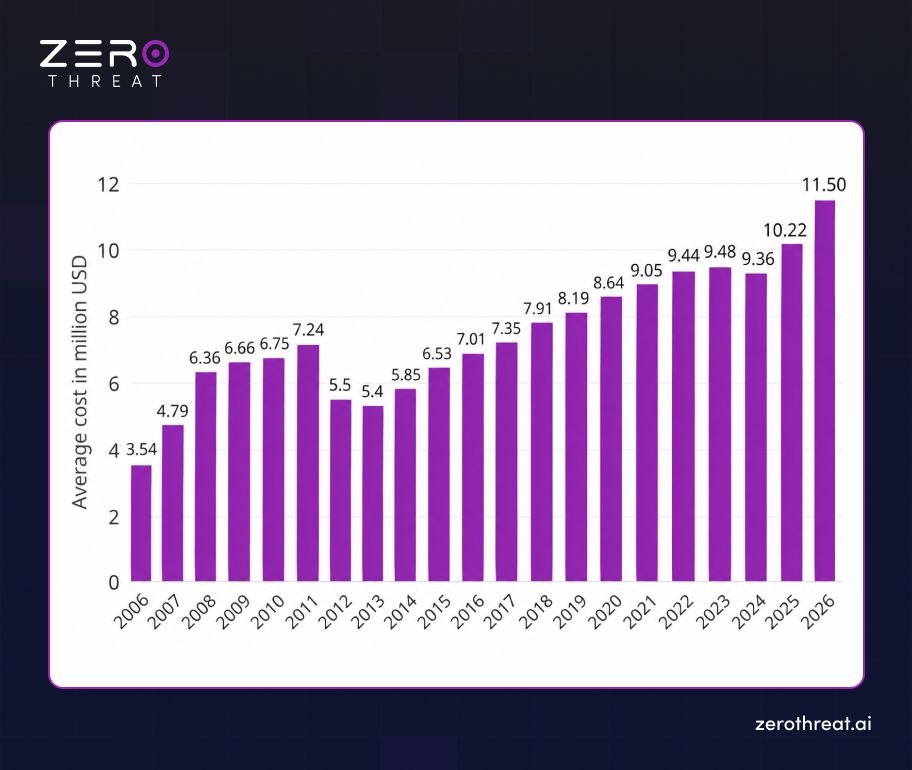
In fact, it is higher than the global average. While the global data breach cost, on average, stands at $4.99 million, it is $11.50 million in the USA. After the USA, Middle East takes the second position with an average cost of $8.00 million.
The costs of data breaches are increasing in the USA as we can see in the following graph.
Apart from the USA, Middle East, Benelux, and Canada, there are many other regions or countries that have seen a sharp spike in the average cost incurred due to data compromises. The interesting thing was, the average cost of breach inclined in all the countries. The table below shows a comparison between the costs from 2025 to 2026 for different countries or regions.
| Country | 2025 | 2026 | Result |
|---|---|---|---|
| United States | 10.22 | 11.50 | Increased |
| Middle East | 7.29 | 8.00 | Increased |
| Benelux | 6.24 | 7.37 | Increased |
| Canada | 4.84 | 5.20 | Increased |
| Germany | 4.03 | 4.93 | Increased |
| LATAM | 3.81 | 4.65 | Increased |
| United Kingdom | 4.14 | 4.17 | Increased |
| Italy | 3.44 | 4.12 | Increased |
| ASEAN | 3.67 | 4.12 | Increased |
| France | 3.73 | 4.05 | Increased |
| Japan | 3.65 | 4.01 | Increased |
| South Africa | 2.37 | 3.04 | Increased |
| South Korea | 2.84 | 3.03 | Increased |
| Australia | 2.55 | 2.96 | Increased |
| India | 2.51 | 2.79 | Increased |
| Brazil | 1.22 | 1.41 | Increased |
Know what attackers can exploit before they find it. Automate penetration testing across your attack surface. Find Vulnerabilities First
The Cost of a Data Breach by Industry
When looking at the statistics for data breach costs based on the industry, the healthcare sector tops the list. Although there has been a sharp increase in the costs of data breaches across different industries, surprisingly healthcare sector has seen a 10.51% decrease in the costs of data breaches.
There are various reasons for higher average data breach costs for most sectors including strict industry regulations, and a data compromise incident can result in heavy penalties. Moreover, some industries have also seen a decline in the cost in 2026.
Let’s see a comparison table for the cost of a data breach in different industries from 2025-2026.
| Industry | 2025 | 2026 | Result |
|---|---|---|---|
| Healthcare | 7.42 | 6.64 | Decreased |
| Financial | 5.56 | 6.29 | Increased |
| Industrial | 5.00 | 5.50 | Increased |
| Technology | 4.79 | 5.50 | Increased |
| Entertainment | 4.43 | 5.38 | Increased |
| Pharmaceuticals | 4.61 | 5.25 | Increased |
| Energy | 4.83 | 5.24 | Increased |
| Services | 4.56 | 5.08 | Increased |
| Communications | 3.75 | 4.71 | Increased |
| Transportation | 3.98 | 4.50 | Increased |
| Media | 4.22 | 4.49 | Increased |
| Hospitality | 4.03 | 4.33 | Increased |
| Consumer | 3.72 | 4.31 | Increased |
| Education | 3.80 | 4.15 | Increased |
| Research | 3.79 | 3.99 | Increased |
| Retail | 3.54 | 3.80 | Increased |
| Public | 2.86 | 3.50 | Increased |
The Cost of Data Breaches by Company Size
Data compromise is not limited to large companies, small and medium-sized companies are also affected by them. In fact, the data breach costs have increased for smaller companies compared to previous years.
As per different reports, there has been a sharp increase in data compromises globally for all kinds of organizations, regardless of their size and industry. These rising breaches have caused companies to pay heavy regulatory fines around the world. These fines add to the overall cost of data breaches.
The table below shows a comparison of the percentage of organizations paying regulatory fines in various ranges in 2024.
| Cost of Fines | % of organizations |
|---|---|
| < $25,000 | 7% |
| $25,001 - $50,000 | 12% |
| $50,001 - $100,000 | 32% |
| $101,001 - $250,000 | 24% |
| > $250,000 | 25% |
Factors That Increase and Decrease Breach Costs
Not every data breach carries the same financial impact. Certain security practices can reduce the cost of detection, containment, and recovery, while other factors can make breaches significantly more expensive. Understanding these factors helps security teams prioritize investments that limit both risk and financial damage.
Key Factors That Decreased Breach Costs
- DevSecOps approach: Integrating security throughout the development lifecycle helps identify and address vulnerabilities earlier, reducing the cost and effort of breach response.
- Identity and Access Management (IAM): Strong IAM controls improve visibility and access governance, helping limit unauthorized access and reduce breach impact.
- Managed Security Service Provider (MSSP): MSSPs can accelerate breach identification and containment, helping organizations reduce the time and resources required to respond.
| Factor | Value |
|---|---|
| DevSecOps approach | -253,805 |
| Identity and access management (IAM) | -225,622 |
| Key lifecycle management tools | -214,923 |
| Encryption | -213,478 |
| Offensive security testing (red teaming, pen or vulnerability testing) | -211,339 |
| SOAR or security orchestration, automation and response tools | -210,771 |
| Certificate lifecycle management tool | -205,265 |
| Data security or protection software (data security posture management) | -198,259 |
| Employee training | -196,259 |
| Endpoint detection and response tools | -177,710 |
| Secret lifecycle management tools | -163,668 |
| Managed security service program | -152,929 |
Key Factors That Increased Breach Costs
- Supply chain data breaches: Breaches involving compromised business partners were the most expensive cost-increasing factor, adding an average of $227,250 to breach costs. These incidents are harder to detect and contain because they involve another organization's infrastructure and security practices.
- Security system complexity: Complex security environments can make monitoring, investigation, and response more difficult and time-consuming, increasing the overall cost of a breach.
- Noncompliance with regulations: Failing to meet regulatory requirements can add significant costs after a breach, particularly through regulatory fines and penalties.
| Factor | Value |
|---|---|
| Supply chain breach (business partner compromise) | 227,250 |
| Security system complexity | 208,265 |
| Lack of visibility into the number and location of applications (shadow IT) | 201,165 |
| Noncompliance with regulations | 201,112 |
| Mismanaged secrets and keys | 198,933 |
| Inability to prioritize threats against the organization | 188,172 |
| Security skills shortage | 179,635 |
| Excessive privileges and poor role management | 177,313 |
The cost of prevention is easier to manage when the alternative is a multimillion-dollar breach. Check Out Pricing
How Has AI Changed the Economics of Data Breaches?
AI is changing data-breach economics in two directions: attackers can launch attacks faster and at greater scale, while organizations can use AI and automation to reduce the cost of responding to them.
The Cost of a Data Breach Report 2026 found that AI-driven attacks increased 56% year over year, with more than one in four organizations experiencing a malicious AI-driven attack. These attacks added approximately $1 million to the average malicious breach cost.
| AI impact | 2026 finding |
|---|---|
| Increase in AI-driven attacks | 56% |
| Additional cost of AI-driven attacks | $1M |
| AI-driven breach cost | $6.04M |
| Non-AI-driven breach cost | $5.03M |
| Deepfake/impersonation attacks | 45% |
| AI-enabled malware | 19% |
AI is also becoming a direct attack surface. Breaches involving AI models or applications rose to 21%, up from 13% in 2025, while their average cost reached $5.33 million, compared with $4.70 million for breaches not involving AI. Model inversion was the most expensive AI-related incident at $6.07 million, followed by prompt injection at $5.89 million.
The economics become even more concerning with shadow AI: incidents more than doubled to 43%, with an average breach cost of $5.39 million.
Yet AI is also part of the solution. Organizations using AI and automation to strengthen security achieved an average $1.93 million reduction in breach costs.
What Determines the Cost of Data Breach?
Let’s see what are the prime factors that determine the end cost of a data breach.
1. Scope and Severity of Breach
A greater number of affected records leads to increased costs for notifications and an increased intensity of damage. Also, confidential details like financial data or personal identifiers generally incur higher costs due to constant risk and regulatory attention.
2. Regulatory Environment
Compliance with standard data protection policies (e.g., GDPR, CCPA) influences costs, including significant fines and the requirement for compliance measures. Also, non-compliance can lead to a large amount of penalties based on the severity of the breach.
3. Notification and Communication
Notification costs include the expenses for intimating targeted users, such as mailing notifications and providing credit monitoring services. Also, managing costs for data breaches substantially affects the goodwill of an organization and causes a loss of trust amongst clients and customers.
4. Operational Impact
Financial losses from service interruptions, including lost revenue and increased operational expenses to restore standard services and solutions.
How to Calculate the Cost of Data Breach?
Let’s refer to the below-mentioned table that covers critical categories that determine the end cost of a data breach. Check out the table to accurately understand how to calculate the cost of a data breach.
| Cost Category | Description |
|---|---|
| Detection and Escalation | These expenses are related to the identification of the breach which validates its extensivity in terms of damage, forensic services to investigate the breach, and other activities that are performed to escalate the issue. |
| Notification | Post discovering the data breach, the affected regulatory bodies are informed about the incident. This includes the cost of sending notification letters, setting up communication channels and call center services for further enquiries. |
| Post-Breach Response | The post-breach response involves activities to address the breaches proactively in the future. This covers the costs of legal fees for handling lawsuits and regulatory inquiries, credit monitoring services are provided to the affected regulatory bodies, and other precautions are undertaken to avoid further data breaches. |
| Lost Business | Businesses bear major losses due to revenue downtime, customer churn, and affected business goodwill. The expenses of customers’ compensation for inconvenience caused, and lost sales determine the lost business cost. |
| Regulatory Fines | Penalties imposed by regulatory bodies for non-compliance cover the costs such as fines under regulations like GDPR and other legal penalties. |
| Operational Costs | Costs related to operational disruptions and recovery such as IT security team to fix the breach, system repairs to resolve vulnerabilities, and other associated expenses in the recovery phase. |
These are the estimated numbers of the factors mentioned in the table. However, the number of factors may increase or decrease with respect to business type and impact of breach on the business. But these are the prime factors that possibly take place when a data breach occurs.
How to Avoid Costly Data Breaches?
Till now you have understood how costly a data breach can be for your company. However, it not only costs in terms of money, but it also affects your market reputation, business operations, and growth. Hence you must prevent data breach incidents to ensure seamless growth.
How can you do that? Well, there are many ways to prevent such incidents as given below.
- Strong passwords: Weak passwords are one of the most common causes of data breaches. Attackers can gain unauthorized access to a system with techniques like brute force with weak passwords and steal sensitive data. Using a strong password that is hard for the attacker to identify can protect the systems and your data.
- Train employees: Human error can result in data compromises. Training your employees in data safety can help you overcome these challenges.
- Use multi-factor authentication: It is an effective measure to protect your critical data. Multi-factor authentication adds another layer of security by forcing users to prove their identities even after entering their username and password. It prevents unauthorized access.
- Handle vulnerabilities: Identifying and resolving vulnerabilities is another critical step in securing your data landscape. Continuous vulnerability assessment can help you discover weaknesses in your systems or applications and mitigate security risks.
Not sure where your biggest security gaps are? Let’s find them before attackers do. Connect With Us
In Conclusion
As attackers look for new ways to breach security, companies must adopt robust security policies to defend their systems to prevent costly data breaches. A company has to face huge financial repercussions when a data breach occurs. Prevention is the best way to avoid it.
Improving your defenses against potential threats is a potent measure to prevent data breach incidents. However, it’s not just about adopting security protocols, identifying vulnerabilities and removing hidden flaws. Securing loopholes in digital assets like web apps and APIs is also important.
One of the best ways to detect and resolve security weaknesses is by using ZeroThreat’s AI-driven automated penetration testing tool. It can help you discover 130K+ vulnerabilities, run exploit validation to verify them, and provides AI-powered remediation so that you can fix the loopholes before they cost you millions.
Frequently Asked Questions
Is a data breach expensive for a small business?
Yes, they are equally expensive for both small, medium, and large businesses. As per statistics, the data breach costs have increased for small businesses compared to the previous year. So, small businesses also face considerable losses due to cyber breaches.
Which factors push up the cost of a data breach?
Why do companies incur costs due to data breaches?
Related Articles


Explore ZeroThreat
Automate security testing, save time, and avoid the pitfalls of manual work with ZeroThreat.