 ZeroThreat Wins Bronze Stevie® Award in Tech Startup of the Year Read more

All Blogs
AI Pentesting Platforms for Regulated Industries: What to Evaluate
Quick Overview: AI pentesting platforms are converging on identical marketing language, which makes feature sheets useless for enterprise selection. This checklist gives security teams ten evaluation criteria grounded in engine behavior, the specific questions to ask each vendor, and the disqualifying answers that should end an evaluation early.
Enterprise security teams are being asked to evaluate a product category that did not exist three years ago, using procurement criteria written for vulnerability scanners. The result is predictable. Vendors are compared on signature counts and CVE coverage, both of which every serious platform can claim, while the capabilities that actually separate autonomous testing from automated scanning go untested until after the contract is signed.
The stakes have moved. The 2026 Verizon Data Breach Investigations Report found that exploitation of vulnerabilities is now the leading initial access vector, accounting for 31% of breaches, overtaking credential abuse for the first time in the report's history.
In the same dataset, only 26% of CISA Known Exploited Vulnerabilities were fully remediated, and median time to resolution climbed to 43 days. Enterprises are not losing because they lack scanners. They are losing because their testing surfaces volume rather than validated, prioritized attack paths.
This checklist for evaluating AI pentesting tool is built to be used during vendor calls and proof of concept planning. Each item states what to evaluate, what to ask, and the answer that should disqualify a platform.
Before you shortlist a vendor, see what enterprise-grade AI pentesting actually looks like. Start Your Enterprise Evaluation
On This Page
- The Check List Your AI Pentesting Tool Must Have
- How to Validate the Checklist in a Proof of Concept
- Choosing on Evidence Rather Than Positioning
The Check List Your AI Pentesting Tool Must Have
1) Can It Discover Business Logic Flaws and Multi-Step Attack Paths?
Business logic and attack chain discovery is the single highest-signal criterion when evaluating an AI pentesting platform, because it is the one capability that cannot be delivered by pattern matching against a signature database.
A signature-driven vulnerability scanner asks whether a given input produces a known unsafe response. It has no model of what the application is for. That is why the flaws that cause the largest enterprise breaches, such as an insufficient authorization check on a resource identifier, a discount that can be applied twice through a replayed request, or an approval step that can be skipped by manipulating state, survive years of clean scan reports.
This is not a fringe category. OWASP Top 10:2025 keeps Broken Access Control at A01 and now explicitly folds BOLA and BFLA authorization failures into it, with contributed data showing every application tested exhibited some form of broken access control. Insecure Design sits at A06. Neither category is reachable through payload libraries alone.
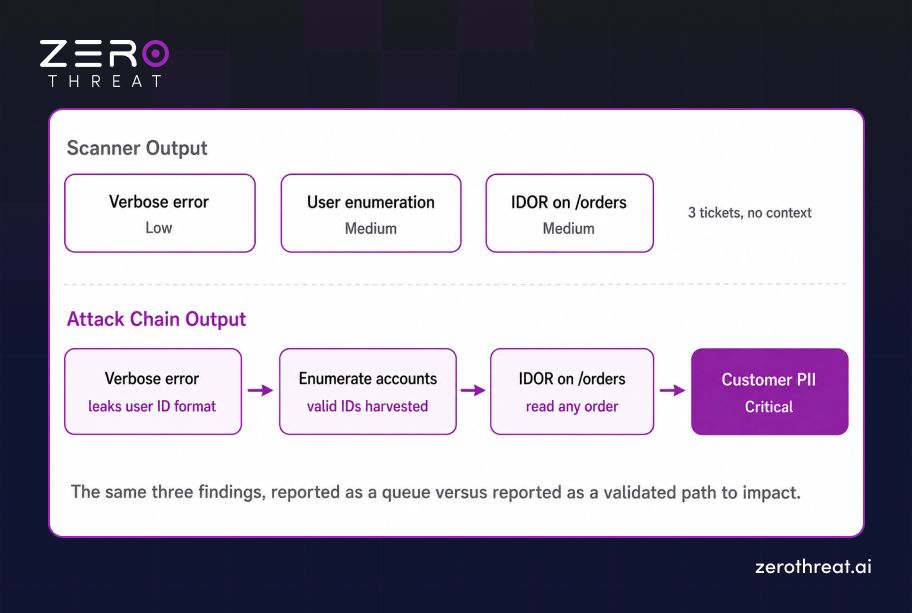
The harder question is chaining. Real intrusions rarely turn on one flaw. They compose a low-severity information disclosure into an account enumeration, into a privilege escalation, into data access. A platform that reports those three findings as three medium-severity items has given you a triage queue. A platform that reports them as one validated path to customer data has given you a decision.
What to ask the vendor
- Show me a report where a critical finding was produced by chaining two or more individually low-severity issues.
- How does the platform learn what a given workflow is supposed to do before it tries to abuse it?
- What classes of business logic flaw do you test for, and which do you explicitly not cover?
Disqualifying answer
Business logic coverage is described entirely as OWASP Top 10 category coverage, or the only chaining example offered is a generic diagram rather than a real customer finding.
2) Does It Validate Vulnerabilities Before Reporting Them?
Exploit validation means the AI penetration testing platform attempts to confirm a vulnerability is genuinely exploitable and attaches the evidence, rather than inferring its existence from a response pattern and flagging it for a human to verify.
Every vendor in this category will quote a false positive figure. The figure is unverifiable and largely meaningless on its own, because it depends entirely on the target set it was measured against. What is verifiable is the methodology behind it. Ask how a finding is confirmed, and the answer separates the field quickly.
Inference-based detection observes that a response contains a database error string and reports SQL injection. Validation-based detection constructs a follow-up request that demonstrates that the injection is real, captures the request and response pair, and includes it in the finding. The first approach generates triage work. The second generates evidence a developer can reproduce in under a minute.
Evidence quality is the proxy metric to score. For every finding, an enterprise buyer should expect the full request and response pair, the exact payload used, the endpoint and parameter, reproduction steps, and where relevant a capture of the resulting state change. If a vendor's sample report shows a severity rating and a paragraph of generic description, the platform is not validating anything.
What to ask the vendor
- Walk me through exactly how the platform confirms a finding is exploitable before it reaches my queue.
- What evidence artifacts ship with every finding, and can I see three unedited examples?
- Which finding types can you validate, and which are reported as unconfirmed?
- How is validation performed safely against a production environment?
Disqualifying answer
The platform cannot distinguish confirmed findings from inferred ones in its own reporting, or evidence consists only of a screenshot and a severity label.
3) Does It Cover Your Full Attack Surface and Application Stack?
Attack surface coverage for an AI pentesting platform means testing everything an external attacker can reach, from exposed infrastructure through to modern application and API layers, not just the pages a crawler can enumerate.
Coverage gaps are where evaluations quietly fail. A platform that tests web applications well but cannot parse a GraphQL schema leaves a large share of a modern enterprise stack untested. A platform that handles REST but ignores exposed infrastructure misses the initial access vector that the DBIR data now ranks first.
Break coverage into layers and confirm each one independently:
| Layer | What To Confirm |
|---|---|
| External infrastructure | Exposed ports, SSL and TLS configuration, DNS records, mail records, subdomain discovery |
| Web applications | Server-rendered apps, single page applications, JavaScript-heavy frontends, client-side routing |
| APIs | REST, GraphQL, SOAP, gRPC, WebSocket, spec ingestion via OpenAPI and Postman collections |
| Undocumented surface | Shadow and zombie endpoints, deprecated API versions, staging paths reachable in production |
| Authenticated surface | Post-login functionality, role-specific views, administrative interfaces |
Undocumented surface deserves particular attention. Most enterprises cannot produce a complete inventory of their own endpoints, and an API that no one documented is an API that no one secured. A platform that only tests what you hand it in a specification file is testing your documentation, not your attack surface.
What to ask the vendor
- How does the platform discover endpoints that are not in the OpenAPI spec I provide?
- How is a single page application with client-side routing enumerated and tested?
- Does GraphQL testing include introspection abuse, nested query depth, and field-level authorization?
- What is tested at the infrastructure layer, and is it part of the same assessment or a separate product?
Disqualifying answer
API coverage requires a complete specification file to work at all, or SPA support means the platform can render JavaScript but cannot reach state behind client-side navigation.
Every AI pentesting platform claims better coverage. See which capabilities actually matter before you buy. Explore AI Pentesting
4) Can It Handle Enterprise Authentication and Authorization?
Enterprise authentication handling determines how much of your application actually gets tested, because a platform that cannot hold a session past the login page will only ever assess the small unauthenticated portion of your attack surface.
This is the criterion that most often collapses during proof of concept, and it is the reason so many organizations have scanned reports that look clean. The unauthenticated surface of a typical enterprise application is a marketing page and a login form. Everything worth testing sits behind SSO.
Three separate capabilities hide inside this item and should be evaluated separately.
Authentication: Can the platform complete a SAML or OIDC flow, handle MFA, and refresh tokens when they expire mid-assessment? Session expiry during a long-running test is the most common cause of silently truncated coverage. Ask specifically what happens when a token expires at minute forty of a two-hour assessment, and whether the report tells you it happened.
Authorization: Testing access control requires more than one identity. The platform needs to hold concurrent sessions for at least two roles and attempt cross-role access to detect horizontal and vertical privilege escalation. A single-credential configuration cannot find BOLA or BFLA, no matter how good the engine is.
Session Integrity: Long assessments touch logout endpoints, password change flows, and session invalidation logic. A platform that logs itself out at minute ten and continues reporting clean results is producing a false negative, which is more dangerous than a false positive because nothing signals that it happened.
What to ask the vendor
- Which identity providers and MFA methods are supported without custom engineering work?
- How many distinct roles can be configured, and does the platform actively test cross-role access between them?
- What happens when a session expires mid-assessment, and does the report surface coverage lose to auth failure?
- How do you avoid triggering account lockout or destructive actions in an authenticated environment?
Disqualifying answer
Authentication requires a recorded login script that your team must maintain, or the platform supports only one credential set at a time and therefore cannot test authorization at all.
5) Does It Adapt During Testing, and Can It Explain Its Decisions?
Adaptive testing is what separates an AI pentesting platform from a scanner with a language model attached to its report generator, because it means the engine changes its attack plan based on what it observes rather than executing a fixed test suite.
This is the criterion most often skipped in enterprise evaluations, and it is the one that determines whether the label on the product is accurate. A conventional scanner decides what to test before it starts. An adaptive engine treats each response as input to the next decision: an unusual header suggests a technology stack, which narrows the payload set, which produces a response that reveals a role boundary, which becomes the next thing to probe.
The practical test is observable. Run the platform twice against two applications of similar size but different function, then compare the request volume and the test types executed. If the two assessments look near-identical, the engine is running a fixed plan and adapting nothing.
Explainability is the enterprise half of this item. Security teams increasingly have to justify autonomous tooling to risk committees and auditors, and "the AI found it" is not an answer that survives that conversation. Ask whether the platform can show the reasoning path behind a finding: what it observed, what it inferred, what it tried next, and why. Platforms that cannot expose that trail create an audit problem long before they create a security one.
What to ask the vendor
- Show me two assessments of different applications and explain why the test plans diverged.
- Can I see the decision trail for a specific finding, including what was tried and discarded?
- What does the engine do when it encounters a technology or framework it has not seen before?
- How do you prevent adaptive testing from taking destructive actions in a production environment?
Disqualifying answer
The AI component turns out to apply only to report summarization or remediation text generation, while detection itself runs a static rule set.
6) Does It Prioritize Findings by Business Impact?
Business-aware prioritization ranks findings by exploitability and consequence within your environment, rather than sorting a queue by CVSS severity, which tells you how bad something could be in theory and nothing about whether it matters to you.
The gap between severity and risk is well documented. Research from the Kenna Security and Cyentia Institute prioritization series found that fewer than two percent of published CVEs are ever exploited in the wild, and the EPSS model maintained by FIRST exists precisely because severity scoring correlates poorly with real-world exploitation. A enterprise security team working on a list of four hundred critical-rated findings without exploitability context has no rational starting point.
For the best AI pentesting tools, prioritization should draw on three inputs beyond severity: whether the finding was validated as exploitable, what the finding actually reaches in terms of data or function, and whether it forms part of a chain that terminates somewhere that matters. A validated IDOR exposing customer records on a payment service should outrank an unvalidated high-severity finding on an internal reporting tool, and the platform should be able to make that call without a human reordering the queue by hand.
Ask how an asset context enters the model. If the platform has no mechanism to learn that one application processes cardholder data and another serves as a marketing microsite, it cannot prioritize business impact regardless of what the datasheet says.
What to ask the vendor
- What signals feed the priority score beyond CVSS, and how are they weighted?
- How do I tell the platform which applications and data classes are business critical?
- Show me a case where a medium-severity finding was correctly ranked above a critical one.
- Can prioritization logic be tuned to our risk model, and is the adjustment auditable?
Disqualifying answer
Prioritization is CVSS sorting with a different label, or business context can only be applied manually after findings are delivered.
7) Does It Produce Actionable Output for Security and Development Teams?
Actionable output means the platform produces different artifacts for different audiences, because the attack path narrative a security team needs, and the reproduction steps developer needs are not the same document at different lengths.
Reporting is where most platforms are evaluated on volume and should be evaluated on fit. Three audiences consume the output of an enterprise pentesting program, and each fails differently when served with the wrong artifact.
Security teams need the attack path, the affected assets, the business impact, and the priority ranking. They are deciding what gets attention this sprint and what gets escalated.
Application teams need the endpoint, the parameter, the payload, the request and response evidence, reproduction steps, and remediation guidance specific to their framework. A finding that says "implement proper access control" with a link to an OWASP page will sit in the backlog. A finding that identifies the unprotected controller method and shows the fix pattern for that framework gets closed.
Executives and auditors need trend, coverage, and posture over time, plus evidence packages that satisfy an assessor without a security engineer rewriting them.
Retest workflow belongs to this item as well. When a developer fixes an issue, the loop should close inside the platform with a targeted retest that verifies the fix and updates the finding state. Programs that require a full reassessment to confirm a single fix do not close findings quickly, which is where remediation time quietly goes.
What to ask the vendor
- Show me the same finding as it appears to be a security lead and to a developer.
- Is remediation guidance specific to our language and framework, or generic to the vulnerability class?
- How does a developer trigger a retest of a single fixed finding, and how long does it take?
- Are compliance reports produced directly, or assembled manually from raw findings?
Disqualifying answer
Every audience receives the same PDF, or verifying a single fix requires re-running the entire assessment.
Enterprise security budgets deserve proof, not promises. Explore pricing built around continuous AI pentesting. View Enterprise Pricing
8) Does It Integrate with Your Existing Security Ecosystem?
Integration quality determines whether findings reach the people who fix them, and it should be evaluated on workflow behavior rather than on the number of logos listed on the integrations page.
A connector that opens a ticket is not an integration. The questions that matter are about state and behavior over time. When a finding is fixed and verified, does the ticket close automatically? When the same issue reappears in a later assessment, does it reopen the original ticket or create a duplicate? Duplicate generation is the fastest way for a security tool to lose the trust of an engineering organization.
For CI/CD, the useful distinction is between reporting and gating. A platform that posts results to a pipeline is informational. A platform that can fail to build on a defined policy, such as any validated critical finding on an internet-facing service, is a control. Ask what the assessment does to build duration, since a security step that adds thirty minutes to every pipeline run will be disabled within a month.
Priority order for an AI-powered pentesting platform is straightforward: CI/CD, ticketing, and vulnerability management aggregation carry the weight. SIEM and SOAR forwarding is useful for correlation but is rarely the deciding factor, because pentest findings are point-in-time evidence rather than runtime alerts. Weight the evaluation accordingly, and be wary of a vendor that leads with SIEM support to compensate for a thin ticketing integration.
What to ask the vendor
- When a finding is remediated and retested, what happens to the linked ticket without human intervention?
- How are recurring findings deduplicated across assessments?
- Can the pipeline fail on policy, and what is the added build time for an incremental assessment?
- Is the public API complete enough to drive assessments and pull results without the UI?
Disqualifying answer
Ticket sync is one-directional, or every assessment regenerates tickets for findings that already exist in the backlog.
9) Can It Scale and Test Continuously Across Hundreds of Applications?
Scale for an AI pentesting tool is a question of concurrency, program management, and commercial model together, because a platform that technically supports hundreds of applications, but prices per assessment will not be run continuously.
Enterprise portfolios are not ten applications. They are two hundred, with a long tail nobody owns, and they change weekly. That reality creates three requirements that a single-application demo will never surface.
Concurrency and Scheduling: How many assessments can run in parallel, and what happens at the limit? Ask for real numbers from a comparable customer rather than an architectural claim. Continuous testing also has to mean something specific: assessments triggered by deployment events, not a monthly scan renamed.
Program Management: At portfolio scale, the platform becomes an operational system. Application grouping, ownership mapping, environment separation, per-team access scoping, and aggregate posture reporting are what make findings routable to the right team without a central bottleneck.
Commercial Model: This is a technical criterion in disguise. If pricing is per assessment or per scan, continuous testing is financially penalized and teams will rate coverage. Model the cost of your actual intended cadence across your actual asset count before signing, not the cost of a quarterly assessment on twenty applications.
What to ask the vendor
- What is the largest deployment you run today, measured in applications and concurrent assessments?
- Does the pricing model change if we move from monthly to per-deployment testing?
- How are applications grouped and access-scoped so each team sees only its own findings?
- What does incremental testing look like when only one service has changed?
Disqualifying answer
Pricing is per scan with no continuous option, or portfolio management amounts to a flat list of targets with no ownership model.
10) Is It Enterprise-Ready on Governance and Data Residency?
Governance readiness covers where your assessment data lives, who can see it, whether it trains vendor models, and whether the platform can be deployed inside your own perimeter, and it is the item most likely to stop a purchase after technical evaluation has already passed.
An AI pentesting platform holds a detailed map of how to compromise your applications. That gives the vendor a supply chain risk with a concentration of sensitive material, and security committees treat it accordingly. Raise these questions early rather than discovering them in a security review three weeks before contract.
The specific items to confirm:
- Data Residency: Which regions can host assessment data, and is residency contractual or best effort?
- Model Training: Are your findings, traffic, or application data used to train models that serve other customers? Get this in writing, not on a call.
- Deployment Model: Is on-premise or private deployment available for regulated and air-gapped environments, and is it the same product or a reduced version?
- Access Control: Role-based access, SSO for the platform itself, and scoping so a team cannot view another business unit's findings.
- Audit Logging: Immutable logs of who ran against which target and who viewed the results. Testing authorization is a governance control.
- Retention and Deletion: How long is data kept, and what does deletion actually remove?
- Compliance Mapping: Findings mapped to OWASP Top 10:2025, PCI DSS, HIPAA, GDPR, and ISO 27001, plus attestation reports your assessors will accept.
On compliance reporting, the useful question is not whether reports exist. It is whether a report from this platform has been accepted by a QSA or an ISO auditor at a comparable organization. Ask for that reference specifically.
What to ask the vendor
- Is customer data ever used to train models, and where is that stated contractually?
- Which regions support full data residency, and does that include backups and logs?
- Is on-premise deployment functionally identical to the cloud product?
- Can you reference a customer whose auditor accepted your attestation report?
Disqualifying answer
Model training practices cannot be stated clearly, or data residency is described as a roadmap item rather than a current contractual commitment.
How to Validate the Checklist in a Proof of Concept
A proof of concept for an AI-driven pentesting tool should be a controlled comparison against a seeded application with known planted flaws, run identically across every vendor, because a vendor-run demo on a vendor-chosen target proves only that the platform works on that target.
Every criterion above can be claimed in a sales call. A structured proof of concept is the only way to test them. Design it before you schedule the first vendor.
Prepare the Target: Use a staging instance of a real application from your portfolio, ideally one with authentication, an API, and a multi-step workflow. Plant a known set of flaws that maps to the checklist: one injection flaw as a baseline, one IDOR reachable only after authentication, one business logic flaw in a multi-step workflow, and one chain that requires composing two low-severity issues. Keep the answer key with two people.
Hold Scope Identical: Same target, same credentials, same roles, same time window, same spec files, for every vendor. Any vendor requesting a different target or extended tuning time is telling you something about time to value.
Measure what the checklist cares about.
| Measure | Why It Matters |
|---|---|
| Planted flaws detected | Detection capability against a known answer key, including the business logic flaw and the chain |
| Unplanted valid findings | Real discovery capability beyond the seeded set, which is the more revealing number |
| False positives | Findings that cannot be reproduced from the supplied evidence, counted by your team |
| Authenticated coverage achieved | Share of post-login endpoints actually exercised, not just reached |
| Time to first validated finding | Practical measure of setup burden and time to value |
| Evidence usability | Have a developer reproduce three findings using only the report and time it |
| Setup effort | Engineering hours to first assessment, including authentication configuration |
What a vendor's response to the proof of concept tells you
Refusal to run against your application, insistence on a vendor-hosted demo environment, or a request to know which flaws were planted are all meaningful signals. So is a platform that needs weeks of tuning before it produces useful output, since that tuning burden does not disappear after purchase. It multiplies across every application you onboard.
Don't rely on feature sheets. See the platform to demonstrate exploit validation and attack discovery in real time. See a Live Assessment
Choosing on Evidence Rather Than Positioning
The ten criteria above share one property: none of them can be answered from a feature comparison table. They are answered by making a vendor demonstrate engine behavior against your application, with your authentication, at your scale, under your governance requirements. Enterprises that run this checklist properly tend to reach a decision faster than those that run a long feature-by-feature comparison, because most of the field eliminates itself on items 1, 2, and 4.
ZeroThreat was built against the failure modes this checklist is designed to expose. The platform perform application-aware pentesting that discovers business logic flaws and composes findings into validated attack chains rather than reporting them as an unranked queue. Findings are exploit-validated with full request and response evidence, which is how it sustains 99.9% detection accuracy with near-zero false positives across 130K+ attack patterns per assessment.
Authenticated and multi-step workflow testing runs without recorded scripts your team has to maintain, coverage extends from external infrastructure through web applications and APIs, prioritization is business-aware rather than severity-sorted, and reporting splits cleanly between the attack path view security teams need and the endpoint, parameter, and evidence detail application teams need. For regulated environments, on-premise deployment and compliance mapping to OWASP, PCI DSS, HIPAA, GDPR, and ISO 27001 are available in the same product.
The best way to evaluate any platform against this checklist is to run it. Sign up for ZeroThreat and test it against your own application, or explore AI pentesting, business logic testing, and authenticated security testing in more depth.
Frequently Asked Questions
How do you verify a vendor's false positive claims?
Ask for the validation methodology behind the number rather than the number itself, since the figure depends entirely on the target set it was measured against. Then verify it directly: run the platform against your own application, have your team attempt to reproduce every finding using only the supplied evidence, and count the ones that cannot be reproduced. Any finding without a request and response pair, payload, and reproduction steps should be treated as unvalidated.
What compliance frameworks should an AI pentesting platform support?
How long should a proof of concept for an AI pentesting platform take?
Explore ZeroThreat
Automate security testing, save time, and avoid the pitfalls of manual work with ZeroThreat.