 ZeroThreat Wins Bronze Stevie® Award in Tech Startup of the Year Read more

All Blogs
Real-Time CVE Mapping & Exploit Validation for Modern AppSec
Attackers weaponize newly disclosed CVEs in hours. According to VulnCheck's Q1 2025 analysis, 28.3% of exploited vulnerabilities were weaponized within one day of disclosure. Mandiant's M-Trends 2026 data puts the mean time to exploit at negative seven days, meaning attackers are exploiting some vulnerabilities before patches are even available. Against that backdrop, a scanner that updates its CVE database weekly is not a scanner doing its job.
Real-time CVE mapping changes that equation. But detection alone doesn't close the gap. The question security teams increasingly ask is not just "did the scanner find this CVE?" but "is this CVE actually exploitable in our application, and can you prove it?" That's where exploit validation comes in, and where most tools stop short.
ON THIS PAGE
- What Is Real-Time CVE Mapping?
- How Does Real-Time CVE Mapping Work in Web Security?
- Why the CVE-to-Exploit Window Has Collapsed
- From Detection to Validation: Why Detection Alone Is Not Enough
- Where Most CVE Scanners Stop Short
- How ZeroThreat Handles Real-Time CVE Coverage
- Evaluating CVE Coverage: Questions to Ask Any Pentesting Platform
- Conclusion
What Is Real-Time CVE Mapping?
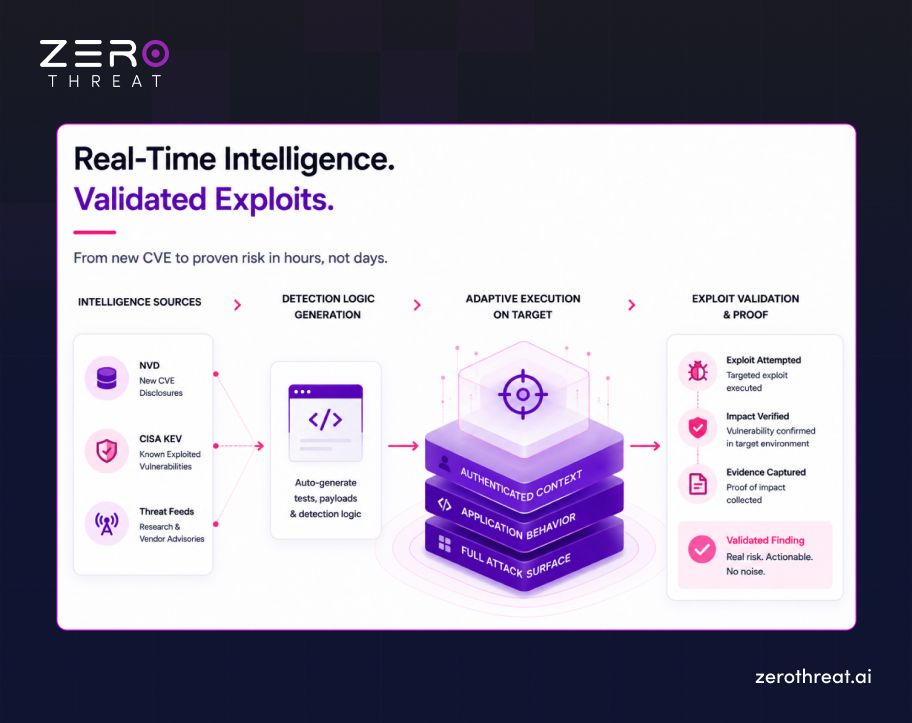
Real-time CVE mapping is the process of continuously ingesting newly disclosed vulnerability data from sources like the NVD, CISA KEV catalog, and threat intelligence feeds, and immediately translating that data into active detection logic that a scanner can execute against live applications. The goal is to close the gap between when a CVE is publicly disclosed and when your security tooling can test for it.
The key word is "continuously." Weekly database syncs are not real-time. An update cycle measured in days is a gift to attackers who operate in hours.
For web applications, effective CVE mapping also means more than signature matching. It requires understanding how a newly disclosed vulnerability class expresses itself in the context of a specific application's architecture, its authentication model, its API surface, and its client-side behavior. A scanner that adds a CVE identifier to its database without adapting its detection logic to the target application's context produces a check, not intelligence.
How Does Real-Time CVE Mapping Work in Web Security?
In practice, real-time CVE mapping at the platform level involves three components working together:
Intelligence ingestion. The platform continuously monitors CVE disclosures from NVD, CISA KEV, vendor advisories, and security research feeds. New CVEs are parsed, categorized by vulnerability class, and queued for detection logic generation.
Detection logic translation. The vulnerability data is mapped to active test cases. For a newly disclosed authentication bypass (BOLA, IDOR, or session fixation variant), the platform generates the test steps, payloads, and expected response patterns needed to probe for the condition in a real application.
Adaptive execution. The scanner dynamically applies newly generated detection logic against the target application's actual attack surface, adjusting execution based on authentication state, API behavior, workflow responses, and runtime application context rather than relying on static payload lists alone. This is where interpreter-driven vulnerability intelligence becomes operationally important, because effective real-time CVE coverage depends on adapting exploit validation to how the application actually behaves.
In practice, this means newly disclosed vulnerabilities are not treated as static signatures but as executable attack workflows that can be continuously updated as new threat intelligence emerges. ZeroThreat implements this through an interpreter-driven execution layer that ingests emerging threats and newly disclosed CVEs, translating them into executable detection and validation workflows within hours rather than days.
Why the CVE-to-Exploit Window Has Collapsed
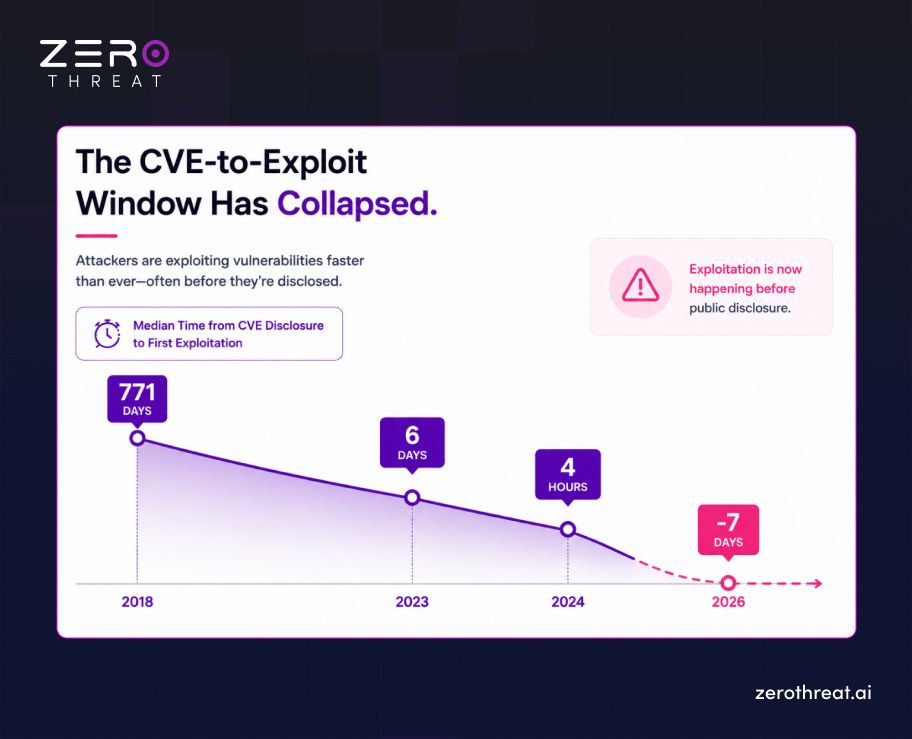
In 2018, the median time from CVE disclosure to first confirmed exploitation in the wild was 771 days. By 2023, that window had compressed to six days. By 2024, to four hours. According to Mandiant's M-Trends 2026 data, the mean time to exploit is now negative seven days, meaning exploitation is increasingly happening before public disclosure.
How Long Does It Take Attackers to Exploit a New CVE?
The answer in 2026 is: often before defenders know the CVE exists.
The 2025 threat landscape reinforced this pattern. Chrome V8's CVE-2025-10585 was actively exploited within 24 hours of disclosure. Fortinet FortiClient EMS's CVE-2026-35616 was weaponized almost immediately. CrowdStrike's 2026 reporting found that 42% of exploited vulnerabilities were attacked before public disclosure.
The 2025 DBIR confirmed vulnerability exploitation represented 20% of all breaches, up 34% year-over-year. Verizon reported that exploitation of vulnerabilities as an initial access vector grew by 34%, accounting for one in five intrusions.
The attack surface is also expanding faster than coverage can keep up. Over 21,000 CVEs were disclosed in H1 2025 alone, roughly 133 new vulnerabilities per day. Over one-third were rated High or Critical.
For web application security teams, the implication is direct: a scanner that updates on a weekly or monthly cycle is working from data that is already out of date. Real-time CVE mapping is not a premium feature. It's the baseline requirement for meaningful web application testing.
From Detection to Validation: Why Detection Alone Is Not Enough
Detecting a CVE and validating whether it's exploitable in a specific application are two entirely different operations. Most DAST tools do the first. Very few do the second reliably.
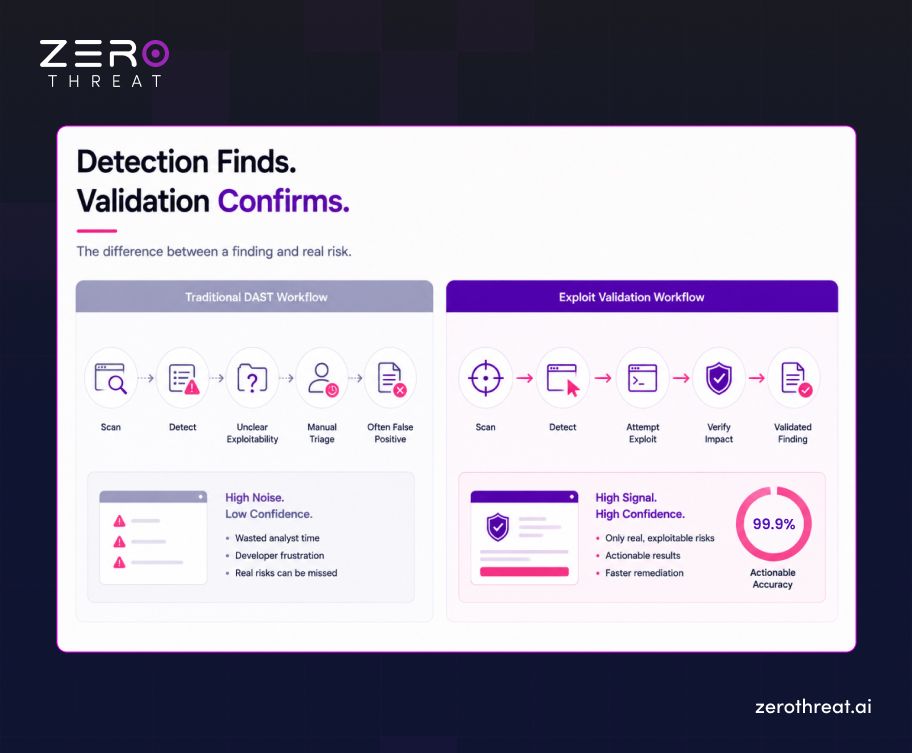
Here's what typically happens without exploit validation. A scanner identifies that the application is running a version of a library associated with CVE-XXXX-YYYYY. It raises a finding. The analyst opens a ticket. The developer looks into it and discovers that the specific code path that would make this CVE exploitable is not present in their implementation. The finding was a detection, not a validated exploit. That's a false positive, and triage time was wasted.
What Is Exploit Validation in Penetration Testing?
Exploit validation is the process of confirming that a detected vulnerability is actually exploitable in the target environment, with demonstrable evidence of impact. A validated finding means the platform attempted the exploit, confirmed it succeeded, and captured proof of what was exposed: session data, sensitive records, privilege escalation evidence, or a reproduction path a developer can follow.
Without validation, detection is a guess. With it, the finding is actionable.
How to Reduce False Positives from CVE Scanners
The answer is not to adjust alert thresholds or suppress noisy findings after the scan completes. Reducing false positives requires active exploit validation before findings are surfaced to analysts.
In practice, this means candidate vulnerabilities must be re-tested in the context of the actual application to determine whether the exploit path is reachable, whether authorization boundaries can be bypassed, and whether the vulnerability produces meaningful impact in the target environment. Findings that cannot be reproduced or validated in context should be filtered before entering remediation workflows.
ZeroThreat applies this through an exploitability-first validation layer integrated directly into the detection pipeline. After the scanner engine identifies a potential issue, the Platform AI re-tests the specific condition in the specific application context. If the exploit doesn't succeed in this environment, the finding is filtered out before it reaches the analyst. The result is a 99.9% accuracy rate, which means the false-positive tax that drains analyst hours from traditional DAST pipelines is largely eliminated.
This is not a post-hoc filter applied to a long finding list. It's a validation step built into the detection pipeline, which is why we frame it as exploitability-first rather than detection-first.
Where Most CVE Scanners Stop Short
Traditional DAST tools were built for a different web. They crawled pages, sent payloads to form fields, and checked HTTP responses against known patterns. That model worked reasonably well for static applications in 2012.
Modern web applications present a different challenge. Single-page applications render entirely in the browser, authenticate users through complex OAuth flows, and expose most of their attack surface through APIs rather than HTML forms. A scanner that doesn't understand JavaScript execution, stateful session management, and API-level interactions will miss significant portions of the attack surface, and therefore miss CVEs that express themselves in those layers.
CVE mapping for single-page applications
SPAs are where legacy DAST coverage breaks down. When the application's critical flows are driven by React, Vue, or Angular, and authenticated through token-based APIs, a scanner that can't maintain stateful sessions or execute multi-step browser interactions simply doesn't see the attack surface that matters most.
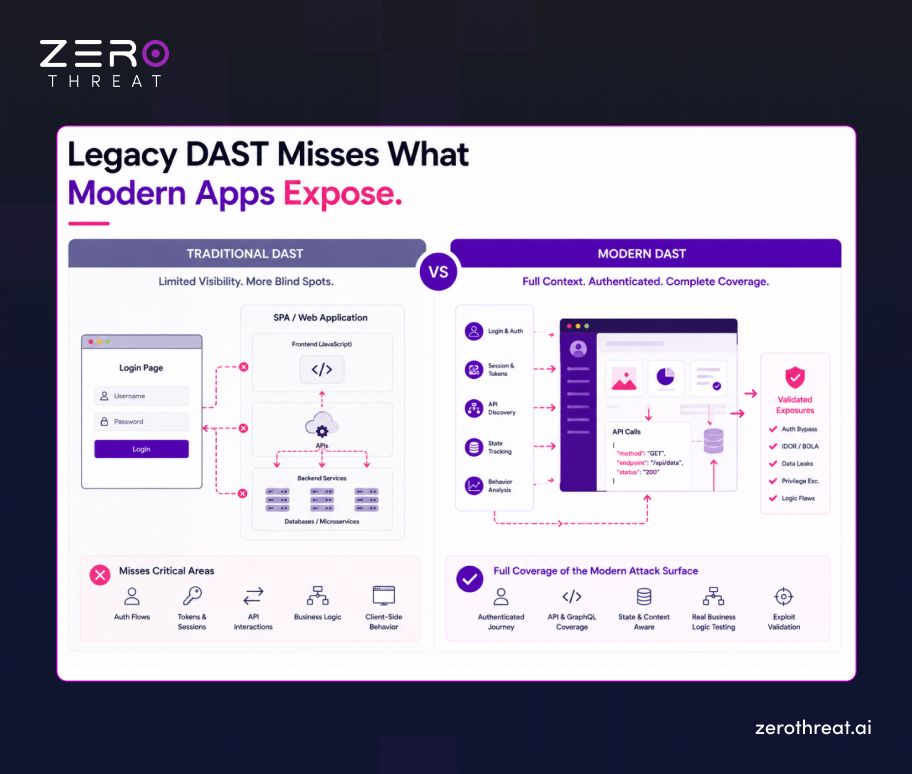
ZeroThreat addresses SPA coverage through deep user-journey scanning via Playwright, which provides advanced browser automation capable of executing authenticated flows, navigating multi-step workflows, and maintaining session state throughout the scan. CVE checks mapped to client-side authentication patterns, CSRF conditions in API calls, and IDOR vulnerabilities in parameterized endpoints are executed in the context of the actual user journey, not a simplified crawl approximation.
This distinction matters for real-time CVE mapping specifically. If a newly disclosed CVE affects an authentication mechanism that only expresses itself inside an authenticated session, a scanner that can't reach authenticated state will never test for it, regardless of how quickly it updated its CVE database.
How ZeroThreat Handles Real-Time CVE Coverage
ZeroThreat's approach to CVE mapping is structured around three capabilities that work together.
Interpreter-driven vulnerability intelligence. The platform continuously ingests emerging threat data and newly disclosed CVEs, translating them into active detection logic within hours. This is not a database sync. It's an intelligence layer that updates what the platform tests and how it tests it, based on the specific nature of each new vulnerability class.
130,000+ executable attack checks with custom, Burp and Nuclei-based template execution. When a newly disclosed CVE has a corresponding Nuclei template or Burp-compatible check, ZeroThreat executes it live against your application within hours of the CVE becoming available. Teams can also author custom templates for organization-specific attack scenarios, extending CVE coverage to threats that public databases haven’t cataloged yet.
Zero-day signal detection. ZeroThreat extends CVE coverage beyond the CVE publication cycle itself. Behavioral pattern analysis and exploit-primitive recognition surface vulnerability signals in authorization bypass, state desynchronization, and multi-step logic flaws before any CVE identifier has been assigned. This closes the gap between when attackers begin exploiting a vulnerability and when defenders have a signature to test against.
In practice, this means that when a critical CVE is disclosed, ZeroThreat's agentic AI pentesting platform can be testing for it in your application the same day, with findings that arrive already validated for exploitability.
Evaluating CVE Coverage: Questions to Ask Any Pentesting Platform
When assessing any web application security tool's CVE handling, the marketing claim is less useful than the operational answer to specific questions.
What is the CVE-to-detection latency? A specific number matters more than "real-time." Hours is defensible. "Weekly updates" is a gap attackers can use.
Does the tool validate exploitability, or just detect presence? If a scanner reports that a CVE-affected version was found but doesn't confirm whether the exploit path succeeds in your specific application, that finding requires manual triage time to confirm.
Does it cover authenticated flows and SPA attack surfaces? A CVE that only expresses itself inside an authenticated session, or through an API call that requires a valid bearer token, will be invisible to a scanner that can't maintain stateful sessions.
What happens when a new CVE lacks a public signature? Zero-day signal detection based on behavioral patterns extends coverage beyond cataloged vulnerabilities. Ask whether the platform detects vulnerability classes or only named CVEs.
Is the finding evidence attached? Proof-based findings include reproduction steps, exposed data evidence, and a clear impact description. These are what compliance audits and remediation workflows require.
Conclusion
The gap between CVE disclosure and active exploitation has closed to the point where weekly scanner updates are a structural liability. Real-time CVE mapping reduces that lag to hours. Exploit validation closes the second gap: the distance between detecting a vulnerability and knowing it's actually exploitable in your specific application.
Security teams running modern web applications need both. Detection without validation generates a triage backlog. Real-time coverage without deep scan reach misses vulnerabilities that only express themselves inside authenticated sessions or SPA flows.
See how ZeroThreat runs proof-based pentesting on your application: explore the agentic AI pentesting platform.
Frequently Asked Questions
What is the difference between real-time CVE mapping and standard vulnerability scanning?
Standard vulnerability scanning typically relies on a periodically updated signature database. Real-time CVE mapping means the platform continuously ingests new CVE disclosures and immediately translates them into active detection checks, reducing the lag between public disclosure and scanner coverage from days or weeks to hours. For web application security specifically, this means newly disclosed vulnerabilities affecting APIs, authentication mechanisms, and SPA frameworks are testable far faster.
How to validate CVE exploitability automatically?
Why do CVSS scores not tell you whether a CVE is exploitable in your application?
What does real-time CVE coverage within hours mean in practice?
Can an AI-powered pentesting platform detect zero-day vulnerabilities before a CVE is published?
Related Articles

Explore ZeroThreat
Automate security testing, save time, and avoid the pitfalls of manual work with ZeroThreat.