 ZeroThreat Wins Bronze Stevie® Award in Tech Startup of the Year Read more

All Blogs
Quick Overview: Explore the 8 most dangerous cyber-attacks targeting the healthcare industry—from ransomware to insider threats. Learn how they impact patient data and operations, and discover effective strategies to prevent, detect, and fix these critical security vulnerabilities.
In recent times, the healthcare industry is not just about saving lives; it’s about protecting them from a silent but deadly adversary: cybercrime or cyberattacks.
Let’s imagine - a life-support system in a hospital goes dark or shuts down mid-surgery. It’s not because of a power outage, but a hacker just locked down the entire network with a single click. And this is not a scene from a thriller movie, but it’s reality in healthcare.
In 2023, 89% of healthcare organizations have experienced data breaches, with the average cost reaching $10.93 million. Cybercriminals are targeting hospitals, clinics, and insurers at alarming rates, putting not just data at risk, but lives.
Now the question is – why healthcare?
The answer is very simple. In healthcare, patient records are worth up to $1,000 per record on the dark web, which is ten times more than a stolen credit card. From SSNs to medical histories, the data is a goldmine for cyber criminals.
Consider the 2021 ransomware attack on Ireland’s Health Service Executive (HSE). It disrupted services nationwide and took months to recover. Or the WannaCry attack on the UK’s HNS in 2017, which canceled over 19,000 appointments and cost an estimated £92 million.
In fact, over 90% of healthcare organizations experienced at least one cybersecurity breach in the last three years. And surprisingly, most of them had vulnerabilities that could have been identified early through penetration testing.
These aren’t isolated incidents, they’re warnings.
In this blog, we will discover the most common and dangerous vulnerabilities found during healthcare penetration testing, from broken access controls to API misconfigurations and third-party app risks. But we’re not just stopping at what’s wrong. Also, we’ll walk you through how to fix each one using proven best practices and tools that won’t slow down operations.
Because in healthcare, every vulnerability you fix is a step toward saving lives.
Thousands use our tool to detect threats early. Don’t get left behind—get insights before attackers strike. See How It Works
On This Page
- Cybersecurity Threats to Healthcare
- Time to Bring in the Professional Pentesting Tool: ZeroThreat
- Wrapping Up
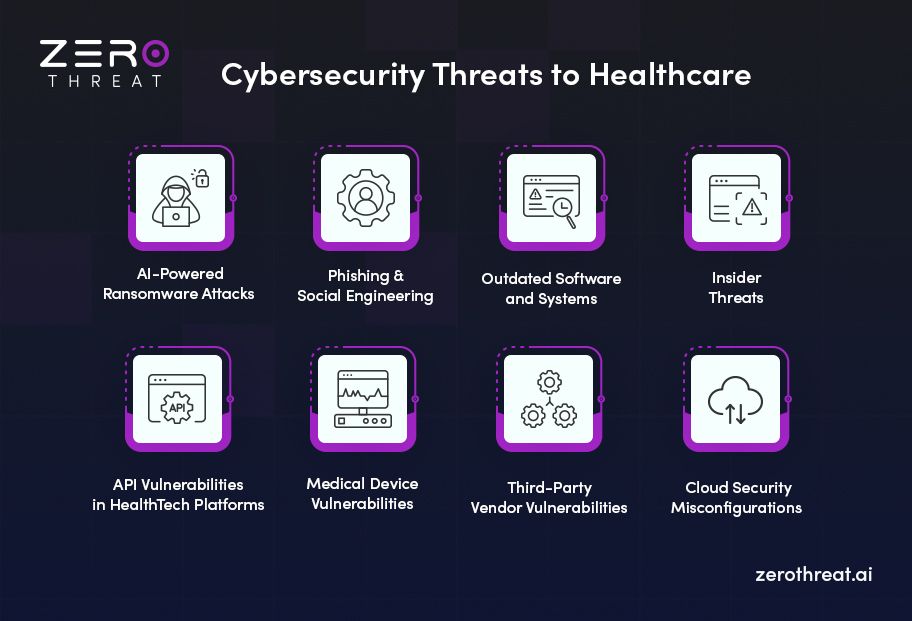
Top 8 Cybersecurity Threats to Healthcare in 2026
Cyber threats are constantly evolving. So is the healthcare industry. They are embracing AI-driven diagnostics, cloud-based EHRs, and interconnected medical devices, while becoming a prime target for cyber threats.
Here are the biggest healthcare security threats shaping the industry this year.
1) AI-Powered Ransomware Attacks
Healthcare organizations store some of the most sensitive and personal information about individuals. Therefore, it makes them prime targets for ransomware attacks. This inherent vulnerability puts them at the center of growing cybersecurity threats.
This type of attack involves malicious software, often a trojan or worm, that infiltrates systems and encrypts all the data on the affected machines. Once the data is locked, attackers display a ransom message demanding payment in exchange for restoring access to the compromised information.
It’s not only about stealing sensitive data, but they also threaten to leak it publicly.
How to Prevent: You must implement a zero-trust approach and strong perimeter defense to prevent ransomware vulnerability. You must ensure that backups are performed regularly, encrypted, and stored offline. Invest in advanced Endpoint Detection and Response (EDR) tools that detect and isolate threats in real time. Start implementing strict email filtering to catch malicious attachments or links before they reach inboxes.
2) Phishing & Social Engineering
We all know that hospitals and clinics operate in fast-paced environments, where urgency is constant. This makes them especially vulnerable to phishing attacks, as busy employees may inadvertently share sensitive information without thorough verification in the rush to respond quickly.
Therefore, attackers now use AI to craft personalized phishing emails and voice scams that are incredibly convincing. This information is later used to commit identity theft.
How to Prevent: The best way to prevent phishing is always to double-check the provenance of any email. You must deploy secure email gateways that use AI to detect deepfake content and malicious impersonation. In addition, implementing Multi-Factor Authentication (MFA) can prevent credential compromise.
3) Outdated Software and Systems
You always get irritated whenever there’s a software update, right? Now you won’t because every software update or patch release comes with fixes for security vulnerabilities. Unfortunately, many healthcare systems still operate on outdated software because updates can be costly, time-consuming, and risk disrupting patient care. As a result, these legacy systems become easy targets for cybercriminals, full of known vulnerabilities waiting to be exploited.
For instance, take electronic health records (EHRs) systems. Many were developed years ago and haven’t been updated, leaving sensitive patient data protected by outdated defenses. It’s like locking a vault with a broken key.
How to Prevent: If it’s not possible for you to update legacy systems immediately, just isolate them within a tightly controlled environment. You may choose the right vulnerability scanners to detect missing patches and outdated software. Along with that, you can also establish a strict patch management program with automated updates and scheduled maintenance windows.
4) Insider Threats (Intentional & Unintentional)
Not all cybersecurity threats arise from outside attackers. Insider threats, whether intentional or accidental, pose a serious risk in healthcare. Employees, contractors, or even patients with access to sensitive systems can steal and leak critical information. Given the massive volume of information moving through healthcare environments daily, it’s alarmingly easy for an insider to go undetected until the damage is already done.
Sometimes, the objective of insider threats is a financial goal. They would want to sell patient data on the black market. Other times. It’s due to the carelessness of employees. They randomly click on malicious links or unintentionally expose sensitive data. Regardless of intent, the consequences can be devastating, putting patient privacy, organizational reputation, and regulatory compliance at serious risk.
How to Prevent: Prevention of insider threats begins with the principle of least privilege. It means you only have to grant access to the data and systems necessary for a user’s role. Also, a strong onboarding process should be implemented, including immediate revocation of credentials when employees leave. Monitor activity with user behavior analytics to flag anomalies like large file transfers or unusual login times.
5) API Vulnerabilities in HealthTech Platforms
While the healthcare sector is moving towards EHR, mobile health apps, wearables, and other online platforms, APIs (Application Programming Interfaces) play a critical role in enabling interoperability. But with this connectivity comes a massive attack surface.
Many HealthTech platforms expose APIs to facilitate data sharing, appointment scheduling, prescription tracking, and remote patient monitoring. However, if these APIs are not properly secured, they become gateways for attackers to access highly sensitive patient data.
The top common API vulnerabilities can be found, such as broken authentication and authorization, excessive data exposure, inadequate rate limiting, lack of encryption, and improper access controls.
How to Prevent: Secure APIs are critical in today’s health tech ecosystem. Use an API gateway security to manage traffic, enforce rate limiting, and require authentication tokens. You can also implement logging and monitoring for all API activities. Go for regular API penetration testing, especially for mobile apps and patient-facing portals. Also, choose the best API pentesting tool that follows the OWASP API Security Top 10 practices, including input validation, proper authentication and authorization for every request.
Don’t wait for a breach. Secure your systems before attackers find the gaps. Talk to a Security Expert
6) Medical Device Vulnerabilities: The Internet of Medical Things (IoMT)
As the Internet of Medical Things (IoMT) continues to grow, the security risks associated with connected medical devices are increasing. From pacemakers to insulin pumps, Internet-connected devices often lack strong security controls. Attackers can exploit these endpoints to pivot inside the hospital network or manipulate patient care devices.
IoT devices have opened the industry to significant cyber security risks, including ransomware, data breaches, DDoS attacks, and more.
How to Prevent: To prevent IoMT-related breaches, secure every connected medical device from the moment it’s used. The first thing you should do is to maintain an up-to-date inventory of all IoMT assets and ensure each device is properly segmented on the network. Choose a manufacturer who prioritize cybersecurity in their firmware and provides regular updates.
7) Third-Party Vendor Vulnerabilities
While developing healthcare software or systems, they always leverage third-party vendors to streamline and improve operations. In fact, the healthcare industry depends heavily on a vast ecosystem of third-party vendors, from cloud providers and software developers to building and data processing firms. This way, the healthcare industry can introduce significant security risks with every external connection.
Third-party vendors often lack the best security compliance and practices that healthcare providers implement. Any vulnerability in their systems can become a gateway for cyber attackers. If a vendor gets compromised, attackers can easily access the connected healthcare organization, bypassing its frontline defenses altogether.
How to Prevent: The first step to mitigate this vulnerability is to start vendor vetting. Assess cybersecurity practices, certifications, and incident history before making any deal. Establish security requirements in agreements, and ensure vendors follow regulated industry security standards and compliance like HIPAA or ISO 27001. Use access control limit what third parties can see or interact with.
8) Cloud Security Misconfigurations
The shift to the cloud has transformed how healthcare organizations store, access, and share data. On the other hand, it has introduced new risks – misconfigurations. A single misconfigured cloud storage bucket can expose thousands of patient records, effectively leaving the digital vault wide open.
And that’s a fact. Healthcare data breaches caused by cloud misconfigurations have already made headlines. The issue is not that the cloud is inherently insecure; it’s that many healthcare organizations fail to configure it correctly. One small weakness can result in massive data exposure, regulatory violations, and long-term reputational damage.
How to Prevent: Preventing cloud misconfigurations means “secure by default” settings and automated compliance checks. You can use IaC templates that follow DevSecOps best practices by integrating security checks into the CI/CD pipelines. In addition, you can enable identity and access management (IAM) with granular controls, and ensure every cloud resource is configured with encryption, logging, and least-privilege access.
Time to Bring in the Professional Pentesting Tool: ZeroThreat
With the rise of cyber attacks, making yourself dependent on outdated security scanners or manual checks is not just ineffective but also dangerous. Healthcare organizations need more than just firewalls and endpoint protection. They need a smart, proactive, and efficient security testing tool, and that’s where ZeroThreat comes in.
ZeroThreat is a next-generation penetration testing platform built for the demands of modern healthcare IT. Whether you're dealing with EHR systems, cloud-hosted patient portals, or third-party APIs, ZeroThreat goes far beyond surface-level scans.
It’s designed to mitigate the exact threats that plague healthcare today, from ransomware and exposed APIs to insider threats. ZeroThreat identifies vulnerabilities with near-zero false positives, thanks to its AI-driven analysis engine.
What ZeroThreat can do for you:
- Scans authenticated pages and APIs
- Supports MFA environments
- Integrates into CI/CD pipelines
- Generates actionable, compliance-friendly reports
Choose the best plan with ZeroThreat and stop threats before they become headlines.
Your app might already be exposed. Run a free scan now—before hackers do. Scan My App Now
Wrapping Up
Now we know, cybersecurity is no longer optional, it’s essential. Therefore, healthcare providers must stay proactive to find and mitigate evolving threats. And the right pentesting tool and vulnerability scanner can make all the difference.
Remember – protecting patient data means protecting lives. It’s time to strengthen your security posture before it’s too late.
Frequently Asked Questions
What are the top vulnerabilities discovered in healthcare penetration testing?
Top vulnerabilities discovered during healthcare penetration testing often include weak passwords, outdated software, misconfigured systems, web app vulnerabilities, phishing & social engineering, and ransomware.
Why is penetration testing particularly important for healthcare organizations?
How often should healthcare organizations conduct penetration testing?
What key components should be included in a healthcare pen‑test report?
Is penetration testing mandatory to comply with HIPAA?
What are the risks of not performing regular penetration testing?


Explore ZeroThreat
Automate security testing, save time, and avoid the pitfalls of manual work with ZeroThreat.