 ZeroThreat Wins Bronze Stevie® Award in Tech Startup of the Year Read more

All Blogs
HIPAA Penetration Testing Explained: Requirements, Best Practices, and Tools
Blog Overview: In this guide to HIPAA penetration testing, let’s understand key requirements, preparation steps, tool section, and how to choose the right testing platform. Discover how ZeroThreat simplifies the process with automated, accurate, and compliance-ready solutions.
Did you know that in just 2023, over 93 million healthcare records were exposed or stolen in data breaches at business partners? That’s even more than the 34.9 million records breaches at hospitals and clinics. And the numbers keep growing. These breaches don’t just lead to big fines, like the $16 million penalty in the well-known Anthem breach of 2015, they also damage patient trust and hurt the reputation of healthcare organizations.
Another example is – the U.S. Department of Health and Human Services (HHS) reported over 725 major healthcare data breaches, exposing more than 133 million patient records. That’s nearly 40% of the entire U.S. population. From ransomware attacks crippling hospitals to phishing scams tricking employees into handing over access, the threats are real, relentless, and rising. And the average cost of a healthcare data breach is $10.1 million—the highest among all industries.
That’s where HIPAA penetration testing has to come into the picture. Definitely, not as a regulatory luxury, but as a critical frontline defense.
Imagine a simulated, real-world attack aimed at your systems: can your access controls, authentication, and encryption measures hold up? Are misconfigurations in EHR platforms, cloud storage, or network devices quietly opening the door to data thieves?
Now the question is, what is HIPAA compliance?
The Health Insurance Portability and Accountability Act (HIPAA) is a set of rules and regulations that protect users' personal health information. According to HIPAA, any organization, company, hospital, or pharmaceutical company that uses and stores confidential health information is required to carry out continued risk assessments through penetration tests or vulnerability assessments.
Ready to Strengthen Your HIPAA Compliance with Real-World Security Testing? Get a Free Pentest Demo
On This Page
- Does HIPAA Compliance Involve Conducting Penetration Tests?
- What is HIPAA Penetration Testing?
- HIPAA Penetration Testing Requirements
- Preparation for a HIPAA Pentest
- How to Choose The Right HIPAA Pentesting Platform?
- How ZeroThreat Can Help with HIPAA Penetration Testing
- Conclusion
Does HIPAA Compliance Involve Conducting Penetration Tests?
When being asked – Does HIPAA require penetration testing, the short answer is “NO”. HIPAA doesn’t explicitly say “you must perform penetration testing.”
But when we dig deeper and see the bigger picture, the answer is: yes. If your organization wants to stay compliant and truly secure, penetration testing is strongly required and recommended.
In fact, penetration testing in healthcare supports various HIPAA requirements and aligns with NIST recommendations for compliance.
Let’s break it down.
HIPAA’s Security Rule outlines three types of safeguards:
- Administrative
- Physical
- Technical
Now, within these, there are two types of implementation specifications:
- Required: must be implemented
- Addressable: must be assessed and implemented if reasonable and appropriate
Penetration testing falls under the addressable specification for Security Management Process (§164.308(a)(1)(ii)(A) – Risk Analysis) and Evaluation (§164.308(a)(8)).
These rules mandate that covered entities and business associates must:
- Identify potential risks and vulnerabilities to electronic Protected Health Information (ePHI)
- Implement security measures sufficient to reduce risks to a reasonable and appropriate level
- Periodically evaluate the effectiveness of those measures
That’s where HIPAA penetration testing becomes vital.
What is HIPAA Penetration Testing?
HIPAA penetration testing or HIPAA pentesting, is a type of security assessment conducted under the HIPAA Security Rules, by a data security analyst, to identify vulnerabilities in systems that handle electronic protected health information (ePHI) to ensure compliance with the Health Insurance Portability and Accountability Act (HIPAA).
The security experts conduct the test, which simulates real-world cyberattacks to uncover weaknesses in an organization’s security posture, particularly those related to ePHI storage and transmission. This helps organizations understand their risks and take steps to protect sensitive patient data.
HIPAA Penetration Testing Requirements
Let’s understand what every healthcare organization needs to do for HIPAA penetration testing.
Risk Analysis
Risk Analysis is a cornerstone of HIPAA compliance requirements.
It’s the foundation of every security measure a healthcare organization implements to protect sensitive data.
In simpler terms, it answers the questions:
- Where is ePHI stored, accessed, or transmitted?
- What could go wrong?
- How likely is it?
- What’s the potential impact?
This includes looking at:
- Weaknesses in software, hardware, or workflows
- Insider threats or third-party risks
- Gaps in access controls, encryption, or backups
- Emerging attack vectors (like phishing or ransomware)
If we give you an example, in 2022, the OCR fined a mental health clinic $250,000 for failing to conduct an enterprise-wide risk analysis. When a breach occurred, they could not prove they had evaluated or mitigated the risk beforehand. This led to costly oversight.
Risk analysis identifies the “what-if” scenarios.
While considering penetration testing, it validates those scenarios in the real world. It helps your organization confirm whether your controls are functioning well and if your assumptions about risk exposure hold true, making it a natural companion to the HIPAA risk analysis requirement.
Fixing Vulnerabilities
Finding vulnerabilities is only half the battle. And fixing them is where true HIPAA compliance and security begins.
Under the HIPAA Security Rule, identifying risks is required, but you don’t have to stop there. Your organization must implement security measures “sufficient to reduce risks and vulnerabilities to a reasonable and appropriate level.” That means you’re expected not just to detect issues, but to respond and remediate them effectively.
In fact, you must choose an automated pentesting tool that can be integrated into the SDLC or DevOps pipeline to find and fix vulnerabilities early. As a result, it saves your time, reduces human error, and ensures continuous protection.
Continuous Monitoring
HIPAA compliance isn’t a one-time checklist, but a continuous activity.
You need to have continuous monitoring to ensure HIPAA compliance. This practice helps you track your systems, networks, and applications for threats, misconceptions, unauthorized access, and vulnerabilities in real-time.
Find Out If Your Systems Can Withstand a Real Attack Before Someone Else Finds Out Start My Risk Assessment
Preparation for a HIPAA Pentest
While talking about cybersecurity in healthcare, effective preparation is key to ensuring the success of a HIPAA pentest. In fact, it’s essential to have a clear understanding of the healthcare organization’s technology infrastructure.
Here’s a step-by-step guide on how to prepare for a HIPAA pentest.
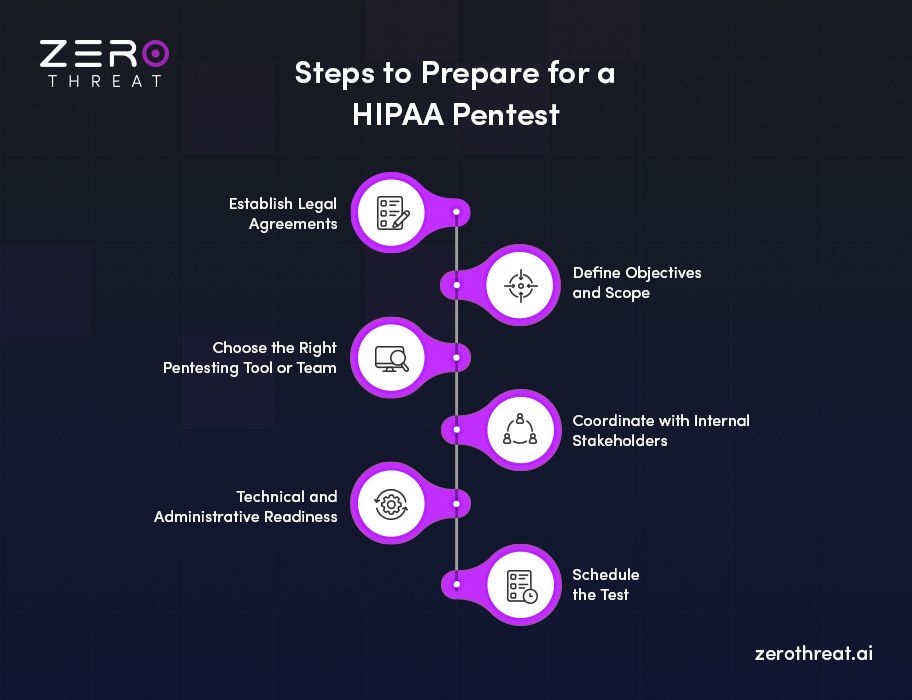
1) Establish Legal Agreements
Before any penetration testing in healthcare begins, especially in a HIPAA-regulated environment, you must do thorough research at the ground level.
You’re not just testing any system; you're dealing with environments that store, process, or transmit Protected Health Information (PHI). That means trust, legal clarity, and shared understanding are critical.
This is where legal agreements come into play.
Healthcare providers and their cybersecurity partners should establish legal agreements such as Non-Disclosure Agreements (NDAs), Business Associate Agreements (BAA), Rules of Engagement (RoE), and Confidentiality & Liability Clauses to ensure the confidentiality of sensitive information.
2) Define Objectives and Scope
Having a clear understanding and scope of penetration test aligns with your security goals, HIPAA requirements, and operational realities, without missing critical vulnerabilities.
A well-defined scope helps you:
- Avoid testing irrelevant systems
- Focus on high-risk areas (like systems handling ePHI)
- Prevent accidental exposure or downtime
- Produce actionable, compliant reports for auditors
3) Choose the Right Pentesting Tool or Team
When it comes to HIPAA penetration testing, choosing the right pentesting tool or partner can make or break your effort. And not just in terms of security findings, but in staying compliant, audit-ready, and patient-trustworthy.
What to Look For in a Pentesting Tool
If you go for an automated pentesting platform, ensure it offers:
- Support for authenticated testing (especially on patient portals, admin consoles, APIs)
- Cloud-native compatibility (AWS, Azure, GCP environments)
- Customization of test cases aligned with HIPAA risks
- Compliance-ready reporting with remediation suggestions
- Integrations with DevSecOps pipelines (to automate and speed up fixes)
Bonus if it includes:
- AI-assisted threat detection
- Real-time dashboards for faster risk triage
- Zero configuration deployment options for ease of use
What to Look for in a Pentesting Team
If you’re hiring an external ethical hacking team or consultancy, ask:
- Do they have healthcare or HIPAA experience?
- Are they certified (OSCP, CEH, CISSP)?
- Do they provide a signed Business Associate Agreement (BAA)?
- Can they work within your specific rules of engagement?
- Will they provide both technical findings and executive summaries for compliance reporting?
Also, check if they’ve worked with EHR platforms, medical IoT devices, or HIPAA-regulated cloud infrastructures.
4) Coordinate with Internal Stakeholders
Having coordination between internal stakeholders ensures the test runs smoothly, securely, and without operational friction. Because if a pentest is poorly communicated, it can trigger alerts, interrupt workflows, or even be mistaken for actual attacks.
5) Technical and Administrative Readiness
Ensuring the readiness of the technical environment and administrative controls makes life easier for the testing team. It avoids unintended data exposure, system downtime, or compliance missteps.
Consider it as the pre-operation checklist for your healthcare infrastructure. Every detail matters, and skipping steps can create risks instead of reducing them.
6) Schedule The Test
Once all the above requirements are checked, the next critical step is to schedule a HIPAA pentest thoughtfully.
In the healthcare industry, where uptime can directly impact patient care, the test window must be carefully planned to balance thorough security evaluation with minimal operational disruption.
This is how healthcare organizations can effectively prepare for a HIPAA penetration test and achieve their security objectives.
Don’t Just Check The Compliance Box, Build Real Resilience Start Pentesting Now
How to Choose the Right HIPAA Pentesting Platform?
Choosing the right penetration testing tool for a HIPAA-compliant environment isn’t just about having numerous features or hefty price tags. But it’s about trust, precision, compliance, and patient safety. The wrong platform could result in missed vulnerabilities, false positives, or exposure of ePHI.
In the healthcare industry, where one breach can cost millions and permanently damage reputation, selecting the right platform is critical.
HIPAA-Focused Security Features
Consider a pentesting tool that offers:
- Data encryption during and after scans
- Audit logs to track all testing activity
- Role-based access control (RBAC) for limiting test visibility
- Willingness to sign a Business Associate Agreement (BAA)
Pro Tip: Tools like ZeroThreat and others that map vulnerabilities to HIPAA Security Rule requirements save you serious reporting time.
Authenticated Testing Capabilities
Healthcare platforms often involve:
- Multi-factor authentication (MFA)
- Patient and provider roles
- Secure messaging and EHR access
Your tool should:
- Support authenticated scans across various user roles
- Handle dynamic session tokens, login sequences, and OAuth flows
- Simulate real-world user journeys that attackers might exploit
Compliance-Ready Reporting
You’re not just scanning — you’re building a paper trail for auditors.
The ideal tool should deliver:
- Clear executive summaries
- Technical details with CVSS scoring
- Guidance aligned with NIST and HIPAA frameworks
- Exportable reports (PDF, JSON, etc.) for compliance documentation
Automation with Intelligence
Speed matters, but not at the cost of false positives. Choose tools that offer:
- Smart automation with contextual awareness
- Low noise-to-signal ratio
- Optional manual verification or integration with human pentesters
- CI/CD integrations for DevSecOps workflows
The best tools don’t just find flaws, they help you fix them fast. Therefore, HIPAA mandates regular risk assessments, which has led to 35% of healthcare providers adopting penetration testing as part of their security practices.
See How Automated HIPAA Pentesting Saves Time and Ensures Compliance Watch ZeroThreat in Action
How ZeroThreat Can Help with HIPAA Penetration Testing
In the healthcare industry, you cannot afford to take chances with penetration testing, especially for HIPAA compliance. Data breaches in healthcare not only cost you fines, but they also deeply damage your business – reputation, trust and regulatory security standards. That’s where ZeroThreat steps in.
Unlike traditional tools, ZeroThreat is purpose-built for modern security teams who need fast, accurate, and compliant pentesting workflows. ZeroThreat ensures your penetration testing aligns with HIPAA Security Rule mandates while eliminating guesswork.
ZeroThreat offers:
- Built-in Compliance Mapping for HIPAA
- Advanced Testing for Complex Healthcare Environments
- Actionable, Auditor-Friendly Reports
- Fast Deployment. Zero Configuration.
- Continuous Monitoring + Retesting
Whether you're preparing for OCR audits, internal HIPAA evaluations, or proactively strengthening PHI security, ZeroThreat delivers the clarity, speed, and trustworthiness healthcare providers and partners need.
See how ZeroThreat simplifies HIPAA pentesting—without compromising depth or compliance. Book a Free Demo
Conclusion
We know that HIPAA penetration testing is not just about a compliance checklist, it’s a critical step toward securing patient data and building and carrying long-term trust. With the right preparation, tools, and partners, your organization can find critical threats, fix them, and stay ahead of them. Whether you're starting fresh or strengthening existing security practices, consistent and strategic pentesting will keep your systems resilient and your data safe.
Frequently Asked Questions
What is HIPAA penetration testing and why is it required?
HIPAA penetration testing is the process of simulated cyberattacks on healthcare systems or applications to identify vulnerabilities that could expose sensitive information It’s required to conduct regular risk analysis, uncover hidden threats, mitigate them and ensure ongoing compliance with HIPAA’s technical and administrative security standards.
How often should organizations conduct HIPAA penetration testing?
What scope areas should HIPAA pen tests cover?
Who is qualified to perform HIPAA penetration testing?
What documentation is required for compliance?
How much does a HIPAA penetration test cost?
What’s the difference between HIPAA pen testing and vulnerability scanning?


Explore ZeroThreat
Automate security testing, save time, and avoid the pitfalls of manual work with ZeroThreat.