 ZeroThreat Wins Bronze Stevie® Award in Tech Startup of the Year Read more

All Blogs

Quick Overview: Choosing the right API penetration testing tool can significantly impact your organization's security posture. This guide explains why API pentesting matters, the key features to evaluate, common vulnerabilities these tools detect, important questions to ask before making a decision, and a practical checklist to help you select an API security testing solution that delivers meaningful security coverage.
APIs have quietly become one of the most targeted attack surfaces in modern applications.
In fact, 87% of organizations experienced an API-related security incident in the past year, while the average number of API attacks more than doubled year over year. Attackers are no longer focusing only on websites and networks. They are actively targeting the APIs that power applications, mobile platforms, cloud services, and AI-driven systems.
That creates a serious challenge for security teams.
Not all API penetration testing tools are built to uncover the same risks. Some focus on known vulnerabilities. Others provide deeper testing for authorization flaws, business logic vulnerabilities, shadow APIs, and real-world attack paths. Choosing the wrong tool can leave critical security gaps undiscovered until an attacker finds them first.
Industry research shows that API vulnerabilities are increasing year over year, and authorization-related weaknesses remain among the most common API security issues exploited by attackers.
So how do you identify the right API penetration testing tool for your environment?
This guide breaks down the key capabilities, evaluation criteria, and questions that matter most when comparing API pentesting solutions. By the end, you will know exactly what to look for, how to assess testing depth, and how to choose a tool that delivers meaningful API security coverage rather than surface-level flaws.
Ready to simplify your API security? Create your account and automate exploit validation now. Sign Up Now!
On This Page
- Why is API Penetration Testing Important?
- What to Look for When Choosing an API Penetration Testing Tool?
- How to Choose the Right API Penetration Testing Tool?
- Quick API Pentest Tool Evaluation Checklist: Feature & Purpose
- Common Vulnerabilities API Pentesting Tools Detect
- Why Choose ZeroThreat as Your Go-To Pentesting Tool for API?
- Wrapping Up: Choosing the Right API Pentesting Tool
Why is API Penetration Testing Important?
APIs expose application functionality, business processes, and sensitive data to external systems. As organizations adopt API-first architectures, the attack surface expands, making APIs a frequent target for threat actors seeking unauthorized access or data exposure.
Many API vulnerabilities stem from issues that traditional security testing often overlooks, including broken authentication, authorization flaws, and insecure business workflows. These weaknesses can remain hidden within complex API interactions and become difficult to identify through automated scanning alone.
API penetration testing is important because it evaluates how APIs behave under real-world attack conditions. It helps uncover security gaps that could allow attackers to manipulate requests, bypass controls, access restricted resources, or abuse application logic.
Benefits of Pentesting APIs for Security Teams
Regular API pentesting gives security teams clear, actionable insight into where their attack surface is exposed before hackers find it first.
- Uncovers hidden vulnerabilities: Identifies weaknesses in authentication, authorization, and data handling that traditional tools typically miss.
- Validates security controls: Confirms that rate limiting, input validation, and access controls are actually working as intended.
- Reduces breach risk: Catches exploitable flaws in API endpoints before they become entry points for data theft or account takeover.
- Supports compliance requirements: Helps meet security compliance standards like OWASP API Top 10, ISO 27001, and SOC 2 through documented test evidence.
- Strengthens DevSecOps pipelines: Integrates security testing early in development, reducing the cost and effort of fixing vulnerabilities post-deployment.
- Exposes business logic flaws: Detects logic-layer vulnerabilities that technical scanners cannot find because they require context and attacker-style reasoning.
- Improves incident response readiness: Security teams gain a clearer picture of what an attacker could do, making threat modeling and response planning more accurate.
What to Look for When Choosing an API Penetration Testing Tool?
The right API penetration testing tool should provide deep API coverage, validate real attack scenarios, support continuous testing, and deliver actionable findings that help you reduce risk across your API ecosystem.
Comprehensive API Coverage
A capable tool needs to test across REST, GraphQL, SOAP, WebSocket, and event-driven APIs. It should also discover shadow APIs, the undocumented or forgotten endpoints that rarely get attention but remain fully exploitable. Incomplete coverage means incomplete protection.
Authentication and Authorization Testing
Most API breaches trace back to broken authentication or misconfigured access controls. Your tool should simulate token theft, replay attacks, privilege escalation, and BOLA scenarios across multiple user roles. Surface-level checks will not catch these. You need a tool that goes deeper into how auth flows actually behave.
Automation and CI/CD Integration
APIs change constantly. Manual testing cannot keep pace with modern software development cycles. Look for a tool that plugs into Jenkins, GitHub Actions, or GitLab pipelines and runs tests automatically on every code push. This keeps security embedded in the development process rather than bolted on at the end.
Business Logic and Workflow Attack Simulation
Standard scanners catch common misconfigurations. What they miss are business logic flaws. Think multi-step transaction abuse, race conditions, and improper role validation. These vulnerabilities require attacker-style, contextual reasoning to detect. A tool that only runs signature-based checks will consistently miss them.
Schema-Aware and Fuzz Testing Capabilities
APIs are defined by schemas. OpenAPI and Swagger specs contain enough information to generate smart, targeted test cases. A strong tool leverages these specs and layers fuzz testing on top, injecting malformed or unexpected inputs to stress-test validation logic. This combination surfaces deep vulnerabilities that standard test cases routinely miss.
Compliance and Visibility Reporting
Security leaders need more than a list of vulnerabilities. They need a view of endpoint coverage over time, remediation progress, and compliance alignment with standards like GDPR, PCI-DSS, and SOC 2. A centralized dashboard with compliance-ready reporting makes it far easier to communicate security posture to auditors and stakeholders.
Don't let business logic flaws compromise your APIs. Deploy ZeroThreat for true security.Secure Your API Today
How to Choose the Right API Penetration Testing Tool?
Choosing an API penetration testing tool is not about picking the most popular name or the one with the longest feature list. It is about finding a tool that matches your environment, your team's workflow, and the actual risk profile of your APIs.
Here is how to approach that decision with clarity.
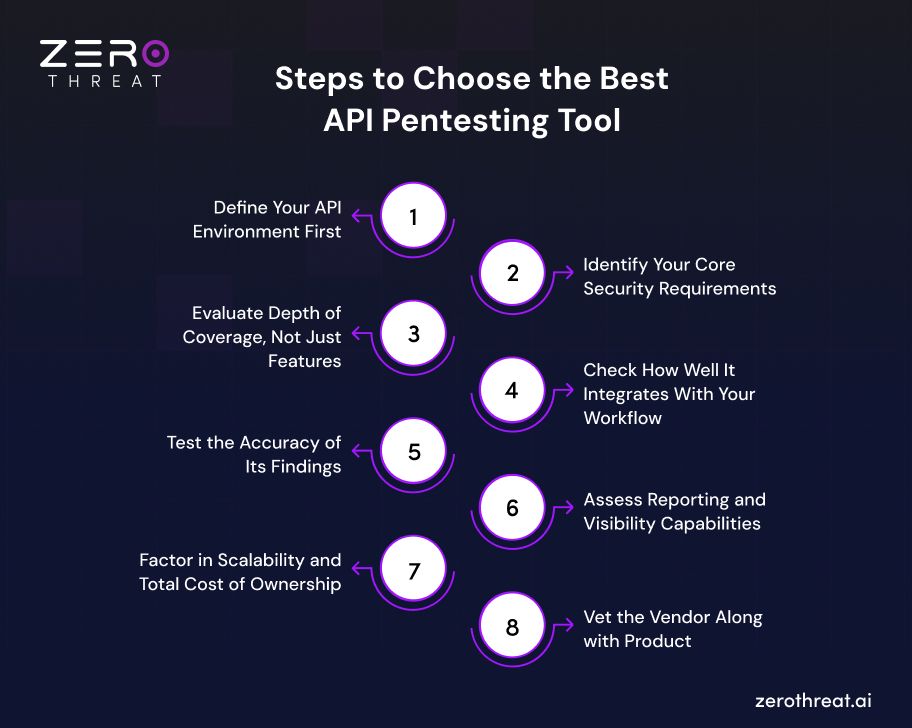
Step 1: Define Your API Environment First
Before you evaluate any tool, map out what you are actually protecting. Know how many APIs you have, what protocols they use, and where they sit in your infrastructure. A tool that cannot cover your specific API types will leave gaps from day one.
Step 2: Identify Your Core Security Requirements
Not every organization has the same risk exposure. A fintech company handling payment APIs has different priorities than a SaaS platform managing user authentication flows. Define the vulnerability categories that matter most to your environment. BOLA, broken authentication, and business logic flaws are a good starting point for most teams.
Step 3: Evaluate Depth of Coverage, Not Just Features
A long feature list means nothing if the tool only runs surface-level checks. Ask specifically whether it detects business logic vulnerabilities, simulates chained attack sequences, and goes beyond the OWASP API Top 10. Tools that stop at common misconfigurations will miss the flaws that actually get exploited in production.
Step 4: Check How Well It Integrates With Your Workflow
Security tools that sit outside your development process get used inconsistently. Look for a tool that integrates directly into your CI/CD pipeline and triggers tests automatically on every build or deployment. If your team runs DevSecOps, this is non-negotiable.
Step 5: Test the Accuracy of Its Findings
Request a trial or proof of concept before committing. Run the tool against a known environment and measure how many of its findings are verified versus false positives. High false-positive rates slow down developers and reduce trust in the tool over time.
Step 6: Assess Reporting and Visibility Capabilities
A good tool tells you what is broken. A great tool tells you how bad it is, which endpoint is affected, and how to fix it. Look for clear severity scoring, developer-ready remediation guidance, and dashboards that track coverage and progress over time. Compliance reporting for standards like PCI-DSS, SOC 2, and ISO 27001 is a strong bonus for enterprise teams.
Step 7: Factor in Scalability and Total Cost of Ownership
A tool that works for 50 APIs today should still work when you have 500. Evaluate how the platform handles scale, what the licensing model looks like as you grow, and what the onboarding and maintenance overhead actually costs. The cheapest option upfront is rarely the most cost-effective one long term.
Step 8: Vet the Vendor Along with Product
Look at whether the vendor specializes in API security or treats it as a secondary use case. Check how frequently they update the platform, whether they publish security research, and what their support track record looks like. API threats evolve fast. Your vendor needs to keep pace.
Quick API Pentest Tool Evaluation Checklist: Feature & Purpose
| Feature | Purpose |
|---|---|
| API Discovery | Identifies undocumented, zombie, and shadow APIs across the environment. |
| Business Logic Testing | Uncovers workflow abuse and application-specific security flaws. |
| Authentication Testing | Validates login mechanisms, tokens, sessions, and identity controls. |
| Authorization Testing | Verifies users can only access permitted resources and functions. |
| Automated Penetration Testing | Continuously tests APIs without requiring extensive manual effort. |
| Real Attack Simulation | Mimics attacker behavior to identify exploitable weaknesses. |
| API Schema Analysis | Uses API specifications to improve testing accuracy and coverage. |
| Fuzz Testing | Identifies input validation flaws and unexpected API behavior. |
| Vulnerability Validation | Confirms findings to reduce false positives and investigation time. |
| CI/CD Integration | Embeds API security testing into development and deployment pipelines. |
| DevSecOps Support | Enables continuous security validation throughout the software lifecycle. |
| Detailed Reporting | Provides actionable findings, affected endpoints, and remediation guidance. |
| Risk Prioritization | Helps teams focus on vulnerabilities with the highest security impact. |
| Scalability | Supports testing across large and complex API ecosystems. |
| Compliance Reporting | Assists with audit readiness and regulatory requirements. |
| Continuous Testing | Detects new vulnerabilities as APIs evolve and change over time. |
| Enterprise Integrations | Connects with ticketing, SIEM, monitoring, and security management platforms. |
Scale API penetration testing without scaling security costs and operational overhead. View Plans
Common Vulnerabilities API Pentesting Tools Detect
Effective API pentesting tools are designed to identify critical security weaknesses across the OWASP API Top 10, ensuring that common attack vectors are mitigated before attackers can exploit your systems.
- Broken Object Level Authorization (BOLA): Attackers manipulate object IDs in API requests to access records belonging to other users without proper authorization checks.
- Broken Authentication: Weak token management, missing session expiry, and flawed login flows allow attackers to hijack accounts or impersonate legitimate users.
- Excessive Data Exposure: APIs return more data than the application actually needs, unintentionally leaking sensitive fields like PII, internal IDs, or financial records.
- Broken Function Level Authorization: Endpoints that perform privileged actions remain accessible to lower-privilege users because role-based access controls are missing or misconfigured.
- Security Misconfiguration: Default settings, verbose error messages, and open debug endpoints give attackers useful information to map and exploit the API.
- Lack of Rate Limiting: Without request throttling, APIs become easy targets for brute force attacks, credential stuffing, and denial-of-service attempts.
- Injection Attacks: SQLi, NoSQL, and command injection through API parameters allow attackers to manipulate backend databases or execute unauthorized commands.
- Business Logic Flaws: Attackers exploit gaps in workflow design, such as skipping payment steps or manipulating transaction sequences, to perform unauthorized operations.
- Shadow and Undocumented APIs: Legacy or forgotten endpoints that bypass security controls remain active and exploitable long after they should have been retired or secured.
- Mass Assignment Vulnerabilities: APIs that blindly bind client-supplied input to internal objects allow attackers to modify fields they were never intended to access.
Why Choose ZeroThreat as Your Go-To Pentesting Tool for API?
ZeroThreat is an AI-powered API penetration testing platform that continuously tests APIs, validates real exploitability, identifies business logic flaws, and helps security teams uncover actionable risks with high accuracy and minimal false positives.
Here is why 5,000+ security teams choose ZeroThreat, and so should you:
- Agentic AI that goes beyond scanning: ZeroThreat's Agentic AI reasons through complex attack paths, validates real exploitability, and confirms vulnerabilities before reporting them. You get proof, not noise.
- Detects business logic flaws standard tools miss: ZeroThreat identifies BOLA, IDOR, broken access control, and workflow-level abuse that rule-based tools consistently overlook. These are the vulnerabilities that cause real breaches.
- Near-zero false positives: Every finding is validated before it reaches your team. Security engineers and developers spend time fixing real issues, not chasing alerts that go nowhere.
- Full API protocol coverage: ZeroThreat tests REST, GraphQL, SOAP, and gRPC endpoints from a single platform. Shadow APIs, undocumented routes, and hidden endpoints are discovered and tested automatically.
- Seamless CI/CD integration: ZeroThreat integrates with CI/CD pipelines such as GitHub Actions, GitLab, AWS, Azure DevOps, CircleCI, and more. Security testing runs automatically on every build, keeping vulnerabilities out of production.
- Zero configuration, instant setup: Teams can start testing immediately with no complex installation or specialized expertise required. Point-and-click simplicity makes it accessible for security and development teams alike.
- Production-safe testing: ZeroThreat runs non-destructive validation techniques that make it safe to test in production environments without disrupting live users or business operations.
- Compliance-ready reporting: ZeroThreat generates audit-ready pentest reports aligned with OWASP API Top 10, PCI-DSS, HIPAA, GDPR, and ISO 27001. Compliance evidence is built into every test.
- AI-driven remediation guidance: Each vulnerability comes with contextual code examples and tailored remediation steps. Developers get exactly what they need to fix issues fast, without back-and-forth with the security team.
Have complex API security requirements? Connect with our experts for a personalized technical walkthrough. Contact Us
Wrapping Up: Choosing the Right API Pentesting Tool
Choosing the right API penetration testing tool requires looking beyond basic vulnerability detection. The most effective solutions provide deep API coverage, validate real security risks, uncover business logic flaws, and continuously assess APIs as applications evolve.
A strong API security testing platform should also fit naturally into development and security workflows. Features such as API discovery, automated testing, CI/CD integration, vulnerability validation, and actionable reporting help teams identify and address risks more efficiently.
As APIs continue to power critical business applications, selecting the right testing tool becomes an important security decision. Prioritizing testing depth, accuracy, scalability, and continuous security validation can help organizations build a stronger and more resilient API security posture.
Frequently Asked Questions
What security standards should API testing tools meet?
API testing tools must align closely with the OWASP API Security Top 10 to ensure coverage of critical flaws like Broken Object Level Authorization. For corporate compliance, platforms should support frameworks like SOC 2, ISO 27001, HIPAA, and PCI DSS by generating detailed, audit-ready technical evidence.
Which API testing tools are best for DevSecOps teams?
How to validate API security tools for enterprise adoption?
Which API penetration testing tool is best for enterprises?

Explore ZeroThreat
Automate security testing, save time, and avoid the pitfalls of manual work with ZeroThreat.