 ZeroThreat Wins Bronze Stevie® Award in Tech Startup of the Year Read more

All Blogs
EHR Penetration Testing Guide: Protect Electronic Health Information
Quick Overview: This guide explains how to identify and fix security gaps in electronic health record systems. It covers common vulnerabilities, high-risk areas, and key stages of the pentesting process to help healthcare organizations strengthen EHR cybersecurity and protect sensitive patient information from breaches and compliance risks.
Electronic Health Record (EHR) systems are transforming how clinicians diagnose, treat, and connect with patients. This digital foundation enables incredible advancements to coordinate treatment, manage workflows, and deliver smarter, faster care.
But this critical infrastructure holds our most personal secrets, making it a top target for cyberattacks. In fact, a staggering 92% of US healthcare organizations have experienced at least one cyber incident in the past year, with patient data being the primary objective.
If we talk about the average cost per healthcare breach, it stands at over $10.1 million (the highest among all industries). Shocking, right! Now you may ask, how can I ensure healthcare record security and not be a victim of an attack or breach? The answer is simple: pentest your EHR systems, find vulnerabilities, and fix them from day one.
In this blog, we’ll help you learn the common vulnerabilities in EHR systems and the scope of attacks. We’ll cover how to perform EHR penetration testing to secure electronic health information and maintain compliance with HIPAA. For now, let’s begin with understanding what exactly EHR system pentesting is.
Keep your EHR systems secure with ZeroThreat’s automated pentesting tools. Start Testing
On This Page
- What is EHR Penetration Testing?
- Common EHR System Vulnerabilities
- High-Risk Areas to Cover in an EHR Pentesting
- Seven Stages of EHR Penetration Testing Process
- How ZeroThreat Can Help with EHR Penetration Testing
- Let’s Summarize
What is EHR Penetration Testing?
Electronic Health Record (EHR) pentesting is a simulated cyber-attack done on EHR systems to uncover vulnerabilities before a hacker does. It is a controlled attack scenario to evaluate how secure your healthcare web application, APIs, databases, and integrations really are.
Performing an EHR penetration test helps healthcare organizations identify weaknesses that could expose protected health information (PHI) or violate security compliance standards like HIPAA.
Unlike a standard vulnerability scan, which only highlights potential flaws, a penetration test goes a step further. It exploits the system like a real hacker and can detect vulnerabilities such as broken authentication, sensitive data exposure, and business logic weaknesses that attackers can target.
For example, a pentest might reveal that an outdated API lets unauthorized users access patient data. These insights allow IT and security teams to strengthen their EHR cybersecurity posture before an actual incident occurs.
In simple terms, by performing a penetration test, you can find vulnerabilities and understand the impact of each one. It helps healthcare providers protect electronic health information, maintain regulatory compliance, and stay away from hefty fines.
Common EHR System Vulnerabilities
EHR systems can be vulnerable due to security gaps that were left unaddressed. Here are the common vulnerabilities you can find in EHR systems.
Weak or Missing Authentication
Many EHR systems still rely on weak credentials or lack proper multi-factor authentication. This makes it easy for attackers to gain unauthorized access to patient data. In healthcare environments where shared workstations are common, credential misuse becomes an even bigger risk.
Solution: Enforce multi-factor authentication (MFA) and strong password policies across all EHR access points to reduce unauthorized logins.
Misconfigured APIs and HL7 Integrations
EHR platforms often use APIs or HL7/FHIR integrations to share patient data with other healthcare applications. When these integrations are misconfigured or left unsecured, they can expose sensitive medical records to external networks. Attackers frequently exploit open endpoints or poorly implemented access controls.
Solution: Perform EHR vulnerability assessments regularly with proper authentication, encryption, and role-based access controls to prevent unauthorized data exposure.
Insecure Direct Object References (IDOR)
An IDOR vulnerability occurs when a system exposes internal database objects, like patient IDs, without proper authorization checks. In EHR software, this can allow an attacker to manipulate URLs or API calls and view other patients’ records. This kind of flaw directly violates HIPAA compliance and puts patient trust at serious risk.
Solution: Implement robust access control checks and use indirect references instead of exposing database identifiers in URLs or APIs.
Injection Flaws (SQLi, Command Injection)
SQLi and command injection are still among the most dangerous attack vectors in healthcare systems. A single unvalidated input field can allow an attacker to execute commands that expose or modify patient data. Since EHR databases store sensitive electronic health information, such exploits can cause massive compliance and financial damage.
Solution: Implement input validation, use parameterized queries, and conduct regular code reviews to prevent injection attacks.
Unprotected Connected Medical Devices (IoMT)
In many hospitals, EHR systems are connected with medical devices through the Internet of Medical Things (IoMT). If these devices lack encryption, firmware updates, or authentication, they become easy entry points for attackers. Once compromised, they can serve as a bridge into the EHR network.
Solution: Isolate IoMT devices on separate networks and ensure all firmware and device software are regularly updated and encrypted.
Cross-Site Scripting (XSS) in Patient Portals
Patient portals are designed for convenience, but often become soft targets for XSS attacks. Malicious scripts injected into these interfaces can steal login sessions or PHI. Since portals directly interact with patients, any compromise affects trust and compliance.
Solution: Apply strict input validation, sanitize all user-submitted data, and perform EHR pentesting to detect and prevent XSS attacks.
Unpatched or Outdated EHR Software
Running outdated EHR versions or ignoring security patches is one of the most common mistakes in healthcare IT. Legacy systems often carry known vulnerabilities that attackers can easily exploit. Regular updates, combined with periodic EHR vulnerability assessments, ensure that software weaknesses don’t accumulate over time.
Solution: Implement an automated patch management process and schedule regular system updates to close known security gaps.
Discover security loopholes 10X faster with ZeroThreat’s pentesting tool. Try Now
High-Risk Areas to Cover in an EHR Pentesting
When you start pentesting EHR systems, some components must be prioritized due to their high-risk factor. Here are the vulnerable attack surface areas you should test first.
EHR Web Applications
EHR web applications are the main entry point to patient data, which makes them a top target for attackers. Weak authentication, poor session handling, and unvalidated inputs are common issues. A focused EHR penetration testing effort can detect vulnerabilities, including OWASP Top 10 and CWE Top 25, in login portals, patient portals, and clinical modules.
Third-Party Integrations (APIs, HL7/FHIR)
Most EHRs rely on APIs and HL7/FHIR integrations to exchange data with other systems. When integrations have security misconfigurations or lack proper authorization, they can expose sensitive patient records. Regular electronic health record security testing should validate authentication and token scopes to prevent such PHI exposure.
Network Infrastructure and IoMT
The hospital network connects servers, EHR databases, and medical devices; all potential attack surfaces. Weak segmentation or outdated firmware in IoMT devices can let attackers move laterally into the EHR system. Healthcare data pentesting must assess network segmentation and device authentication to ensure IoMT devices don’t become bridges into the core EHR network.
PHI Data Flows
Every point where protected health information (PHI) moves, starting from input to storage, can be a target for hackers. Many EHR systems still fail to encrypt PHI during transmission or rely on insecure data sharing. A detailed EHR vulnerability assessment helps map data flows and detect weak points. Plus, encrypting PHI both at rest and in transit, with strict access rules, keeps sensitive information secure.
7 Stages of EHR Penetration Testing Process
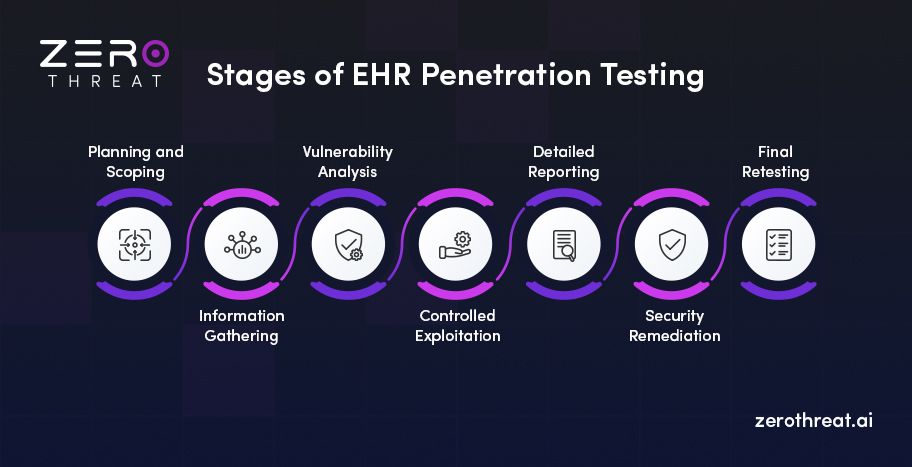
Here are the general stages of EHR pentesting; they can vary depending on your scope and compliance requirements.
Stage 1: Planning & Scoping
Every effective EHR penetration testing engagement starts with a clear scope. This stage defines which systems, networks, and applications will be tested, along with compliance goals like HIPAA or HITECH. The objective is to align the test with business and regulatory needs without disrupting clinical workflows.
Stage 2: Information Gathering
In this stage, testers collect intelligence about the target EHR environment. This includes mapping domains, APIs, user roles, and data flows to understand how electronic health information moves across the system. The goal is to identify potential entry points an attacker might exploit. Tools like network scanners and passive reconnaissance methods help gather details without alerting the system.
Stage 3: Vulnerability Analysis
Once information is gathered, security teams perform a detailed EHR vulnerability assessment to pinpoint weaknesses. This involves analyzing configurations, outdated software, access control flaws, and encryption gaps. In EHR systems, vulnerabilities in APIs or HL7/FHIR integrations are common. Each finding is evaluated based on its potential impact on patient data and compliance.
Stage 4: Controlled Exploitation
This phase simulates real-world attacks in a safe and controlled way. Testers attempt to exploit identified vulnerabilities to understand their actual impact on EHR cybersecurity. The focus isn’t on disruption, but on checking if PHI can be accessed, modified, or exfiltrated. Controlled exploitation helps verify how far an attacker could go and what security gaps are missing.
Stage 5: Detailed Reporting
Once testing is complete, every finding is compiled into a structured EHR penetration testing report. The report explains the vulnerabilities discovered, their risk levels, and how they could affect compliance and patient safety. Some tools even offer audit-ready reports with actionable fixes to help security teams patch vulnerabilities quickly.
Stage 6: Security Remediation
The developers work on fixing the vulnerabilities found during testing. This includes applying patches, strengthening authentication, and tightening access controls. Effective collaboration between testers and development teams ensures lasting cybersecurity in healthcare systems rather than one-time fixes.
Stage 7: Final Retesting
After remediation, testers perform a final retest to confirm that all issues have been properly resolved. This step validates that vulnerabilities are closed, and no new ones have emerged during patching. It’s also a crucial step for maintaining compliance with frameworks like HIPAA.
How ZeroThreat Can Help with EHR Penetration Testing
ZeroThreat makes EHR penetration testing faster, easier, and more accurate with its automated pentesting tool. It simulates real-world attacks to uncover security gaps in EHR systems, APIs, and healthcare applications, helping you find and fix vulnerabilities.
Here’s how ZeroThreat helps:
- Comprehensive Vulnerability Scanning: ZeroThreat detects misconfigurations, weak access controls, and outdated components across EHR systems.
- API Pentesting: The platform tests healthcare APIs and integrations to find insecure endpoints and potential PHI exposure points.
- Continuous Security Validation: With CI/CD integration, ZeroThreat enables ongoing EHR vulnerability assessment, making testing a regular part of development.
- Automated Compliance Checks: It aligns findings with HIPAA, GDPR, and PCI DSS standards, helping teams stay audit-ready with measurable results.
- Detailed Remediation Reports: Each assessment includes clear, actionable remediation steps backed by technical evidence.
These features are just the tip of the iceberg of what ZeroThreat provides. If you want to test your application and know it for yourself, try ZeroThreat for free with full access.
Secure your EHR systems before the attack with AI-driven security solutions. Contact Us
Let’s Summarize
Securing electronic health records allows you to maintain patient trust and compliance. Regular EHR penetration testing helps uncover weak spots in authentication, data flows, and APIs before they lead to real-world incidents.
A structured testing approach, from planning and vulnerability analysis to remediation and retesting, ensures continuous security. It allows healthcare teams to stay one step ahead of threats, meet HIPAA and other regulatory standards, while keeping patient data safe.
For organizations looking to simplify this process, ZeroThreat offers an intelligent pentesting solution that identifies vulnerabilities across EHR systems, APIs, and web apps. It helps security teams strengthen defenses without slowing operations, ensuring electronic health information remains protected and compliant.
Frequently Asked Questions
What is penetration testing for EHR systems?
Penetration testing for EHR systems involves simulating cyberattacks to uncover security weaknesses in electronic health record applications, APIs, and networks. It helps identify potential entry points before attackers do, keeping electronic health information safe and compliant.
Is penetration testing required for HIPAA-compliant EHR software?
How often should hospitals test their EHR systems?
What’s the difference between EHR and EMR security testing?
How does penetration testing protect PHI?

Explore ZeroThreat
Automate security testing, save time, and avoid the pitfalls of manual work with ZeroThreat.