 ZeroThreat Wins Bronze Stevie® Award in Tech Startup of the Year Read more

All Blogs
Data Breach Risks in Multi-Tenant SaaS Applications: Challenges and How to Prevent
Quick Overview: A multi-tenant SaaS environment offers efficiency and scale, but it also introduces unique data breach risks. This guide breaks down the common causes of SaaS breaches, the core challenges of protecting shared architectures, and the essential practices to prevent exposure. Use it as a clear guide to strengthen tenant isolation, reduce misconfigurations, and improve overall SaaS platform security.
Multi-tenant SaaS has become the engine behind modern business. It powers the tools we use every day, starting from analytics platforms to collaboration suites, and gives companies the speed and scale they need to grow without slowing down. It’s one of the biggest reasons SaaS adoption keeps rising year after year.
But this shared model also changes how risk works. When multiple customers share the same application and infrastructure, a single weak link can create a ripple effect. According to IBM’s 2025 Cost of a Data Breach Report, 82% of breaches involved data stored in cloud environments, and misconfigurations remain one of the top contributors. In multi-tenant systems, those gaps don’t just expose one user; they can open doors across tenants.
That’s why understanding how and why these breaches happen is important. In this blog, we’ll break down the most common data breach risks in multi-tenant SaaS applications. We’ll understand why they occur, and the practical steps SaaS teams can take to prevent them. With that said, let’s get started!
Get started and take the first step toward stronger SaaS security with ZeroThreat. Sign Up Now
On This Page
- What is a Multi-Tenant SaaS Application?
- Common Causes of Data Breaches in Multi-Tenant SaaS
- Multi-Tenant SaaS Data Protection Challenges
- Prevent Data Breaches in a Multi-Tenant SaaS Application
- Wrapping Up
What is a Multi-Tenant SaaS Application?
A multi-tenant SaaS application is a software setup where multiple customers share the same application and infrastructure, but their data stays logically separated. It’s one shared system, serving many users at the same time, without mixing their information.
In this model, every customer (or “tenant”) uses the same codebase and resources. What changes behind the scenes is how the platform isolates each tenant’s data. This architecture helps SaaS companies scale faster, reduce operational costs, and deliver updates to all tenants at once.
But the shared nature of the system also introduces challenges, such as the risk of security misconfigurations and weak isolation, leading to multi-tenant SaaS data breaches.
If you are not using the right approach and tools, these risks can turn into real problems. On the other hand, ensuring strong tenant isolation, regular monitoring, and best security practices can easily protect your SaaS application from cyberattacks.
Common Causes of Data Breaches in Multi-Tenant SaaS
Data breaches in multi-tenant SaaS often come from small gaps that are missed during daily operations. Understanding these common causes helps you spot early risks and strengthen the foundation of your SaaS security.
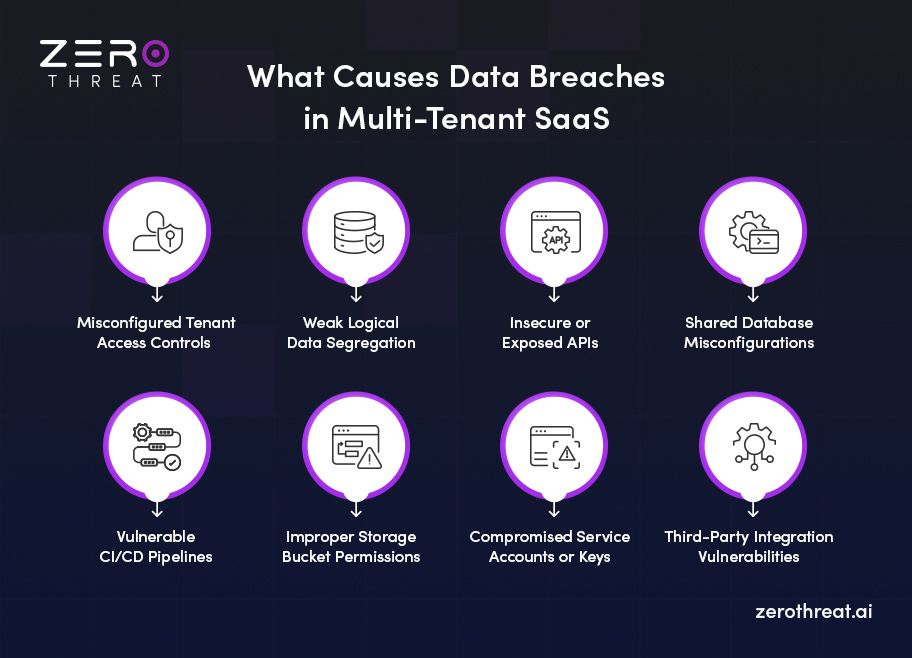
Misconfigured Tenant Access Controls
Misconfigured tenant access controls often open the door to unintended data exposure. When permissions are set too broadly or inherited incorrectly, users may gain access to data outside their tenant. This is one of the most common causes of SaaS application breach risks because it usually goes unnoticed until it's exploited.
Weak Logical Data Segregation
Weak logical data segregation makes it harder to keep each tenant’s data isolated inside a shared environment. Problems usually appear in areas like shared queries, caching layers, or row-level filtering that isn’t applied consistently. Even small mistakes here can lead to cross-tenant data leakage.
Insecure or Exposed APIs
APIs carry tenant data between services, which makes them a high-risk point if they’re not handled well. An insecure endpoint, missing authentication, or misconfigured API can allow attackers to pull data they shouldn’t have access to. Many SaaS breaches start with an overlooked API route or a poorly tested update.
Shared Database Misconfigurations
Shared databases are efficient, but they also increase risk when configured incorrectly. Issues like weak row-level security, incorrect schema design, or unmanaged query access can expose one tenant’s data to another. These mistakes often happen during rapid development or scaling phases.
Vulnerable CI/CD Pipelines
A vulnerable CI/CD pipeline can expose sensitive code, build secrets, or internal configurations that attackers can use to breach a multi-tenant SaaS environment. Issues like weak access control or insecure deployment scripts often create silent entry points. Because CI/CD interacts with every part of the application, a single gap can impact all tenants at once.
Improper Storage Bucket Permissions
Storage buckets hold customer data, logs, backups, and other critical assets, so improper permissions become a direct risk. Public access settings, overly broad read/write rules, or missing encryption often lead to data breaches. These mistakes are common because storage is easy to deploy but hard to monitor.
Compromised Service Accounts or Keys
Service accounts and API keys often have wide-reaching access across a multi-tenant SaaS environment. If any of them are leaked, hardcoded, or stored in insecure places, attackers can move through the system without being noticed. This can lead to unauthorized access across multiple tenants.
Third-Party Integration Vulnerabilities
Many SaaS applications rely on third-party tools for payments, analytics, communication, or workflows. If any of these integrations have security gaps, they can become indirect paths into the system. A vulnerability in a plugin or external API can expose tenant data even if your core application is secure.
Explore how our ZeroThreat’s SaaS security solution protects multi-tenant apps. Learn More
Multi-Tenant SaaS Data Protection Challenges
Protecting data in a multi-tenant SaaS environment isn’t always simple, especially when multiple customers share the same system. Each layer of architecture brings its own set of security challenges. Here are some of the challenges you may face while securing SaaS applications.
Maintaining Strong Tenant Isolation
Strong tenant isolation is one of the hardest parts of securing a multi-tenant SaaS environment. Every layer, including database, application logic, APIs, and storage, must ensure that data never crosses tenant boundaries. Even a small mistake in how queries or permissions are handled can lead to cross-tenant exposure.
Ensuring Logical Data Segregation
Logical data segregation keeps each tenant’s data separate inside shared systems. The challenge is that segregation depends on consistent filters, rules, and access checks across the entire application. If any one of these controls is missing or misconfigured, data may be exposed through normal operations.
Managing Access Controls
Access controls grow more complicated as SaaS platforms increase tenants and roles. When permissions expand or overlap, it becomes easy to create gaps that attackers can exploit. Poorly managed roles are a common cause of data breaches in multi-tenant SaaS applications.
Securing Shared Databases
Shared databases make scaling easier, but keeping them secure is not that easy. Here, the issues often arise from weak security, shared schemas, or misconfigured permissions that expose one tenant’s data to another. Because so much data is stored in one place, a single mistake can affect the entire system.
Protecting APIs Across Tenants
Protecting APIs becomes a challenge because you need to validate each API request with the correct tenant content. If the platform doesn’t enforce this consistently, attackers can access data from other tenants through exposed routes.
Securing Third-Party Integrations
Third-party integrations in SaaS applications can introduce a new layer of risk, especially when they handle or store tenant data. A breach in one of these services can spread into your environment even if your core systems are secure.
How to Prevent Data Breaches in a Multi-Tenant SaaS Application
Preventing data breaches in a multi-tenant SaaS setup starts with getting the basics right. When the architecture, access controls, and monitoring are handled with care, the risk drops quickly. Here are the data breach risks prevention strategies that can help you safeguard your SaaS platform.
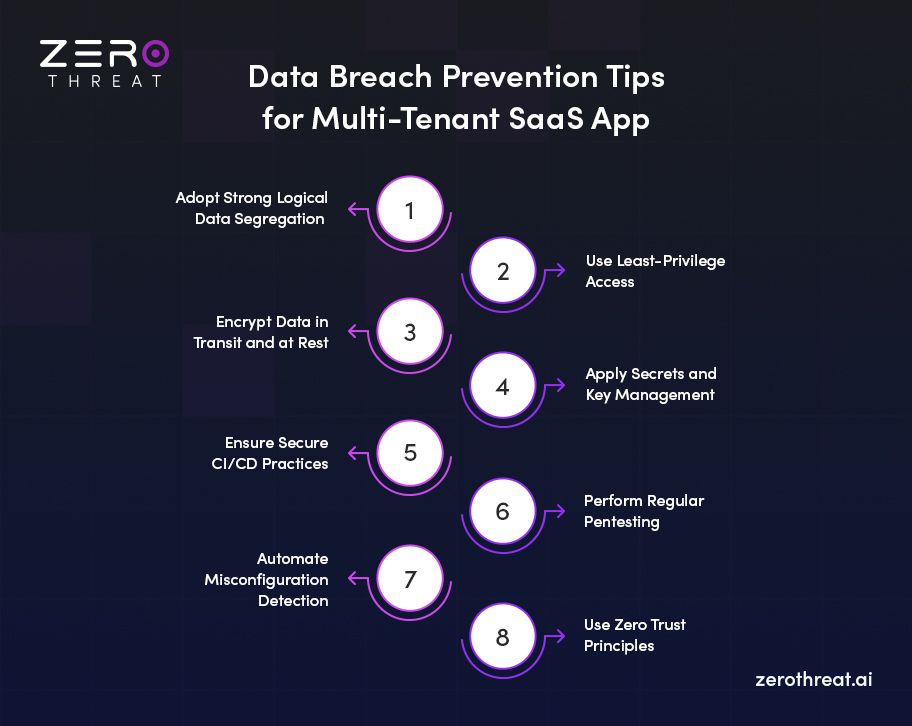
Adopt Strong Logical Data Segregation
Keep tenant data isolated at every layer so no customer can access another tenant’s information. Strong logical separation limits the attack surface and prevents cross-tenant leaks.
- Partition data with tenant-aware schemas or row-level security.
- Enforce tenant IDs in every query and API call.
- Validate tenant context at the service and database layers.
- Use access policies that restrict data paths per tenant.
- Test segregation controls regularly.
Use Least-Privilege Access
Give every identity only the minimum access needed to perform its role. This reduces the impact of compromised accounts and prevents sensitive data exposure.
- Restrict permissions by role, scope, and tenant boundary.
- Remove unused privileges on a fixed schedule.
- Use JIT (just-in-time) access for admin actions.
- Segment internal teams from production data.
- Monitor and alert on privilege escalation.
Encrypt Data in Transit and at Rest
Encryption protects sensitive tenant information even if traffic is intercepted or storage is compromised. It creates an essential security barrier against unauthorized access.
- Enforce TLS 1.3 for all internal and external communication.
- Use strong, industry-approved algorithms (AES-256 ) for encryption at rest.
- Rotate certificates and keys on a schedule.
- Apply encryption to backups, logs, and file storage.
- Validate encryption settings during every deployment.
Apply Secrets and Key Management
Implement secure secret key management to prevent attackers from abusing exposed API keys, tokens, and credentials. Good secret handling keeps your environment predictable and safe.
- Store secrets in a dedicated vault, not in code.
- Rotate secrets automatically and track usage.
- Enforce MFA and access control for retrieving secrets.
- Limit secret scope to the minimum required.
- Audit secret access and identify anomalies early.
Ensure Secure CI/CD Practices
A secure CI/CD pipeline prevents attackers from injecting malicious code or accessing and exposing sensitive data. Strong controls keep every deployment trusted and tamper-free.
- Use role-based access control (RBAC) to restrict who can push or approve code.
- Scan the pipeline for secrets, vulnerabilities, and supply-chain risks.
- Sign builds and validates integrity before deployment.
- Isolate build environments and enforce least-privilege credentials.
- Log every pipeline action for audit and incident review.
Perform Regular Pentesting
Performing continuous pentesting helps you uncover exploitable weaknesses before attackers do. It gives clarity on how your multi-tenant architecture behaves under real-world attack paths.
- Validate the authentication and authorization of your application.
- Test tenant isolation and cross-tenant data access.
- Review findings and fix high-risk gaps quickly.
- Simulate API security testing and privilege escalation attempts.
- Retest after every major release or infrastructure change.
Automate Misconfiguration Detection
Misconfigurations are one of the fastest ways attackers gain access to SaaS environments. Automation ensures issues are caught early instead of becoming hidden risks.
- Continuously scan cloud and container settings.
- Flag public buckets, open ports, and weak policies.
- Monitor all changes from your baseline configuration.
- Validate IAM roles and permissions automatically.
- Integrate alerts with your existing security workflow.
Use Zero Trust Principles
Zero Trust assumes no user, device, or service is inherently safe. Every request must be verified, which reduces lateral movement and protects tenant data.
- Validate identity and context for each request.
- Enforce micro-segmentation across services.
- Apply strong MFA for all privileged actions.
- Monitor behavior to detect risky access patterns.
- Limit default trust and continuously re-evaluate permissions.
Need help securing your shared SaaS environment? Contact Us
Wrapping Up
Data breaches in multi-tenant SaaS environments often start with small oversights such as weak isolation, exposed APIs, or misconfigurations that go unnoticed. But these risks are manageable when security practices become part of the day-to-day build and release process instead of an afterthought.
Strong tenant separation, least-privilege access, secure CI/CD pipelines, and regular pentesting create a safety net that protects every tenant in a shared environment. As your platform grows and the applications become more complex, these practices help you stay away from cyberattacks.
In the end, preventing data breaches is about protecting trust. With the right security practices and a pentesting tool, you can detect and prevent data breach attacks from day one.
Frequently Asked Questions
How do cross-tenant vulnerabilities contribute to data breaches in SaaS applications?
Cross-tenant vulnerabilities expose one tenant’s data to another, creating a direct path for unauthorized access. These issues usually appear when isolation controls fail inside shared databases, APIs, or authorization logic. Once an attacker bypasses these boundaries, they can read or modify data across multiple accounts.
What methods do attackers commonly use to breach multi-tenant SaaS systems?
How can SaaS providers prevent data breaches in shared environments?
What are the best practices for detecting data breaches in multi-tenant SaaS applications?
How do misconfigurations in multi-tenant architecture increase the risk of data breaches?
How can continuous monitoring help detect early signs of data breaches in SaaS?
Explore ZeroThreat
Automate security testing, save time, and avoid the pitfalls of manual work with ZeroThreat.