 ZeroThreat Wins Bronze Stevie® Award in Tech Startup of the Year Read more

All Blogs
SaaS Breaches from Misconfigured APIs: How to Detect and Prevent Them
Quick Summary: Misconfigured APIs are one of the most common causes of SaaS data breaches. This blog explains how these misconfigurations occur, the risks they pose, and how to detect and prevent them. It also highlights best practices to strengthen your API security posture and reduce the chances of data exposure in SaaS applications.
APIs have become the invisible engine of modern SaaS. They connect users, systems, and data in real time, powering everything from user logins to billing workflows. This interconnectedness is what makes SaaS so efficient and scalable.
But with every API endpoint, there comes the risk of breaches in SaaS applications. In fact, misconfigured APIs are one of the leading causes of SaaS data breaches. According to Gartner, by 2026, 90% of web-enabled applications will have more attack surface exposed through APIs than through the user interface itself.
If you are someone who wants to secure your SaaS app from breaches that happen due to misconfigured APIs, this blog is for you. Here, we’ll understand the common types of API misconfigurations, how you can find them, and close the vulnerable endpoints with best security practices. So, let’s get started by discussing why APIs are the most vulnerable component in SaaS apps.
Ready to see how secure your APIs really are? Run your first automated pentest on ZeroThreat. Start For Free
On This Page
- Why APIs are the Weakest Link in SaaS Security
- Common Types of API Misconfigurations in SaaS
- How to Detect Misconfigured APIs in SaaS Applications?
- Best Practices to Prevent API Misconfiguration Attacks in SaaS
- Summing Up
Why APIs are the Weakest Link in SaaS Security
Using APIs for SaaS apps allows developers to connect services, move data between systems, and power features users rely on every day. But this convenience comes with the cost of increased attack surfaces. When APIs are misconfigured or lack proper security controls, they expose sensitive data, business logic, and even entire customer accounts.
Here’s why APIs are often the easiest target for exploiting SaaS security:
API Sprawl Leads to Blind Spots
As SaaS apps grow, new APIs keep getting added; sometimes by different teams, in different languages, or without full documentation. This leads to what’s called API sprawl. When no one tracks all live APIs, it’s easy for a test or old API to stay publicly accessible. That’s how misconfigured APIs in SaaS end up exposed without anyone noticing.
Misconfigurations Are Common
APIs often skip security reviews during rapid deployments. Developers might forget to add authentication, restrict access, or encrypt data properly. And unlike traditional UI vulnerabilities, API security misconfigurations don’t break functionality, so they can’t be detected until exploited.
Traditional Scanners Miss Real Risks
Most vulnerability scanners focus on known CVEs or code-level issues, not API misconfiguration vulnerabilities like broken access control or sensitive data exposure. That means your scans can come back clean even when attackers can still inject data via an open endpoint.
APIs Connect Directly to Data Stores
APIs connect your app to databases, user accounts, and payment details. If an attacker finds an API without proper access control, they can be just one request away from reading or modifying sensitive data.
Hard to Monitor Without Automation
With cloud-native SaaS apps, new APIs get added constantly. Keeping track of them in real-time is tough. Without strong cloud security posture management, it’s easy for one insecure endpoint to stay undetected and open to attacks.
Common Types of API Misconfigurations in SaaS
Common API misconfigurations often slip into SaaS applications without anyone noticing, but they create some of the easiest paths for attackers. Most of these issues come from small gaps in access control, authentication, or data handling. Understanding these misconfigurations is the first step toward preventing SaaS breaches before they happen.
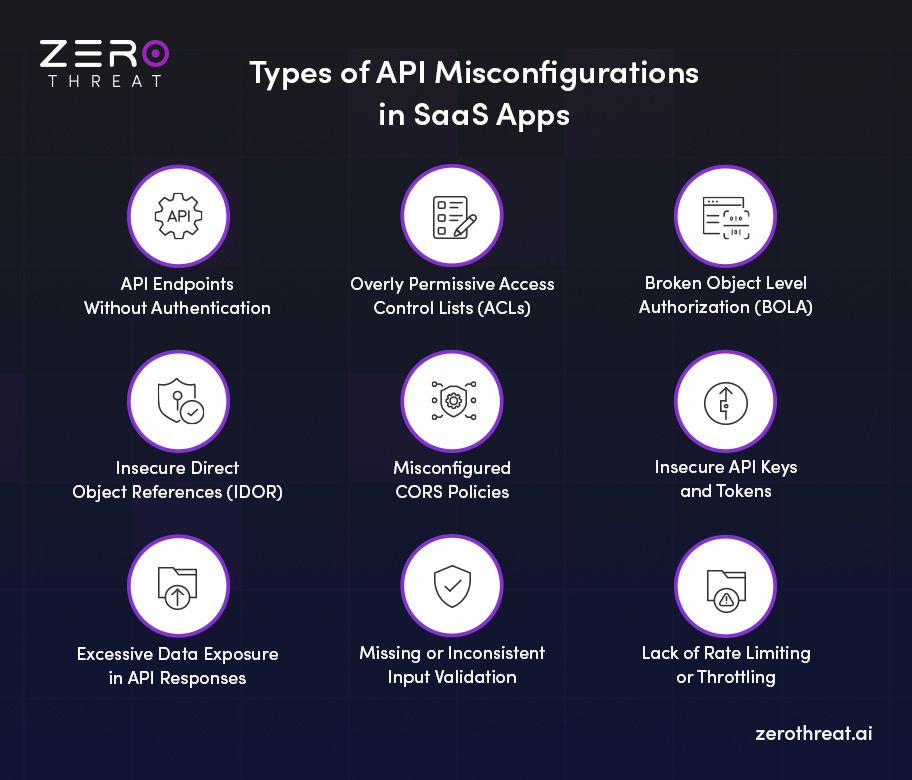
API Endpoints Without Authentication
This is one of the most common API security issues in SaaS applications. When endpoints don’t require authentication, anyone can access them. That means unauthorized users or attackers can view or edit sensitive data without needing a login. These misconfigured APIs in SaaS are often exposed by accident, especially during rapid development or testing.
Overly Permissive Access Control Lists (ACLs)
ACLs decide who can access specific data or features in your app. If they are set too loosely, such as allowing access to "all users" or "any authenticated user," they expose far more than intended. These security misconfigurations don’t break functionality, but they completely compromise your security controls.
Broken Object Level Authorization (BOLA)
BOLA occurs when an API allows users to access someone else’s data simply by changing an ID in the request. This API risk in SaaS applications is often exploited with minimal effort. If your app handles sensitive data, this type of misconfiguration can lead to serious SaaS breaches caused by insecure API design.
Insecure Direct Object References (IDOR)
IDOR vulnerability happens when an API exposes internal identifiers like user IDs or file names without checking if the requester is allowed to access them. Attackers can change these identifiers in the URL or request to access someone else's data. This issue often slips during testing, and it can lead to sensitive data exposure for SaaS apps.
Misconfigured CORS Policies
CORS (Cross-Origin Resource Sharing) controls which websites can call your APIs. When CORS settings are too broad, such as allowing requests from any domain, they put your entire SaaS app at risk. A malicious website could make a user’s browser interact with your API without the user even knowing. This kind of misconfiguration is a common reason why data leaks happen in cloud SaaS environments.
Insecure API Keys and Tokens
API keys and tokens act like passwords for systems talking to each other. When these keys are hardcoded in the app, exposed in public repos, or shared across services, they give attackers full access to your backend systems. These types of API misconfiguration vulnerabilities are often exploited using leaked keys found online, making it crucial to rotate and store keys securely.
Excessive Data Exposure in API Responses
Some APIs return more data than the client needs, often for convenience during development. But this exposes sensitive fields like internal metadata to anyone who makes a request. Even if the fields aren’t shown in the UI, they can be seen in the API response and used for targeted attacks. In SaaS, this becomes a serious issue when APIs return raw database entries without filtering.
Missing or Inconsistent Input Validation
When APIs don’t validate the input properly, they become vulnerable to attacks like SQL injection, command injection, or script injection. This happens when user-supplied data is trusted without sanitization. It’s a common misconfiguration where rapid iteration leads to validation and business logic exploits in SaaS applications.
Lack of Rate Limiting or Throttling
Rate limiting controls how many requests a client can make in a certain time frame. Without it, attackers can flood your API with automated requests, leading to denial of service or brute-force attacks. It also creates opportunities for abuse of APIs that return sensitive data. For SaaS platforms that handle real-time operations, not having throttles in place leaves data at risk.
Discover and fix API security risks in your SaaS with a 99.9% accurate vulnerability assessment. Start at $0
How to Detect Misconfigured APIs in SaaS Applications?
Detecting API misconfigurations in SaaS environments requires more than a one-time scan. APIs evolve fast, and what was secure last month might be exposed today. You need to use a mix of automation, API security testing, and monitoring to stay ahead of threats.
Here’s how you can detect API misconfigurations in SaaS apps:
1. Use Automated API Discovery Tools
Most misconfigurations go unnoticed simply because the team doesn’t know the API exists. Start by using SaaS app security tools that automatically scan your environment to discover every API, including internal, external, and shadow APIs. This gives you a full picture of what’s exposed and where risks might hide.
2. Scan for API Misconfiguration Vulnerabilities
Traditional vulnerability scanning tools often miss API-specific risks like BOLA or excessive data exposure. Use automated scanners or DAST tools built to detect SaaS API misconfiguration vulnerabilities, especially those that map logic and data flow. Make this part of your CI/CD pipeline, so new misconfigurations don’t get merged into production.
3. Test API Access Controls Manually
Automated tools help, but some misconfigurations require human logic to be found. Test whether you can change an object ID to access another user’s data or remove a token and still get a response. Check the number of fields returned and find out the information clients get even when they didn’t ask for it. Those could be the reasons behind excessive data exposure.
4. Monitor API Logs for Usual Activity
Even a secure API can be misused if no one is watching. Set up API logging to track all requests (successful and failed ones). Use alerts to catch sudden spikes, unusual user agents, or repetitive access to the same endpoint. These are signs someone may be probing your APIs for misconfigurations.
5. Perform Continuous API Security Testing
Misconfigurations are inevitable when you scale. That’s why SaaS companies use API security posture management tools to continuously monitor, flag, and fix issues across environments. These tools help maintain automated controls, so a risky change doesn’t go unnoticed in a busy release cycle.
Best Practices to Prevent API Misconfiguration Attacks in SaaS
Preventing API misconfigurations in SaaS starts with maintaining security at every stage instead of fixing issues later. Here's how you can reduce the risk of API misconfiguration attacks and protect your SaaS application from cyberattacks.
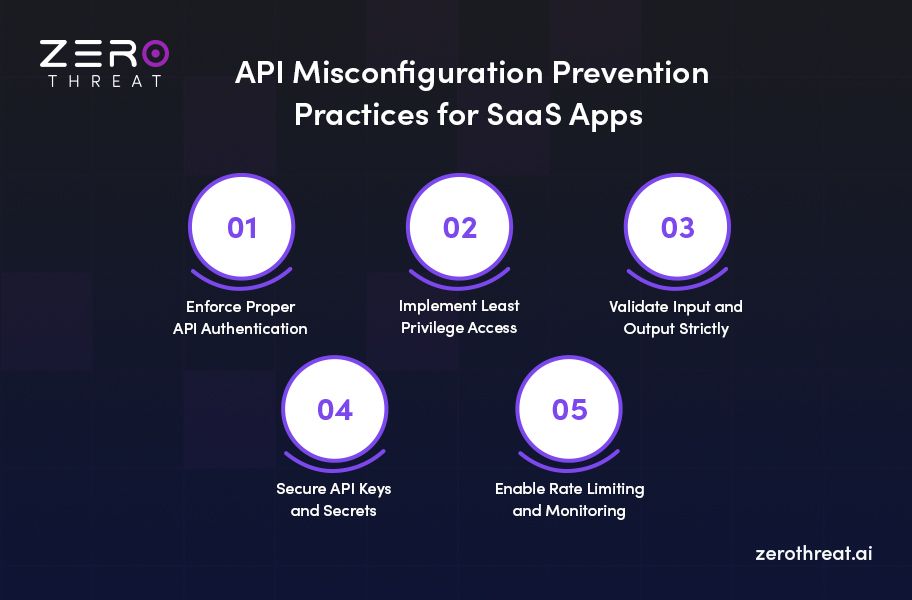
Enforce Proper API Authentication
Make sure every API endpoint requires secure authentication and try to avoid using open or unauthenticated APIs unless necessary. Use OAuth 2.0, JWTs, or API keys with strict scopes to control who can access what. These practices ensure that your APIs are protected from unwanted access.
Implement Least Privilege Access
Give users and systems only the permissions they actually need. Use role-based access control (RBAC) and restrict data access at the object level. Object-level restrictions prevent unauthorized access to sensitive data, and it is one of the simplest ways to stop attacks like BOLA or unauthorized data viewing.
Validate Input and Output Strictly
Never trust data that comes from outside your system. You must validate every input to prevent injection attacks, malformed data, or unexpected behavior. Plus, filter API responses so that you don’t expose sensitive fields in public view, because most data leaks happen from APIs returning too much.
Secure API Keys and Secrets
Hardcoding API keys or leaving them in public repos is an open invitation for misuse. You should use encrypted vaults or environment variables to manage credentials and always rotate them on a schedule. Additionally, you can set API key expiration dates to limit damage if they leak.
Enable Rate Limiting and Monitoring
Without rate limits, attackers can brute-force their way through APIs or overwhelm them with traffic. Use throttling to restrict how fast any user or IP can hit your endpoints. Pair this with continuous monitoring to spot abnormal spikes or suspicious patterns. It will allow you to catch a potential attack in progress.
Need help with your SaaS app security testing? Let our team handle it. Contact Us Today!
Summing Up
APIs power the core of every SaaS platform, but when left misconfigured, they can be the first reason behind breaches. But with the right security practices, such as continuous API discovery, strict authentication, least privilege access, and automated security validation, the risk is preventable.
If you want to check for misconfigurations in your SaaS app, you can discover the APIs, perform scanning, and test. It will allow you to find exploitable vulnerabilities in your SaaS app that you can fix by enforcing API security practices.
If you’re ready to see where your APIs truly stand, try running ZeroThreat’s automated pentesitng tool on your SaaS application. It’s fast, accurate, and built to uncover hidden API risks before attackers do.
Frequently Asked Questions
How do misconfigured APIs lead to data breaches in SaaS applications?
Misconfigured APIs expose sensitive data by allowing unauthorized access to endpoints or responses. Attackers can exploit weak access controls, excessive data exposure, or insecure tokens to retrieve customer or system data without being detected.
What role does authentication play in API misconfigurations?
Can an automated tool detect API misconfigurations in real time?
What is the difference between API vulnerabilities and API misconfigurations?
What are the early warning signs of API misconfigurations in SaaS?


Explore ZeroThreat
Automate security testing, save time, and avoid the pitfalls of manual work with ZeroThreat.