 ZeroThreat Wins Top InfoSec Innovators 2026 Award for Penetration Testing Read more

All Blogs
A Complete Guide to Securing Cloud-Native Applications with Attack Chain Discovery
Quick Overview: Cloud-native breaches don't come from one critical bug, but they come from an attacker chaining several unremarkable ones across containers, APIs, Kubernetes, and the cloud plane. This guide walks how those chains assemble, why severity-scored scanners miss them, and how attack chain discovery finds and validates the full path before someone else walks it.
The shift to cloud-native application development was supposed to make systems faster, more resilient, and easier to maintain. In many respects, it was delivered on all three. But it also created a security model that most organizations are still catching up with. When a monolithic application was breached, the blast radius was bounded by what that application could access. When a cloud-native application is breached, the blast radius can be the entire cloud account.
The Verizon Data Breach Investigations Report found that vulnerability exploitation is now the leading initial access vector, accounting for 31% of all breaches, overtaking credential abuse for the first time. In cloud-native environments, those exploits rarely end where they begin. Attackers do not stop at the first foothold. They follow the architecture, pivoting through service-to-service APIs, escalating via service account tokens, and exfiltrating through cloud provider metadata services in a sequence of steps that no single vulnerability scan would ever reveal.
Securing cloud-native applications through attack chain discovery means shifting the security question from "what is vulnerable?" to "where can an attacker go from here?" That is not just a philosophical change. It requires a fundamentally different approach to testing, one that understands application context, can traverse internal API boundaries, and validates multi-step exploit chains rather than cataloging individual weaknesses.
This guide covers the full picture: the anatomy of a cloud-native attack surface, how attack chains form and propagate across microservices and Kubernetes clusters, the specific techniques attackers use for lateral movement and privilege escalation, and the gap between shift-left scanning and the runtime application security testing that cloud-native environments actually require.
Your cloud-native applications evolve every day. Don't let hidden attack chains evolve with them. Start Continuous Protection
ON THIS PAGE
- The Anatomy of a Cloud-Native Attack Surface
- Why Traditional Scanners Miss Cloud-Native Attack Chains
- Attack Chain Mechanics in Cloud-Native Environments
- The Kubernetes Attack Path: From Pod to Cluster Owner
- API Attack Chains in Microservices Architectures
- A Methodology for Discovering Attack Chains
- How ZeroThreat Discovers and Validates Cloud-native Attack Chains
- Conclusion
The Anatomy of a Cloud-Native Attack Surface
A traditional web application has one attack surface: the HTTP interface it exposes to the world. Cloud-native applications have several. Understanding each layer is the prerequisite for understanding how attack chains cross between them.
The Perimeter Has Dissolved
In a monolithic architecture, the "perimeter" was meaningful. A firewall in front of a single application server gave security teams a defined boundary to defend. In a cloud-native environment, that boundary no longer exists in any meaningful sense. Services talk to each other over internal APIs. Those internal APIs are often as feature-rich and as poorly secured as their external-facing counterparts, but they receive a fraction of the security scrutiny, because the assumption is that internal equals trusted.
That assumption is precisely what attackers exploit.
- 27% Year-over-year growth in cloud-native vulnerabilities as containers, APIs, and microservices expanded
- 73% of organizations experienced at least one API-related security incident in the past year
- 54% of cloud environments contain credentials hard-coded in configuration files or containers
- 29% of cloud environments contain an asset that is simultaneously exposed, vulnerable, and privileged
The Five Layers of Cloud-Native Attack Surface
A production cloud-native environment presents at least five distinct layers of attack surface, and real attack chains routinely cross all of them:
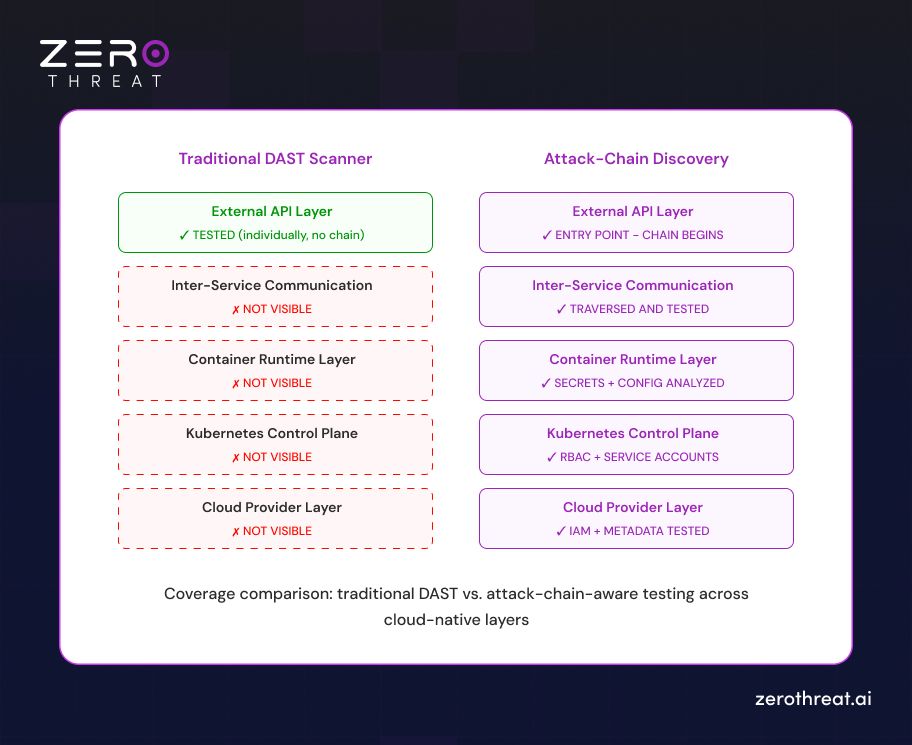
The external API layer is what most security tools test. It includes the API gateway, load balancer, and any services with routes exposed to the internet. This is where initial access most commonly occurs, through injection vulnerabilities, authentication bypasses, BOLA, or SSRF.
The inter-service communication layer is what most security tools ignore. In a microservices architecture, individual services communicate over internal HTTP or gRPC APIs. These APIs frequently lack the authentication controls applied to external-facing routes. An attacker who gains a foothold in one pod can often reach dozens of other services without any additional credentials.
The container runtime layer covers the execution environment of the application itself, the container, its mounted volumes, its environment variables, and its filesystem. Secrets exposed as environment variables, writable mounts, and privileged container configurations are all attack surfaces that exist at this layer.
The Kubernetes control plane layer is where privilege escalation payoffs are highest. The Kubernetes API server is the nervous system of the cluster. An attacker who can authenticate it with sufficient permissions controls every workload running in the environment. Service account tokens, RBAC misconfigurations, and admission controller weaknesses all live here.
The cloud provider layer is the ultimate target in most attacks against cloud-native applications. Cloud provider IAM roles, the instance of metadata service, managed databases, and object storage are all accessible from within the cluster. An attacker who reaches this layer can often exfiltrate data, provision new resources, or pivot to other cloud accounts entirely.
Container application security testing that stops at the external perimeter is not testing the attack surface that attackers actually traverse. Effective cloud-native security requires visibility across all five layers simultaneously, and the ability to follow the chain from one layer to the next.
Why Traditional Scanners Miss Cloud-Native Attack Chains
Traditional DAST (Dynamic Application Security Testing) tools were designed for a different world. They crawl a web application's URL space, inject payloads into form fields and request parameters, and report on individual responses. That model was imperfect even for monolithic applications. For cloud-native environments, it fails systematically.
Single-Endpoint Testing vs Multi-Step Chain Discovery
The core problem is that most scanners treat each endpoint as an independent test target. They send a request, analyze the response, and move on. But a cloud-native attack chain is not a single request. It is a sequence: authenticate to the API gateway, call a microservice that fetches a remote URL, observe that the URL is user-controlled, construct an SSRF payload that targets the metadata endpoint, parse the response to extract temporary credentials, and use those credentials to call the cloud provider's management API.
No single step in that chain looks dangerous in isolation. The API gateway request is legitimate. The URL parameter appears to accept external URLs for image resizing. The metadata endpoint is not part of the application's declared API surface. A scanner that evaluates each request independently will not and cannot see the chain.
The Context Problem
Cloud-native attack chains depend on context. Whether a service account token can escalate privileges depends on what RBAC permissions are bound to it. Whether an SSRF vulnerability is critical depends on whether IMDSv2 is enforced or whether the metadata service returns sensitive credentials. Whether an internal API endpoint is exploitable depends on whether the inter-service network policies allow the calling pod to reach it.
Traditional DAST tools have no mechanism for acquiring this context. They operate in a black-box mode that is genuinely blind to Kubernetes RBAC configurations, cloud provider IAM assignments, and network policy enforcement. They cannot reason about what a successfully exploited SSRF would yield in this specific environment.
Ephemeral Infrastructure
Cloud-native environments are also inherently ephemeral. Research shows that 72% of containers live for fewer than five minutes. Scheduled scans that run nightly or weekly are testing a snapshot of an environment that may bear little resemblance to the production state at the time of a real attack. Continuous, runtime-aware security testing is not a luxury in cloud-native environments, it is the only model that can keep pace with the deployment cadence.
Attack Chain Mechanics in Cloud-Native Environments
An attack chain in any environment is a sequence of weaknesses and transitions that an attacker follows from initial access to a defined objective. In cloud-native architectures, those chains share common structural grammar, even when the specific vulnerabilities change.
The Cloud-Native Attack Chain Template
Most successful attacks against cloud-native applications follow a recognizable pattern with six stages, though not every attack traverses every stage in sequence:
Stage 1: External discovery and enumeration. The attacker maps the external API surface, identifying endpoints, authentication mechanisms, API versions, and error disclosure patterns. Shadow APIs that are no longer documented but still deployed are common entry points discovered during this phase.
Stage 2: Initial exploitation. The attacker exploits a vulnerability in an externally reachable endpoint. The most common entry vectors in cloud-native environments are SSRF (CWE-918), broken object-level authorization (BOLA, OWASP API Security A1), injection attacks, and authentication bypass vulnerabilities in API gateway or service mesh configurations.
Stage 3: Pivot to internal services. With a foothold in one service, the attacker enumerates and probes internal APIs using the compromised service's network position. Internal services that trust traffic from other cluster pods become accessible. This stage frequently involves abusing the Kubernetes service discovery mechanism (CoreDNS) to enumerate internal endpoints.
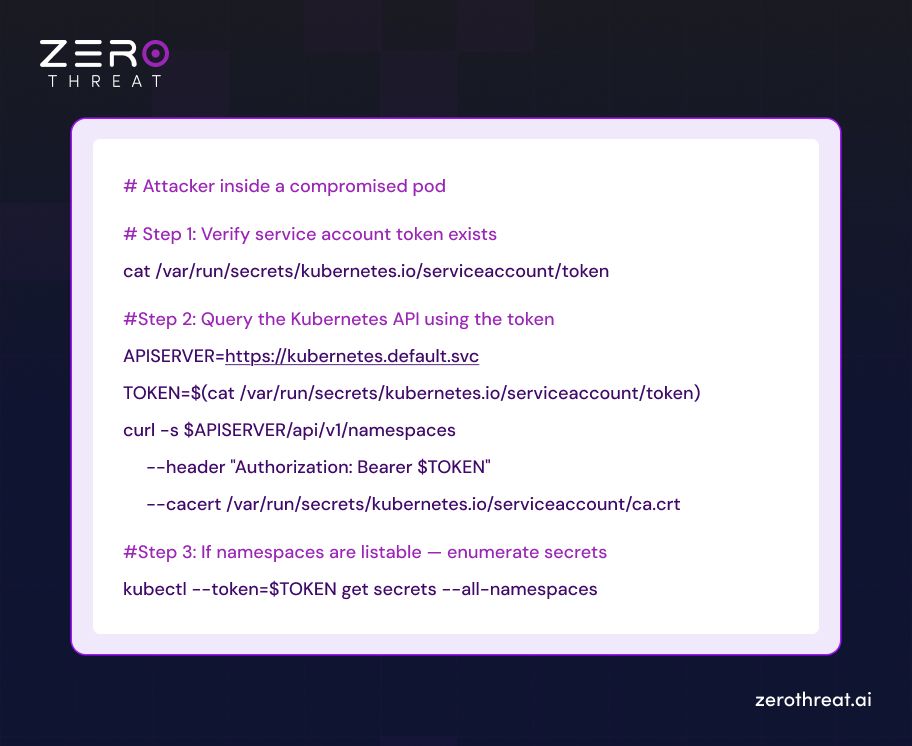
Stage 4: Credential and secrets extraction. The attacker extracts credentials from the compromised environment. This includes service account tokens mounted at /var/run/secrets/kubernetes.io/serviceaccount/token, environment variables containing API keys or database passwords, and cloud provider metadata endpoints that return temporary IAM credentials.
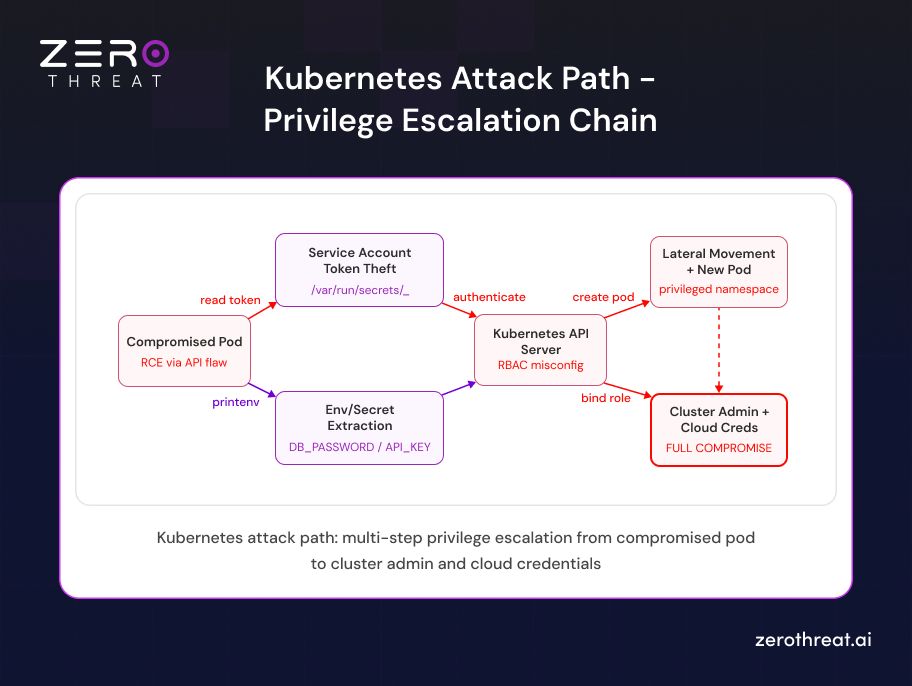
Stage 5: Privilege escalation and lateral movement. Using extracted credentials, the attacker escalates privileges within the Kubernetes cluster or cloud provider account. Lateral movement across Kubernetes involves creating pods in privileged namespaces, binding cluster roles to compromised service accounts, or accessing secrets in other namespaces. In cloud environments, it means assuming IAM roles with broader permissions.
Stage 6: Objective execution. With sufficient privileges, the attacker achieves their objective, exfiltrating data from cloud storage, implanting persistence in the cluster, pivoting to other cloud accounts, or deploying ransomware across cluster workloads.
Modern cloud applications require security that understands how distributed systems actually work. See AI in Action
The Correlation Problem
The critical insight about attack chains is that their individual links are often low or medium severity when evaluated in isolation. CVSS scores are assigned to individual vulnerabilities, not to the chains they form. An SSRF vulnerability rated CVSS 5.3 in a microservice that has no direct path to sensitive data is genuinely low risk. The same SSRF vulnerability in a microservice running in a pod with an over-permissive IAM role bound to its service account is a critical finding, because the chain that extends from that SSRF reaches data exfiltration in two steps.
This is why vulnerability scanners that report isolated findings systematically understate cloud-native risk. A list of medium-severity findings may contain three links that form a critical chain. Without the chain, the security team patches in the wrong order, or does not patch at all, because the individual findings do not trigger remediation urgency.
The Kubernetes Attack Path: From Pod to Cluster Owner
Kubernetes attack path analysis is one of the most consequential areas of cloud-native security testing. The Kubernetes architecture introduces a set of privilege escalation primitives that are unique to container-orchestrated environments, and that attackers have fully internalized.
Service Account Token Abuse
Every Kubernetes pod is mounted with a service account token by default, at /var/run/secrets/kubernetes.io/serviceaccount/token. This token is a JWT that authenticates the pod to the Kubernetes API server. If the service account has permissive RBAC bindings, which is common in clusters that default to broad roles for developer convenience, an attacker who can execute commands inside the pod gains immediate access to the cluster API.
RBAC Privilege Escalation Paths
Even without a direct cluster-admin binding, an attacker with limited Kubernetes API access can often escalate through indirect paths. The most common are: creating a pod in a privileged namespace that mounts the host filesystem; binding a new role to the compromised service account through a create/bind RBAC permission; or abusing a pods/exec permission to execute commands inside another pod that has more permissive bindings.
The Kubernetes attack path is not a single vulnerability, but it is a graph of possible transitions between states of access. Lateral movement Kubernetes security testing requires mapping that graph, not just scanning for individual misconfigurations.
Real-World Impact: The IngressNightmare Pattern
The severity of Kubernetes attack paths became concrete when Wiz researchers disclosed the "IngressNightmare" vulnerabilities in early 2025. Analysis found that approximately 43% of cloud environments were vulnerable, with over 6,500 clusters exposed to remote code execution via the Ingress NGINX Controller. The researchers noted the absence of least-privilege design as a key amplifier: "the exploit ended up with privileges to take control of the cluster." This is the cluster escalation pattern in practice, an admission controller vulnerability, coupled with insufficient network policy and broad RBAC, creating a direct path to cluster takeover from a single network request.
API Attack Chains in Microservices Architectures
APIs are the connective tissue of microservices architectures. They are also, increasingly, the primary attack vector. Research shows that 84% of organizations experienced an API security incident in the past year. In microservices environments, the API attack chain problem is compounded by the sheer number of endpoints, and the absence of centralized access control logic.
The Shadow API Problem
Every microservice has its own API. As services are updated, deprecated endpoints often linger in the codebase without appearing in any OpenAPI specification or gateway configuration. These shadow APIs present a unique risk in cloud-native architectures: they are accessible from within the cluster, they are never tested because they are not known to exist, and they frequently lack the authentication controls applied to documented endpoints, because they were never intended to be permanent.
Shadow API discovery requires probing microservice-to-microservice traffic patterns, fuzzing endpoint paths against running services, and cross-referencing internal DNS resolution against gateway routing tables. This is not a capability that any traditional web crawler possesses.
BOLA Chains Across Service Boundaries
Broken Object Level Authorization (BOLA, OWASP API Security A1) is the most common API vulnerability by volume. In a microservices architecture, BOLA chains work differently than in monolithic applications. An attacker may exploit a BOLA vulnerability in a user-facing service to obtain an object identifier (an order ID, a user ID, a document reference) and then use that identifier against an internal API that does not perform its own authorization check because it assumes its caller has already authorized the request.
This is the microservices trust model working against security. Service A trusts Service B. Service B trusts Service C. If an attacker gains access to Service B's API (directly, or by compromising Service A and using its credentials to call B), the absence of re-authorization in Service C means the attacker can traverse all the way to the data that Service C controls.
API Security Testing for Cloud-Native
Effective API security testing in cloud-native environments requires more than scanning documented endpoints against OWASP API Security Top 10. It requires discovering undocumented internal endpoints, understanding the inter-service authorization model, and testing whether access controls are consistently enforced across service boundaries. The API security testing capability that actually surfaces microservices attack chains needs to trace API calls across service boundaries, not just probe individual endpoints in isolation.
The cost of securing cloud-native applications grows with complexity. Choose a platform built to simplify it. Compare Plans
A Methodology for Discovering Attack Chains
Discovering cloud-native application attack paths isn't magic; it's a repeatable process. Whether done by a human red team or an automated platform, effective attack chain discovery follows the same five moves.
Map the Full Surface
Start with reachability across every layer, external edge, apps, APIs, containers, orchestration, cloud plane. You can't discover a chain through a component you didn't know was exposed. This includes discovering shadow and zombie APIs, forgotten subdomains, and every service that can talk to every other service.
Build the Context Graph
Represent the environment as a graph: services, identities, tokens, trust relationships, and data stores as nodes; reachability and permission as edges. This graph is what makes "A leads to B leads to C" expressible in the first place. It's the substrate every real chain is walked on.
Reason about Paths
With the graph in hand, search it the way an attacker would: from every reachable entry point, what's the next possible step, and where does a sequence of steps terminate at something valuable? This is where container-to-cluster escalation, SSRF chains, and API pivots get proposed as candidate paths.
Validate Every Step
A proposed path is a hypothesis until each link is proven. Validation means actually performing the step, and confirming it works: the SSRF really reaches IMDS, the token really opens the cluster API, the role really reads the bucket. This is the difference between a theoretical finding and a demonstrated breach, and it's what eliminates false positives.
Rank By Business Impact and Report for Two Audiences
Finally, order chains by where they end, not how they start. A path terminating at your customer database outranks one terminating at a public asset, regardless of the entry point's CVSS score. Then report the same chain two ways: the full attack path, impact, and priority for security teams; and the specific endpoint, parameter, evidence, and remediation for the application team that owns the fix.
How ZeroThreat Discovers and Validates Cloud-native Attack Chains
Understanding the theory of attack chain discovery is one thing. Executing it at the speed and depth cloud-native deployments demand is another. Manual red teaming can walk a chain once, on a snapshot, on a schedule. Automated pentesting that reasons the way an attacker does can walk every plausible chain, continuously, without a ticket. Here is how ZeroThreat's engine does it.
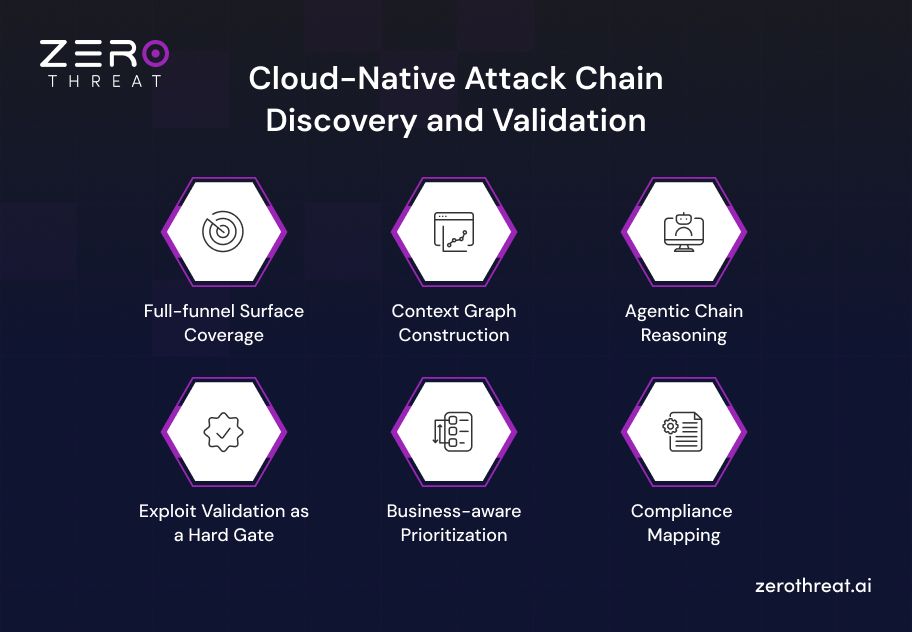
Full-funnel Surface Coverage
ZeroThreat starts at the outermost layer of the external attack surface: ports, TLS, DNS, and mail, the same reconnaissance an attacker runs before touching any application logic. It then works inward: web applications, APIs, authentication flows, complex user workflows, containers at the API level, and the cloud control plane. Nothing is scoped out because a chain that skips a layer doesn't exist in the real world.
Context Graph Construction
Rather than firing payloads and pattern-matching responses, the engine builds a structural model of the environment: which services are reachable, how they trust each other, what identities are in play, and which data stores sit at the end of which permission paths. This context graph is what makes reasoning about multi-hop chains possible. It's also what powers the zero-false-positive guarantee, a finding only surfaces if it exists in the graph with a validated path to reach it.
Agentic Chain Reasoning
With the graph in memory, the engine reasons about paths the way a skilled attacker would: from each reachable entry point, what's the next reachable step, and does a sequence of steps terminate at something worth taking? This isn't rule-based matching against known patterns. It's the engine constructing novel paths based on what it has learned about the specific environment, including complex authenticated workflows it navigates like a real user, without needing Playwright specs written by your team.
Exploit Validation as a Hard Gate
No finding is reported until it is proven. Every link in every proposed chain is validated end to end, production-safely, before it reaches a report. This is an architectural commitment, not a confidence threshold. It's the reason ZeroThreat delivers zero false positives at 99.9% detection accuracy across 130K+ vulnerability coverage. The output isn't "these things might be connected." It's "we walked this path, here is the evidence, here is the impact."
Business-aware Prioritization and Dual-audience Output
Validated chains are ranked by where they end, not where they start, customer data outranks internal tooling regardless of the entry-point severity. The same chain then produces two outputs. Security and AppSec teams get the full attack path, impact, and priority mapped to compliance frameworks including OWASP, PCI DSS, HIPAA, GDPR, and ISO 27001. Application teams get the specific endpoint, parameters, reproduction steps, and remediation guidance for the exact service they own. One path, two reports, no translation required.
For security teams running cloud-native security testing at scale, the distinction matters enormously. A list of 400 medium-severity findings with uncertain exploitability generates noise. A list of 12 validated attack chains with confirmed impact and mapped remediation paths generates action. ZeroThreat's application-aware pentesting produces the latter, a finding set that security teams can act on immediately, with confidence that every item in the report represents a real, exploitable risk in their specific cloud-native environment.
Compliance Mapping for Cloud-Native Environments
Cloud-native applications subject to compliance requirements face a challenge that is structurally different from monolithic applications: the relevant controls span multiple OWASP frameworks, infrastructure standards, and cloud provider security benchmarks simultaneously. ZeroThreat maps every identified attack chain and vulnerability to the specific controls it violates across OWASP Top 10, OWASP API Security Top 10, PCI DSS, HIPAA, GDPR, and ISO 27001, generating audit-ready evidence that covers both the application layer and the infrastructure layer in a single pentest engagement.
For security teams preparing for audits, the value is not just the list of findings, it is the evidence chain that demonstrates the exploit path, the remediation taken, and the post-remediation validation that the vulnerability no longer exists. That cycle, find, validate, remediate, re-test, is what cloud-native compliance programs require, and what automated penetration testing built for cloud-native environments enables continuously.
Let's explore how your environment stands up to real-world attack scenarios. Request a Demo
Conclusion
Securing cloud-native applications is ultimately a problem. Every microservice, container, Kubernetes identity, and cloud resource is a node; every trust relationship, API call, and permission is an edge. Attackers walk that graph looking for paths; most security tools look at nodes.
Attack chain discovery bridges that gap by treating the path as the product, mapping it, walking it, proving it, and ranking it by what it actually costs to lose. The teams that operationalize this discipline, whether through continuous automated pentesting or disciplined runtime security testing against their deployed stack, stop reacting to breach post-mortems and start intercepting the chains before they're walked.
Frequently Asked Questions
How do PCI DSS, HIPAA, and GDPR map to cloud-native attack chains in practice?
Compliance frameworks define controls at the individual finding level. What they actually require underneath is proof that regulated data is unreachable by an unauthorized party. Attack chain discovery maps directly to that requirement, because a chain is defined by where it terminates. A chain that ends at cardholder data is a PCI DSS failure regardless of how any individual link scores in isolation. ZeroThreat produces compliance-mapped reports that tie each validated chain to the specific OWASP, PCI DSS, HIPAA, GDPR, or ISO 27001 control it violates, which is the output auditors actually want, not a CVSS-sorted list.
How frequently should cloud-native attack chain testing be run?
Does ZeroThreat need source code, Kubernetes manifests, or cluster credentials to discover attack chains?
How does ZeroThreat validate exploit chains without disrupting a live cloud-native environment?
How is ZeroThreat different from running a red team exercise to find cloud-native attack chains?
Can ZeroThreat integrate attack chain discovery into a CI/CD pipeline?
Explore ZeroThreat
Automate security testing, save time, and avoid the pitfalls of manual work with ZeroThreat.