 ZeroThreat Wins Bronze Stevie® Award in Tech Startup of the Year Read more

All Blogs
Quick Overview: This blog explains application-aware attack chain discovery: a testing method that learns how your application behaves, then links individual weaknesses into the multi-step exploit paths attackers actually follow. You will learn what an attack chain is, why traditional scanners miss these paths, how the discovery pipeline works, and how ZeroThreat finds and validates these chains across web apps and APIs.
Most vulnerability reports read like a parts list. SQL injection here, an insecure direct object reference there, a missing security header somewhere else. The problem is that attackers do not think in parts lists. They think in paths.
A skilled attacker rarely needs a single catastrophic bug. They need a sequence of small, individually unremarkable weaknesses that connect into something serious. An overlooked API route exposes an object identifier. That identifier slips past a weak authorization check. That access unlocks an administrative function that was never meant to be reachable. Each step looks minor in isolation. Together they become a full account takeover or a data breach.
This is why a scanner can return a clean report on an application that a human pentester then walks straight through. The scanner found the parts. It never assembled the path.
Application-aware attack chain discovery exists to close that gap. It is the practice of testing an application the way an attacker experiences it: as a connected system of routes, sessions, roles, and workflows, where the real risk lives in how those elements interact. With the rise of agentic AI pentesting, this approach has moved from something only senior pentesters could do by hand to something AI agents can perform at scale, across web apps and APIs.
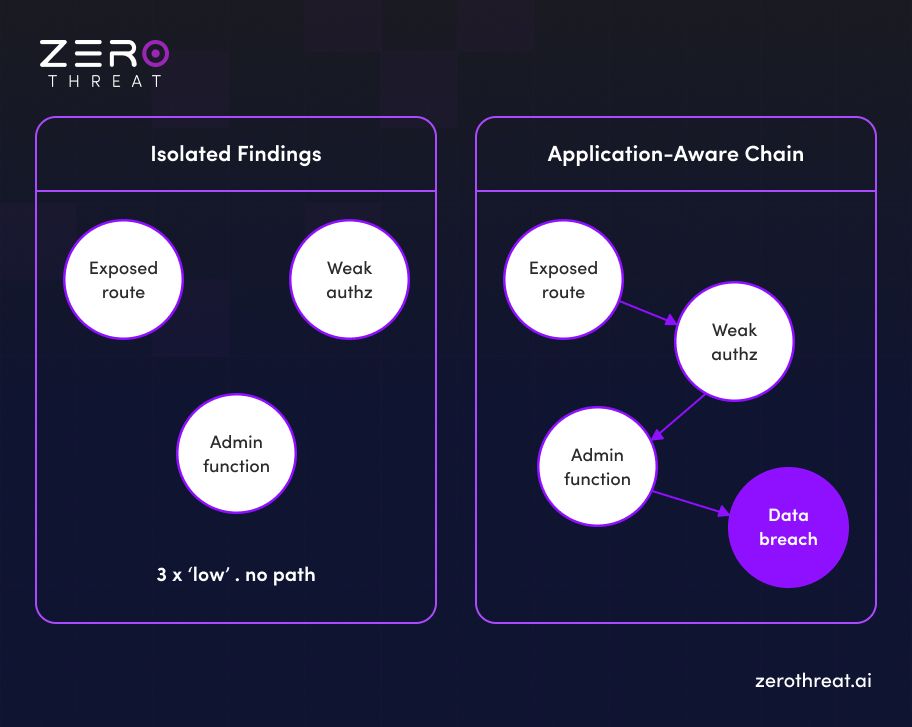
(Three findings that look minor in isolation become a single critical path once the application context links them)
Waiting for the next pentest leaves weeks of exposure. Secure every application change as it happens. Start Pentesting
ON THIS PAGE
- What is an Attack Chain?
- Why Do Traditional Scanners Miss Attack Chains?
- What “Application-Aware” Actually Means?
- How Application-Aware Attack Chain Discovery Works?
- An Attack Chain Walkthrough
- Why This Matters Now: The Threat Landscape
- How ZeroThreat Approaches Attack Chain Discovery
- Key Takeaways
What is an Attack Chain?
An attack chain is the ordered sequence of steps an attacker takes to move from initial access to their final objective, with each step depending on the success of the one before it.
The idea borrows from the military “kill chain” model, where an operation is broken into stages such as reconnaissance, weaponization, delivery, exploitation, and action on objectives. Applied to a web application or an API, an attack chain is built from smaller building blocks that security teams often call primitives:
- Reconnaissance primitives: discovering hidden routes, undocumented API endpoints, or shadow functionality.
- Access primitives: weak authentication, exposed tokens, or insecure direct object references (IDOR, classified under CWE-639 and CWE-284).
- Escalation primitives: privilege escalation through parameter tampering or broken function-level authorization (BFLA).
- Impact primitives: data exfiltration, unauthorized state changes, or business logic abuse such as price manipulation.
The critical insight is that severity is contextual. An IDOR on a public marketing page is noise. The same IDOR on an endpoint that returns another user’s payment records is a breach. You cannot judge the second case without understanding what the application does and who is allowed to do it. That understanding is exactly what “application-aware” provides.
Why Do Traditional Scanners Miss Attack Chains?
Legacy dynamic application security testing (DAST) tools and signature-based scanners were built for a different era of web applications. They tend to fall short in four specific ways.
They test in isolation. A conventional scanner fires a payload, reads the response, and decides pass or fail for that one request. It has no concept of “if I can do step one, can I now reach step two?” Chaining requires state and memory across requests, which point-in-time scanners are not designed to maintain.
Lack Business Context: Authorization and business logic flaws are the hardest class of vulnerability precisely because the malicious request looks completely normal to the application. According to the OWASP Top 10:2025, Broken Access Control remains the number one web application risk, and every application analyzed in the contributed dataset contained some form of broken access control. These are logic failures, and a tool that only matches known signatures cannot infer intent.
Cannot Reach Modern Routes: Single-page applications built with React, Vue, or Angular define most of their navigation in JavaScript. A crawler that only parses static HTML links never sees those client-side routes, so large portions of the application surface are simply invisible to it. The endpoints attackers reach through the running app are the ones the scanner never tested.
Drown Teams in Noise Because they cannot confirm exploitability, signature scanners report everything that matches a pattern, including findings that are not reachable or not exploitable. Security engineers then spend hours triaging false positives instead of fixing real issues.
The result is a coverage gap that maps almost perfectly onto where real breaches happen: authenticated areas, complex workflows, and access control logic.
Traditional scanners miss the connections attackers exploit. Discover what your current tools aren't showing you. See AI in Action
What “Application-Aware” Actually Means?
Application awareness is the difference between a tool that knows your app exists and a tool that understands how your app works. Four layers of awareness matter.
Route Awareness: The system enumerates the full surface, including client-side routes extracted from JavaScript bundles, dynamically generated views, and API endpoints that never appear in static markup. You cannot test what you cannot see, so reach defines the ceiling on everything else.
Workflow and State Awareness: The system understands multi-step user journeys: log in, add an item to a cart, apply a discount, check out. Modeling that state lets the tester probe what happens when steps are reordered, repeated, skipped, or run concurrently, which is where race conditions and logic abuse hide.
Authorization Awareness: The system understands roles and ownership. It can ask the questions that matter most: can a standard user reach an admin function, can one tenant read another tenant’s data, can a horizontal request to a sibling object identifier succeed? This is authorization testing, and it directly targets the OWASP API risks BOLA and BFLA.
Business Impact Awareness: Finally, the system understands what each asset is worth. A finding that exposes financial records is prioritized above a finding that exposes a public help article, even if both share the same technical CWE.
Together, these four layers turn a flat list of issues into a map of how an attacker would actually navigate your application.
How Application-Aware Attack Chain Discovery Works?
Under the hood, application-aware discovery runs as a pipeline. Each stage feeds the next, and AI agents handle the work that previously required a skilled human pentester.
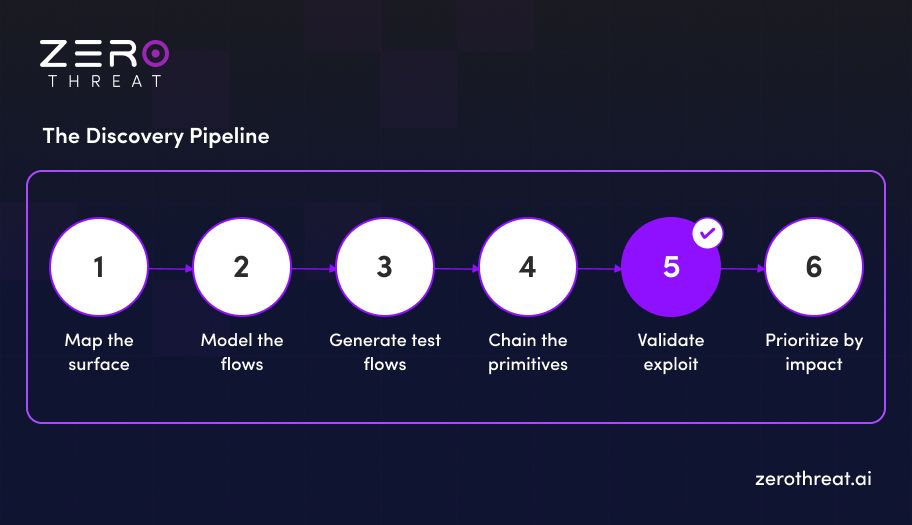
- Map the Surface. A JavaScript route extractor parses client-side bundles to recover the routes a static crawler would miss, building a complete inventory of pages, views, and API endpoints. Deeper coverage at this stage is what makes everything downstream possible.
- Model the Flows. The engine reconstructs complex UI flows and authenticated user journeys, so it understands the legitimate sequence of actions before it tries to break the sequence.
- Generate Test Flows Automatically. Testing modern SPAs traditionally meant writing Playwright scripts by hand for every flow, which is slow and expensive to maintain. Automated Playwright generation removes that burden: the system produces the browser automation needed to exercise each flow, saving engineering time and freeing teams from rewriting specs every time the UI changes.
- Chain the Primitives. This is the heart of the method. Purpose-built AI agents reason across discovered weaknesses and test whether they connect. Does this exposed identifier feed a request that bypasses an authorization check? Does that bypass unlock a sensitive function? The agents pursue the path, not just the point.
- Validate Exploitability. Rather than reporting a theoretical match, the agents attempt to confirm that the chain genuinely works. Validation is what keeps false positives near zero and ensures the findings that reach your team are real.
- Prioritize by Business Impact. Confirmed chains are ranked using business-aware risk prioritization, so the highest-impact path against your most sensitive assets surfaces first. The output is risk-based reporting that an engineer can act on immediately.
This pipeline is why AI pentesting can find complex, multi-step attack chains that signature scanners walk past, while keeping the noise low enough to trust.
An Attack Chain Walkthrough
A concrete example makes the concept tangible. Consider a multi-tenant SaaS billing application.
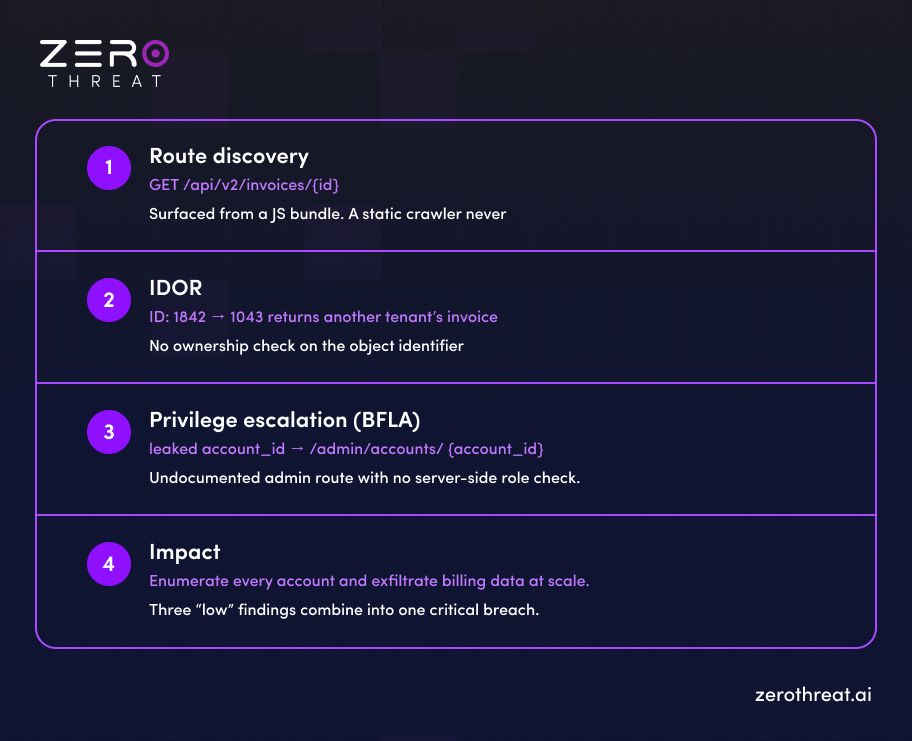
Step 1: Route Discovery
The JavaScript route extractor surfaces an internal endpoint, /api/v2/invoices/{id}, that is referenced only inside a compiled front-end bundle and never linked from any visible page. A static crawler would never reach it.
Step 2: Insecure Direct Object Reference (IDOR)
The endpoint returns an invoice for any numeric identifier without verifying that the requesting user owns it. Changing {id} from 1042 to 1043 returns a different customer’s invoice. On its own a scanner might rate this medium severity, if it found the endpoint at all.
Step 3: Boken Function-Level Authorization (BFLA)
That invoice payload leaks an account_id. Feeding that identifier into a separate, undocumented /admin/accounts/{account_id} route, which lacks a server-side role check, returns full account configuration, including billing contacts and plan controls.
Step 4: Impact
With cross-tenant read access and an exposed administrative function, an attacker can enumerate every account in the platform and exfiltrate billing data at scale. What began as three “low” findings is, in combination, a critical breach.
No single step here is exotic. The danger is the chain, and only a tester that understands the application’s routes, ownership model, and workflows can assemble it.
Security risks don't wait for budget cycles. Protect your applications with a plan built for continuous testing. Explore Plans
Why This Matters Now: The Threat Landscape
The economics of getting this wrong are well documented, and the trend lines all point the same direction.
Breaches are still expensive even as detection improves. The IBM Cost of a Data Breach Report 2025 puts the global average cost of a breach at 4.44 million US dollars, with the United States average reaching 10.22 million. The same research found that organizations using AI and automation extensively in their security programs saved roughly 1.9 million dollars per breach, the largest single cost difference the study has measured.
Attackers are increasingly exploiting application weaknesses directly. The Verizon 2025 Data Breach Investigations Report found that exploitation of vulnerabilities grew to 20 percent of initial access vectors, a 34 percent year-over-year increase, while credential abuse remained the top vector at 22 percent. Notably, 88 percent of basic web application attacks involved stolen credentials, which is exactly the kind of authenticated access that point-in-time scanners never test behind.
Put those facts together and the message is clear. The most damaging breaches start with the application layer, frequently behind a login, and they unfold as chains rather than single events. Testing that stops at the unauthenticated surface and reports isolated findings is testing the wrong thing.
How ZeroThreat Approaches Attack Chain Discovery
ZeroThreat was built around the premise that finding real attack paths matters more than counting potential issues. Its AI pentesting engine performs application-aware attack chain discovery across web applications and APIs through the capabilities described above.
- Deeper Coverage: A JavaScript route extractor reaches client-side routes and hidden endpoints that static crawlers miss, so testing starts from a complete picture of the application surface.
- Complex UI Flow Handling: The engine models multi-step authenticated journeys, the territory where business logic and authorization flaws actually live.
- Purpose-built AI Agents: Agents built from the ground up reason across findings to assemble and pursue multi-step attack chains, not just flag isolated patterns.
- Authorization Testing: Dedicated checks for IDOR, BOLA, and BFLA probe whether users can act outside their intended permissions.
- Business-aware Risk Prioritization and Risk-based Reporting: Confirmed chains are ranked by their impact on your most sensitive assets, so remediation effort goes where it counts.
The platform backs this with broad detection depth, including 130K+ vulnerability checks and 99.9 percent detection accuracy, while validation keeps false positives near zero. Because the testing is automated, a full assessment runs in hours rather than the weeks a manual engagement requires. ZeroThreat does not replace human expertise. It automates the repetitive, large-scale discovery and validation work so your team can focus on the decisions that need judgment.
So, what are you waiting for? Sign up for free now.
Discover what your current security testing may be missing with a personalized product demonstration. Request a Demo
Key Takeaways
Attackers do not exploit vulnerabilities one at a time. They assemble them, turning a hidden route, a weak authorization check, and an exposed admin function into a single critical breach that no isolated finding would have predicted. That is exactly the blind spot traditional scanners leave behind, because they can see the parts but never assemble the path.
Application-aware attack chain discovery closes that gap by testing your application the way an attacker experiences it: as a connected system of routes, sessions, roles, and workflows.
With purpose-built AI agents handling the discovery, chaining, and validation, this depth of testing becomes continuous and scalable rather than a once-a-year manual exercise, surfacing validated, business-ranked attack paths in hours instead of weeks.
As breach costs stay high and attackers shift toward exploiting application weaknesses directly, the takeaway is simple: stop counting isolated findings and start mapping the paths that actually put your data at risk.
Explore ZeroThreat
Automate security testing, save time, and avoid the pitfalls of manual work with ZeroThreat.