 ZeroThreat Wins Bronze Stevie® Award in Tech Startup of the Year Read more

All Blogs
How Application-Aware AI Pentesting Discovers Authentication and Authorization Flaws
Quick Overview: Modern authentication and authorization flaws often hide within user workflows, session states, and access control logic that traditional security testing fails to understand. This blog explores how application-aware AI pentesting analyzes application context to uncover complex identity and permission vulnerabilities, helping security teams detect high-impact risks that conventional scanners frequently miss.
An attacker rarely kicks down the front door. They log in with a valid account, change one ID in a request, and quietly read a stranger's invoice. They accept an OAuth token that was never validated. They call an admin endpoint the UI never showed them. None of this looks like an attack in a network log. It looks like a user simply using the application, which is exactly why it works.
Identity is where applications get breached, yet identity is precisely where traditional testing goes blind. A vulnerability scanner that cannot hold a session, distinguish an admin from a customer, or walk through a multi-step checkout will miss the flaws that matter most.
That gap is what application-aware AI pentesting closes. Instead of firing payloads at URLs, it behaves like a real user with real credentials: it authenticates, maintains tokens, maps who can do what, and probes the boundaries between roles.
This article breaks down why conventional testing misses identity flaws, what makes modern apps so hard to test, and exactly how an application-aware engine discovers authentication and authorization vulnerabilities, from session fixation and JWT weaknesses to BOLA, BFLA, and cross-tenant access failures.
Test real user journeys, not just exposed endpoints. Try It Free
On This Page
- Why Traditional Security Testing Misses Authentication and Authorization Flaws
- Why Modern Applications Make Auth Testing More Complex
- How Application-Aware AI Pentesting Maps Auth, Authz, and User Workflows
- Authentication Flaws It Can Discover
- Authorization Flaws It Can Discover
- Conclusion
Why Traditional Security Testing Misses Authentication and Authorization Flaws
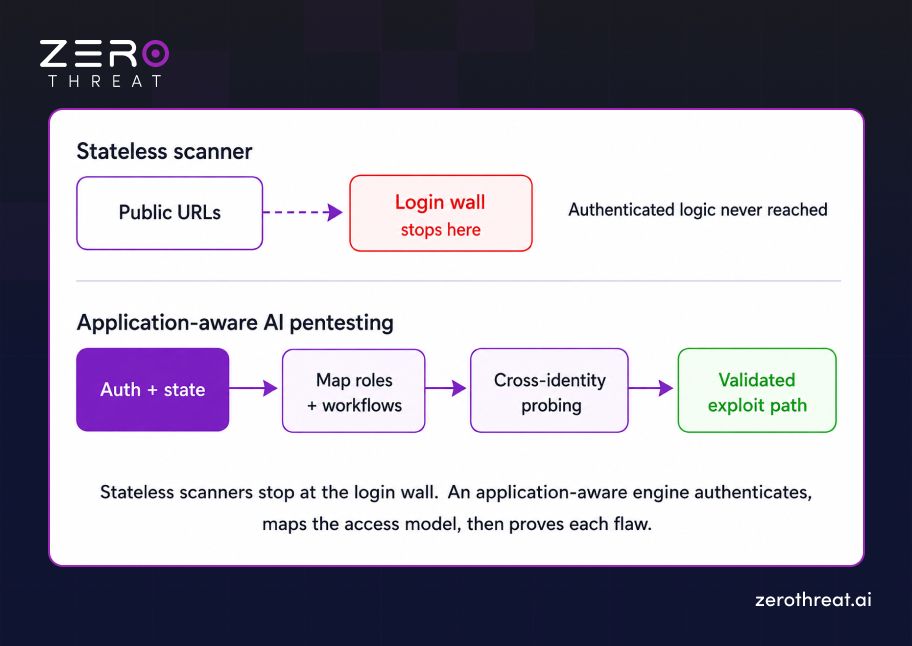
Traditional security testing misses authentication and authorization flaws because it operates outside the application's logged-in state, treating pages as isolated URLs rather than a connected sequence of user actions governed by roles, sessions, and permissions.
A vulnerability like broken access control only appears when the tool knows who a user is supposed to be and then catches the application letting them be someone else. Legacy scanners never establish that context, so the flaw stays invisible.
Limited Visibility into Authenticated User Journeys
Most classic vulnerability scanners live in the pre-login world. They crawl public pages, fuzz visible parameters, and match responses against signatures. But authorization logic lives past the login screen, inside dashboards, account settings, billing pages, and admin panels. If the tool cannot reliably log in and stay logged in, it never exercises the code paths where access control is enforced, and an unexercised path is an untested one.
Stateless Testing Misses Session-Dependent Vulnerabilities
Authentication is stateful by nature. Whether a request succeeds depends on the cookie, the bearer token, the CSRF value, and where the user is in a flow. Stateless testing fires each request in isolation, so it cannot detect session fixation, tokens that survive logout, or a session that fails to rotate after a privilege change. These flaws only reveal themselves across a sequence of requests that share and mutate state, which is precisely what a stateless tool cannot model.
Lack of Role and Permission Awareness
Authorization is comparative. To find a privilege escalation you have to know that a viewer should not reach an admin function, and to find BOLA you have to know that user A should not read user B's object. A tool with no concept of roles has no baseline to compare against. It sees an HTTP 200 and calls it a success, when the real question is whether this specific identity should have received that 200 at all.
Business Logic and Multi-Step Workflows Remain Untested
The highest-impact authorization gaps live inside workflows: skipping the payment step, approving your own request, or replaying a one-time action. Detecting them means completing a workflow correctly, then deliberately breaking the intended order. Signature-based scanners have no model of what the correct sequence is, so they cannot recognize when it has been subverted. The logic flaw sails through untouched.
Why Modern Applications Make Authentication and Authorization Testing More Complex
Modern applications make authentication and authorization testing more complex because identity is now distributed across federated protocols, client-side rendering, and independent services, so no single request or page reveals the full access-control picture.
The logic that once sat in one monolith is now spread across identity providers, browsers, and dozens of microservices, and each layer introduces its own way to get authorization wrong.
OAuth, OpenID Connect, SAML, and MFA Authentication Flows
Federated identity replaces a simple username and password with multi-party token exchanges: redirects, authorization codes, ID tokens, refresh tokens, and assertions. Each handoff is a place to fail. A missing state check enables CSRF on the callback, a skipped signature check lets a forged token through, and a lax redirect allowlist enables token theft. A tool that cannot complete these flows end to end cannot test them, and MFA adds another stateful step that stops naive scanners cold.
Single-Page Applications and Dynamic JavaScript Interfaces
In a single-page application, there is almost nothing in the initial HTML. Routes, forms, and actions are assembled by JavaScript at runtime, and the real security surface is the API calling those interactions trigger. A crawler that only reads static markup sees an empty shell. Reaching the authenticated functionality requires actually rendering and driving the interface, which is why ZeroThreat runs complex SPAs through real browser execution rather than static parsing.
APIs, Microservices, and Distributed Authorization
When one action fans out across many services, each service must independently verify the caller's rights. In practice, teams often trust an upstream gateway and skip the check downstream, assuming someone else already validated it. That assumption is where BOLA and BFLA breed. Testing it means exercising services both through the front end and directly at the API layer, because an endpoint that looks protected in the UI may be wide open when called on its own.
Multi-Tenant and Role-Based Access Control Models
SaaS platforms layer tenants, organizations, teams, and roles on top of each other. A single object might be readable by its owner, its team lead, and a tenant admin, but never by anyone in a different tenant. Verifying these boundaries requires testing from multiple identities across multiple tenants at once, comparing what each is allowed to see. Single-identity testing structurally cannot detect a cross-tenant leak, because it only ever holds one point of view.
Think your access controls are secure? Let AI prove it. Test with AI
How Application-Aware AI Pentesting Maps Authentication, Authorization, and User Workflows
Application-aware AI pentesting behaves like a real, logged-in user. It navigates the live application, maintains sessions and tokens, learns each role's permissions, ties frontend actions to their backend APIs, and explores authenticated workflows to build a working model of who can do what. That model is the reference point every access-control test is measured against.
Learning Application Navigation Beyond Static Crawling
Instead of parsing static HTML, the engine drives the application the way a person does, rendering JavaScript, following dynamic routes, filling forms, and reacting to what the interface actually presents. This browser-level execution reaches SPAs and workflow-heavy apps that static crawlers cannot, and it does so without brittle prerecorded scripts, so the map reflects the application as it truly behaves at runtime.
Maintaining Authentication State, Sessions, and Tokens
Once authenticated, the engine holds the full session context: cookies, bearer tokens, refresh tokens, and CSRF values. It knows when a token expires and refreshes it, and it keeps distinct sessions for distinct users in parallel. Because it maintains state, it can test what happens across the lifecycle, whether a session survives logout, whether it rotates after a role change, and whether an old token still works when it should not.
Identifying User Roles and Permission Boundaries
Given credentials for multiple roles, the engine profiles what each one can reach and builds an expected permission map. That map becomes the ground truth for authorization testing: it defines the boundary a low-privilege user should never cross, so when the application lets them cross it, the violation is unambiguous rather than a guess. This is the difference between reporting a status code and proving an access-control failure.
Correlating Frontend Interactions with Backend APIs
Every button click and page load maps to underlying API requests. The engine records that correspondence, so it can test each endpoint both through the UI and directly, stripped of the frontend's guardrails. A delete action that is hidden behind a disabled button in the interface is still just an API call underneath, and calling it directly is exactly how attackers find function-level authorization gaps.
Dynamically Exploring Authenticated Business Workflows
Rather than testing endpoints in isolation, the engine completes real multi-step journeys, then attacks the sequence: reordering steps, skipping approvals, replaying actions, and swapping in another identity's object IDs mid-flow. This is where workflow-level authorization flaws surface, the ones that only exist because step three trusts that step two was performed by the right person.
Authentication Flaws Application-Aware AI Pentesting Can Discover
Authentication flaws are weaknesses in how an application verifies identity, and application-aware AI pentesting discovers them by driving real login, session, token, and recovery flows to completion, then testing whether identity can be forged, replayed, or bypassed. Because these flaws depend on state and sequence, they only appear to be a tool that can hold a session and manipulate it deliberately.
Authentication Bypass
Sometimes a protected page or API is reachable without ever completing login: through a forced-browsing path, a default account, a debug route, or logic that trusts a client-supplied flag. The engine tests protected resources both with and without valid credentials, and with tampered ones, to confirm whether identity is truly enforced on server-side or merely assumed by the interface.
Weak Session Management and Session Fixation
Session handling breaks in quiet ways: identifiers that do not regenerate after login, sessions that persist after logout, tokens with no expiry, or predictable session values. By maintaining and inspecting session state across the lifecycle, the engine catches fixation, where an attacker plants a session ID a victim then authenticates into, and it flags cookies missing HttpOnly, Secure, or SameSite protections.
JWT and Token Validation Weaknesses
JSON Web Tokens fail when they are trusted without proper verification. The engine tests for the alg:none downgrade, unverified or weak signatures, missing expiry and audience checks, and tokens accepted after logout. It also probes sensitive data exposed in the payload and for whether a token issued to one user can be replayed by another, which turns a token weakness directly into account takeover.
OAuth and SSO Implementation Flaws
Federated login is a chain, and each link can break. The engine walks the full OAuth and OIDC flow to test for missing state parameters that enable login CSRF, overly permissive redirect URIs that leak authorization codes, unvalidated ID token signatures, and mix-up conditions between providers. These are integration flaws, invisible unless the tool can actually complete the exchange end to end.
Password Reset and Account Recovery Vulnerabilities
Recovery flows are a favorite backdoor. The engine exercises the reset path to test for predictable or non-expiring reset tokens, host-header poisoning that redirects reset links to an attacker, user enumeration through differing responses, and reset endpoints that fail to bind the token to the requesting account. A weak reset flow undermines every other authentication control on the login page.
MFA Bypass and Token Replay Attacks
MFA is only as strong as its enforcement. The engine checks whether the second factor can be skipped by calling post-login endpoints directly, whether a session issued before MFA already grants access, whether one-time codes can be brute-forced or reused, and whether a captured token replays cleanly. The DBIR specifically flags the rise of MFA bypass techniques, so testing enforcement, not just presence, is essential.
Stop paying the price for missed vulnerabilities. Explore Pricing
Authorization Flaws Application-Aware AI Pentesting Can Discover
Authorization flaws are failures to enforce what an authenticated user is allowed to do, and application-aware AI pentesting discovers them by testing every object, function, and property from multiple identities at once, catching the moment one user reaches something that belongs to another. Broken access control tops the OWASP charts precisely because it is invisible to any test that only ever holds a single point of view.
Broken Object Level Authorization (BOLA / IDOR)
BOLA, historically known as IDOR, is the single most prevalent API risk: API1 in the OWASP API Security Top 10, present in a large share of API attacks. It happens when an endpoint exposes an object ID, such as /api/orders/1043, without verifying the caller owns it. The engine holds two authenticated sessions and swaps one user's object IDs into the other's requests. If user B's data returns, the flaw is proven, not merely suspected.
Broken Function Level Authorization (BFLA)
BFLA is about reaching functions above your role, typically admin or privileged actions a lower-privilege user should never invoke. Because the engine correlates UI actions to their raw API calls, it can invoke sensitive functions directly, bypassing whatever button-hiding the frontend relied on. A standard user successfully calling POST /api/admin/users is a clean BFLA finding.
Broken Object Property Level Authorization (BOPLA)
BOPLA operates one level finer, at the field. A user may legitimately access an object but should not read or write specific properties of it, such as a hidden role, isAdmin, or balance field. The engine tests both directions: mass-assignment, where an attacker injects a restricted property into an update, and excessive exposure, where the response returns fields the caller should never see.
Horizontal and Vertical Privilege Escalation
Horizontal escalation is reaching a peer's data at the same privilege level; vertical escalation is climbing to a higher one. Using its role map, the engine drives actions as a low-privilege identity against resources and functions reserved for higher roles or other users, and confirms escalation whenever the boundary gives way. The permission model built earlier is what makes each result definitive.
Cross-Tenant Access Control Failures
In multi-tenant SaaS, the hardest boundary to hold is the wall between tenants. The engine operates identities in separate tenants simultaneously and attempts to read or modify one tenant's objects while authenticated as another. Any leakage across that wall is a severe, often catastrophic finding, and it is one that single-identity testing is structurally incapable of detecting.
Hidden Administrative Functions and Business Logic Authorization Gaps
Some of the worst gaps are actions the UI never exposes but the API still honors: undocumented admin routes, internal debug endpoints, or workflow steps that skip an ownership check. By exploring authenticated workflows and correlating them to backend calls, the engine surfaces these hidden functions and the logic gaps where an application forgets to ask, again, whether this identity is really allowed to proceed.
| Capability | Traditional / Stateless Scanning | Application-Aware AI Pentesting |
|---|---|---|
| Reaches authenticated pages | Rarely, breaks at login | Yes, maintains full session |
| Tests across multiple roles | No role awareness | Builds per-role permission map |
| Detects BOLA / IDOR | Largely missed | Proven via cross-identity requests |
| Handles OAuth / SSO / MFA flows | Cannot complete flow | Walks the flow end to end |
| Cross-tenant access checks | Single identity only | Parallel identities across tenants |
| Result quality | Status codes, false positives | Validated exploit path, zero false positives |
Watch AI navigate authenticated workflows like an attacker. Schedule a Demo
Conclusion
Authentication and authorization vulnerabilities are not payloads you can pattern-match from the outside. They are failures of context: who the user is, what session they hold, which role they carry, and whether the application enforces the boundary between what they may and may not do. A missing ownership check, a token trusted without verification, an admin route reachable by a customer, none of these reveal themselves to a tool that never logged in and never learned the access model.
That is why testing has to move inside the application. Discovering these flaws means holding real sessions, distinguishing real roles, walking real workflows, and probing the boundaries between identities the way an attacker does. When a tool understands sessions, tokens, roles, and permissions as a connected model, broken access control stops being invisible and becomes reproducible, provable, and fixable.
This is exactly the gap application-aware AI pentesting is built to close. ZeroThreat authenticates like a user, maintains state across the session lifecycle, maps each role's permissions, and correlates every frontend action to its backend API, then tests across identities and tenants to surface broken auth, BOLA, BFLA, privilege escalation, and cross-tenant leaks, each backed by a validated exploit path and zero false positives. To find your identity and access flaws before an attacker does, start testing with ZeroThreat
Frequently Asked Questions
Why are authorization vulnerabilities commonly missed during security assessments?
Authorization is comparative and stateful, which makes it hard for automated tools and easy to overlook in manual reviews. Detecting a flaw like BOLA requires at least two authenticated identities and the knowledge that one should not access the other's data. Tools that operate from a single session, or that only see HTTP status codes, have no baseline to judge against. The logic also lives deep inside authenticated workflows, so anything that cannot reliably log in and hold state never reaches it.
Can application-aware AI pentesting identify identity and access control issues across both web applications and APIs?
How often should authentication and authorization testing be performed in modern CI/CD pipelines?
Explore ZeroThreat
Automate security testing, save time, and avoid the pitfalls of manual work with ZeroThreat.