 ZeroThreat Wins Bronze Stevie® Award in Tech Startup of the Year Read more

All Blogs
Authenticated Security Testing: Why It Matters for Modern Application Security
Quick Overview: Many of the most critical application vulnerabilities exist behind authentication, where traditional unauthenticated scans never reach. This guide explains how authenticated security testing works, why these risks remain hidden, and the best practices for uncovering them effectively.
An attacker who obtains a working set of credentials does not stop at the login page. That is where real work starts. Once inside a valid session, they probe what the account can touch: whose records they can reach by incrementing an ID, which admin action forgot to check their role, which multi-step workflow can be pushed past its intended limits.
That surface is precisely what most security testing never sees. A scanner pointed at a sign-in screen maps the public shell of an application: marketing pages, the login form, a handful of unauthenticated endpoints. The application itself, its account data, its role hierarchy, its business logic, sits behind a session the scanner never establishes.
This is the gap that authenticated security testing closes. By testing from inside an authenticated session, with real credentials and real privilege levels, it reaches the code paths where broken access control, privilege escalation, and business-logic flaws actually live. These are consistently the highest-impact and hardest-to-automate vulnerabilities in modern web applications and APIs.
Below, we cover what authenticated security testing is, why so many critical vulnerabilities hide behind authentication, how the testing works mechanically, the specific vulnerability classes it uncovers, why those flaws stay invisible to conventional tools, and how to run it well.
Security teams discover something new every time they scan. Start Discovering
On This Page
- What is Authenticated Security Testing?
- Why Vulnerabilities Hide Behind Authentication
- How Authenticated Security Testing Works
- Vulnerability Classes You Can Only Find With Authentication
- Why These Vulnerabilities Stay Hidden
- Best Practices for Authenticated Security Testing
- Conclusion
What is Authenticated Security Testing?
Authenticated security testing is the practice of assessing an application from inside a valid, logged-in session, using real credentials to reach the functionality and data that only become available after authentication.
It stands in contrast to unauthenticated, or black-box testing, which probes an application from the outside as an anonymous visitor. An unauthenticated test can only see what any stranger can see. An authenticated test carries a live session token and behaves like a legitimate but adversarial user: it holds a login, moves through the account, and questions every trust boundary it meets.
The distinction that matters most here is between authentication and authorization. Authentication answers "who are you?" and is handled by login flows, session establishment, token issuance, and multi-factor checks. Authorization answers "what are you allowed to do?" and is enforced through role checks, ownership checks, and permission logic.
A perfectly authenticated user can still trigger serious flaws when the application fails to verify that their identity is actually permitted for the action they attempt. Those authorization failures can only be observed from inside a session, which is why authenticated testing exists.
Modern AI-powered pentesting tools do not use a single login. They run with a matrix of credentials across privilege levels, a standard user, a second standard user, an administrator, a tenant in a multi-tenant system, so they can compare what each identity is allowed to do and catch the cases where those boundaries leak.
Why Vulnerabilities Hide Behind Authentication
Vulnerabilities hide behind authentication because the majority of an application's logic, data, and trust boundaries only exist after login, and a test that never authenticates never reaches them.
Think about where the code lives. The public surface of a typical application is thin: a landing page, a login form, maybe a pricing page and a contact endpoint. Everything that makes the product a product, the dashboards, the account settings, the record CRUD operations, the billing flows, the admin console, the API endpoints that move real data, is gated behind a session. That is the bulk of the attack surface, and it is invisible to an anonymous scan.
Access control, by definition, governs what an authenticated user is allowed to do. A test that never logs in cannot evaluate access control at all, so it structurally cannot find the single most prevalent category of web application risk.
There is a second reason these flaws hide: they are invisible from the outside because they are not "broken" in any way a stranger can observe. An IDOR endpoint returns a clean, valid response. A missing role check on an admin function works exactly as coded. The application is behaving as written. The vulnerability only surfaces when a specific identity sends a specific request that the application should have refused, and you cannot send that request without first being that identity.
| Dimension | Unauthenticated Testing | Authenticated Testing |
|---|---|---|
| Surface reached | Public pages, login, a few open endpoints | Full post-login application and API surface |
| Access-control flaws | Not reachable | Reachable |
| Business-logic flaws | Rarely | Core focus |
| Privilege escalation | Not testable | Directly testable |
| What a clean result means | The public shell looks fine | The real application was actually exercised |
How Authenticated Security Testing Works
Authenticated security testing works by establishing a valid session the way a real user would, maintaining that session across the entire test run, and then exercising the application's post-login surface across one or more privilege levels.
The first job is getting in and staying in. Applications authenticate in several ways, and a test has to handle each: session cookies, JWT and bearer tokens, OAuth2 and OIDC flows, SAML-based single sign-on, and multi-factor prompts. Establishing the session is only the start. The harder part is keeping it valid: tokens expire, sessions time out, and refresh flows have to fire at the right moment, or the test silently drops to an unauthenticated state and stops finding anything meaningful.
With a stable session in place, the test maps the authenticated surface: the pages, endpoints, parameters, and API routes that only appear once you are logged in. It then exercises that surface with the mindset of an adversarial account holder, and, critically, it does the same across multiple identities so it can compare boundaries. The sequence looks like this:
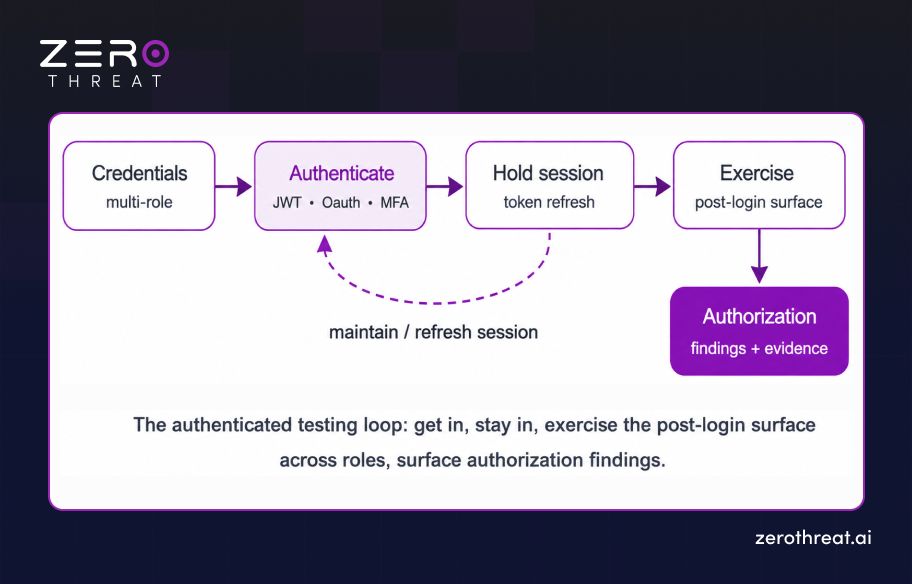
The multi-role dimension is what separates real authenticated testing from simply "logging in and scanning." Many of the most damaging flaws are only visible when you hold two sessions at once and compare them: user A creates a record, user B tries to read it, and the test watches whether the application says no. A single-session scan cannot ask that question.
Real security comes from understanding applications, not just scanning them. Explore AI Pentesting
Vulnerability Classes You Can Only Find with Authentication
The vulnerability classes that require authentication to find are almost all access-control and business-logic failures: IDOR and BOLA, broken function-level authorization, privilege escalation, tenant isolation breaks, and workflow abuse.
These are not fringe issues. They are the categories that dominate real breaches, and they share a trait: each one lives inside a valid session and looks like normal traffic from the outside.
Insecure Direct Object References (IDOR) and BOLA
An object reference flaw occurs when a user-supplied identifier flows into a resource lookup without a check that the requester actually owns the object (CWE-639). Change /api/orders/1043 to /api/orders/1044 and you read someone else's order. On APIs this is Broken Object Level Authorization, and OWASP ranks it as the number one API security risk. Finding it requires two authenticated identities and a comparison of what each is permitted to access.
Broken Function Level Authorization (BFLA)
Here a standard user reaches a function they should never be able to invoke, such as a regular account calling POST /admin/users/delete. The endpoint may not even be linked to the interface. The only way to find it is to hold a low-privilege session and attempt privileged actions, watching the ones the server fails to reject.
Privilege Escalation
Horizontal escalation reaches another user's data at the same privilege level. Vertical escalation gains higher privileges than the account should hold, often through metadata manipulation such as tampering with a JWT claim or a hidden role field. Both are questions about what a specific authenticated identity can do, so both require a session to test.
Multi-tenant Isolation Failures
In SaaS platforms, the highest-severity flaw is often one tenant reaching another tenant's data. Testing it means authenticating as tenant A and attempting to reference tenant B's objects. This is invisible to any test that logs in as a single account, and catastrophic when it exists.
Business-logic and Workflow Abuse
Some flaws are not breaking code at all: the application works exactly as designed, and the attacker abuses the design. Skipping a payment step, replaying a one-time action, manipulating quantities to force a negative total, or completing a multi-stage flow out of order. These live deep inside authenticated workflows and demand a tester that can carry state across many steps while logged in.
Why These Vulnerabilities Stay Hidden
These vulnerabilities stay hidden because conventional tools cannot reliably hold a session, traverse multiple roles, or reason about whether a valid-looking request is actually authorized, so the flaws sit inside responses that look completely normal.
The first barrier is the session itself. Automated crawlers lose authenticated state constantly: a token expires mid-run, a refresh flow is missed, a logout is triggered by accident, and the tool quietly reverts to scanning the public shell. Modern login flows make this worse, with multi-step authentication, MFA prompts, and SSO redirects that a simple scanner cannot navigate. If a tool cannot stay logged in, everything behind the login is a blind spot.
The second barrier is comparison. As OWASP notes, BOLA is not easily detectable with automated static or dynamic testing, because catching it means holding two identities and checking whether one can reach the other's objects. Most scanners operate with a single session and simply cannot pose that question.
The third barrier is interpretation. An authorization bypass usually returns a clean HTTP 200 with valid-looking data. There is no error, no injected payload, no signature for a rule-based tool to match. Distinguishing a legitimate response from an unauthorized one requires understanding what this specific user should have been allowed to see. Pattern matching cannot do that. It takes an application-aware approach that models identity, role, and object ownership, and reasons about intent rather than scanning for known-bad strings.
This is the shift that makes hidden vulnerabilities findable: testing that understands the application it is inside, sustains real sessions through complex flows, moves between roles, and evaluates each response against what the acting identity was actually permitted to do.
Best Practices for Authenticated Security Testing
Doing authenticated testing well is less about tooling volume and more about discipline in how sessions, roles, and evidence are handled. The practices below separate a test that genuinely exercises the application from one that merely logs in.
- Build a Credential and Role Matrix: Provision accounts for every privilege level that matters: at least two standard users, an administrator, and a separate tenant in multi-tenant systems. You cannot test a boundary you have no identity on either side of.
- Verify The Session Stays Valid Throughout the Run: Continuously confirm the test is still authenticated. A run that silently drops to an anonymous state produces a clean report that means nothing.
- Test Object-level Authorization with At Least Two Accounts: For every endpoint that accepts an object ID, have a second identity attempt to reach the first identity's objects. This is the core check for IDOR and BOLA.
- Cover Both Horizontal and Vertical Escalation: Attempt same-level data access across users and privileged actions from low-privilege accounts. Do not assume the interface hides what the server refuses to enforce.
- Scope Destructive Actions Carefully: Authenticated tests can create, modify, and delete real data. Define what is safe to exercise, especially against production, so testing does not become an incident.
- Run It Continuously, Not Once a Year: Access-control and business-logic flaws are introduced with every new endpoint and role change. Point-in-time testing misses everything shipped since the last assessment.
- Capture Evidence for Every Finding: Record the request, the acting identity, the response, and the reproduction step. Authorization findings are only actionable when the team can see exactly which identity reached what it should not have.
Every great security platform looks good on a website. Ours proves it live. See It Live
Conclusion
The vulnerabilities that cause the worst breaches are rarely the ones a stranger can see from outside. They are the access-control gaps, privilege-escalation paths, and business-logic flaws that live inside a valid session and return perfectly normal-looking responses. If your testing never authenticates, it never reaches them, and a clean report is measuring the wrong surface.
This is the problem ZeroThreat is built to solve. Its application-aware engine authenticates the way a real user would, holds sessions through complex, multi-step workflows without requiring pre-written Playwright specs, and moves across roles and tenants to test what each identity is actually permitted to do.
Instead of flagging surface anomalies, it validates real authorization and business-logic attack chains behind the login and hands both security and application teams the request, the evidence, and the remediation path. To see what your unauthenticated scans have been missing, start with ZeroThreat.
Frequently Asked Questions
What is the difference between authenticated and unauthenticated testing?
Unauthenticated testing probes an application as an anonymous outsider and can only reach public pages and open endpoints. Authenticated testing carries a valid session and exercises the full post-login surface, including account data, privileged functions, and business logic. Access-control and business-logic flaws are only reachable with authentication.
Why do most critical vulnerabilities require authentication to find?
Can automated scanners perform authenticated testing?
How often should authenticated security testing run?


Explore ZeroThreat
Automate security testing, save time, and avoid the pitfalls of manual work with ZeroThreat.