 ZeroThreat Wins Bronze Stevie® Award in Tech Startup of the Year Read more

All Blogs
Quick Overview: Selecting the right Adversarial Exposure Validation (AEV) tools is critical as attacks become quicker and more damaging. This guide covers the top AEV tools you can choose from. It explains how they work, how they differ from BAS and penetration testing, and what features to look for. Plus, it provides tool comparisons and practical benefits you should know about.
Most organizations today are finding a long list of vulnerabilities via some or the other tools, but most of them aren’t even exploitable. In fact, research indicates that while thousands of new vulnerabilities are discovered annually, only 6% of published CVEs are ever actually exploited by threat actors.
This massive gap between "potential risk" and "actual exposure" is exactly why you need to use an Adversarial Exposure Validation (AEV) tool.
With plenty of options available in the market, it is confusing to choose which one will fit right for you. And know that selecting the wrong one can increase the vulnerability detection time more than manual testing.
To make sure you select the right one, we’ve detailed the top Adversarial Exposure Validation tools after hands-on usage of each. Read the blog till the end to learn what features you should look for, the key features of each tool, and choose the right one.
Run your first AI-powered pentest and uncover real exploitable risks in minutes, not hours. Begin My Free Trial
ON THIS PAGE
- Best Adversarial Exposure Validation Tools: Quick Glance
- What are Adversarial Exposure Validation Tools?
- How does the Adversarial Exposure Validation Tool Work?
- Key Features to Look for in AEV Tools
- Top 10 Adversarial Exposure Validation (AEV) Tools
- How AEV is Different than BAS and Penetration Testing Tools
- Benefits of Using Adversarial Exposure Validation Tools
- Final Thoughts
Best Adversarial Exposure Validation Tools: Quick Glance
| Tools | Key Focus | Top Feature | Best For |
|---|---|---|---|
| Pentera | Automated network and infrastructure pentesting | Agentless attack chaining in production | Enterprises validating internal and external attack paths |
| AttackIQ | Security control validation (BAS + AEV) | MITRE ATT&CK-based adversary simulation | Large teams testing detection and prevention controls |
| Terra Security | Agentic AI continuous pentesting | Real-time attack path chaining | Teams needing deep business logic and continuous testing |
| BreachLock | Continuous pentesting, and AEV + PTaaS | Unified pentesting with compliance reporting | Engineering teams needing continuous pentesting with compliance |
| SafeBreach | Breach and attack simulation | Large attack library across kill chain | Enterprises testing detection and response effectiveness |
| NodeZero | Autonomous pentesting | No-config attack path discovery | Teams needing fast, autonomous red teaming |
| Cymulate | Exposure management and validation | Full attack chain simulation with AI insights | Teams improving overall security posture continuously |
| Picus Security | Security control validation | Threat library with compliance mapping | Organizations needing compliance-driven validation |
| Scythe | Adversary emulation and purple teaming | Custom attack campaign creation | Security teams running advanced attack simulations |
| XM Cyber | Attack path management and exposure validation | Choke point based risk prioritization | Teams focused on fixing critical attack paths first |
What are Adversarial Exposure Validation Tools?
Adversarial Exposure Validation tools are offensive security platforms that simulate real-world cyber attacks to test how exposed your systems actually are. They go beyond finding vulnerabilities and focus on validating whether those weaknesses can be exploited in real conditions.
These tools are a core part of adversarial exposure validation. They continuously test web applications, APIs, and infrastructure using attack techniques that mimic real threat actors. This includes automated attack simulation, exploit validation, and security posture verification.
If compared with traditional security testing tools, AEV tools provide more accurate results about which vulnerabilities are truly exploitable. This helps security leaders focus on risks that matter, instead of fixing false positives or theoretical issues.
In modern environments, AEV tools support continuous security validation. They align with practices like Continuous Threat Exposure Management (CTEM) and allow CISOs and security teams to know real attack surface risk in an ongoing, practical way.
How does the Adversarial Exposure Validation Tool Work?
AEV tools follow a structured four-step process to continuously test, identify, and validate security gaps before real attackers find them.
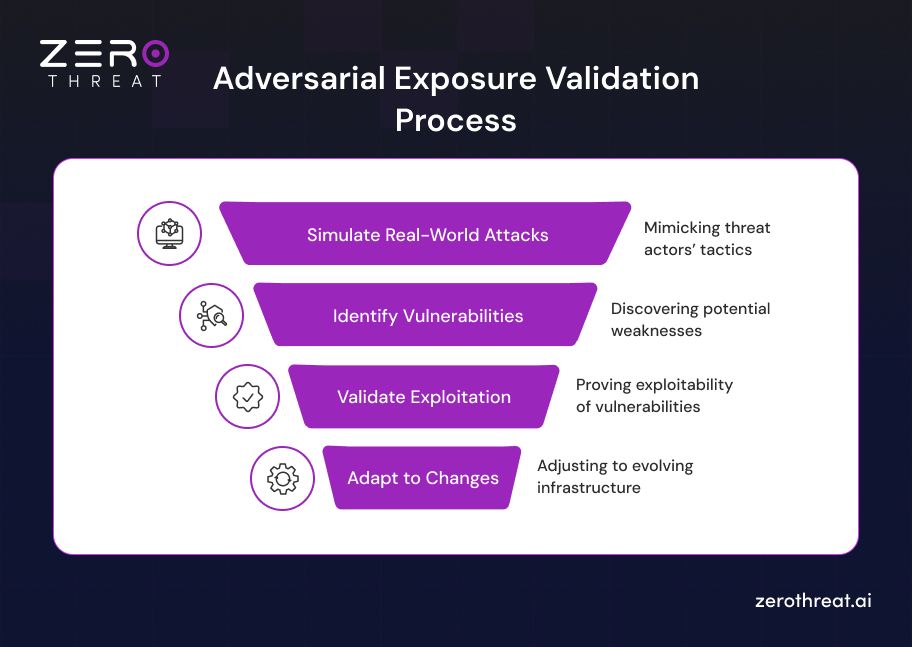
- Simulate Real-World Attacks: The tool mimics actual threat actor tactics and techniques, running attack scenarios mapped directly to MITRE ATT&CK.
- Identify Vulnerabilities: It scans for weaknesses across your environment, including misconfigurations, unpatched systems, and control gaps that scanners typically overlook.
- Validate Exploitation: It goes beyond detection. The platform proves whether identified vulnerabilities are actually exploitable under real attack conditions, not just theoretically at risk.
- Adapt to Changes: As your infrastructure evolves, the tool adjusts continuously. Every new asset, integration, or configuration shift gets tested against current threat scenarios automatically.
Finding vulnerabilities in your application is not enough. You should know which one actually matters. Detect Exploitable Threats
Key Features to Look for in AEV Tools
Choosing the right adversarial exposure validation tool depends on how well it proves real exploitability. Here are the must-have features to look for in an AEV tool for making the right selection.
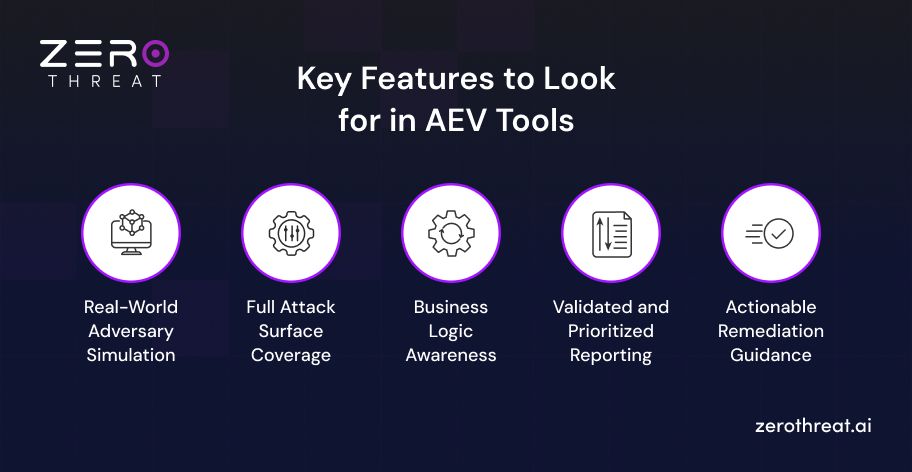
Real-World Adversary Simulation
Look for tools that simulate real attacker behavior using tactics, techniques, and procedures instead of static test cases. The platform should adapt based on system responses and execute multi-step attack paths. This helps uncover chained vulnerabilities and realistic exploitation scenarios.
Full Attack Surface Coverage
A strong AEV tool should validate exposure across web apps, APIs, cloud assets, and internal systems. It must include authenticated and white-box testing to identify deep vulnerabilities. Broad coverage ensures no critical entry point or hidden exposure is left untested.
Business Logic Awareness
Advanced tools should understand application workflows, user roles, and logic flows. This allows them to identify business logic vulnerabilities that traditional scanners miss. These flaws often have the highest business impact and require context-aware testing.
Validated and Prioritized Reporting
The tool should confirm which vulnerabilities are truly exploitable and rank them based on real risk. This reduces alert fatigue and helps teams focus on issues that attackers can actually use. Prioritized reporting improves decision-making and remediation speed.
Actionable Remediation Guidance
Look for tools that provide clear and practical remediation steps. Reports should include context, impact, and developer-focused fixes. This ensures findings can be resolved quickly and integrated into DevSecOps workflows for continuous security.
Top 10 Adversarial Exposure Validation (AEV) Tools
The tools below help organizations validate real attack paths, test exploitability, and continuously measure security exposure across apps, APIs, and cloud environments.
1. Pentera
Pentera is an automated security validation platform that safely emulates real cyber attacks across internal and external environments. It focuses on identifying exploitable vulnerabilities by simulating attack chains without disrupting production systems.
The platform enables organizations to test network, cloud, and endpoint security by executing real attack scenarios. It validates security controls and helps teams understand how attackers can move laterally and escalate privileges within environments.
Key Features of Pentera...
- Automated attack simulation across network and infrastructure
- Safe exploitation of vulnerabilities in production environments
- Lateral movement and privilege escalation testing
- Internal and external attack surface validation
- Continuous security validation and retesting
- Security control effectiveness validation
- Detailed reporting with remediation insights
Best For: Organizations needing scalable, automated red teaming and chained-attack simulations across hybrid environments.
2. AttackIQ
AttackIQ is an enterprise-grade adversarial exposure validation platform designed to continuously test security controls using real-world adversary techniques. It operationalizes continuous threat exposure management through persistent validation.
It maps attack scenarios to frameworks like MITRE ATT&CK and continuously evaluates detection and prevention capabilities. It helps organizations identify control gaps, prioritize risks, and validate defense effectiveness across their security ecosystem.
Key Features of AttackIQ...
- MITRE ATT&CK aligned adversary simulation
- Continuous exposure validation across controls
- Security control validation and risk scoring
- Attack path mapping and exposure prioritization
- Integration with SIEM, EDR, and SOAR tools
- Continuous retesting and threat monitoring
- CTEM-aligned security validation workflows
Best For: Large enterprises focused on validating security controls and operationalizing continuous threat exposure management.
3. Terra Security
Terra Security is an agentic AI-driven offensive security platform designed for continuous penetration testing. It simulates real attacker behavior using autonomous agents that adapt to application logic, workflows, and system changes in real time.
The tool validates exploitability through continuous attack path chaining and change-based testing. With human-in-the-loop validation and production-safe execution, it delivers accurate findings while reducing noise and aligning results with real business risk.
Key Features of Terra Security...
- Agentic AI-driven continuous pentesting
- Real-time attack path chaining and validation
- Dynamic attack surface monitoring and asset discovery
- Business logic-aware testing with white-box context
- Human-in-the-loop validation for accuracy
- Change-based testing for evolving environments
- Compliance-ready reporting with verified findings
Best For: Enterprises needing deep, continuous web application and business logic security validation.
4. BreachLock
BreachLock is a unified penetration testing platform that combines PTaaS, attack surface management, and continuous security testing into a single system. It provides centralized visibility across assets, vulnerabilities, and validated attack paths for better risk understanding.
The platform blends AI-driven automation with human expertise to deliver continuous pentesting across web, API, cloud, and network layers. It supports DevOps pipeline security, real-time collaboration, and compliance-ready reporting with actionable remediation insights.
Key Features of BreachLock...
- Unified platform for PTaaS and attack surface management
- Continuous pentesting with automated and manual testing
- API, web, network, and cloud security testing coverage
- Attack path mapping and validation capabilities
- DevOps integration with built-in ticketing workflows
- Real-time collaboration and centralized dashboards
- CREST-certified and customizable compliance reports
Best For: Engineering-driven teams looking for integrated, continuous pentesting with strong compliance support.
5. SafeBreach
SafeBreach is an enterprise-grade breach and attack simulation platform that validates security controls using real-world attack scenarios. It continuously tests defenses across the entire kill chain to identify gaps and measure resilience.
The platform uses an extensive attack library and automated simulations to assess detection and prevention capabilities. It provides detailed insights, prioritizes threats, and integrates with existing security tools to improve remediation and overall security posture.
Key Features of SafeBreach...
- Large attack library with thousands of real-world scenarios
- Continuous breach and attack simulation across environments
- MITRE ATT&CK aligned threat validation
- Attack path validation with impact analysis
- Integration with SIEM, SOAR, and security tools
- Automated threat prioritization and risk scoring
- Custom dashboards with posture tracking and reporting
Best For: Enterprises focused on validating security controls and improving detection and response effectiveness through continuous simulation.
Security testing shouldn't break your budget. Compare plans crafted for your AppSec. Check Out Pricing
6. NodeZero
NodeZero by Horizon3.ai is an autonomous penetration testing platform that continuously discovers and exploits vulnerabilities across networks. It operates without manual setup and safely validates real attack paths using AI-driven offensive techniques.
The platform focuses on proving exploitability through real attack chaining, including credential abuse and lateral movement. It provides clear evidence of risk and actionable insights, helping teams fix the most critical security gaps efficiently.
Key Features of NodeZero...
- Autonomous pentesting with no manual configuration
- Real attack path validation with chaining techniques
- Credential exposure and privilege escalation testing
- Internal and external network security validation
- Continuous retesting after remediation
- Proof-based findings with clear evidence
- Safe execution in production environments
Best For: Security teams that need autonomous network pentesting with real attack path validation.
7. Cymulate
Cymulate is an exposure management and adversarial validation platform that continuously simulates real-world threats across the entire kill chain. It focuses on validating exploitability and improving security posture using AI-driven attack simulation.
The platform integrates with existing security controls and provides continuous validation of detection and prevention capabilities. It uses threat intelligence and automation to prioritize risks and help teams optimize defenses based on real attacker behavior.
Key Features of Cymulate...
- Continuous attack simulation across full kill chain
- AI-powered threat validation and prioritization
- Integration with SIEM, EDR, and security controls
- Real-time security posture monitoring
- Threat intelligence-driven simulations
- Detection engineering and alert optimization
- Actionable insights for defense improvement
Best For: Organizations focused on continuous threat validation and improving detection and response capabilities.
8. Picus Security
Picus Security simulates how attacks unfold across every phase of the cyber kill chain. The platform utilizes a continuously updated library based on the latest threat intelligence. This allows teams to replicate the tactics used by advanced threat actors accurately.
Analysts can measure control gaps using reports aligned with standards like NIST CSF and ISO 27001. It is especially useful for uncovering success paths for lateral movement or privilege escalation. This makes it a top choice for compliance validation.
Key Features of Picus Security...
- Extensive and continuously updated threat library
- Real-world attack simulation across multiple vectors
- Vendor-specific mitigation and detection rules
- Continuous security validation at enterprise scale
- Integration with existing security tools
- Threat-informed prioritization of risks
- Detailed reporting with actionable insights
Best For: Enterprises seeking deep control validation with strong remediation guidance and threat intelligence.
9. Scythe
Scythe is an adversary emulation and exposure management platform designed to help organizations test their defenses against realistic cyber attack scenarios. It enables security teams to emulate advanced threat actors and validate how well security controls perform under real conditions.
The platform provides flexible attack campaign creation and supports purple teaming exercises across the organization. With continuous validation and attack path testing, Scythe helps teams improve detection capabilities, strengthen response processes, and reduce exposure to real threats.
Key Features of Scythe...
- Adversary emulation and attack simulation
- Custom attack campaign builder
- Purple teaming and collaborative testing
- MITRE ATT&CK framework mapping
- Security control validation and exposure assessment
- Detection and response effectiveness testing
Best For: Security teams conducting advanced adversary emulation, purple teaming, and continuous security validation.
10. XM Cyber
XM Cyber combines attack path mapping with security control validation for continuous exposure management. It identifies how threat actors could move from low value assets to your crown jewels. The tool chains small misconfigurations together to find hidden risks.
It integrates with CMDBs and vulnerability scanners to help security teams close exposures proactively. The tool provides a visual representation of attack paths across hybrid infrastructure. This helps organizations focus their remediation efforts where they matter most.
Key Features of XM Cyber...
- Full attack path discovery and visualization
- Continuous exposure validation across environments
- Choke point analysis for risk prioritization
- Automated mapping of exploitable attack paths
- Integration with security and IT systems
- Risk-based prioritization based on exploitability
- Reporting for business and technical stakeholders
Best For: Organizations focused on attack path analysis and prioritizing remediation based on real exploitability.
How AEV is Different than BAS and Penetration Testing Tools
Adversarial Exposure Validation focuses on continuously proving whether exposures are actually exploitable in real environments. It simulates real attacker behavior, chains weaknesses, and provides evidence of successful attack paths instead of just listing risks.
Breach and Attack Simulation tools mainly test security controls. They run predefined attack scenarios to check if tools like EDR or SIEM detect or block threats. They validate defense effectiveness, but they do not deeply confirm real exploitability across complex attack paths.
Penetration testing is a manual and periodic assessment performed by ethical hackers. It provides deep insights but is limited in scope and frequency. AEV extends this by automating and continuously validating real-world attack feasibility at scale.
AEV vs BAS vs Penetration Testing
| Aspect | AEV | BAS | Penetration Testing |
|---|---|---|---|
| Core Focus | Validating exploitable attack paths | Testing security control effectiveness | Find and exploit vulnerabilities |
| Testing Logic | Dynamic and adversary-driven | Static and scenario-based | Manual or automated checklists |
| Frequency | Continuous and change-based | Continuous and scheduled | Periodic or point-in-time |
| Scalability | High through AI automation | High through automation | Low due to manual labor costs |
| Adaptability | Adapts in real-time to systems | Relies on predefined playbooks | Depends on human skill level |
| Primary Goal | Finding real business risk | Measuring defensive coverage | Meeting compliance and security audits |
Benefits of Using Adversarial Exposure Validation Tools
Adversarial Exposure Validation tools help you understand real security risk by validating exploitability. They support continuous security testing and give clear insight into how attackers can impact your environment.
- Validates Real Exploitability: AEV tools confirm which vulnerabilities can actually be exploited in real conditions. This removes guesswork and helps you focus on risks that attackers can use, not just theoretical weaknesses.
- Reduces False Positives: By validating attack paths and exploit success, AEV tools filter out noise from traditional scanners. This allows security teams to spend time fixing real issues instead of chasing low-impact alerts.
- Enables Continuous Security Validation: AEV platforms run continuously and adapt to changes in your environment. This ensures your security posture is always tested against evolving threats, not just assessed at a single point in time.
- Improves Risk Prioritization: These tools rank vulnerabilities based on real-world impact and attack feasibility. This helps teams prioritize fixes that reduce actual risk and improve overall security posture effectively.
- Uncovers Complex Attack Paths: AEV tools chain multiple weaknesses across systems to simulate real attack scenarios. This helps identify how attackers can move laterally and reach critical assets through multi-step exploitation.
- Strengthens Detection and Response: Modern AEV tools test whether security controls detect and respond to real attacks. It identifies gaps in SIEM, EDR, and monitoring systems and improves overall defensive readiness.
Don’t know what security testing tool and approach to use? Let experts at ZeroThreat help you out. Connect With Us
Final Thoughts
The approach to security is changing from just finding vulnerabilities to focusing on risks that can lead to attacks. With that, traditional tools are no longer fully reliable at most points.
On the other hand, using adversarial exposure validation helps you understand which weaknesses can actually be exploited and how attackers move through your environment.
Each of the tools mentioned above has the same intent: to provide you with exploited, validated vulnerability findings. When choosing a tool, focus on features such as attack surface coverage, prioritized reports, and real-world adversary simulation.
With the right tool, security becomes effortless, and you can spend time developing and deploying more without worries of threats the next day.
Frequently Asked Questions
What are adversarial exposure validation tools?
Adversarial exposure validation tools simulate real attack scenarios to prove if vulnerabilities are actually exploitable. They continuously validate attack paths, detection, and response across your environment, giving evidence of real risk instead of theoretical findings.
AEV vs BAS: what’s the difference?
Is AEV better than penetration testing?
How does adversarial exposure validation work?
Which AEV tools simulate real cyber attacks continuously?
Is Adversarial Exposure Validation better than BAS?


Explore ZeroThreat
Automate security testing, save time, and avoid the pitfalls of manual work with ZeroThreat.