 ZeroThreat Wins Bronze Stevie® Award in Tech Startup of the Year Read more

All Blogs
10 Best Agentic AI Pentesting Tools to Use in 2026: Force Multiplying Security
Quick Overview: A detailed breakdown of the top agentic AI penetration testing tools, covering their core capabilities, key features, and what they are best for. It dives into what to look for in a solution and how to choose the right platform based on autonomy, speed, integration, exploit validation, and environment coverage.
Today, AI is no longer a future idea in cybersecurity; it’s a core defense strategy. Around 77% of security professionals now embedded AI in their security stack, and 89% say AI will be essential for future cyber defenses, showing how critical intelligent automation has become in handling vulnerabilities and emerging threats.
At the same time, traditional penetration testing can be slow, manual, and expensive. Hackers now use automation and AI to scale attacks. To keep pace, leading teams must turn to an agentic AI pentesting tool that autonomously plans, simulates, and validates real attack paths instead of just running basic scans.
This blog explores the best agentic AI penetration testing tools, helping you select the right solution to uncover exploitable risks and improve the security posture of your web app and APIs with less effort and more accuracy.
Secure your web apps at dev speed with ZeroThreat’s agentic AI. Get Started Free
On This Page
- Agentic AI Pentesting Tools: Quick Overview
- What to Look for in an Agentic AI Pentesting Tool?
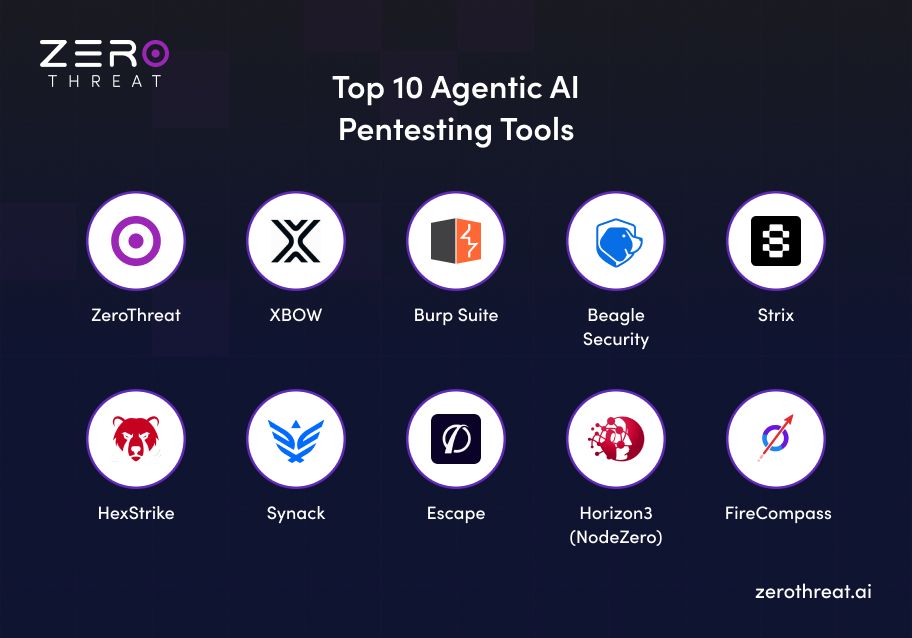
- Best Agentic AI Penetration Testing Tools (2026)
- How to Choose the Right Agentic AI Pentesting Testing Tool?
- Why Choose ZeroThreat as Your Agentic AI Pentesting Solution?
- Final Verdict
Agentic AI Pentesting Tools: Quick Overview
| Tool Name | Primary Focus | Key Capability | Automation Level | Best For |
|---|---|---|---|---|
| ZeroThreat | Web Apps & APIs | AI-driven reasoning and exploit validation | Partially Autonomous | Continuous AI pentesting with proof-of-exploit |
| XBOW | Web vulnerabilities | Parallel machine-scale attacks | Fully Autonomous | Human-level depth at machine speed |
| Burp Suite | Manual pentesting | MCP-powered AI in Repeater | Human-in-the-loop | Experts needing an AI co-pilot |
| Beagle Security | Web Apps, APIs & GraphQL | Autonomous attack-path reasoning with proof-of-exploit validation | Agentic AI | Dev and security teams needing authenticated, business-logic-aware pentests without agency turnaround times |
| Strix | Cloud-native stacks | Attack path graph visualization | Partially Autonomous | Persistent adversarial cloud pressure |
| HexStrike | Offensive frameworks | Orchestration of 200+ tools | Human-in-the-loop | Open-source CTF and bug bounty hunting |
| Synack | Enterprise scale | Elite researcher + AI (Sara) | Hybrid (Human + AI) | Regulated industries needing manual assurance |
| Escape | API & GraphQL | Business logic security testing | AI-Powered DAST | Teams with high-velocity API deployments |
| Horizon3 | Infrastructure | Real-world attack chaining | Fully Autonomous | Production-safe infrastructure validation |
| FireCompass | External footprint | Multi-stage attack tree engine | Fully Autonomous | Continuous external attack surface management |
What to Look for in an Agentic AI Pentesting Tool?
The value of a security tool is no longer measured by the length of its vulnerability list. It is actually evaluated by its ability to act with intent and provide validated proof. Here are the critical capabilities you should look for when selecting an agentic AI pentesting tool.
- Goal-Oriented Reasoning: Instead of following fixed playbooks, the tool should plan attack sequences based on objectives. It must adapt its tactics dynamically as it discovers new environmental feedback.
- Multi-Step Attack Chaining: Look for an agentic tool capable of linking multiple minor findings into a full attack path. This ensures the tool can simulate how real attackers pivot through complex environments.
- Automatic Remediation Testing: Select a platform that can automatically replay attack scenarios after you apply a fix. This ensures that your remediation truly eliminates the exposure.
- Business Logic Awareness: Top-tier tools identify flaws in unique application workflows that standard scanners miss. They prioritize what actually breaks your real-world business logic testing rather than just flagging generic vulnerabilities.
- Seamless Pipeline Integration: To maintain speed, the tool should integrate directly into your CI/CD workflows. It should trigger continuous testing automatically to catch regressions the moment new code is pushed.
- Evidence and PoC Generation: The system should generate reproducible Proof-of-Concept (PoC) scripts. This proves a bug is actually exploitable and helps your developers verify and fix the issue faster.
- Compliance Mapping: Look for built-in support for standards like the OWASP Top 10. This helps you generate audit-ready reports that map directly to GDPR, PCI DSS, and ISO certifications.
Run your first agentic AI pentest today and see real vulnerabilities instantly. Start Testing Now
Best Agentic AI Penetration Testing Tools (2026)
The best tools act as autonomous partners that understand context and prove vulnerability findings. Here are the top ten tools you must know before selecting.
1. ZeroThreat
ZeroThreat is an agentic AI penetration testing tool built to validate real exploit paths across modern web applications and APIs. Unlike traditional scanners that generate large volumes of unverified alerts, its AI-driven approach analyzes how different user actions interact within an application to uncover chained vulnerabilities that appear only during realistic attack conditions.
ZeroThreat operates within controlled testing boundaries, allowing organizations to validate risks safely in staging environments. The system combines autonomous reasoning with user-defined guidance, producing findings that are auditable, reusable, and designed to meet enterprise governance and security testing requirements.
Its agentic AI layer reasons through potential attack paths, while the scanning engine performs deep automated testing and the platform AI revalidates findings to eliminate false positives. By automating attacker-style testing workflows, the platform enables organizations to conduct deep security assessments up to 10× faster, significantly reducing manual pentesting effort while improving accuracy and risk visibility.
Key Features of ZeroThreat...
- Agentic AI-driven exploit validation workflows.
- Code-level vulnerability pattern recognition.
- Open attack template support (Burp + Nuclei)
- Complex UI & SPA scanning via Playwright.
- Automated asset discovery and scanning.
- Support for REST, GraphQL, gRPC, and SOAP API testing.
- CI/CD integration for modern development pipelines.
Best For: Startups, MSSPs, Enterprises and SaaS companies needing fast, zero-setup AI-driven pentesting for web applications and APIs.
2. XBOW
XBOW is an autonomous offensive security platform designed to match the depth of premium manual pentesting engagements. It utilizes multiple AI agents to discover, validate, and exploit web-application vulnerabilities independently, ensuring that every finding is confirmed through real-world system exploitation.
The platform eliminates traditional scanner noise by providing reproducible proof-of-concept scripts for every confirmed bug. It executes targeted attacks in parallel at machine-scale speed, allowing security teams to explore deep attack paths and edge cases without increasing their overall operational overhead.
Key Features of XBOW...
- Multi-agent autonomous discovery and orchestration.
- Real exploitation-based vulnerability validation.
- Automated Proof-of-Concept (PoC) script generation.
- Parallel execution of targeted offensive attacks.
- Integration for one-click pentests within the Vanta UI.
- Support for testing production-grade, complex web applications.
Best For: Organizations requiring human-level depth and verified exploit evidence at the speed of a fully autonomous platform.
3. Burp Suite
Burp Suite Professional has integrated agentic AI directly into its Repeater tool to act as an on-demand pentesting partner. This assistant helps researchers analyze HTTP history, suggest creative attack angles, and push through roadblocks while maintaining the user’s full control during deep client engagements.
Using the open Model Context Protocol (MCP), Burp connects with external agents to automate repetitive tasks like sorting requests or checking endpoints. It performs safe-active testing following OWASP standards, ensuring that high-risk actions avoid impacting production systems or exposing sensitive data during the audit.
Key Features of Burp Suite (Burp AI)...
- AI assistant integration within the Repeater tool.
- Context-aware HTTP history analysis and retrieval.
- Automated request labeling and notes in Repeater.
- Safe-active testing mode for OWASP-standard checks.
- Montoya API for custom AI extension development.
- Bridge connection for external agents like Cursor or Claude.
Best For: Professional pentesters and security researchers who want to amplify their manual expertise with a reasoning-capable AI co-pilot.
4. Beagle Security
Beagle Security is an agentic AI penetration testing platform built for web applications, APIs, and GraphQL endpoints. Its AI agents plan and execute test sequences based on how an application actually behaves rather than working off a static rule set, reasoning through attack paths, adapting as they uncover new information, and validating exploitability instead of surfacing unverified alerts.
The platform learns an application's business logic from recorded user flows, letting it navigate multi-step processes such as checkouts or authenticated workflows the way a human tester would. It also fingerprints the underlying tech stack to select relevant test cases and contextualize its findings, and each reported vulnerability comes with proof-of-exploit detail, including the payload used and the exact path affected, so teams can verify and prioritize fixes rather than triage a raw findings list.
Key Features of Beagle Security…
- Agentic AI penetration testing with autonomous attack-path reasoning and chaining.
- Business-logic recording for testing complex, authenticated user flows.
- REST API and GraphQL security testing alongside web application coverage.
- Automated tech-stack fingerprinting for contextual, relevant test selection.
- Proof-of-exploit reporting with payload and affected-path detail.
- Vulnerability index covering 3,000+ vulnerability types.
- CI/CD pipeline integration for testing earlier in the development cycle.
Best For: Development and security teams that need authenticated, business-logic-aware penetration tests for web apps, APIs, and GraphQL.
5. Strix
Strix focuses on autonomous adversarial testing specifically for cloud-native environments and complex modern stacks. It identifies reachable assets and maps attack paths across interconnected systems continuously. This platform adapts as infrastructure changes from configuration drift or new deployments.
The system operates by securing code, APIs, and cloud surfaces using specialized autonomous agents. It provides deep visibility into exposure introduced by frequent releases and dynamic resources. The platform also auto-validates every finding to confirm exploitability with proof.
Key Features of Strix...
- Autonomous cloud-focused attack simulation.
- Continuous asset discovery and attack-path mapping.
- Agent-driven exploit attempts and exposure validation.
- Automated fix generation with merge-ready pull requests.
- Attack path graph visualization.
- Specialized agents for custom environment tuning.
- Native integrations with GitHub, Slack, and Jira.
Best For: Organizations seeking persistent adversarial pressure and cloud-native security for environments with frequent releases.
6. HexStrike
HexStrike AI is an offensive security framework that integrates professional security tools with autonomous AI agents. It utilizes a multi-agent architecture to deliver comprehensive testing for penetration testing, bug bounty hunting, and CTF challenges. The system is built on intelligent decision-making.
The framework operates through human-in-the-loop interaction using external Large Language Models via the Model Context Protocol. It creates a continuous cycle of prompts, analysis, and feedback to refine testing. It supports browser automation and real-time CVE analysis.
Key Features of HexStrike...
- Multi-agent architecture with 50+ specialized AI agents.
- Integration of 200+ professional security tools into one platform.
- Model Context Protocol (MCP) support for external LLM interaction.
- Real-time CVE analysis and exploit generation.
- Browser automation for JavaScript execution and DOM analysis.
- Specialized tools for reverse engineering and binary analysis.
- Open-source framework accessible via GitHub.
Best For: Security professionals and bug bounty hunters needing a unified, open-source multi-agent orchestration framework.
Compare plans and start automated pentesting without hiring experts. Compare Plans
7. Synack
Synack provides a comprehensive security testing platform that unites the strategic power of over 1,500 elite human researchers with Sara, its proprietary autonomous red agent. This hybrid approach delivers continuous, trusted testing across complex applications and cloud environments.
The platform identifies and prioritizes vulnerabilities by mimicking real-world attacker intuition while leveraging AI to handle reconnaissance and noise reduction. This ensures teams receive validated findings that resolve directly to business risks without the overhead of manual data triaging.
Key Features of Synack...
- Sara (Synack Autonomous Red Agent) for vulnerability prioritization.
- Synack Red Team (SRT) access to 1,500+ human researchers.
- Continuous automated attack surface discovery and fingerprinting.
- Headless API penetration testing missions.
- Gray box application and host security assessments.
- Point-in-time and continuous cloud environment testing.
- Integrated vulnerability disclosure program (VDP) management.
Best For: Large enterprises seeking to scale offensive testing by combining high-speed agentic AI with the precision of elite human expertise.
8. Escape
Escape is an AI-powered DAST platform built specifically to secure modern developer stacks and API-heavy environments. It utilizes a unique reasoning engine to perform deep security testing at the business logic level, discovering complex flaws.
The tool provides instant code-to-cloud visibility with agentless discovery and automated documentation for REST, GraphQL, and gRPC endpoints. By integrating directly into CI/CD pipelines, it enables teams to remediate real vulnerabilities at the speed of daily releases.
Key Features of Escape...
- Proprietary business logic security testing algorithm.
- Agentless API discovery and shadow asset inventory.
- Native support for GraphQL and gRPC security testing.
- Automated OpenAPI and Swagger documentation generation.
- CI/CD integration for shift-left offensive security.
- 140+ specific attack scenarios including BOLA and IDOR.
- Automated framework-specific code remediations for developers.
Best For: DevOps and security teams needing autonomous, logic-aware testing for APIs and modern applications without slowing down deployment pipelines.
9. Horizon3 (NodeZero)
Horizon3 is a fully autonomous penetration testing platform that enables organizations to continuously assess their security posture at scale. It operates without human intervention, dynamically traversing networks and chaining vulnerabilities to reach high-value targets.
Designed for production safety, the platform provides verified proof of exploitability across internal, external, and cloud infrastructure. It empowers teams to prioritize remediation based on actual impact and offers targeted retesting to confirm fixes are successful.
Key Features of Horizon3.ai (NodeZero)...
- 100% autonomous real-world attack path chaining.
- Production-safe internal and external penetration testing.
- Automated Kubernetes and cloud-native security assessments.
- NodeZero Tripwires for integrated honeytoken-based threat detection.
- Active Directory password auditing and identity validation.
- Rapid response alerts for CISA KEV and emerging CVEs.
- One-click targeted retesting for fix validation.
Best For: Organizations requiring a self-service, autonomous platform to validate actual exploitability across complex hybrid infrastructure and identity layers.
10. FireCompass
FireCompass provides an agentic AI platform that continuously maps shadow assets and validates exploitability across web, API, cloud, and infrastructure. It focuses on automating multi-stage attack paths while prioritizing real risks with evidence-backed results for security teams.
The system discovers every attacker-visible asset using zero-knowledge reconnaissance and highlights crown-jewel paths. It integrates automated red teaming with MITRE-aligned attack trees to emulate real-world adversaries, simulating lateral movement and privilege escalation to find every exploitable gap.
Key Features of FireCompass...
- Zero-knowledge autonomous asset discovery.
- Multi-stage attack path mapping and visualization.
- Patented PARC attack-tree engine.
- MITRE-aligned lateral movement and traversal simulation.
- Continuous external attack surface management (ASM).
- Evidence-backed exploit validation for reported risks.
- Hybrid expert-in-the-loop business logic validation.
Best For: Enterprises needing continuous automated red teaming and global attack surface management across complex cloud and infrastructure.
How to Choose the Right Agentic AI Pentesting Testing Tool?
Selecting the right agentic AI pentesting tool requires looking beyond basic scanning features. You need an autonomous system that aligns with your specific infrastructure, data sovereignty, and integrates into development workflows.
Infrastructure and Asset Coverage
Ensure the tool provides end-to-end coverage across your entire stack, including code, APIs, and cloud infrastructure. It should offer deep asset visibility, identifying shadow IT and forgotten resources that traditional scanners often miss during periodic or annual assessments.
Intelligent Risk Prioritization
Look for platforms that filter out noise by applying business context to findings. The best tools act like a senior partner, automatically triaging results and focusing your team on confirmed, reachable attack paths rather than overwhelming them with thousands of theoretical or low-impact vulnerabilities.
Deployment Speed and Workflow Integration
Select a solution built with a "dev-first" mindset that integrates directly into your CI/CD pipelines. You want a tool that is easy to deploy, ideally in under an hour, allowing findings to flow directly into ticketing systems like Jira or Slack for rapid remediation.
Data Residency and Sovereignty
Check if the vendor offers multi-region hosting to meet your organization's data sovereignty needs. Because it is critical to know exactly where your scan data and sensitive findings are stored. Tools supporting specific EU or US hosting provide essential compliance with local regulations.
In simple terms, the ideal tool should act as a force multiplier for your human experts. It handles repetitive processes and complex chaining while allowing your red team to focus on complex business logic flaws that require human intuition and creative strategy.
Why Choose ZeroThreat as Your Agentic AI Pentesting Solution?
ZeroThreat’s goal is to ensure that modern web applications and APIs remain secure without lagging behind the speed of development. It eliminates false-positives and complexity by combining automation with agentic AI to find critical flaws quickly and accurately.
- AI-Driven Exploit Validation: Controlled agentic AI validates real attack paths using adaptive workflows to prove the actual impact of discovered vulnerabilities.
- Logic-Based Attack Coverage: The platform identifies vulnerabilities caused by flawed business logic and workflow misuse that traditional automated scanners often miss.
- Comprehensive API Security: You get deep testing for REST and GraphQL endpoints, including the automated discovery of shadow APIs and broken authentication.
- Exceptional Detection Accuracy: With a 99.9% accuracy rate, ZeroThreat ensures near-zero false positives, allowing your team to focus exclusively on fixing real risks.
- 10X Faster Performance: Most comprehensive scans finish in less than two hours, keeping your security posture strong without slowing down deployment.
- Zero-Configuration Setup: You can start testing immediately with point-and-click simplicity, requiring no complex configuration or specialized security expertise.
- AI-Powered Remediation Reports: It provides AI-generated actionable remediation guidance that helps you reduce mean-time-to-remediate (MTTR) by 88%.
- Audit-Ready Compliance: The tool generates audit-friendly reports to help you meet security compliance and allows you to white-label reports with your brand, logo, and URL.
Have questions about integrating agentic AI into your CI/CD pipeline? Contact Us
Final Verdict
The rise of agentic AI represents a major shift from simple automation to intent-driven security systems. By adopting goal-oriented reasoning, these tools act as essential force multipliers for modern human teams. They successfully eliminate false positives so that you can focus on validated, real-world exploitability.
The right tool depends on your environment, whether you secure web apps, APIs, cloud infrastructure, or AI systems. And before choosing a platform, focus on autonomy, proof-of-exploit validation, and integration with your workflow.
AI can scale and accelerate testing, but it should align with your security maturity and risk profile. When selected carefully, an agentic AI pentesting tool becomes your personal ethical hacker for testing and securing web apps and APIs.
Frequently Asked Questions
What are agentic AI pentesting tools?
Agentic AI pentesting tools are autonomous security systems that simulate real attacker behavior. They use agentic AI to perform reconnaissance, exploit chaining, and proof-of-exploit validation without constant human control. Unlike basic scanners, AI dynamically reasons about application behavior, adapts attack paths, and sequences tests based on live context.
How are agentic AI pentesting tools different from traditional pentesting tools?
Can AI pentesting tools replace human pentesters?
Are AI pentesting tools safe to use in production environments?
What are the benefits of AI-powered pentesting?
What should I look for in an agentic AI pentesting tool?


Explore ZeroThreat
Automate security testing, save time, and avoid the pitfalls of manual work with ZeroThreat.