 ZeroThreat Wins Bronze Stevie® Award in Tech Startup of the Year Read more

All Blogs
DevOps Pipeline Security Explained: Why DevSecOps Teams Choose ZeroThreat
Blog Overview: Modern DevOps pipelines move fast, but rapid change increases security risk. This blog explains common DevOps security challenges, why continuous testing is essential, and how ZeroThreat helps DevSecOps teams embed automated, runtime-aware security into CI/CD pipelines without slowing delivery.
Modern software delivery has transformed how organizations innovate, scale, and compete. Teams deploy multiple times a day, infrastructure is ephemeral, and cloud-native architectures dominate production environments. But as speed has increased, so has the attack surface. Today, the DevOps pipeline itself has become one of the most targeted assets in the enterprise.
Traditional security models were never designed for CI/CD pipelines, microservices, or Infrastructure as Code. They rely on periodic scans, manual reviews, and siloed teams, approaches that simply do not scale in today’s DevOps-driven world. The result is a growing attack surface, misconfigurations in production, vulnerable dependencies shipping to customers, and security teams overwhelmed with noise instead of actionable risk.
This is where DevSecOps comes in, as a fundamental shift in how organizations build, deploy, and secure software. DevSecOps demands security that is automated, contextual, developer-friendly, and deeply integrated into the delivery pipeline.
ZeroThreat was built specifically for this reality. It’s designed from the ground up to secure modern pipelines without slowing teams down.
In this article, we are going to talk about why security in DevOps pipeline is critical, the challenges DevSecOps teams face, and how ZeroThreat’s automated pentesting delivers a security model aligned with how modern engineering organizations actually work.
Start securing your DevOps pipeline with continuous security, no complex setup, no workflow disruption Get Started Free
On This Page
- Understanding the Modern DevOps Pipeline
- Why Traditional Security Tools Fail in DevOps Environment
- Understanding Security Risks in DevOps Pipelines
- Best Practices for Securing the DevOps Pipeline
- ZeroThreat’s DevSecOps-First Design Philosophy
- Conclusion: Security That Moves at the Speed of DevOps
Understanding the Modern DevOps Pipeline
To secure CI/CD pipeline effectively, it is critical to understand how modern DevOps environments function.
A typical DevOps pipeline includes:
- Source control and collaboration (Git-based repositories)
- Continuous integration (automated builds and tests)
- Continuous delivery/deployment (automated releases to staging and production)
- Cloud and containerized infrastructure
- API-driven application architectures
- Monitoring and feedback loops
Each stage introduces its own attack surface. There may be phases where code commits include insecure dependencies, CI pipelines expose secrets, APIs ship without proper authorization checks, and misconfigurations can propagate instantly across environments.
Security in this context cannot be an isolated phase. It must operate as a continuous control layer across the entire pipeline.
Why Traditional Security Tools Fail in DevOps Environment
Most vulnerability scanners and top security testing tools were designed for static, perimeter-based environments. When we tried to integrate them into DevOps pipelines, they introduced friction, blind spots, and operational pain.
Security Happens Too Late
Traditional penetration testing and vulnerability assessments are often scheduled near release milestones. By the time issues are identified, teams are already under pressure to deploy, leading to risk acceptance rather than remediation.
Tools Lack Runtime Context
Static scans and surface-level tests do not reflect how applications and APIs behave in real environments. This results in false positives, missed business logic flaws, and incomplete coverage.
Manual Processes Do Not Scale
DevOps pipelines can execute dozens of builds per day. Manual testing, ticket triage, and report reviews cannot keep pace with this cadence.
Security Becomes a Bottleneck
When security tools slow down builds or require complex configurations, engineering teams bypass them. Over time, security is perceived as an obstacle rather than an enabler.
Understanding Security Risks in DevOps Pipelines
DevOps pipelines are designed to maximize speed, automation, and repeatability, but these same strengths also introduce unique and often underestimated security risks. Unlike traditional application delivery models, modern pipelines span multiple tools, environments, identities, and third-party components. Each integration point becomes a potential attack vector if not properly secured.
To implement CI/CD pipeline security testing, DevSecOps teams must first understand where risks originate, how they propagate, and why they are difficult to detect using legacy security approaches.
Expanding Attack Surface of Modern Pipelines
A DevOps pipeline is no longer a simple path from code to production. It is a complex, interconnected system involving:
- Source code repositories
- CI/CD platforms
- Artifact repositories
- Container registries
- Cloud providers
- Secrets managers
- Monitoring and deployment tools
Every integration introduces credentials, permissions, APIs, and automation logic. When these components are misconfigured or insufficiently monitored, attackers can exploit them to move laterally across the pipeline.
Identity and Access Misconfigurations
One of the most critical and common risks in DevOps pipelines is overprivileged identities.
Pipelines rely heavily on non-human identities such as:
- Service accounts
- CI/CD tokens
- Cloud roles
- API keys
These identities are often granted broad permissions to “make things work,” but over time they accumulate access far beyond what is necessary.
Common identity-related risks include:
- Long-lived secrets stored in plaintext
- Reused credentials across environments
- CI jobs running with administrative cloud privileges
- Lack of rotation or monitoring for pipeline credentials
If an attacker gets access to a single pipeline credential, they may inherit the same level of access as the pipeline itself, often including the ability to deploy to production or modify infrastructure.
Supply Chain Vulnerabilities in Dependencies and Build Artifacts
Modern applications are assembled, not written from scratch. A typical codebase may depend on hundreds or thousands of third-party libraries, containers, and external services.
This creates significant supply chain risk, including:
- Vulnerable open-source dependencies
- Malicious or compromised packages
- Dependency confusion attacks
- Tampered build artifacts
Because dependencies are often trusted implicitly, malicious changes can flow through the pipeline unnoticed and be deployed at scale. In fact, traditional vulnerability scanning often fails to account for how a dependency is actually used, leading to both false positives and missed high-impact risks.
Embed security directly into your CI/CD pipelines and detect real risks. Secure Your DevOps Pipeline
Insecure CI/CD Configurations
CI/CD platforms are high-value targets because they sit at the center of the delivery process.
Misconfigurations commonly seen in CI/CD environments include:
- Publicly accessible build logs exposing secrets
- Unrestricted execution of pull request pipelines
- Lack of approval gates for sensitive actions
- Insecure handling of environment variables
Attackers frequently exploit these weaknesses to execute arbitrary code within build environments or to exfiltrate secrets used later in the pipeline.
Once a CI/CD system is compromised, every downstream deployment becomes suspected.
Infrastructure as Code and Cloud Misconfigurations
Infrastructure is now provisioned automatically using code, which means infrastructure mistakes scale instantly.
Common infrastructure-related risks include:
- Overly permissive IAM roles
- Publicly exposed storage or services
- Insecure network configurations
- Missing logging or monitoring controls
Since these misconfigurations are defined in code, they can be repeatedly deployed across multiple environments if not caught early. Traditional post-deployment security tools often detect these issues only after they are already exposed.
Lack of Contextual Risk Awareness
Perhaps the most dangerous risk in DevOps pipelines is lack of context.
Many security tools evaluate components in isolation:
- A vulnerability without knowing if it’s reachable
- A permission without knowing how it’s used
- A configuration without understanding its impact
This fragmented view leads to two major problems:
- High-risk issues are buried in noise
- Teams become desensitized to security alerts
Without correlating data across the pipeline (code, dependencies, infrastructure, and runtime behavior), organizations struggle to identify which risks actually matter.
Best Practices for Securing the DevOps Pipeline
Strengthening your DevOps pipeline requires more than adding isolated security checks or running occasional scans. Since the pipeline is dynamic, automated, and deeply interconnected, security must be continuous, contextual, and embedded into every stage of delivery. The most effective DevSecOps teams focus on practices that reduce risk systematically while preserving speed and developer autonomy.
Below are the best DevSecOps practices that modern organizations adopt to secure their DevOps pipelines at scale.
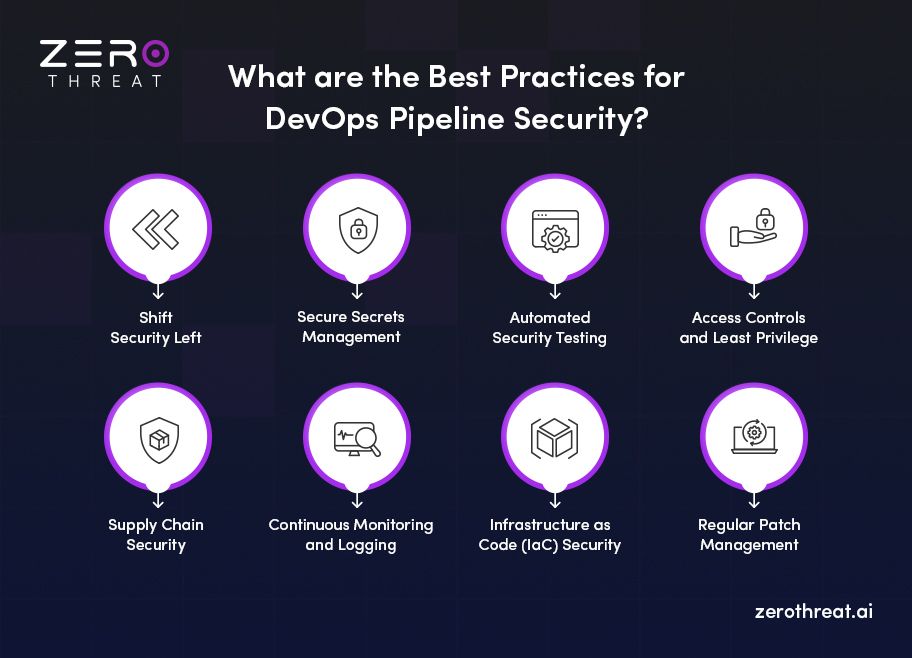
Shift Security Left
Integrate security checks early in the development process to identify risks before they reach production. Running automated code analysis, dependency checks, and vulnerability scans during CI/CD enables faster remediation and reduces downstream risk.
Secure Secrets Management
Manage credentials through centralized secret management solutions rather than embedding them in code or configuration files. Secrets should be encrypted, access-controlled, and dynamically injected at runtime to prevent accidental exposure.
Automated Security Testing
Embed automated security testing directly into the pipeline using SAST and top DAST tools. Scanning container images and application artifacts ensures vulnerabilities are detected continuously without slowing delivery.
Access Controls and Least Privilege
Limit access to pipeline resources by enforcing role-based permissions and least-privilege principles. Protect sensitive actions with multi-factor authentication and approval workflows to reduce the impact of compromised accounts.
Supply Chain Security
Validate the integrity and origin of third-party dependencies and container images. Artifact signing and verification ensure that only trusted components are promoted through the pipeline.
Continuous Monitoring and Logging
Maintain detailed logs across pipeline stages and integrate them with centralized monitoring systems. Continuous visibility enables rapid detection and response to abnormal or unauthorized activity.
Infrastructure as Code (IaC) Security
Scan infrastructure templates for insecure configurations before deployment. Enforcing security policies as code ensures infrastructure remains compliant and consistent across environments.
Regular Patch Management
Keep CI/CD platforms, build agents, and dependencies up to date. Regular patching reduces exposure to known vulnerabilities and limits attack opportunities.
Talk to us to understand how continuous pentesting fits into your DevSecOps strategy. Contact Security Team
ZeroThreat’s DevSecOps-First Design Philosophy
ZeroThreat is not a traditional security tool adapted for DevOps. But it is a modern web app and API pentesting platform designed from the ground up for DevSecOps teams. Its design philosophy is rooted in a simple but critical belief: security must move at the same speed as modern software delivery, without creating friction for developers or operational overhead for security teams.
Instead of treating security as a separate control layer, ZeroThreat embeds security in CI/CD pipeline for SaaS teams.
Built for Pipelines, Not Perimeters
Legacy security solutions focus on defending static perimeters and long-lived infrastructure. On the other hand, ZeroThreat is designed for ephemeral pipelines, short-lived environments, and continuous change.
The ZeroThreat’s dynamic application security testing understands how code moves from commit to production, how artifacts are built and promoted, and how identities and permissions are used at each stage. This pipeline-native awareness allows ZeroThreat to detect risks that only emerge when changes are viewed end-to-end, rather than in isolation.
Security by Design, Not by Enforcement
ZeroThreat emphasizes security enablement over security enforcement. Instead of blocking developers with rigid controls or late-stage approvals, it provides early, contextual insights that help teams make secure decisions proactively.
By identifying risk at the moment it is introduced, ZeroThreat allows developers to fix issues quickly, without breaking flow or delaying releases.
Context-Driven Risk Intelligence
A core principle of ZeroThreat’s design is that context determines risk. The platform correlates data across:
- Code changes and dependencies
- CI/CD execution paths
- Cloud identities and permissions
- Infrastructure configurations
- Runtime behavior
This correlation enables ZeroThreat to distinguish between theoretical issues and real threats. Instead of overwhelming teams with alerts, it surfaces only the risks that are relevant, exploitable, and impactful within their specific environment.
Automation-Native and Policy-Driven
DevSecOps requires automation at scale, and ZeroThreat is built with automation as a first-class capability, positioning it among the top DevSecOps tools for secure SDLC without disrupting development velocity.
Security controls and guardrails are defined as policies that can be:
- Version-controlled
- Applied consistently across pipelines and teams
This policy-driven approach ensures security standards are enforced automatically, without relying on manual reviews or tribal knowledge.
Designed for Developer Adoption
ZeroThreat’s architecture prioritizes usability and adoption by engineering teams. Security insights are delivered where developers already work, using clear language and actionable guidance.
Instead of abstract security findings, ZeroThreat explains:
- Why an issue matters
- How it impacts the application or environment
- What the recommended remediation is
This reduces friction, shortens feedback loops, and helps developers take ownership of security outcomes.
Continuous Security Across the Delivery Lifecycle
ZeroThreat’s DevSecOps-first philosophy recognizes that security does not stop at deployment. The platform provides continuous visibility and risk assessment across build, deploy, and runtime stages.
By maintaining a continuous security posture rather than point-in-time checks, ZeroThreat’s vulnerability scanner helps teams detect emerging threats, configuration drift, and privilege misuse as they occur, not after damage is done.
Choose a security plan that scales with your app complexity, without hidden costs. View Pricing
Conclusion: Security That Moves at the Speed of DevOps
DevOps has redefined how software is built. Security must evolve accordingly.
Securing the DevOps pipeline is no longer about adding checkpoints or slowing releases. It is about embedding continuous, intelligent security controls that operate at the same speed as development.
ZeroThreat is built for this reality. By aligning with DevSecOps security best practices, ZeroThreat enables teams to deliver secure software without sacrificing velocity.
Rather than acting as a late-stage gate, security becomes a continuous, collaborative part of how software is built and shipped. With ZeroThreat, organizations can confidently move fast while keeping their DevOps pipelines secure by design.
Sign up with ZeroThreat for free and tighten DevOps pipeline security now.
Frequently Asked Questions
How can DevSecOps teams detect vulnerabilities before they reach production?
DevSecOps teams detect vulnerabilities early by integrating security into CI/CD pipelines. Continuous scanning during builds and deployments identifies insecure code, vulnerable dependencies, API flaws, and misconfigurations as they are introduced, enabling faster remediation before production exposure.
Why is continuous security testing critical for DevOps pipelines?
How does ZeroThreat integrate security into existing DevOps workflows?
How does ZeroThreat reduce false positives for DevSecOps teams?
How does ZeroThreat help DevSecOps teams manage pipeline attack surfaces?
Why should DevSecOps teams prioritize automated pentesting over manual testing?


Explore ZeroThreat
Automate security testing, save time, and avoid the pitfalls of manual work with ZeroThreat.