 ZeroThreat Wins Bronze Stevie® Award in Tech Startup of the Year Read more

All Blogs
PTaaS Explained: The Complete Guide to Penetration Testing as a Service
Quick Overview: This guide breaks down Penetration Testing as a Service (PTaaS), how it works, and how it compares to traditional, automated, and manual pentesting. You'll learn the step-by-step PTaaS workflow, real cost ranges for 2026, common challenges teams face, and how automated tools power continuous, production-safe testing at scale.
Security testing is inevitable for protecting your data against evolving cyber threats. Traditional pentesting is widely used by organizations to conduct a comprehensive security audit of their IT infrastructure to discover hidden weaknesses, test its resilience, and enhance security posture.
However, traditional pentesting is a one-time test that organizations usually perform 1-2 times a year. Do you think it is enough to keep your assets safe? Well, if we look at the data by Statista, common IT security vulnerabilities and exposures (CVEs) have risen sharply over the past few years.
This indicates that more frequent security testing is needed to ensure data protection. Here, PTaaS comes into the picture. They perform continious penetration test, so that you can have the view of latest security posture and fix security weaknesses.
This article provides detailed information about PTaaS to help you understand its meaning and importance. So, keep reading to make informed decisions about cybersecurity for your organization.
Supercharge your security service offerings by running automated, zero-false-positive penetration tests today. Launch Your First Pentest
On This Page
- What is Penetration Testing as a Service (PTaaS)?
- PTaaS vs Automated Pentesting vs Manual Pentesting
- How Does PTaaS Work?
- Continuous PTaaS vs Point-in-Time Testing
- How PTaaS Handles Production Testing?
- How Much Does PTaaS Cost?
- What are the Benefits of Penetration Testing as a Service?
- What are the Challenges Faced in Penetration Testing as a Service?
- How Automated Penetration Testing Tools Powers Modern PTaaS?
- To Wrap Up
What is Penetration Testing as a Service (PTaaS)?
Penetration Testing as a Service (PTaaS) is a security testing model that delivers penetration testing through a continuous, service-based approach. It combines expert-led testing, security platforms, and ongoing vulnerability assessment to identify exploitable weaknesses.
Unlike traditional penetration tests that are often performed once or at fixed intervals, PTaaS enables organizations to test applications and infrastructure more frequently. This helps security teams identify risks as environments, features, and attack surfaces change.
A typical PTaaS offering can cover web applications, APIs, cloud environments, networks, and other critical assets. Depending on the provider, testing may combine automated security testing with manual penetration testing to validate vulnerabilities and attack paths.
PTaaS also provides centralized findings, remediation guidance, and retesting capabilities. This gives developers and security teams better visibility into vulnerabilities and helps them prioritize fixes based on real-world exploitability and business impact.
PTaaS vs Automated Pentesting vs Manual Pentesting
Choosing the right assessment model depends on your security goals, testing speed, and budget. While automated pentesting offers rapid code scans and manual audits provide deep human intelligence, PTaaS bridges this gap by combining continuous automation with expert validation.
| Aspect | PTaaS | Automated Pentesting | Manual Pentesting |
|---|---|---|---|
| Testing Approach | Automated testing + expert validation | Automated security scans and tests | Human-led security testing |
| Testing Frequency | Continuous or on-demand | Frequent or continuous | Periodic or scheduled |
| Human Expertise | Available for validation and analysis | Minimal | High |
| Coverage | Broad and continuous | Broad, based on tool capabilities | Deep, focused testing |
| Business Logic Testing | Supported, depending on provider | Limited | Strong |
| Speed | Fast and recurring | Very fast | Slower |
| Reporting | Continuous findings and remediation insights | Automated vulnerability reports | Detailed expert report |
| Best For | Continuous application security | Frequent vulnerability discovery | Deep security assessment |
How Does PTaaS Work?
PTaaS works by turning penetration testing into a repeatable security workflow that combines defined scope, expert-led testing, platform automation, finding validation, remediation tracking, and retesting.
1. Define the Testing Scope
The organization identifies the applications, APIs, cloud assets, networks, or other systems that need testing. The scope also defines testing objectives, access requirements, exclusions, testing windows, and rules of engagement.
2. Authorize and Prepare Testing
Before testing begins, the provider establishes authorization and provisions the required access. Qualified penetration testers are assigned based on the assets and security objectives, while the PTaaS platform centralizes engagement details.
3. Execute Security Testing
Pentesters assess the authorized environment using manual techniques, automated security testing, or both. They look for exploitable vulnerabilities, authentication and authorization weaknesses, misconfigurations, business logic flaws, and attack paths.
4. Validate and Prioritize Findings
Potential vulnerabilities are validated to determine whether they are actually exploitable and what impact they could have. The PTaaS platform then provides evidence, severity context, and remediation guidance for actionable findings.
5. Remediate Identified Vulnerabilities
Security and development teams review the findings and address confirmed vulnerabilities within their existing remediation workflows. PTaaS platforms can help teams track issue status, collaborate with testers, and manage remediation from a centralized interface.
6. Retest and Verify Fixes
After vulnerabilities are fixed, testers perform targeted retesting to verify that the remediation was effective. The results are recorded in the platform, creating a continuous feedback loop between penetration testing, vulnerability remediation, and security validation.
7. Repeat Testing as Risk Changes
PTaaS can support recurring, on-demand, or change-triggered testing. Organizations can initiate new assessments when applications, infrastructure, configurations, or attack surfaces change, helping security validation keep pace with development and operational changes.
Upgrade your testing toolkit to deliver faster, high-precision automated pentest coverage for enterprise clients. Power Your Pentests
Continuous PTaaS vs Point-in-Time Testing
Continuous PTaaS and point-in-time testing represent two different approaches to security assessment. One tests your environment year-round, the other tests it once and stops. Here's how they compare:
| Aspect | Continuous PTaaS | Point-in-Time Testing |
|---|---|---|
| Testing Model | Ongoing, runs continuously or on demand throughout the year | A single engagement with a fixed start and end date |
| Coverage Window | Tests your environment as it changes, including new features and endpoints | Tests only what existed at the time of the engagement |
| Vulnerability Detection | Catches new vulnerabilities as they emerge, close to real time | Misses vulnerabilities introduced after the test concludes |
| Reporting Speed | Findings appear on a live dashboard as they're discovered | Delivered as a static report weeks after testing ends |
| Retesting | Built into the platform, available on demand | Requires a new engagement, often at additional cost |
| Compliance Fit | Supports continuous compliance and audit readiness | Satisfies point-in-time compliance checkboxes only |
| Cost Structure | Subscription-based, predictable annual spend | Project-based, billed per engagement |
| Best For | Fast-moving teams shipping frequent releases | Organizations with infrequent releases or fixed audit cycles |
How PTaaS Handles Production Testing?
PTaaS providers can support security testing in production by using controlled testing methods that reduce the risk of disrupting live applications. Testing is scoped carefully to identify vulnerabilities without affecting availability or customer data.
Before testing begins, security teams define rules of engagement, approved targets, testing windows, and prohibited actions. This allows penetration testers to assess real attack surfaces while maintaining clear safeguards around business-critical systems.
PTaaS platforms can combine automated security checks with expert-led validation to identify exploitable vulnerabilities in live applications, APIs, and infrastructure. Production-safe techniques help testers avoid destructive payloads and unnecessary service disruption.
When vulnerabilities are discovered, teams receive actionable findings with technical evidence and remediation guidance. Retesting can then verify fixes without waiting for another annual assessment, helping organizations maintain security visibility as production environments continuously change.
How Much Does PTaaS Cost?
The cost of Penetration Testing as a Service (PTaaS) varies based on the testing scope, environment complexity, testing depth, and service model. According to Andersen’s 2026 penetration testing cost guide, PTaaS subscriptions typically range from $2,000 to $20,000+ per month.
Typical PTaaS pricing can be structured into different package levels:
| PTaaS Package | Approximate Cost |
|---|---|
| Starter | $3,000 to $10,000 |
| Professional | $10,000 to $30,000 |
| Enterprise | $30,000 to $100,000+ |
These figures are indicative rather than fixed prices. The final PTaaS cost depends on factors such as the number of applications and APIs, infrastructure complexity, testing frequency, compliance requirements, and the level of manual testing involved.
What Affects PTaaS Pricing?
- Scope: More applications, APIs, cloud assets, and integrations generally increase costs.
- Testing Depth: Manual validation and advanced exploitation require more specialist effort.
- Testing Frequency: Continuous or recurring assessments can affect the subscription tier.
- Compliance Requirements: Regulatory requirements may require additional testing coverage and reporting.
- Retesting: Confirming that vulnerabilities have been properly fixed can influence the overall service cost.
- Provider Expertise: Experienced penetration testers and specialized security expertise generally command higher rates.
When evaluating PTaaS pricing, organizations should look beyond the subscription amount. Check what is included in the scope, how much manual testing is performed, whether retesting is included, and how findings are validated. A low-cost package may provide limited coverage if it relies primarily on automated scanning.
Scale your PTaaS offering without scaling your overhead. Compare plans built for providers. Check Out Pricing
What are the Benefits of Penetration Testing as a Service?
Penetration testing is important, and it is a vital component of modern cybersecurity strategy. However, traditional pentesting isn’t a complete solution for contemporary organizations as they need frequent security testing to defend against evolving cyber threats.
So, there comes the role of Penetration Testing as a Service offering ongoing tests with tools and reports that help fix vulnerabilities faster. It helps improve security regularly by conducting tests constantly. Let’s check out how it helps in security testing by knowing its benefits.
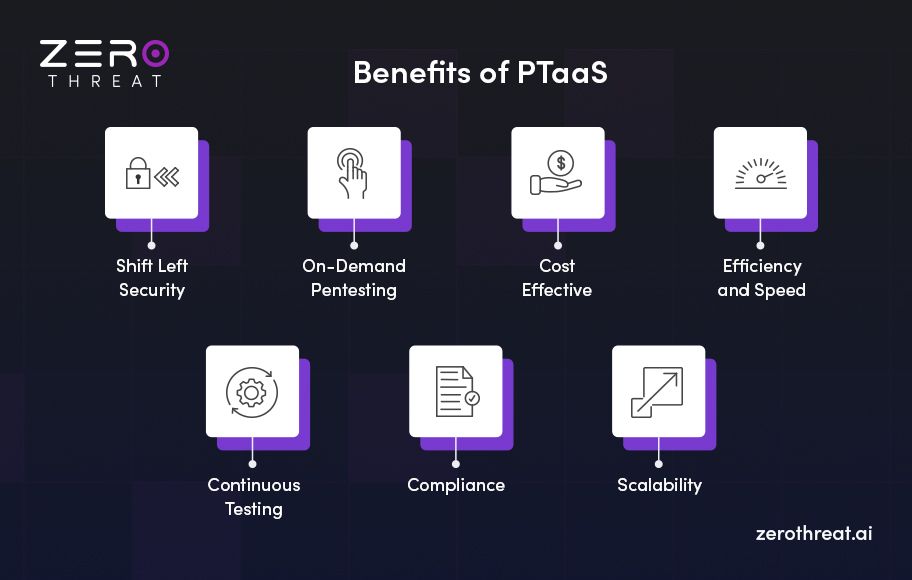
Shift Left Security
PTaaS seamlessly integrates into a development workflow, allowing teams to catch security weaknesses early before an application is deployed. As a result, security teams can stay ahead of threat actors and build highly secure applications.
On-Demand Pentesting
PTaaS provides penetration testing on demand and displays the vulnerabilities detected when found and posted by pentesters on a centralized dashboard. It helps organizations gain insights into their threat landscape by mimicking the actions of a real hacker. These tests enable them to evaluate the efficacy of their current security posture.
Cost Effective
Penetration Testing as a Service is cost-effective compared to an in-house pentesting team. With PTaaS, your organization can leverage the sophisticated skills of various pen testers. Besides, they have the necessary expertise, tools, and experience in pentesting. However, your organization will have to invest in training, ṭools, and other resources in case of an in-house team that will increase the cost.
Efficiency and Speed
PTaaS offers more efficient and speedy testing compared to a traditional pentesting method. So, it reduces the time required for vulnerability remediation and saves resources. Since the PTaaS platform has experts with experience in serving diverse businesses, they are able to offer tailored services.
Continuous Testing
Pen Testing as a Service offers continuous security assessment to help identify vulnerabilities as early as possible and mitigate cybersecurity risks. Your organization can integrate continuous security testing into your CI/CD pipeline with PTaaS.
Compliance
There are various standards and compliances that organizations must adhere to build customer trust and avoid regulatory fines. PTaaS helps your organization align with diverse industry regulations like PCI DSS, GDPR, SOC2, OWASP, and more.
Scalability
Another advantage of choosing a PTaaS platform is scalability. It not only allows you to run a small-scale test for smaller organizations, but you can also scale up testing for large enterprises. Hence, this platform offers comprehensive security assessment regardless of an organization’s size.
What are the Challenges Faced in Penetration Testing as a Service?
PTaaS makes penetration testing more continuous and accessible, but organizations can still face challenges involving scope, testing accuracy, production safety, tester expertise, remediation, and integration with existing security workflows.
- Defining the Testing Scope: Rapidly changing applications, APIs, cloud assets, and third-party integrations can make it difficult to maintain an accurate and complete attack surface.
- Balancing Automation and Manual Testing: Automated security testing provides speed and scale, but complex vulnerabilities and business logic flaws often require skilled penetration testers for proper validation.
- Production Testing Risks: Testing live applications requires carefully controlled techniques, testing rules, and safeguards to prevent service disruption, data exposure, or unintended system changes.
- Managing False Positives: Automated tools can generate findings that require manual validation. Security teams need accurate results to avoid wasting time investigating vulnerabilities that are not exploitable.
- Remediation Coordination: Large volumes of security findings can make vulnerability prioritization difficult, especially when development and security teams lack clear ownership and remediation workflows.
- Maintaining Continuous Coverage: Applications and infrastructure change frequently. Keeping security testing aligned with new features, deployments, APIs, and attack surfaces requires consistent monitoring and testing.
- Choosing the Right Provider: PTaaS providers differ in testing depth, platform capabilities, manual expertise, reporting, and retesting support. Organizations must evaluate these factors before selecting a service.
How Automated Penetration Testing Tools Powers Modern PTaaS?
Automated penetration testing tools give PTaaS the speed and scalability needed for continuous security testing. They automate repetitive tasks while allowing security experts to focus on deeper validation, business logic, and complex attack paths.
Continuous Discovery and Scanning
Automation can continuously discover exposed assets, endpoints, APIs, and common vulnerabilities. This helps PTaaS platforms keep security testing aligned with changing application environments instead of relying only on periodic assessments.
Faster Vulnerability Detection
Automated tools can execute large numbers of security checks quickly and consistently. This allows PTaaS providers to identify common weaknesses faster while reserving manual testing time for areas that require human judgment.
Automated Vulnerability Validation
Modern PTaaS platforms can use automation to support vulnerability validation and exploitability checks. This helps reduce the effort involved in repetitive testing and gives security teams more actionable findings.
Support for Continuous Testing
Automation makes recurring and on-demand testing more practical. PTaaS can run security checks as applications and attack surfaces change, helping organizations identify new risks without waiting for another scheduled penetration test.
Human Expertise Where It Matters
Automation does not replace skilled penetration testers. Modern PTaaS combines automated testing with human expertise to investigate business logic flaws, chained attack paths, authentication weaknesses, and vulnerabilities that require contextual analysis.
Faster Remediation Feedback
Automated testing can continuously surface security findings through a centralized platform. When combined with expert validation and retesting, this creates a feedback loop that helps development teams identify, fix, and verify vulnerabilities more efficiently.
In short, automation provides the scale and speed, while human-led penetration testing provides the depth and context. This combination is what makes modern PTaaS more suitable for continuously changing application and cloud environments.
Running a PTaaS business with complex workflows? Let's talk about fitting ZeroThreat in. Connect With Us
To Wrap Up
Penetration Testing as a Service gives organizations a more continuous way to validate their security posture. It combines penetration testing expertise, security platforms, automation, vulnerability validation, remediation tracking, and retesting into an ongoing process.
The real value of PTaaS is its ability to keep security testing aligned with changing applications and attack surfaces. Instead of relying only on periodic assessments, teams can test more frequently and address exploitable weaknesses closer to when they appear.
However, effective PTaaS should not be treated as automated vulnerability scanning alone. Strong programs combine automation with skilled human testing to uncover business logic flaws, chained attack paths, authorization issues, and other weaknesses that require security expertise.
For organizations with rapidly changing environments, PTaaS can make penetration testing more actionable and easier to integrate into ongoing security workflows. The right approach is one that provides meaningful coverage, accurate findings, practical remediation guidance, and continuous validation.
Frequently Asked Questions
How much does penetration testing (PTaaS) cost?
It depends on multiple factors in a project, such as testing scope, frequency of tests, and the size of your organization. Typically, Penetration Testing as a Service ranges between $400 - $3000.
How much time does PTaaS take?
What to consider before choosing PTaaS?


Explore ZeroThreat
Automate security testing, save time, and avoid the pitfalls of manual work with ZeroThreat.