 ZeroThreat Wins Bronze Stevie® Award in Tech Startup of the Year Read more

All Blogs
PentestGPT Alternatives Compared: Which AI Pentesting Platform Is Best?

Quick Overview: PentestGPT is an open-source, LLM-guided pentesting framework: a reasoning copilot for human operators, not an autonomous platform. Teams outgrowing it want validated findings, compliance-ready reporting, and hands-off coverage. This guide ranks five alternatives, led by ZeroThreat, across autonomy, exploit validation, web and API breadth, and cost.
An attacker probing your login flow does not stop copying Nmap output into a chat window. They chain a weak session token into an IDOR, pivot through an exposed API, and walk out with data, all in one continuous motion. PentestGPT was a landmark because it showed a language model could reason through part of that sequence. What it was never built to do is run the whole sequence end to end, prove the exploit, and hand you a report an auditor will accept.
That gap matters more than ever. The 2026 Verizon DBIR found that vulnerability exploitation is now the single most common initial access vector in breaches, at 31 percent, overtaking credential abuse for the first time in the report's history and rising 55% year over year. Attackers are moving to the path of least resistance: the unpatched, internet-facing application. Meanwhile, only 26% of known-exploited vulnerabilities were fully remediated last year, and median time to patch stretched to 43 days.
PentestGPT is an excellent place to learn craft. It is not the tool that closes that exposure window at scale. This guide explains exactly what PentestGPT is, why teams look for alternatives, and how the five strongest options in 2026 compare on the criteria that actually reduce risk: autonomy, exploit validation, false-positive control, web and API coverage, reporting, and price. ZeroThreat's AI pentesting tool leads the list, and the sections below show the reasoning behind that.
Why guess which platform wins? Let your application decide. Sign Up Free
On This Page
- What is PentestGPT?
- Why Do Teams Look for PentestGPT Alternatives?
- How to Evaluate an AI Pentesting Tool?
- Top 5 PentestGPT Alternatives in 2026
- Feature Comparison at a Glance
- How to Choose the Right Alternative?
- Why Zerothreat is the Strongest Alternative?
- Conclusion
What is PentestGPT?
PentestGPT is an open-source, LLM-empowered penetration testing framework that acts as a reasoning copilot for a human operator, breaking an engagement into planning, generation, and parsing steps so the tester always knows what to try next. It was introduced in a 2023 research paper, published at USENIX Security 2024, and is maintained on GitHub.
Its original design solved a specific problem: raw language models lose the thread during a long engagement. PentestGPT keeps a Pentesting Task Tree and splits the work across three cooperating modules, a Reasoning module that mirrors a lead tester, a Generation module that constructs concrete steps, and a Parsing module that digests tool output. That structure let it outperform a bare GPT model by a wide margin on benchmark targets and solve real Capture The Flag challenges.
In practice, PentestGPT runs from the terminal, typically on Kali Linux, and connects to a model provider through an API key you supply. Later versions add an autonomous pipeline that can drive an agent through staged phases and a legacy interactive mode that talks to many providers including OpenAI, Anthropic, Google, and local models through Ollama. It is free to run, but you pay the underlying model provider for token usage.
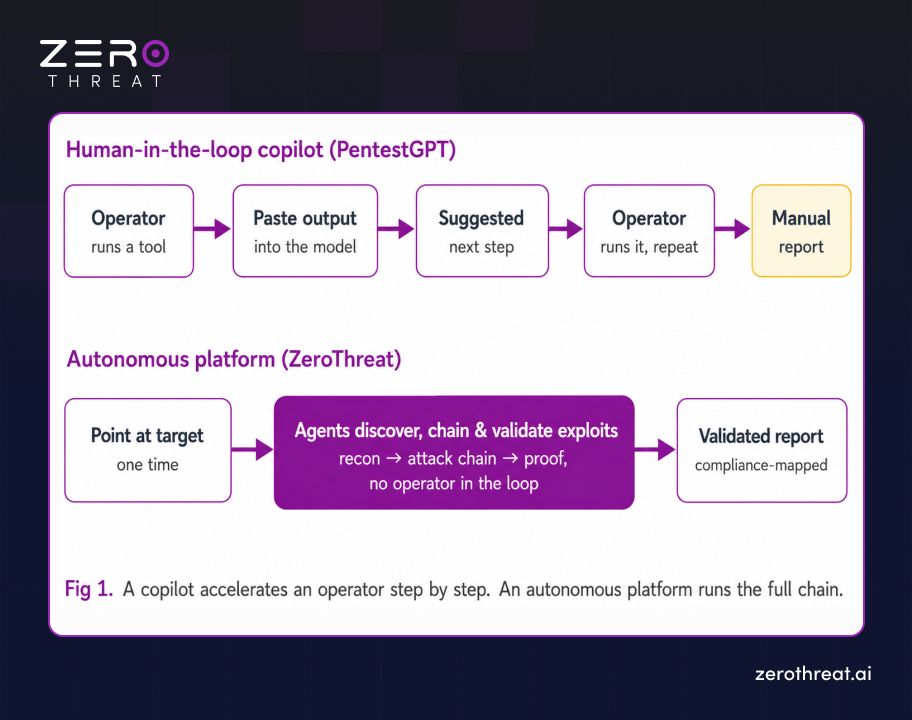
The key thing to understand is what it is not. PentestGPT is a framework and an assistant. It does not ship production-grade exploit validation, it does not produce compliance-mapped reports out of the box, and it assumes you already know how to run a penetration test. It augments an expert; it does not replace the program around one. That distinction is the entire reason this list exists.
Why Do Teams Look for PentestGPT Alternatives?
Teams look for PentestGPT alternatives when they need autonomy, validated findings, and audit-ready reporting that an open-source copilot cannot provide. PentestGPT accelerates a skilled human; it does not run a repeatable security program on its own.
The reasons are consistent across the security teams that graduate from it:
- Human-in-the-Loop Fatigue: During a real engagement, an operator cannot afford to feed tool output into a prompt every few minutes. The copilot model does not scale to continuous testing across a large attack surface.
- No Native Exploit Validation: PentestGPT suggests what to try. It does not safely confirm exploitability and produce proof, which is the line that separates a real pentest from a scanner that reports theoretical issues.
- No Compliance-ready Reporting: There is no built-in output that maps findings to OWASP, PCI DSS, HIPAA, or ISO 27001, or that a developer can act on and an auditor will accept.
- Data-handling Concerns: Sending target details to a third-party model API is a security-review blocker for regulated teams that need data sovereignty or air-gapped operation.
- Expertise Assumption: The tool assumes deep pentesting skill. Understaffed teams need a platform that closes the loop, not one that adds cognitive load.
- Setup And Maintenance Burden: You own installation, model configuration, updates, and integration. That is engineering time most teams would rather spend on remediation.
None of this makes PentestGPT bad. It makes it the wrong shape for a production security program. The alternatives below close that loop in different ways.
How to Evaluate an AI Penetration Testing tool?
The strongest AI pentesting tools are judged on autonomy, exploit validation, false-positive control, attack-surface breadth, reporting quality, and deployment control, not on how impressive a demo looks for forty minutes.
Before shortlisting any PentestGPT alternative, weigh it against these seven criteria:
- Autonomy: Can agents execute a full attack sequence, from reconnaissance to a validated result, without a human directing each step? Genuine autonomy still keeps you in control through scope boundaries and approval gates.
- Exploit Validation: Does the tool confirm a vulnerability is exploitable and show proof, or does it report "potential" issues you still have to triage?
- False Positive Control: Low-noise output is worth more than a long list. A tool that floods your team with unconfirmed findings creates work rather than reducing it.
- Attack-surface Breadth: Does it cover modern web apps, APIs, authenticated flows, and business logic, or only one slice? Match the tool to the surface you actually run.
- Business-logic and Workflow Depth: Many flaws live in multi-step user journeys, not in a single OWASP signature. Testing that behaves like a real user finds what signature scanners miss.
- Reporting and Compliance Mapping: Can you hand the output to a developer to fix and to an auditor to satisfy SOC 2, ISO 27001, PCI DSS, or HIPAA?
- Deployment and Data Control: Cloud, on-prem, or air-gapped? For regulated industries, where your application traffic goes is often the deciding factor.
Every platform says "AI." See what makes the difference. Explore the Difference
Top 5 PentestGPT Alternatives in 2026
The list below is ordered for teams moving from an open-source copilot toward a production-grade AppSec program. ZeroThreat leads because it closes the widest set of gaps that push teams away from PentestGPT in the first place.
1) ZeroThreat
Best For: Web + API teams that want validated, compliance-ready pentesting without an operator in the loop
ZeroThreat is an AI pentesting platform for web applications and APIs that runs the full attack sequence autonomously, then proves what it finds. Where PentestGPT suggests a next step, ZeroThreat's agents discover the attack surface, chain vulnerabilities into real exploit paths, validate them safely, and rank each finding by business impact. That is the difference between guidance and results.
It closes the exact gaps that push teams off PentestGPT. Findings are validated rather than theoretical, which is why the platform reports zero false positives. Reports map directly to OWASP, PCI DSS, HIPAA, GDPR, and ISO 27001, with reproduction steps, affected endpoints, parameters, and evidence for developers alongside full attack paths for security teams. And for regulated environments, on-prem and air-gapped deployment keeps application traffic inside your network, removing the data-handling blocker that a model-API copilot introduces.
- Autonomous exploit chaining across the full external surface, from ports, SSL, DNS, and mail through apps, APIs, auth, and workflows
- Business-logic and authenticated testing that navigates complex, multi-step workflows the way a real user would, no Playwright specs required
- Zero false positives through validation, plus business-aware prioritization that ranks risk by real impact
- Production-safe scanning designed for live environments, with CI/CD integration for continuous coverage
2) NodeZero (Horizon3.ai)
Best For: Enterprise internal network and Active Directory attack-path validation
NodeZero is one of the most frequently cited autonomous platforms in 2026 analyst roundups. It validates attacker objectives across internal infrastructure, simulating credential abuse and lateral movement to surface real network attack paths at scale. Founded by former US special operations veterans, it is strongest where the primary question is internal network exposure.
- Autonomous network pentesting with proof of lateral movement
- Strong for AD attack paths and large internal estates
- Limited application-layer depth: no source-code analysis or white-box web testing
3) Pentera
Best For: Automated security validation across a broad enterprise exposure surface
Pentera remains a formidable name in automated exposure validation. It safely emulates attacks across the environment to validate which exposures are genuinely exploitable, giving large enterprises a way to test controls continuously rather than once a year.
- Broad automated validation across the enterprise attack surface
- Mature enterprise integrations and support
- Infrastructure-oriented; less specialized in deep web and API application logic than a dedicated AppSec platform
4) XBOW
Best For: Continuous, bug-bounty-style autonomous testing on internet-exposed apps
XBOW is a fully autonomous offensive-security platform known for reaching the top of the global HackerOne leaderboard. It emphasizes deterministic exploit validation and very low false-positive rates, oriented toward continuous, attacker-style testing of internet-facing applications.
- Fully autonomous web application testing with proof-first validation
- Strong bug-bounty-style coverage on external apps
- Narrower on API breadth, authenticated workflows, and on-prem control than a full web + API platform
5) Penligent
Best For: SaaS teams wanting agentic, end-to-end web attack-path discovery
Penligent positions itself as an agentic AI hacker that orchestrates a large set of industry-standard tools to discover and exploit vulnerabilities, adapting its approach as an ethical hacker would during an engagement. It appears in nearly every 2026 agentic-pentesting list and is strong on web application attack-path discovery.
- Agentic, adaptive testing across many integrated tools
- Evidence-based reporting on discovered exploit chains
- Lighter on deep gray-box business-logic testing and source-code review
PentestGPT Alternatives Feature Comparison at a Glance
The table summarizes how each option maps to the criteria that matter most when moving beyond an open-source copilot. It is directional; verify current capabilities against each vendor before you shortlist.
| Capability | ZeroThreat | NodeZero | Penligent | XBOW | Pentera | PentestGPT |
|---|---|---|---|---|---|---|
| Runs autonomously | Yes | Yes | Yes | Yes | Yes | Copilot |
| Validates exploits (proof) | Yes | Yes | Yes | Yes | Yes | No |
| Web + API breadth | Both | Network | Web | Web | Infra | Manual |
| Business-logic / auth testing | Deep | Limited | Some | Some | Limited | Manual |
| Zero false positives | Yes | Low | Low | Very low | Low | N/A |
| Compliance-mapped reports | Yes | Yes | Partial | Partial | Yes | No |
| On-prem / air-gapped | Yes | Varies | Cloud | Cloud | Yes | Self-host |
| Setup effort | Low | Medium | Low | Low | Medium | High |
How to Choose the Right Alternative?
Choose a PentestGPT alternative by matching the tool to your real attack surface and the outcome you need to prove, not by chasing the most autonomous-sounding demo. The right pick depends on what you test and who has to accept the results.
A quick way to narrow the field:
- If your risk is web apps and APIs, and you need validated findings plus reports auditors accept, ZeroThreat is the most direct fit.
- If your risk is internal networks and Active Directory, NodeZero's lateral-movement validation is purpose-built for it.
- If you want continuous, bug-bounty-style coverage on internet-exposed apps, XBOW's autonomous offense model fits.
- If broad enterprise exposure validation across infrastructure is the goal, Pentera is a mature choice.
- If you are learning AI-assisted methodology or accelerating a skilled human operator, PentestGPT itself remains an excellent starting point. It is a teacher, not a program.
Most mature teams layer these rather than pick one. DAST runs on every pull request for fast feedback, an autonomous AI pentester runs on a deeper cadence to catch what scanners miss, and humans validate the highest-severity output. The question is which platform anchors that deeper cadence for your application surface.
Why Zerothreat is The Strongest Alternative?
ZeroThreat is the strongest PentestGPT alternative for application security because it turns reasoning into a validated, reportable result across both web and API surfaces, with zero false positives and deployment you control.
Many of the reasons teams leave PentestGPT points back to the same missing piece: the loop never closes. A copilot hands you up a suggestion; you still have to run it, confirm it, triage it, and write it up. ZeroThreat closes that loop by design.
Its agents discover the full external attack surface and behave like a real user through complex, authenticated workflows, so they find the business-logic flaws that live between OWASP signatures. They chain findings into complete attack paths and validate each one safely, which is why the platform reports zero false positives instead of a queue of maybes. Security teams get the full attack path, impact, and priority; application teams get reproduction steps, endpoints, parameters, evidence, and remediation guidance. Findings map to OWASP, PCI DSS, HIPAA, GDPR, and ISO 27001, so the same report satisfies a developer and an auditor. And for regulated industries, on-prem and air-gapped deployment removes the data-handling concern that a third-party model of API creates.
PentestGPT proved that AI can reason about an attack. ZeroThreat is what that reasoning becomes when it has to hold up in production: application-aware AI pentesting that discovers, chains, validates, and reports without an operator in the loop.
Every platform looks good on paper. See the difference live. Reqeust a Demo
Conclusion
PentestGPT is where you learn. A platform is where you operate. Vulnerability exploitation is now the number one way breaches start, and remediation is falling behind. An open-source copilot accelerates one expert. Closing the exposure window at scale takes a platform that validates what it finds and reports it in a form your developers and auditors can both use.
Frequently Asked Questions
Why do teams look for PentestGPT alternatives?
Teams look for alternatives when they need autonomy, validated exploits, and audit-ready reporting an open-source copilot cannot provide. PentestGPT accelerates a skilled human step by step; it does not run a repeatable program, confirm exploitability, or map findings to compliance frameworks on its own.
What is the best PentestGPT alternative for web and API security?
Is PentestGPT autonomous?

Explore ZeroThreat
Automate security testing, save time, and avoid the pitfalls of manual work with ZeroThreat.