 ZeroThreat Wins Top InfoSec Innovators 2026 Award for Penetration Testing Read more

All Blogs
Quick Overview: Choosing the right AI pentesting platform requires more than comparing feature lists. This guide evaluates the best XBOW alternatives in 2026, comparing their capabilities, strengths, and ideal use cases. Learn what sets each solution apart and how to choose the right fit for your organization's security needs.
An attacker no longer waits for your quarterly pentest window. They automate reconnaissance, chain low-severity findings into working exploits, and reach your data at machine speed. The 2026 Verizon Data Breach Investigations Report makes the shift concrete: exploitation of vulnerabilities became the number one initial access vector at 31% of breaches, up from 20% the prior year, finally overtaking phishing and stolen credentials.
XBOW put autonomous offense on the map. It was the first AI agent to top HackerOne's US leaderboard, and it proved that machines could find and validate real, exploitable bugs. That success is exactly why so many teams now evaluate it, and why so many of those same teams start asking hard questions. Can it test our APIs, not just our web front end? Will it run continuously, or only when we book an engagement? What happens to a finding after it is proven? And can it run inside a regulated environment that cannot ship traffic to a cloud?
This guide breaks down the top XBOW alternatives in 2026: what each one is built for, where it is strongest, and how to choose the right fit for your coverage, deployment, and compliance needs.
Don't choose a pentesting tool until you've tested one yourself. Sign Up Free
ON THIS PAGE
- Zerothreat Vs XBOW At a Glance
- What Is XBOW?
- Why Teams Look for XBOW Alternatives
- What Security Teams Weigh When Evaluating XBOW
- Which Alternative Fits Your Scenario
- The Top 5 XBOW Alternatives In 2026
- Comparing XBOW Alternatives
- How To Choose Your XBOW Alternative
- Which Solution Is Best For Your Organization
- The Bottom Line
ZeroThreat Vs XBOW At a Glance
ZeroThreat and XBOW both use agentic AI to validate real exploits, but they solve different halves of the problem. XBOW is built for periodic, red-team-style engagements against web applications and prices per pentest.
ZeroThreat is built to run continuously across web apps and APIs, test authenticated workflows and business logic the way a real user moves through them, stay safe against live production, and deploy on-prem when data cannot leave your network. Both prioritize proof over noise. The difference is breadth, cadence, and control.
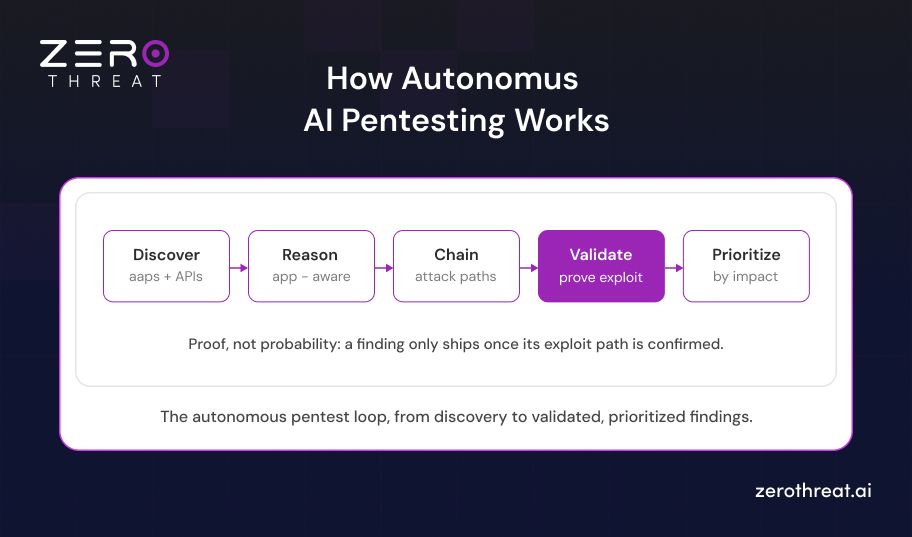
ZeroThreat delivers application-aware AI pentesting that reasons about how your application actually behaves, then chains findings into validated attack paths a scanner would walk right past. Every result arrives with reproducible evidence, so security teams see impact and priority while application teams get the endpoint, the parameter, and the fix.
What Is XBOW?
XBOW is an autonomous offensive security platform that uses AI agents to discover, chain, and validate exploitable vulnerabilities in web applications at machine speed.
Founded in January 2024 by Oege de Moor with engineers who previously worked on GitHub Copilot and GitHub Advanced Security, XBOW coordinates many AI agents in parallel, each focused on a specific attack vector, then confirms findings with reproducible proof-of-concept payloads rather than theoretical risk scores.
Its breakout moment came in 2025, when XBOW reached the top of HackerOne's US leaderboard, submitting more than a thousand validated vulnerabilities and matching a principal pentester's 40-hour assessment in roughly 28 minutes. In November 2025, the company launched XBOW Pentest On-Demand, a self-serve pentest delivered in about five business days, with pricing that starts around $6,000 per engagement. In 2026, it added a Microsoft Security Copilot integration and expanded into APAC, and it has raised well over $100 million to scale.
Credit where it is due: XBOW pushed the entire AI pentesting category forward and showed the industry that autonomous agents can find genuinely exploitable flaws in production systems. The questions below are not about whether the approach works. They are about whether a single, web-app-focused, point-in-time model matches how your team ships and how your risk actually accrues.
Why Teams Look for XBOW Alternatives
Teams look for XBOW alternatives when they need continuous coverage, native API and business-logic testing, on-prem control, or a built-in remediation workflow that a point-in-time, web-app engagement does not provide. The gaps tend to surface in the same order for most evaluators.
Coverage Stops at the Web Apps
XBOW is strong against web applications, but modern attack surface is wider. APIs now carry the sensitive logic and data that attackers want most, and business-critical flaws such as BOLA, BFLA, and workflow abuse live in how the application behaves, not in a CVE list. Teams that need API pentesting alongside web coverage often need a second tool to fill the gap.
Point-in-Time, Not Continuous
When software ships several times a day, a pentest that runs on request leaves long windows uncovered. New code, new endpoints, and new logic can go live between engagements. Teams increasingly want testing that runs continuously as the application changes, closer to the pace of the pipeline than the pace of a scoping call.
Per-Pentest Pricing Versus Predictable Coverage
An on-demand engagement priced per test is easy to reason about for a one-off assessment. It is harder to scale across hundreds of applications or frequent releases without cost climbing quickly. Teams protecting a large portfolio often prefer a model built for breadth and repetition rather than discrete engagements.
The Finding Is the Start, Not the Finish
A validated exploit is only useful once it is fixed. Teams want findings that route to the right owner with clear, reproducible steps and remediation guidance built in. That is where AI-driven remediation reporting turns a proof-of-concept into a closed ticket rather than a line in a PDF.
Data Residency and On-prem Requirements
Finance, healthcare, government, and defense often cannot send application traffic to a cloud-hosted scanner. These teams need private or air-gapped deployment with full data sovereignty. A cloud-only model rules itself out before the evaluation even starts.
The comparison doesn't end here. See what modern AI pentesting can do. Learn More
What Security Teams Weigh When Evaluating XBOW
Security teams weigh XBOW on four practical axes: coverage breadth, false-positive and triage load, depth on business logic, and how autonomy is governed. Community and analyst commentary in 2025 and 2026 surfaces a consistent, useful picture, and it is worth reading fairly.
On coverage, independent 2026 comparisons repeatedly note that XBOW is focused on web application and API testing rather than internal networks, infrastructure, or cloud, so teams needing full-stack validation pair it with a network-focused tool.
On triage, early leaderboard analysis observed that a meaningful share of autonomous submissions were marked informative or not applicable, which means human review still gates what reaches a team.
On depth, the same commentary credits XBOW for excelling at technical classes such as SQL injection, cross-site scripting, and remote code execution, while noting that context-heavy and business-logic issues still benefit from human judgment.
On governance, XBOW is explicit that autonomy runs inside a defined scope with logged, auditable actions and alignment to SOC 2, ISO 27001, and PCI DSS, and the company frames its tool as augmenting security teams rather than replacing them.
That framing is the right one, and it is shared by every serious platform in this space, ZeroThreat included. AI handles breadth, speed, and repeatable validation. People handle the deepest, most application-specific reasoning.
Which Alternative Fits Your Scenario
The right XBOW alternative depends on what you are testing and where it has to run. Match your situation to the fit below before shortlisting.
Scenario 1: You want continuous, application-aware testing across web apps and APIs.
Choose ZeroThreat. It reasons about application behavior, tests authenticated flows and business logic, and validates real attack paths across both web and API surfaces on an ongoing basis.
Scenario 2: You need to validate internal networks, Active Directory, and cloud kill-chains.
Choose Horizon3.ai NodeZero or Pentra. Both are built for autonomous network and infrastructure validation, chaining misconfigurations and credentials into multi-step attack paths.
Scenario 3: You want to self-host, control the stack, and run testing inside CI.
Choose Strix or ZeroThreat. Strix is free, self-hosted, and CI-native if you want to own the stack; ZeroThreat gives you the same proof-based validation as a managed platform, with production-safe testing and on-prem deployment.
Scenario 4: You have pentesters and want AI to accelerate their existing workflow.
Choose Penligent. It keeps the operator in control at the command line while the agent handles execution. If your team needs proof-based findings without running an engagement at all, choose ZeroThreat.
Scenario 5: You are in a regulated or air-gapped environment that cannot send traffic to the cloud.
Choose ZeroThreat. On-prem deployment keeps application traffic inside your network with full data sovereignty and audit-ready reporting.
Top 5 XBOW Alternatives in 2026
These five stand out for teams moving off, or evaluating against, AI penetration testing tool, XBOW. The list spans application-layer pentesting, continuous API testing, and network validation, because the honest answer is that the best fit depends on what you need to cover.
1) ZeroThreat - AI pentesting tool for web apps and APIs
ZeroThreat runs continuous, AI pentests that reason about how your application actually works, then chain findings into validated attack paths. It tests authenticated journeys and business logic the way a real user moves through the product, no scripts required, and it is engineered to run safely against live production. Findings arrive with reproducible proof, so security teams see the full attack path, impact, and priority, while application teams get the exact endpoint, parameter, evidence, and remediation.
- Breadth: Web apps and APIs in one platform, including agentic AI pentesting that validates exploitability rather than matching signatures.
- Business Logic: Detects workflow-level abuse, BOLA, BFLA, IDOR, and broken auth that scanners miss.
- Production-safe: Designed to test live environments without disrupting them.
- Deployment: Cloud or on-prem for regulated and air-gapped organizations.
- Compliance: Maps findings to OWASP, PCI DSS, HIPAA, GDPR, and ISO 27001.
- Signal Quality: 99.9% detection accuracy, 130K+ vulnerability coverage, zero false positives.
Best For
Security and application teams that need continuous, proof-based coverage across web and API surfaces, with on-prem control when data cannot leave the network.
The ZeroThreat Difference
XBOW proves you can automate offense. ZeroThreat proves you can operate it continuously: across web apps and APIs, safely in production, with on-prem deployment and zero false positives, so every validated finding is one your team can act on today. Start free.
2) Strix - Open-source autonomous AI pentesting agents
Strix is the standout open-source answer to XBOW. It runs autonomous AI agents that execute your code dynamically, probe the application like a real attacker, and validate every finding with a working proof-of-concept rather than a "possible vulnerability" alert.
A multi-agent architecture splits the work across reconnaissance, exploitation, and validation, and the agents come equipped with a real offensive toolkit: an HTTP interception proxy, browser automation, a shell, and a Python sandbox for custom exploit development. It runs from the CLI against a local directory, a repository, or a live web app, and drops into CI to gate pull requests.
- Free and self-hosted, with no vendor lock-in and bring-your-own-LLM support.
- Validated findings with reproducible proof-of-concept exploits.
- Coverage across OWASP Top 10 classes including IDOR, SQL injection, SSRF, XSS, and business logic flaws.
- CI/CD native via GitHub Actions, GitLab CI, and similar pipelines.
Best For
Engineering teams that want to self-host, experiment, and keep full control of the stack. The trade-off is that you own the infrastructure, the LLM bill, and the tuning. ZeroThreat delivers the same proof-based validation as a managed platform, with production-safe testing, compliance mapping, and on-prem deployment out of the box.
3) Pentera - Automated security validation for networks and infrastructure
Pentera automates penetration testing across internal networks, external attack surface, cloud, and identity, emulating full kill-chain attacks including credential cracking and lateral movement. It is a mature choice for enterprises focused on continuous exposure validation at the infrastructure layer, and it typically runs as an on-prem, annually licensed platform.
- Broad network, cloud, and identity coverage.
- Full kill-chain emulation with continuous validation.
- Enterprise-grade, on-prem deployment.
Best For
Large enterprises validating network and infrastructure exposure. Pair with an application-layer tool like ZeroThreat for web and API depth.
4) Horizon3.ai NodeZero - Autonomous internal network penetration testing
NodeZero runs autonomous internal network pentests, dynamically chaining misconfigurations, weak credentials, and CVEs into multi-step attack paths rather than following predefined scripts. It has run well over a hundred thousand autonomous pentests across thousands of organizations and is especially strong in complex Active Directory environments, with application-layer testing available through early access.
- Dynamic attack-path chaining across network, cloud, and identity.
- Proven at scale in Active Directory-heavy environments.
- Unlimited pentests under a SaaS subscription model.
Best For
Enterprise teams that need continuous internal network validation. ZeroThreat covers the application and API depth NodeZero is still expanding into.
5) Penligent - Agentic, CLI-first pentesting for security practitioners
Penligent takes the practitioner's side of the problem. Rather than abstracting the engagement behind a dashboard, it orchestrates multiple offensive tools under an agentic layer with a CLI workflow and customizable prompts, keeping the tester in control while the AI handles execution. Its pitch is compression: work that takes a human a week is targeted to finish in about an hour, with severity-classified findings and one-click proof-of-concept generation.
- Agentic multi-tool orchestration across the pentest workflow.
- CLI-driven with customizable prompts, so testers steer the engagement.
- Detailed reports with severity classification and generated proof-of-concept.
Best For
Consultants and in-house pentesters who want AI to accelerate their own workflow, not replace it. ZeroThreat is the better fit when you need continuous, hands-off coverage that a whole team can rely on rather than an operator-driven tool.
Why pay more before you compare what's included? View Pricing
Table Comparison: XBOW and Its alternatives
Capabilities and pricing move quickly in this category, so treat the table as a starting shortlist and confirm current details with each vendor before you commit.
| Capability | ZeroThreat | Xbow | Strix | Pentera | Nodezero | Penligent |
|---|---|---|---|---|---|---|
| Web app pentesting | Yes | Yes | Yes | Limited | Early access | Yes |
| API security testing | Yes | Yes | Yes | Limited | No | Partial |
| Network / infra validation | Focus on apps | No | Partial | Yes | Yes | Partial |
| Agentic exploit validation | Yes | Yes | Yes | Yes | Yes | Yes |
| Business logic testing | Yes | Partial | Yes | Infra-focused | Infra-focused | Partial |
| Continuous testing | Yes | On-demand | Yes | Yes | Yes | Operator-driven |
| Production-safe | Yes | Yes | Self-managed | Yes | Yes | Self-managed |
| On-prem / air-gapped | Yes | Enterprise | Self-hosted | Yes | SaaS | Self-hosted |
| Compliance mapping | Yes | Yes | Enterprise tier | Yes | Yes | Reports only |
| Zero false positives | Yes | Near-zero | PoC-validated | Varies | Varies | Varies |
| Pricing model | Pay per scan & Unlimited target scan | Per pentest | Free / open source | Annual license | SaaS subscription | Subscription |
How to Choose Your XBOW Alternative
Choosing an XBOW alternative comes down to three questions: what you need to cover, how often it has to run, and where it is allowed to run. Work through them in order and the shortlist narrows quickly.
1) Define Your Real Attack Surface
List what actually needs testing: web apps, APIs, internal network, cloud, identity. An application-heavy surface point to ZeroThreat or Strix. An infrastructure-heavy surface points to Pentera or NodeZero. If it is both, plan to pair an application-layer platform with a network-layer one.
2) Match Cadence to Your Release Velocity
If you ship weekly or daily, a point-in-time engagement leaves gap. Prioritize continuous, agentic testing that runs as the application changes, so new endpoints and logic are covered at the moment; they go live.
3) Confirm Deployment and Data Residency
If regulation or policy prevents application traffic from leaving your network, on-prem is a hard requirement, not a preference. Confirm it before you evaluate features, because a cloud-only tool cannot pass that gate no matter how good the engine is.
4) Check What Happens After a Finding
A proven exploit only reduces risk once it is fixed. Favor platforms that route findings to owners with reproducible steps and remediation guidance, so validation converts into closed tickets rather than backlog.
Which Solution Is Best for Your Organization
The best XBOW alternative for your organization depends on your primary persona and constraints, and for most application-focused teams that answer is ZeroThreat.
Enterprise Security Teams
You need consistent coverage at scale, audit-ready evidence, and regional data control. ZeroThreat delivers continuous application and API pentesting with compliance mapping and on-prem deployment. Add Pentera or NodeZero if network and identity validation are also in scope.
Application and DevSecOps Teams
You need findings you can act on inside the pipeline: the endpoint, the parameter, the evidence, and the fix. Strix fits if you want to self-host and are willing to own the infrastructure and LLM costs. ZeroThreat fits if you want the same proof-based validation without operating it yourself, with production-safe testing and on-prem control for regulated stacks.
Lean and Fast-moving Teams
You do not have a red team and cannot afford triage noise. Point-and-click agentic pentesting with zero false positives means you spend time fixing real issues, not sorting alerts.
Regulated and Air-gapped Organizations
Finance, healthcare, government, and defense teams that cannot ship traffic to a cloud should shortlist ZeroThreat for application coverage and Pentera for infrastructure, both of which support private deployment.
Experience the difference before choosing your next pentesting platform. Get a Demo
The Bottom Line
XBOW earned its reputation by proving autonomous offense works, and it remains a strong choice for on-demand, web-app engagements. But attackers do not test once a quarter, and neither should you. The moment coverage has to span APIs and business logic, run continuously against production, and deploy where your data is required to stay, the shortlist narrows fast.
That is exactly the problem ZeroThreat is built to solve. It brings application-aware AI pentesting to both web apps and APIs, validates real exploit paths instead of guessing at risk, runs safely in production, deploys on-prem for regulated environments, and delivers every finding with reproducible proof and a clear fix. The result is continuous, proof-based coverage your security and application teams can trust, with 99.9% detection accuracy and zero false positives.
If you are evaluating XBOW alternatives, the fastest way to compare is to point ZeroThreat at your own application and see what it validates. Sign up for ZeroThreat and run your first agentic pentest today.
Frequently Asked Questions
What should I look for in an XBOW alternative?
When evaluating an XBOW alternative, consider factors beyond AI automation. Compare vulnerability coverage, exploit validation, support for authenticated testing, web and API security capabilities, reporting quality, CI/CD integration, deployment options (cloud or on-premises), and the platform's ability to reduce false positives.
Are AI pentesting tools suitable for enterprise environments?
Why is exploit validation important in AI pentesting?
Are XBOW alternatives suitable for startups as well as large enterprises?
Explore ZeroThreat
Automate security testing, save time, and avoid the pitfalls of manual work with ZeroThreat.