 ZeroThreat Wins Top InfoSec Innovators 2026 Award for Penetration Testing Read more

All Blogs
Penligent Alternatives Compared: Which AI Pentesting Platform Is Right for You?

Quick Overview: Evaluating AI pentesting platforms goes beyond feature lists. In this guide, we compare the leading Penligent alternatives, examine where each solution excels, and help you choose the right platform for your organization's application security needs.
An attacker looking at your application does not open a terminal and run Nmap. They log in. They click through checkout, change a single object ID in a request, replay a session token that should have expired, and walk out with data that no port scan would ever surface. The attack surface that matters most sits behind authentication, inside multi-step workflows, and across API endpoints that no crawler discovered.
That gap is why the market for AI pentesting is fragmenting fast. Penligent has become one of the most visible names in the category, positioning itself as an agentic AI hacker that reasons across more than 200 industry-standard tools and returns evidence-backed findings without a human writing command. It is a genuinely capable piece of engineering. But it is built around an operator: someone who knows what to prompt, how to score a run, and how to interpret an exploit chain.
Security teams building a continuous application security program often need something different. They need testing that understands the application, not just the host. They need authenticated coverage, business logic abuse detection, API discovery, zero false positives, and reports a developer can act on without a translator.
This article breaks down what Penligent does well, why teams look for alternatives, the criteria that actually matter in an evaluation, and the six strongest Penligent alternatives in 2026, starting with ZeroThreat.
See what your current security testing leaves behind. Try It Free
ON THIS PAGE
- What Is Penligent?
- Why Security Teams Look for Penligent Alternatives
- How to Evaluate a Penligent Alternative
- Top 6 Penligent Alternatives in 2026
- Penligent Alternatives Compared: Feature Matrix
- ZeroThreat Vs Penligent: Where the Difference Shows Up
- Which Penligent Alternative Fits Your Team?
- Conclusion
What Is Penligent?
Penligent is an agentic AI penetration testing tool that takes a natural language objective, plans an attack path, and autonomously orchestrates more than 200 industry-standard security tools such as Nmap, Nikto, Gobuster, Burp Suite, sqlmap, and Metasploit to produce evidence-backed findings. It positions itself as an AI operator layer on top of the offensive tooling security engineers already use, compressing reconnaissance, exploitation, and reporting into a single automated workflow.
The architecture is what makes it distinctive. Rather than shipping its own detection engine, Penligent applies chain-of-thought reasoning to decide which tool to run next, parses the output, and uses that context to select the following step. If it finds an outdated service, it pivots to CVE validation. If it finds an exposed directory, it enumerates further. The result is a transparent, step-by-step decision log that a pentester can audit.
What Penligent Does Well
- Tool Orchestration at Scale: Parallelized recon across Nmap, WhatWeb, Gobuster, searchsploit, and the broader Kali ecosystem, with automatic output parsing.
- Evidence-first Output: Reproducible artifacts and execution logs for each finding rather than a list of unverified possibilities.
- Natural Language Control: No scripting required. An engineer states an objective and the agent builds the plan.
- Human-in-the-loop Flexibility: Operators can steer, intervene, and take manual control mid-run.
- Reporting Aligned to SOC 2 and ISO 27001: Exportable, editable, audit-oriented documents.
- Deployment Control: On-premise installation and private model integration through an inference gateway.
- Accessible Entry Point: A freemium tier and hands-on labs make it popular with bug bounty hunters and practitioners learning AI-assisted offense.
That combination has earned Penligent a place in nearly every 2026 roundup of agentic pentesting tools. It is a strong choice for a specific job: giving a skilled operator leverage during a point-in-time engagement.
Why Security Teams Look for Penligent Alternatives
Security teams look for Penligent alternatives when they need continuous, application-aware testing that runs without a skilled operator driving it, covers authenticated workflows and business logic in depth, and produces developer-ready remediation rather than red team artifacts. The gaps are structural, not defects. They follow directly from Penligent's design as an operator-centric tool orchestrator.
Five patterns come up repeatedly in evaluations.
1) It assumes an operator who already knows pentesting
Natural language prompting lowers the syntax barrier, not the expertise barrier. Someone still has to define the objective, judge whether the agent went down the right path, and decide whether a finding is real risk or noise. Independent 2026 reviews consistently describe Penligent as strong for practitioners while noting it is not yet a primary enterprise platform. If your AppSec function is two engineers supporting sixty developers, an expert-in-the-loop model does not scale.
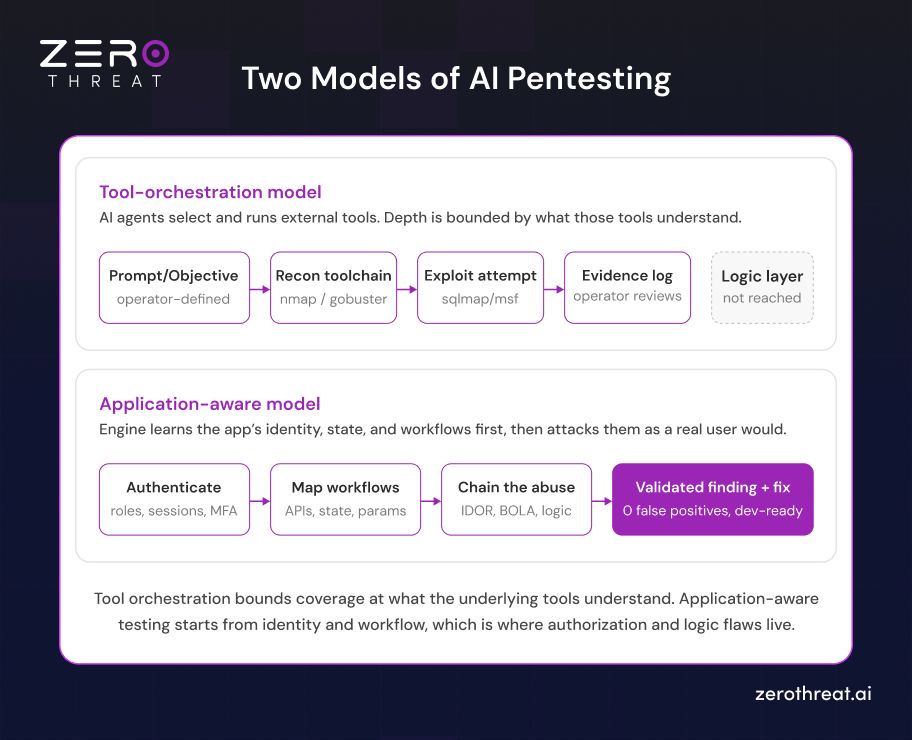
2) Tool orchestration is not application awareness
The Kali toolchain was built for infrastructure. Nmap maps ports. Gobuster finds directories. SQLmap tests injection points you already know about. None of them understand that a shopping cart has a state machine, that a refund workflow can be raced, or that a JWT issued to a low-privilege tenant should not resolve a high-privilege object ID. Third-party technical comparisons flag limited gray-box business logic depth as Penligent's main coverage constraint. That is precisely where modern breaches happen.
3) Point-in-time runs leave a coverage gap
An agentic engagement produces an excellent snapshot. Applications, however, ship daily. Every deploy adds endpoints, changes authorization logic, and expands the attack surface. Teams that need automated penetration testing woven into CI/CD want continuous validation between engagements, not a report that ages out in a sprint.
4) Findings are built for attackers, not developers
Evidence-first artifacts and execution logs are exactly what a red teamer wants. A developer wants the vulnerable endpoint, the parameter, the payload, the affected code path, and a fix they can ship. When an offensive tool hands engineering a proof of concept and a transcript, someone in the middle absorbs the translation cost.
5) Compliance breadth stops short for regulated teams
SOC 2 and ISO 27001 alignment covers a lot of ground. Teams under PCI DSS, HIPAA, or GDPR obligations generally need vulnerability evidence mapped directly to those frameworks, plus OWASP Top 10 and OWASP API Top 10 traceability, without a manual mapping exercise before every audit.
Before you pick a Penligent alternative, see what's possible. Explore AI Pentesting
How to Evaluate a Penligent Alternative
Evaluate a Penligent alternative on eight criteria: application-layer depth, authenticated and session-aware testing, business logic coverage, API discovery and testing, exploit validation and false positive rate, remediation quality, continuous CI/CD integration, and deployment and compliance fit.
Feature checklists collapse quickly under these questions, because most tools in this category are strong on two or three and thin on the rest.
The eight criteria that decide the shortlist
- Application-layer Depth: Does the engine understand HTTP state, single-page app routing, and GraphQL, or is it wrapping infrastructure scanners?
- Authenticated and Session-aware Testing: Can it hold a session through MFA, token refresh, and role switching without breaking scope?
- Business Logic Coverage: Can it detect price manipulation, workflow bypass, race conditions, and privilege escalation through legitimate-looking requests?
- API Discovery and Testing: Does it find shadow and undocumented endpoints, and test for BOLA and BFLA from the OWASP API Top 10?
- Exploit Validation and False Positives: Is every finding proven exploitable, or is triage still your problem?
- Remediation Quality: Does a developer get an actionable fix, or does an engineer have to translate a red team's artifact?
- Continuous Testing and CI/CD: Can it run on every deploy, or only when someone launches an engagement?
- Deployment and Compliance Fit: On-premise or air-gapped support, plus mapping to OWASP, PCI DSS, HIPAA, GDPR, and ISO 27001.
Top 6 Penligent Alternatives in 2026
The six strongest Penligent alternatives in 2026 are ZeroThreat, XBOW, Horizon3.ai NodeZero, Pentera, Terra Security, and PentestGPT. They are not interchangeable. Each solves a different shape of the problem, and the right choice depends on whether you are securing applications, validating internal infrastructure, or accelerating a human red team.
1) ZeroThreat - Best overall Penligent alternative for web app and API pentesting
ZeroThreat is an application-aware AI pentesting platform for web applications and APIs. Where Penligent orchestrates tools around a target, ZeroThreat's engine learns the application itself: it authenticates, holds session state through complex flows, maps the real API surface, and then attacks the way a real user with bad intentions would. No Playwright specs. No scripting. No operator sitting in the loop deciding what to run next.
That difference shows up most sharply in the vulnerability classes that matter. Broken object level authorization, workflow abuse, privilege escalation across tenants, and multi-step attack chains are not things a port scanner or a directory brute-forcer can reach. They require an engine that understands what the application is supposed to do before it can work out how to break it.
The output is built for two audiences at once. Security teams get the full attack path, the business impact, and a risk-ranked priority. Application teams get reproduction steps, the exact endpoint and parameter, the evidence, and remediation guidance they can ship without a translation meeting.
Strengths
- Application-aware engine, not a scanner wrapper
- Business logic and authenticated coverage in depth
- Every finding validated: zero false positives
- Risk ranked by business impact, not raw CVSS
- Developer-ready remediation with evidence
- Compliance mapping: OWASP, PCI DSS, HIPAA, GDPR, ISO 27001
- Continuous testing on every deploy
Consider If
- Focused on web apps and APIs rather than internal Active Directory attack paths
- Not designed as a bug bounty hunting assistant
- Teams wanting fully manual, command-level control may prefer an operator tool
2) XBOW - Best for autonomous offensive breadth and bug bounty style discovery
XBOW is a fully autonomous AI pentester that made its name by climbing to the top of the HackerOne leaderboard against human researchers. Its multi-agent architecture explores adversarially, chaining exploits across a target with very low false positive rates and deterministic validation. For organizations with a mature security team that wants raw attacker breadth, it is formidable.
Strengths
- Proven autonomous exploit discovery at scale
- Strong deterministic validation of findings
- Adversarial multi-agent exploration
Consider If
- Action-based pricing can escalate with frequent testing
- Reports lean offensive rather than developer-ready
- Less optimized for engineering-led remediation workflows
3) Horizon3.ai NodeZero - Best for autonomous internal network and Active Directory validation
NodeZero is the most frequently cited autonomous pentesting platform in 2026 analyst roundups, and it solves a different problem than Penligent. It validates attacker objectives across internal infrastructure: credential abuse, lateral movement, and Active Directory attack paths, proving impact rather than listing findings. If your primary concern is the internal network rather than the application layer, this is the strongest fit on the list.
Strengths
- Deep internal network and AD attack path validation
- Proof-driven impact reporting
- Mature enterprise deployment model
Consider If
- No source code or gray-box application testing
- Application logic and API depth are limited
- Not a shift-left or CI/CD tool
4) Pentera - Best for enterprise-wide automated security validation programs
Pentera sits in the automated security validation category, continuously testing internal, external, and cloud surfaces against real attack techniques to verify that controls actually hold. It is a program-level tool for large security organizations that need to prove resilience across the whole estate, with the governance and reporting an enterprise buyer expects.
Strengths
- Broad validation across network, cloud, and external surfaces
- Continuous control effectiveness testing
- Enterprise governance and reporting maturity
Consider If
- Application-layer and API depth is secondary to infrastructure
- Enterprise pricing and rollout effort are significant
- Less suited to fast-moving product engineering teams
5) Terra Security - Best for agentic testing with a human validation layer
Terra Security blends agentic AI pentesting with human oversight, positioning itself between fully autonomous platforms and traditional consultancies. Every finding passes through expert review before it reaches you, which appeals to organizations that want AI speed but are not yet comfortable acting on machine-validated results alone.
Strengths
- Human validation reduces trust friction
- Continuous, context-aware application testing
- Good fit for regulated buyers wanting attestation
Consider If
- Human-in-the-loop caps testing frequency and speed
- Cost scales with the human review layer
- Less self-serve than fully automated platforms
6) PentestGPT - Best free and open-source alternative for skilled operators
PentestGPT is the open-source project that started the AI pentesting conversation. It is an interactive assistant rather than an autonomous agent: it helps a human pentester plan tasks, suggest next steps, and generate payloads. If Penligent's appeal to you is the operator-acceleration angle and budget is the constraint, PentestGPT delivers a meaningful share of that value for free.
Strengths
- Free, open source, actively maintained
- Excellent learning and research entry point
- Fully transparent and customizable
Consider If
- Not autonomous: a skilled human must drive every step
- No enterprise reporting, compliance mapping, or support
- You own all setup and maintenance
Know what you're paying for before you commit. Compare Plans
Penligent Alternatives Compared
Across the eight evaluation criteria, ZeroThreat is the only platform on this list that combines application-aware testing, business logic and authenticated coverage, validated zero-false-positive findings, developer-ready remediation, and continuous CI/CD execution in a single product. The matrix below is scoped to the application security use case, which is the job most teams are hiring a Penligent alternative to do.
| Capability | ZeroThreat | Penligent | XBOW | NodeZero | Pentera | Terra |
|---|---|---|---|---|---|---|
| Application-aware engine | Yes | Partial | Yes | No | No | Yes |
| Authenticated / session-aware testing | Deep | Basic | Partial | Limited | Limited | Yes |
| Business logic abuse detection | Yes | Limited | Partial | No | No | Partial |
| API discovery + BOLA / BFLA testing | Yes | Partial | Partial | No | Partial | Partial |
| False positives | Zero | Low | Low | Low | Low | Low |
| Developer-ready remediation | Yes | Limited | Limited | Partial | Partial | Partial |
| Continuous CI/CD testing | Yes | Partial | Partial | No | Partial | Partial |
| Runs without an expert operator | Yes | No | Partial | Yes | Yes | Yes |
| Compliance mapping breadth | OWASP, PCI DSS, HIPAA, GDPR, ISO | SOC 2, ISO | Limited | Partial | Broad | Partial |
| On-prem / air-gapped deployment | Yes | Yes | No | Yes | Yes | No |
Assessments reflect publicly documented capabilities as of 2026 and are scoped to web application and API security testing. Vendor capabilities change frequently: verify against current documentation before purchase.
ZeroThreat vs Penligent: Where the Difference Shows Up
ZeroThreat differs from Penligent in three structural ways: it tests the application rather than orchestrating tools around it, it runs continuously without an expert operator, and it delivers validated findings with developer-ready fixes instead of red team evidence logs. Each difference has a concrete consequence in the vulnerabilities you find and the ones you miss.
1) Application awareness beats tool orchestration
Penligent's intelligence sits in the planner: which tool to run, in what order, based on what came back. That is a real advance over static playbooks. But the ceiling on what it can find is set by the tools it calls, and those tools were built for infrastructure. They do not model application state.
ZeroThreat's engine builds an internal model of the application before it attacks. It knows which endpoints belong to which role, which parameters carry object references, and which sequence of requests constitutes a legitimate checkout versus an abusable one. That is what makes it possible to find an IDOR that only triggers after a specific workflow step, or a privilege escalation that requires three chained requests across two API versions. Read more on how this works in web application security testing.
2) Continuous coverage beats point-in-time engagements
An agentic engagement is an event. Your application is streaming. ZeroThreat runs inside CI/CD, so every merge that adds an endpoint or changes an authorization check gets tested before it reaches production. The DBIR's widening remediation gap, median time-to-patch now at 43 days, is not a patching problem alone. It is a detection of latency problems. You cannot fix what you have not yet found.
3) Validated findings beat evidence logs
Penligent's evidence-first output is a genuine strength for a red teamer who is going to write the report anyway. For an AppSec team feeding a backlog, the finish line is different: a ticket a developer can pick up. ZeroThreat validates every finding through actual exploitation, ranks it by business impact rather than raw CVSS, and ships the endpoint, parameter, payload, evidence, and fix together. That is the difference between zero false positives and low false positives, and it is the difference an engineering manager feels every sprint.
The Practical Test
Point both tools at a staging application with a multi-tenant billing workflow. Ask a simple question: can a Tier 1 user, by manipulating an object ID mid-workflow after a session refresh, retrieve another tenant's invoice? An infrastructure toolchain will not reach that state. An application-aware engine will, because it authenticated, held the session, understood the workflow, and knew which parameter carried the object reference. Run that test. It settles the evaluation faster than any feature matrix.
Which Penligent Alternative Fits Your Team?
Choose ZeroThreat for continuous web application and API security testing, NodeZero or Pentera for internal network and enterprise-wide validation, XBOW for autonomous offensive breadth, Terra Security when human validation is a requirement, and PentestGPT when budget is the binding constraint and you have skilled operators.
| If your situation is... | The strongest fit is |
|---|---|
| A product engineering org shipping web apps and APIs daily, with a small AppSec team | ZeroThreat. Continuous, application-aware, zero false positives, developer-ready fixes. |
| A SaaS company under PCI DSS, HIPAA, GDPR, or ISO 27001 pressure | ZeroThreat. Findings map directly to the frameworks auditors ask about. |
| An enterprise validating internal networks and Active Directory attack paths | NodeZero or Pentera. Infrastructure validation is their core. |
| A mature security team wanting maximum autonomous offensive discovery | XBOW. Proven adversarial breadth, with cost that scales by action. |
| A regulated buyer that requires human attestation on every finding | Terra Security. Expert review sits in the loop by design. |
| A skilled pentester or bug bounty hunter with no budget | PentestGPT. Free, open source, operator-driven. |
| An air-gapped environment that cannot send traffic to a cloud scanner | ZeroThreat on-premise, for the application layer. |
See How a modern AI pentesting platform performs in your environment. Book a Demo
Conclusion
Penligent earned its place in the AI pentesting conversation. It showed that an agent can reason across a real offensive toolchain and produce evidence a professional will trust. If your job is a scoped engagement and you have the expertise to drive it, it is a capable tool.
But most security teams are not running engagements. They are running a program: dozens of applications, hundreds of APIs, and a release cadence that outruns any point-in-time test. Those teams need testing that understands the application, not just the host. Testing that runs on every deploy, not every quarter. Testing that surfaces the IDOR behind the login, the race condition in the refund flow, and the shadow endpoint nobody documented, then proves each one is real and tells a developer exactly how to fix it.
That is what ZeroThreat was built for. Its engine authenticates, holds session state through complex workflows, maps the full API surface, and chains attacks the way an adversary would, delivering 130K+ vulnerability coverage at 99.9% detection accuracy with zero false positives. Security teams get the attack path and business impact. Application teams get the endpoint, the evidence, and the fix.
Stop choosing between coverage and confidence. Start your free ZeroThreat scan and see what an application-aware engine finds in your app that a tool orchestrator walks straight past.
Frequently Asked Questions
What is the best Penligent alternative in 2026?
ZeroThreat is the best Penligent alternative for teams securing web applications and APIs. It replaces tool orchestration with an application-aware engine that authenticates, holds session state through complex workflows, discovers the full API surface, and chains real attack paths, delivering validated findings with zero false positives and developer-ready remediation.
Why do security teams look for Penligent alternatives?
How is ZeroThreat different from Penligent?
Do any Penligent alternatives support on-premise deployment?

Explore ZeroThreat
Automate security testing, save time, and avoid the pitfalls of manual work with ZeroThreat.