 ZeroThreat Wins Bronze Stevie® Award in Tech Startup of the Year Read more

All Blogs
Isolated Vulnerability vs Attack Chains: Why the Difference Matters
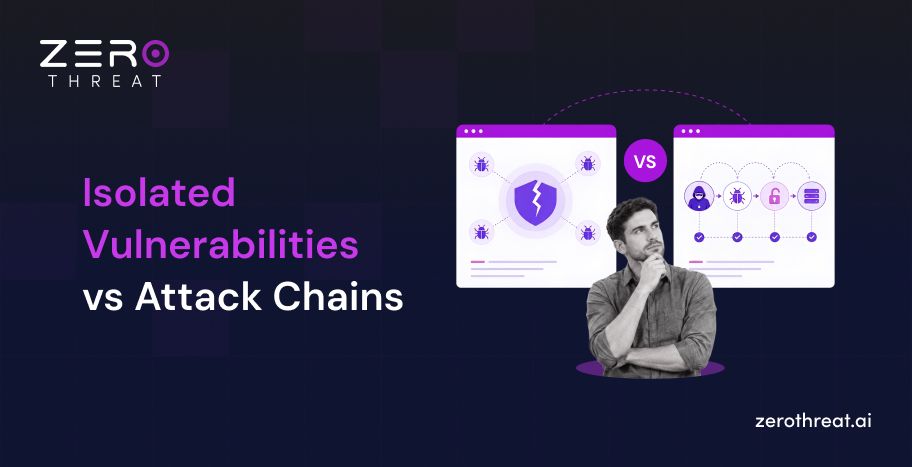
Quick Overview: Most scanners and pentests score each flaw on its own, and most backlogs get sorted the same way. Attackers do not. They link a low severity leak, a broken access control, and a forgotten feature into one path that ends in data theft. This article explains why that difference decides real risk, and how to find the chains that matter.
A scanner or any traditional pentesting tool flags three findings on your application and rates all three medium: a verbose error that leaks an internal hostname, a profile endpoint that trusts whatever ID sits in the URL, and an image import feature that will fetch any address you hand it.
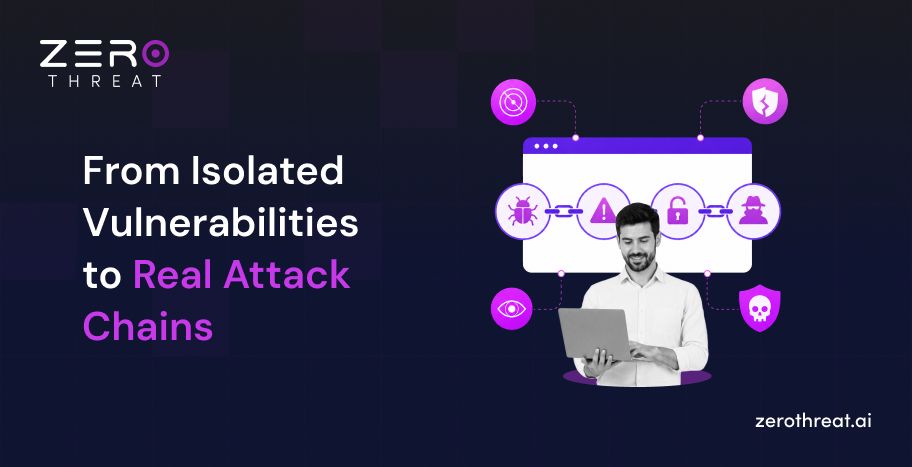
Reviewed one at a time, each earns a shrug and a slot near the bottom of the backlog. An attacker reads the same three as a single sentence: pull another user's ID from the leaked response, feed it to the profile endpoint to steal an admin session, then aim the importer at the cloud metadata service and walk out with the keys to the account.
That is the gap between how defenders catalog weaknesses and how attackers use them. A record 48,185 CVEs landed in 2025, which shows only about 5 to 6% of reported vulnerabilities are ever exploited in the wild. Sorting an ever longer list by severity measures how bad each flaw could be alone, not how flaws combine into a path an attacker can actually walk.
This article breaks down the difference that decides real risk: what isolated findings are, what an attack chain actually is, why severity scores misjudge attack risk, and how a few low and medium findings become a critical compromise. A side-by-side comparison, the anatomy of a real chain, and how ZeroThreat surfaces business critical paths round it out.
Attackers connect the dots. Your security platform should too. Get Started Free
On This Page
- What are Isolated Vulnerability Findings?
- What is Attack Chain?
- Difference Between Isolated Findings Vs Attack Chains
- Why Isolated Findings Fail to Reflect Real Attack Risk?
- Anatomy of a Real-World Attack Chain
- How Zerothreat Discovers Business Critical Attack Chains?
- Move Beyond the Count
What are Isolated Vulnerability Findings?
Isolated vulnerability findings are individual security weaknesses that a vulnerability scanner or pentest reports and scores on their own, each treated as a self-contained issue with its own severity rating and remediation ticket, independent of how it might connect to other flaws in the same application.
This is the default output of most application security testing tools. A scanner sends payloads at endpoints and parameters, matches responses against known weakness signatures, maps each hit to a CWE and CVE, attaches a CVSS score, and drops it into a report. The deliverable is a list. A manual pentest produces a richer version of the same artifact, but it is still organized as discrete findings, each with a severity label and a fix.
Findings get treated independently for a structural reason: the tools that generate them test one input at a time, and the scoring models that rank them measure the intrinsic properties of a single flaw. CVSS was designed to answer "how severe is this specific weakness if exploited," not "can an attacker reach it, and what does reaching it unlock." So, the report is sorted by severity bucket, critical first, and triage follows the sort.
The limitation is baked into the format. A disconnected list has no notion of reachability, sequence, or business meaning. A critical rated flaw buried behind three authentication layers, and a low rated flaw sitting on an unauthenticated endpoint are sorted purely by their intrinsic scores, even though the low one may be the easier door.
The list grows every quarter and says nothing about which of its entries an attacker can actually stitch together. That model was manageable when disclosure volume was low. It is not anymore, which is exactly why the world's canonical scoring database stopped trying to score everything.
What is Attack Chain?
An attack chain is a sequence of individually distinct weaknesses, misconfigurations, and business logic flaws that an attacker links together to progress from an initial foothold to a high impact objective such as data theft, account takeover, or full system compromise.
The defining property of a chain is that its severity is emerging. Each link may be low or medium in isolation, but the risk of the whole is determined by where the sequence ends, not by the highest score of any single component. A chain that terminates in a customer database is critical even if every link along the way looks routine.
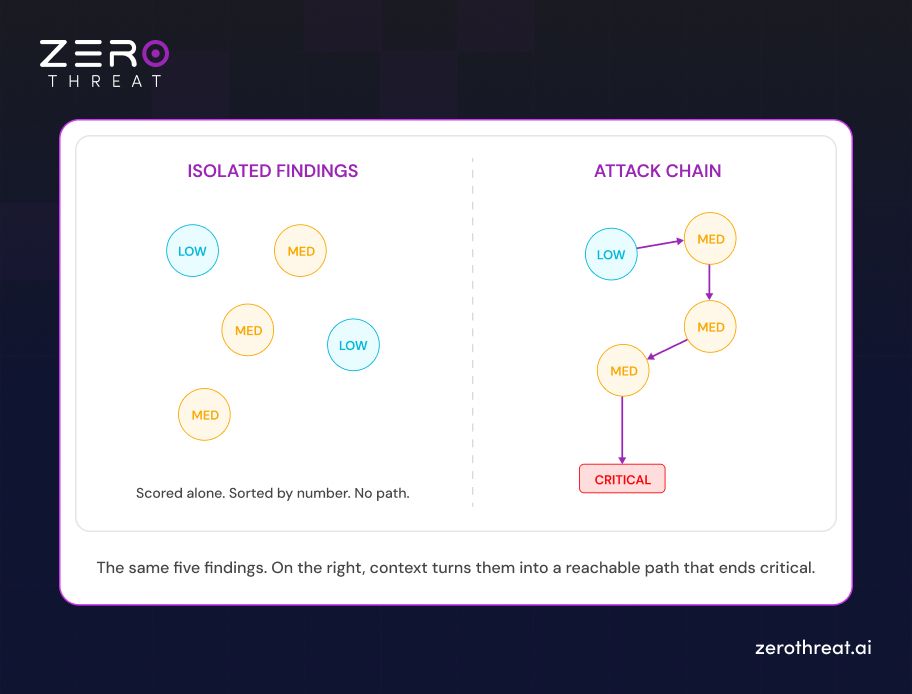
Chains form when different classes of weakness feed one another. An information disclosure hands an attacker the object IDs needed for a broken access control. A weak session control turns that access into privilege escalation. A server-side request forgery in a helper feature pivots from the application into internal infrastructure. A business logic flaw lets an attacker skip a payment step or an approval gate that the code assumed could never be bypassed. Order and reachability are the whole game: link B only matters if link A actually exposes it.
This is why application context is not a nice to have but a prerequisite for understanding exploitability. Two identical CVEs on two identical stacks carry completely different real risk depending on how many controls stand between the flaw and an attacker, which identity can reach it, and what the next step unlocks. Context is what converts a flat list of flaws into a map of paths, and paths are what attackers walk.
Isolated Vulnerability Findings vs Attack Chains
The core difference between isolated vulnerability findings and attack chains is context: isolated findings measure the intrinsic severity of one flaw at a time, while attack chains measure the real exploitability and business impact that emerge when multiple flaws are combined into a reachable path.
| Dimension | Isolated Vulnerability Findings | Attack Chains |
|---|---|---|
| Risk assessment | Per flaw severity score, assigned in isolation | Emergent risk from the full sequence, scored by the objective it reaches |
| Exploitability | Assumed and theoretical; reachability ignored | Proven; requires an ordered, reachable path from access to impact |
| Context awareness | None; the flaw is scored in a vacuum | Application, identity, and business context are central |
| Prioritization | By severity bucket; volume overwhelms capacity | By exploitable path and business impact; a short, actionable queue |
| False positives | High; unreachable or inert flaws flagged as urgent | Low; only validated, proven paths are reported |
| Remediation strategy | Patch every high; one ticket per finding | Break the chain at its cheapest link; fix the path |
| Business impact | Not modeled; a checkout flaw and a static page flaw look alike | Modeled directly; risk tied to money, data, and access |
See how application-aware AI identifies business-critical attack paths automatically. Explore Attack-Driven Testing
Why Isolated Findings Fail to Reflect Real Attack Risk
Isolated findings fail to reflect real attack risk because they score the theoretical severity of single flaws while ignoring exploitability, the relationships between flaws, and the application and business context that decides whether a path is reachable at all.
Four blind spots follow directly from the per finding model.
CVSS Measures Severity, Not Exploitability
A 9.8 with no reachable path is less urgent than a 6.5 on an internet facing endpoint an attacker is already probing. The data bears this out: only 2.3% of CVSS 7 and above flaws are ever seen in an exploitation attempt, while 28% of the CVEs actually exploited in early 2025 carried only medium base scores. A severity first queue systematically deprioritizes more than a quarter of what attackers actually use.
Hidden Relationships Stay Hidden
The dangerous property of a chain, that link A unlocks link B, is invisible to a model that evaluates each flaw in a vacuum. No amount of per finding scoring reveals a connection it was never designed to look for.
Business and Application Context Is Missing
A scanner does not know which endpoint moves money, which identity is privileged, or which workflow can be skipped. A low rated flaw on a checkout or authentication flow can pose far more real risk than a high rated flaw on a static marketing page, but the score cannot tell them apart.
Volume Creates Alert Fatigue and Misdirected Effort
With more than 48,185 CVEs a year and only enough capacity to remediate a slice of the backlog, a list sorted by intrinsic severity sends teams to patch loud, unreachable flaws while quiet, chainable ones stay open. The credential driven, application layer paths that make up a growing share of breaches, rarely sit at the top of that list.
None of this means severity scores are useless. It means they are input, not verdict. Treated as the whole answer, they answer a question attacker never asks.
Anatomy of a Real-World Attack Chain
A real-world attack chain turns several low and medium findings into a single critical outcome by using each weakness to unlock the next, so the compromise emerges from the sequence rather than from any one flaw.
Consider a multi-tenant SaaS application. Here is how five unremarkable findings combine into a breach.
Step 1: Reconnaissance through information disclosure (Low)
A verbose error page and a misconfigured response header leak the application's internal API structure and reveal that user records are keyed by sequential numeric IDs. On its own, information leaks. In a chain, a map.
Step 2: Broken access control via IDOR (Medium)
The orders API trusts the object ID supplied in the request without checking whether the caller owns it. Incrementing the ID returns other tenants' records. Among them is an account flagged with an elevated support role. Alone, a medium access control bug. Here, the attacker now knows who to become.
Step 3: Privilege escalation through weak session logic (Medium)
A predictable password reset token, harvested using data exposed in Step 2, lets the attacker take over the elevated support account and assume a privileged session. No single control was catastrophic, but the sequence just crossed the line from customer to administrator.
Step 4: SSRF through a helper feature (Medium)
An avatar import feature, available to the now privileged session, fetches any URL it is given. The attacker points it at the cloud metadata endpoint and retrieves temporary infrastructure credentials. A textbook server-side request forgery, and the pivot from application to cloud.
Step 5: Impact: data exfiltration (Critical)
Those metadata credentials grant read access to the storage bucket holding customer data. Exfiltration begins. The outcome is critical, yet not one of the five findings would have topped a severity sorted backlog on its own.
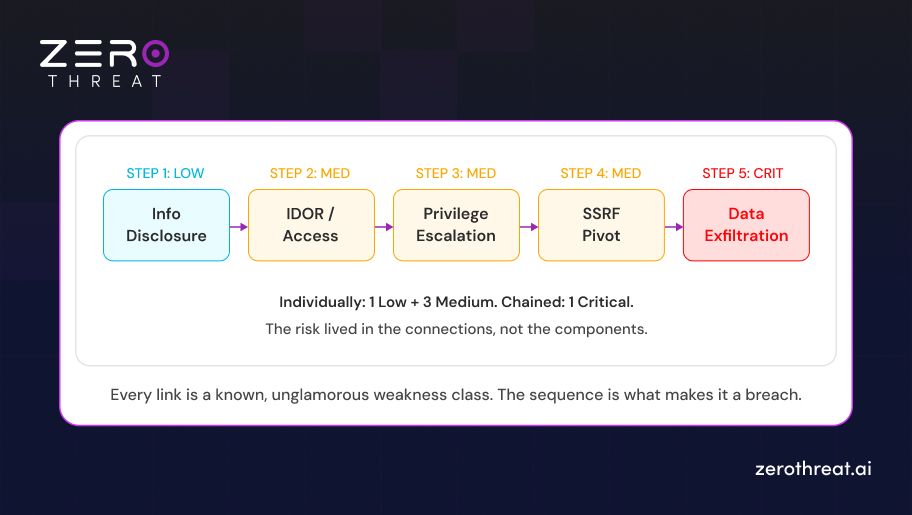
The takeaways for defenders are consistent. The chain's risk lived in the connections, not the components. Every link belonged to a well understood weakness class that a severity score would have parked in the middle of the backlog. Reachability and identity context, which endpoint was exposed to which session, are what made the path exploitable. And the only reliable way to see the path is to validate it from end to end, because no per finding score would ever have surfaced it.
How ZeroThreat Discovers Business-Critical Attack Chains
Closing the gap between findings and paths is a testing problem, not a scoring problem. ZeroThreat’s AI-powered automated penetesting approaches application security testing as attack path discovery rather than list generation, and that shift shows up in five places.
Application-aware Testing
The engine models the application the way a real user experiences it, navigating multi step workflows, authenticated states, and API sequences to reach functionality that flat scanners never touch. This is real user workflow testing, which requires no scripts. Hence, complex flows like checkout, onboarding, and approval gates are exercised as an attacker would exercise them.
Correlation Across Workflows and APIs
Instead of emitting a flat list, ZeroThreat correlates findings across the full external attack surface and the application itself, linking an information leak on one endpoint to a broken access control on another and a pivot on a third into a single candidate path.
Proof-based Exploit Validation
Every candidate chain is validated by safely reproducing the path end to end, so a reported attack chain arrives with evidence, not a probability estimate. This is where near-zero false positives come from: if it is reported, it was proven.
Prioritization by Attack Path, Not by Score
Findings are ranked by the business impact of the path they enable, not the CVSS of the loudest component. Security teams receive the full attack path, impact, and priority; application teams receive the repro steps, endpoints, parameters, evidence, and remediation guidance they need to fix it.
Remediation with Chain Context
Because the whole path is known, guidance points to the cheapest link to break. Fixing a single control often neutralizes the entire chain, which is a very different instruction than "patch these forty findings."
Experience how ZeroThreat turns disconnected findings into actionable attack intelligence. Request a Personalized Demo
Move Beyond the Count
A longer backlog is not a clearer picture of risk, and sorting it by severity answers a question attackers never ask. What decides whether an application gets breached is not how many flaws it has, but which ones connect, how reachable they are, and what the sequence unlocks. Prioritizing exploitable attack paths over disconnected findings shrinks a backlog of thousands into a handful of chains that actually threaten the business, and gives developers one fix that breaks the whole path instead of a stack of tickets.
This is what ZeroThreat is built for. It tests your application the way a real user moves through it, correlates weaknesses into complete attack paths, and validates each one end to end, so every reported chain arrives with proof and zero false positives. Stop triaging a list and start closing the paths an attacker would actually walk.
Frequently Asked Questions
Can low severity vulnerabilities become critical when combined in an attack chain?
Yes, low severity vulnerabilities can absolutely become critical when combined in an attack chain, because a chain inherits the severity of the objective it reaches rather than the highest score of any single link. A low rated information leak that exposes object IDs, a medium rated access control flaw, and a medium rated SSRF can together deliver full data exfiltration.
How do attack chains help security teams prioritize remediation more effectively?
Are attack chains limited to web applications, or do they also apply to APIs and microservices?
What information is required to accurately identify an attack chain?
Can automated pentesting platforms identify attack chains without manual intervention?

Explore ZeroThreat
Automate security testing, save time, and avoid the pitfalls of manual work with ZeroThreat.