 ZeroThreat Wins Top InfoSec Innovators 2026 Award for Penetration Testing Read more

All Blogs
How ZeroThreat Builds Real Attack Chains from Isolated Vulnerabilities
Quick Overview: Security tools hand you a flat list of isolated vulnerabilities ranked by severity. Attackers ignore the list and chain those weaknesses into a path to your most sensitive data. This article breaks down how ZeroThreat's application-aware AI pentesting discovers, validates, and prioritizes complete attack chains, so your team fixes the one link that collapses the entire route instead of chasing hundreds of disconnected tickets.
An attacker studying your application is not reading your vulnerability report. They look at your app the way a burglar looks at a building: not as a list of individual locks, but as a route. A verbose error leaks an internal hostname. That points at an API with a broken authorization check. Which returns a token stored where it never should have been. Which unlocks an admin action that was never meant to be reachable. Four unremarkable findings, none flagged red, add up to a clean path to your most sensitive data. The danger was never in any single link. It was in the connection.
The numbers back this up. Only a thin slice of published vulnerabilities are ever exploited in the wild, roughly 2% to 7%, and the ones that cause real damage are rarely the highest scored. A 2026 analysis found that just 2.3% of CVSS 7-plus flaws ever saw a real exploitation attempt, while 28% of exploited flaws carried only medium scores. Severity tells you how loud a vulnerability is, not where it leads.
So, the real question is not how many vulnerabilities you have, but what an attacker can string together to reach what matters. That is what this article answers: why isolated findings misrepresent real risk, what a real attack chain looks like inside a modern web app or API, why most tools cannot see one, and how ZeroThreat's application-aware AI pentesting discovers, validates, and prioritizes complete attack paths, so you can break the single link that collapses the entire route.
The most dangerous risk isn't a single vulnerability, but it's the path between them. Reveal it now. Reveal Hidden Risks
On This Page
- Why Isolated Vulnerabilities Don't Reflect Real Risk
- Understanding Real Attack Chains in Modern Applications
- The Technical Challenges of Connecting Vulnerabilities
- How ZeroThreat Discovers and Connects Attack Chains
- How ZeroThreat Validates Attack Chains Before Reporting Them
- Prioritizing Attack Chains by Exploitability and Business Impact
- Why Traditional Security Tools Fail to Identify Real Attack Chains
- Breaking the Attack Chain Instead of Chasing Individual Vulnerabilities
- Conclusion
Why Isolated Vulnerabilities Don't Reflect Real Risk
Isolated vulnerabilities don't reflect real risk because risk lives in the relationships between weaknesses, not in any single finding. A vulnerability scored in isolation answers one narrow question, how bad could this be on its own, while attackers ask a completely different one: what can I reach if I combine this with everything else that is already broken.
The CVSS was built to describe the intrinsic severity of a flaw. It was never designed to know whether a flaw is reachable in your environment, whether it sits on a path to sensitive data, or whether a chain of lower-severity issues around it adds up to something catastrophic. So, a medium-severity IDOR on an internal endpoint gets triaged down, even though it is the exact pivot an attacker needs after stealing a session token from a separate, also-medium flaw.
This is why score-driven queues mislead teams. When you sort by CVSS and fix top-down, you spend your effort on the vulnerabilities that look dangerous and starve the ones that are dangerous in context. The result is a backlog that grows faster than it shrinks and a false sense that the criticals are handled.
How attackers chain seemingly unrelated weaknesses
Attackers are opportunistic pathfinders. They start from whatever foothold is cheapest, often steal credentials, and then look for the next hop. A classic real-world sequence looks like this:
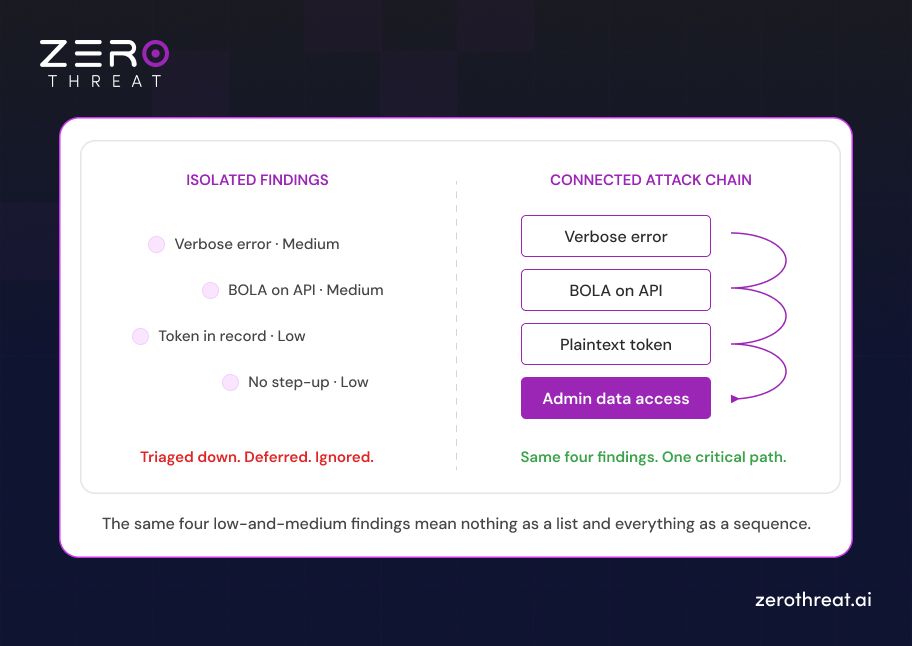
- A verbose error message leaks into an internal API host and a parameter naming convention.
- A broken-object-level authorization (BOLA) check on that API lets a low-privilege user read other tenants' records.
- One of those records contains a service token stored in plaintext.
- That token unlocks an admin workflow with no additional step-up verification.
Not one of those four steps is a headline vulnerability. Chained, they are a complete tenant-to-admin compromise. The 2025 Verizon DBIR, which analyzed more than 22,000 incidents, found system intrusion, the pattern defined by exactly this kind of multi-step movement, to be the leading breach pattern. Breaches are built from sequences, not single shots.
Understanding Real Attack Chains in Modern Applications
A real attack chain is an ordered sequence of individually minor weaknesses that, executed together, moves an attacker from an entry point to a high-value objective such as data theft, account takeover, or privilege escalation. Each step depends on the state created by the previous one, which is exactly why the chain, not the component, is the unit of real risk.
In a modern application, the surface that makes chaining possible is far larger than a list of endpoints. It spans authenticated and unauthenticated states, single-page frontends talking to dozens of microservice APIs, third-party integrations, background jobs, and business workflows that assume users behave in a fixed order. Every one of those assumptions is a place a chain can form.
Attack chains versus isolated vulnerabilities
The difference is about state and dependency. An isolated vulnerability is a static fact: this endpoint reflects unsanitized input. An attack chain is a dynamic story: because the attacker obtained a valid low-privilege session here, they could reach that endpoint, and because that endpoint returned an object reference they should not see, they could pivot to the next service. Isolated findings describe conditions. Chains describe consequences.
Multi-step exploitation in practice
Multi-step exploitation is now the default shape of a serious intrusion, not the exception. A representative modern chain moves through recognizable phases:
- Foothold: Stolen credentials, a leaked token, or an unauthenticated endpoint gives initial access. The DBIR notes stolen credentials feature in the overwhelming majority of basic web application attacks.
- Discovery: The attacker maps reachable functionality from that vantage point, looking for the next authorization or logic gap.
- Escalation: A broken access control or business logic flaw lifts them into a higher-privilege context.
- Lateral Movement: They pivot between services, tenants, or APIs using access the application never intended to grant.
- Impact: Data exfiltration, fund transfer, or persistence completes the objective.
For an example:
Consider a fintech dashboard. An attacker with a basic user account notices that the transaction export endpoint accepts an account ID in the URL and does not verify ownership (a BOLA flaw, CWE-284 family). That alone leaks statements. But the exported file also includes an internal reference used by a separate reconciliation of API that lacks function-level authorization (BFLA). Chaining the two, the attacker moves from reading one account to triggering privileged reconciliation actions across accounts. Two medium findings, one business-critical breach. This is the shape ZeroThreat is built to see.
The Technical Challenges of Connecting Vulnerabilities
Connecting isolated vulnerabilities into attack chains is technically hard because it requires understanding application state, authentication context, workflow order, and data flow all at once, which classic scanners deliberately ignore in order to run fast and stateless.
To assemble a real chain, a testing engine has to solve several interlocking problems that a per-request scanner never attempts:
Mapping Exploit Dependencies
Every step in a chain has preconditions. A privilege-escalation flaw is only reachable if you already hold a valid session of a certain type. Modeling these dependencies means representing "what must be true before this exploit works" and "what becomes true after it succeeds", the state transitions that let one weakness feed the next.
Authentication States and Session Logic
Modern apps have many identity contexts: anonymous, low-privilege user, admin, service account, cross-tenant. A vulnerability that is invisible as an anonymous user may be wide open to one authentication hop later. An engine that cannot hold and switch between authenticated states cannot see most chains at all.
Application Workflows and Business Logic
Workflows encode assumptions, checkout before payment, approval before disbursement, verification before role change. Business logic attacks abuse the order and the transitions, not the syntax of any request. Detecting them requires modeling the intended path so the engine can probe every meaningful deviation from it.
API Relationships and Dynamic Behavior
A single user action in a single-page app can trigger a fan-out of API calls across services, with tokens and object references passed between them. Shadow and undocumented endpoints widen this further. The engine must discover these relationships at runtime and track how data and trust propagate, because that propagation is where cross-service chains live.
Correlation. Validation. Exploitation. See every phase of an attack chain mapped automatically. Explore the Engine
How ZeroThreat Discovers and Connects Attack Chains
ZeroThreat discovers and connects attack chains by mapping the application like a real user, correlating findings across authentication states and services, and generating an attack graph that models every viable exploit path from entry point to business-critical objective. This is the engine at the center of ZeroThreat's application-aware AI pentesting, and it replaces the flat vulnerability list with a navigable model of how weaknesses actually connect.
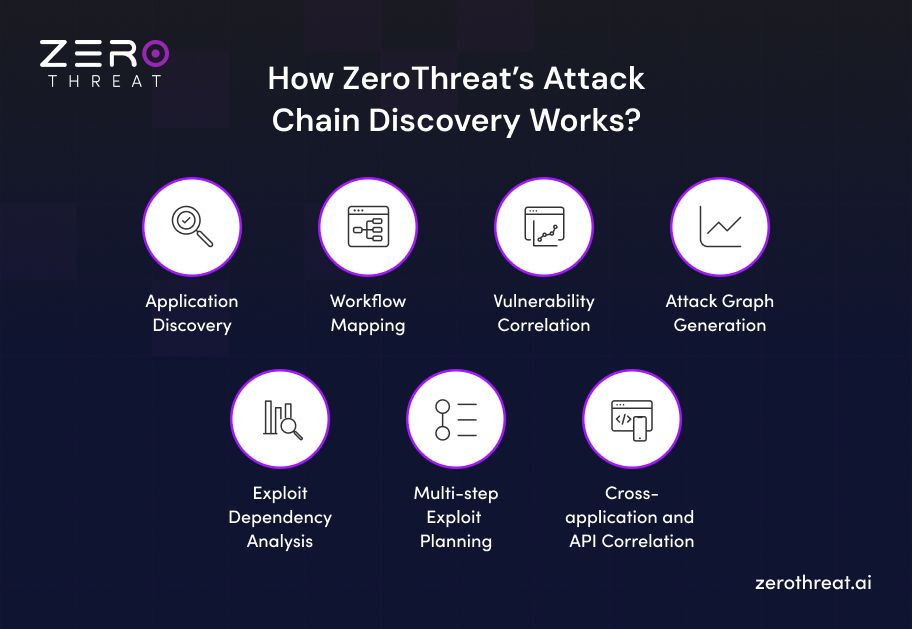
The engine runs as a sequence of stages, each feeding the next.
Application Discovery
ZeroThreat first builds a complete picture of the target: pages, routes, forms, single-page-app states, and the full API surface behind them, including undocumented and shadow endpoints that inventory tools miss. Discovery runs across the external footprint too, so the entry points a chain might start from are all in scope, not just the ones a spec file declared.
Workflow Mapping
Rather than firing isolated requests, the engine exercises real user journeys, sign-up, login, multi-step forms, checkout, approval flows, the way an actual user would. It records the intended order of operations and the state each step produces, so it understands the workflows an attacker would try to subvert. No Playwright specs to author; the engine learns the flows by navigating them.
Vulnerability Correlation
As findings surface, ZeroThreat correlates them against the state model instead of listing them independently. It asks which weaknesses share a context, an authentication level, an object reference, a service boundary, so that a leak here and an authorization gap there are recognized as potentially connected rather than filed as two unrelated tickets.
Exploit Dependency Analysis
For each candidate weakness the engine models preconditions and post-conditions: what access it requires, and what new access it grants. This is what lets one finding become the launchpad for the next. Dependencies are the edges that turn a set of vulnerabilities into a traversable graph.
Attack Graph Generation
ZeroThreat assembles these dependencies into an attack graph, nodes are application states and weaknesses, edges are the exploit transitions between them. Every route from an entry node to a sensitive-asset node is a candidate attack chain. The graph makes explicit what a vulnerability list hides: the actual paths through your application.
Multi-step Exploit Planning
From the graph, the engine plans concrete multi-step sequences, ordering the exploits so each step establishes the state the next one needs, mirroring how a human attacker reasons from foothold to objective.
Cross-application and API Correlation
Finally, ZeroThreat connects paths that span services and APIs, following tokens, object references, and trust relationships as they cross boundaries. This is where the most damaging chains hide, and where single-target scanners are structurally blind.
How ZeroThreat Validates Attack Chains Before Reporting Them
ZeroThreat validates attack chains by proving each step is actually reachable and exploitable in a safe, controlled way, so every reported chain is evidence-backed rather than theoretical, which is how it delivers zero false positives. A candidate path in the graph is only a hypothesis until the engine demonstrates it end to end.
Reachability Analysis
Before spending any effort exploiting a step, ZeroThreat’s automated pentesting confirms the step is genuinely reachable from the current state, that the required authentication context, entry point, and preconditions truly hold in this environment. Paths that look valid on paper but are unreachable in practice are pruned early. Reachability is the single biggest reason theoretical severity overstates real risk, and it is where most of the noise gets removed.
Safe Exploit Validation
For reachable steps, the engine performs controlled, production-safe validation, demonstrating the exploit works without causing damage, corrupting data, or disrupting the live application. It confirms the transition genuinely grants the next state in the chain, then moves on, assembling proof one verified hop at a time.
Removing False Positives
Because a chain is only reported when every link is independently proven reachable and exploitable, unverifiable candidates never reach your queue. This is the mechanism behind ZeroThreat's near-zero false positives: the standard for reporting is demonstrated exploitation, not pattern matching. Your team stops spending review cycles confirming whether findings are even real.
Proof-based Findings
Each validated chain ships with evidence, the exact sequence of steps, the endpoints and parameters involved, the state transitions, and reproduction detail. Security teams get the full attack path with impact and priority. The finding is not an alert to investigate. It is a proven attack to fix.
Modern AppSec teams prioritize attack paths, not vulnerability counts. Find the plan built for that shift. Compare Options
Prioritizing Attack Chains by Exploitability and Business Impact
ZeroThreat prioritizes attack chains by combining how exploitable a path is with what it would cost the business if exploited, ranking real routes to real assets above high-scoring findings that lead nowhere. Priority follows the path's consequence, not the loudest CVSS number on the list.
The engine scores each validated chain across a set of factors that map to how a defender and an attacker both think about value:
- Reachability: How directly an attacker can start and complete the chain from a realistic entry point. Proven, low-friction paths outrank complex, conditional ones.
- Privilege Gained: How far the chain escalates, from single-record access to admin or service-level control.
- Data Exposure: The sensitivity and volume of data the endpoint of the chain unlocks.
- Lateral Movement: Whether the chain lets an attacker pivot across services, tenants, or environments, widening blast radius.
- Business Criticality: The importance of the asset or workflow at the end of the path to the organization, not a generic severity label.
- Compliance Impact: Whether the exposed data or function touches regulated scope, mapped to frameworks including OWASP, PCI DSS, HIPAA, GDPR, and ISO 27001.
This is why prioritization is business-aware rather than score-driven. A validated chain that reaches cardholder data through a reachable path ranks above an unreachable critical-scored flaw on an isolated internal service, because the first is a breach waiting to happen and the second is not.
Why Traditional Security Tools Fail to Identify Real Attack Chains
Traditional security tools fail to identify real attack chains because they test in isolation, one request, one rule, one finding at a time, and never model the state, workflow order, and cross-service dependencies that let weaknesses connect. They are optimized to enumerate vulnerabilities, not to reason about paths.
Static analysis (SAST) inspects source code for risky patterns but has no view of runtime reachability, so it cannot tell which flaws are actually exploitable in a running system, let alone how they link. Legacy dynamic scanning – DAST tools, fires payloads at endpoints statelessly, catching individual reflections and injections while missing anything that depends on holding an authenticated session or following a workflow. Both produce long, flat lists sorted by generic severity, and both leave the connective reasoning to already-overloaded humans.
| Capability | Legacy SAST / DAST / Scanners | ZeroThreat Application-Aware AI Pentesting |
|---|---|---|
| Testing model | Per-request, stateless, rule-driven | Stateful, application-aware, path-driven |
| Output | Flat list of isolated findings | Validated attack chains and an attack graph |
| Authenticated & multi-state testing | Limited or none | Full, across identity contexts |
| Business logic & workflow abuse | Missed | Modeled and probed |
| Cross-service / API chaining | Structurally blind | Correlated across boundaries |
| Exploit validation | Pattern match, unverified | Safe, proof-based, 0 false positives |
| Prioritization basis | Generic CVSS severity | Reachability + business impact |
Breaking the Attack Chain Instead of Chasing Individual Vulnerabilities
Breaking the attack chain means fixing the one link whose removal makes an entire exploit path impossible, rather than trying to patch every individual finding on the path. When you think in chains, remediation stops being an endless queue and becomes a small set of high-leverage cuts.
An attack graph changes what "fixing" means. A single well-chosen fix can invalidate many chains at once, because most paths through an application funnel through a handful of shared weak links. Identifying and cutting those links is far more efficient than draining a backlog finding by finding.
Root-cause Remediation
ZeroThreat points at the underlying weakness that enables the transition, not just the symptom at the surface. Fixing the missing authorization check that made a pivot possible closes that pivot for every chain that relied on it, often collapsing several validated paths with one change.
Fix Sequencing
Because chains are ranked by exploitability and business impact, remediation can be sequenced by leverage. Teams cut the links that break the most critical paths first, getting maximum risk reduction from the earliest fixes instead of working alphabetically through a severity list.
Eliminating the Entire Attack Path
The goal is not zero findings; it is zero viable paths to what matters. A chain with a single link removed is a dead route. Measuring progress by paths broken, rather than tickets closed, aligns security effort with the outcome that actually protects the business.
Watch ZeroThreat connects the dots across web apps and APIs in a personalized demo. See It Live
Conclusion
The vulnerability list is a comfortable fiction. It promises that if you patch enough rows, you are safe, but attackers never read it top to bottom. They read your application as a graph of possibilities and walk the cheapest route to what they want, stitching together the quiet, deprioritized weaknesses that no single score flagged as urgent. As long as security is measured in isolated findings, the most dangerous paths will keep slipping through the middle of the queue.
ZeroThreat's AI pentesting closes that gap by testing the way attackers think. It maps the real application, correlates weaknesses across states and services, generates an attack graph of every viable path, and then proves each chain step by step, so nothing reaches your team without evidence. It is a short, ranked list of validated, business-critical attack chains, each with the one link you can cut to make the whole path impossible. That is the shift from counting vulnerabilities to eliminating attacks, and it is how modern application security stops chasing findings and starts breaking chains.
Frequently Asked Questions
Why aren't CVSS scores enough to prioritize real risk?
CVSS measures the intrinsic severity of a flaw in isolation. It does not know whether a flaw is reachable in your environment or whether a group of lower-severity issues chains into a critical path. Research shows only a small share of high-CVSS vulnerabilities are ever exploited, while a meaningful portion of exploited vulnerabilities carry only medium scores, so score-driven queues routinely deprioritize the flaws that actually get chained into breaches.
Is ZeroThreat's exploit validation safe to run against production?
How does ZeroThreat connect isolated vulnerabilities into attack chains?
How is ZeroThreat different from traditional DAST scanners and pentesting tools?

Explore ZeroThreat
Automate security testing, save time, and avoid the pitfalls of manual work with ZeroThreat.