 ZeroThreat Wins Bronze Stevie® Award in Tech Startup of the Year Read more

All Blogs
TL;DR
- Application security testing tools help detect vulnerabilities across web apps, APIs, cloud workloads, and CI/CD pipelines before attackers exploit them.
- Modern AppSec platforms combine SAST, DAST, API security testing, and AI-driven risk analysis for broader security coverage.
- Choosing the right AppSec tool depends on your infrastructure, compliance needs, developer workflow, and security maturity.
- AI-powered automated pentesting is helping teams reduce false positives with exploit validation of the attack paths and improve remediation speed.
A single vulnerable API, exposed dependency, or insecure CI/CD workflow is enough to turn an application into an easy entry point for attackers. And with the pace of modern development, the chance of something like this happening is quite high.
According to recent research, almost 84% of organizations have vulnerabilities categorized as high-risk, while 86% of commercial codebases evaluated open-source software vulnerabilities.
This clearly shows us how vulnerable applications are and how badly traditional testing methods have failed to ensure security. The solution to this problem is selecting the right application security testing tool and adapting it into your workflows for repetitive, continuous tests.
The right AppSec platform helps organizations detect exploitable vulnerabilities earlier, automate security testing across the SDLC, reduce false positives, and continuously validate security posture across web applications, APIs, containers, and cloud environments.
In this guide, we will break down the top application security testing tools in 2026, compare their strengths, highlight their best use cases, and help you choose the right solution for your security needs.
Keep pace with evolving threats using smarter application security tools. Start for FREE
ON THIS PAGE
- Application Security Testing Tools: Quick Glance
- Why Use Application Security Testing Tools (Critical Reasons)
- Key Features to Look for in Application Security Testing Tools
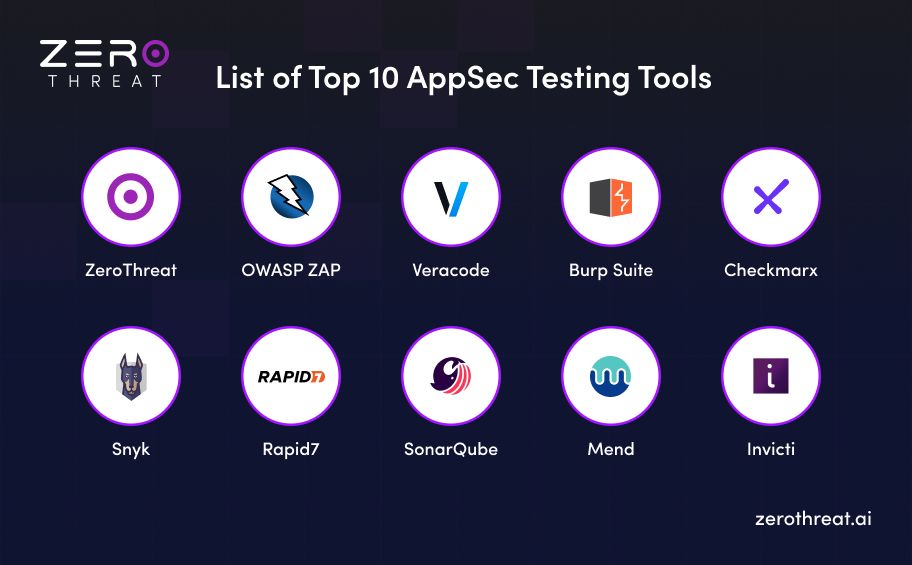
- Top 10 Application Security Testing Tools
- Enhance Security with the Right AppSec Tool
Best Application Security Testing Tools: Quick Glance
| Tools | Category | Top Feature | Best Use Case |
|---|---|---|---|
| ZeroThreat | AI-powered automated pentesting | Agentic AI exploit validation with near-zero false positives | Continuous security testing for modern DevSecOps environments |
| OWASP ZAP | Open-source DAST | Automated web application and API vulnerability scanning | Cost-effective DAST for developers and security teams |
| Veracode | SAST and AST | Unified SAST, DAST, and software composition analysis | Large-scale AppSec and compliance management |
| Burp Suite | DAST and manual testing | Advanced proxy interception and attack automation | Professional penetration testing and bug bounty workflows |
| Checkmarx | SAST and SDLC security | AI-powered risk prioritization across the SDLC | Enterprise DevSecOps and secure software development |
| Snyk | SCA and container security | Vulnerability scanning inside developer workflows | Securing cloud-native and open-source environments |
| Rapid7 | DAST and vulnerability management | Attack Replay for remediation validation | Continuous DAST for modern applications and APIs |
| SonarQube | SAST and code quality Analysis | Security-focused code analysis with CI/CD integration | Secure coding and continuous code inspection |
| Mend | SCA and supply chain security | Open-source dependency and AI-generated code security | Managing software supply chain risks and compliance |
| Invicti | Enterprise DAST | Proof-based vulnerability validation that confirms exploitability | Accurate web vulnerability detection with reduced false positives |
Why Use Application Security Testing Tools (Critical Reasons)
Modern application security testing tools offer automated pentesting, CI/CD integration, and comprehensive coverage across APIs and code. These key features help teams identify exploitable risks early, which is the key reason why you should be using an AppSec tool.
Detect Vulnerabilities Before Attackers Do
Application security testing tools help teams uncover vulnerabilities such as SQL injection, authentication flaws, insecure APIs, and misconfigurations before they reach production. This reduces the chances of data breaches, account compromise, and exploitation of OWASP Top 10 risks.
Reduce Manual Security Testing Effort
Automated application security testing tools reduces repetitive manual testing tasks by continuously scanning applications, APIs, dependencies, and runtime environments. Security teams can focus more on validating critical risks and business logic vulnerabilities instead of handling routine scans.
Improve Compliance and Audit Readiness
Many application security testing tools provide compliance-ready reporting aligned with standards such as PCI DSS, HIPAA, SOC 2, and OWASP guidelines. This helps organizations simplify audit preparation and maintain stronger visibility into their security posture.
Identify Security Issues Earlier in Development
Shift-left security practices allow developers to detect vulnerabilities during coding and testing stages rather than after deployment. Early remediation lowers fixing costs, reduces security debt, and prevents vulnerabilities from reaching production systems.
Improve API and Cloud Application Security
Modern applications rely heavily on APIs, microservices, and cloud-native infrastructure. Application security testing tools help organizations continuously scan APIs, containers, cloud workloads, and exposed services for security weaknesses that attackers commonly target.
Reduce False Positives and Alert Fatigue
Advanced AppSec platforms use runtime validation, contextual analysis, and AI-assisted prioritization to reduce false positives. This helps developers focus on exploitable vulnerabilities instead of wasting time reviewing low-risk or inaccurate alerts.
Support Continuous Security Testing
Security testing is no longer a one-time activity before release. Modern AppSec tools support continuous testing across development, staging, and production workflows, helping organizations maintain stronger visibility as applications evolve rapidly.
Detect real attack paths, API flaws, and critical security gaps 10× faster with ZeroThreat. Pentest My App
Key Features to Look for in Application Security Testing Tools
The best application security testing tools help organizations detect exploitable vulnerabilities, improve DevSecOps efficiency, secure APIs, and support continuous security validation across modern applications, cloud environments, and CI/CD pipelines.
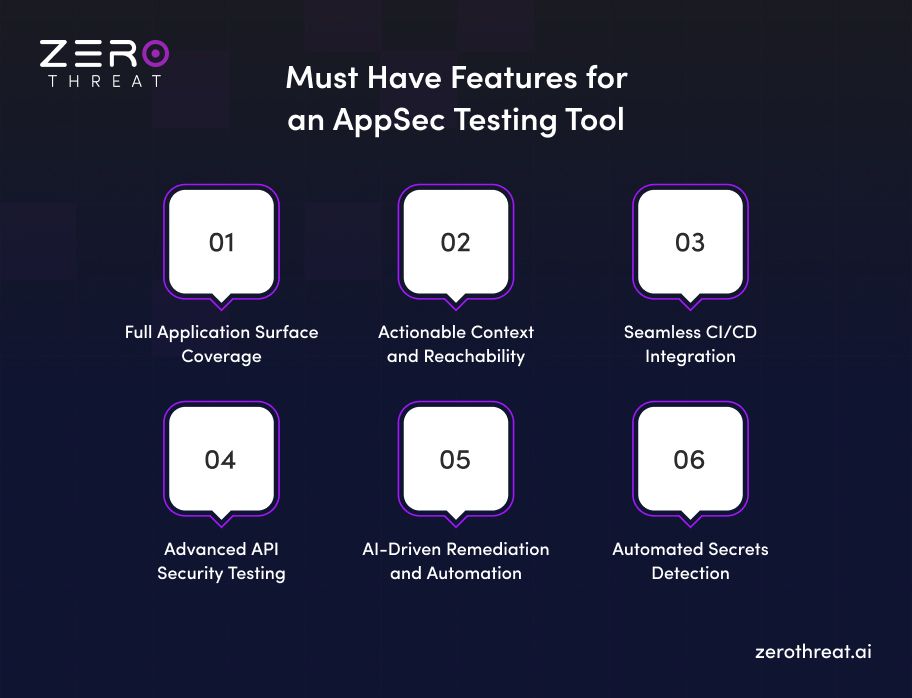
Here are the core features AppSec tools must have:
Full Application Surface Coverage
Effective platforms must analyze your entire software stack, including source code, open-source dependencies, and APIs. This unified visibility ensures you catch vulnerabilities across containers and running services. It prevents security gaps that attackers often exploit in complex cloud-native environments.
Actionable Context and Reachability
Modern tools should provide a list of bugs along with findings of runtime behavior to show if a vulnerability is actually reachable in production. That context helps teams prioritize issues based on business impact, which significantly reduces noise and false positives.
Seamless CI/CD Integration
Security checks should happen directly within your existing developer workflows. Look for tools that integrate natively with GitHub or GitLab pipelines. This allows for continuous testing during every pull request. It ensures that security remains a standard part of your delivery process.
Advanced API Security Testing
Today, APIs are the primary target for attackers, and you can’t take a risk on them. Your chosen solution must evaluate complex request handling, authentication flows, and integration points. Comprehensive API scanning identifies logic flaws and broken object-level authorization that traditional static analysis tools might miss during development.
AI-Driven Remediation and Automation
As code volume increases, manual testing and retesting become impossible for most teams. Modern platforms use AI-assisted testing and guided remediation to suggest specific code fixes. Automated policy enforcement maintains a strong security posture without requiring constant manual intervention from your security professionals.
Automated Secrets Detection
Hardcoded credentials in version control systems pose a massive security risk. Tools must automatically detect exposed API keys, tokens, and passwords. Promptly identifying these secrets prevents unauthorized access. It ensures that sensitive data does not accidentally leak into your repositories.
Top 10 Application Security Testing Tools
The best application security testing tools help organizations detect vulnerabilities, secure APIs, strengthen DevSecOps workflows, and automate continuous security testing across modern web applications and cloud-native environments. Here are the top tools you can use.
1. ZeroThreat
Category: AI-Powered Automated Pentesting
ZeroThreat is an AI-powered penetration testing platform that identifies and validates real, exploitable vulnerabilities across modern web applications and APIs. Using Agentic AI pentesting, it executes adaptive attacker workflows to simulate real-world attack paths, proving impact and eliminating false positives.
The platform can check for 130K+ vulnerabilities with real-time CVE coverage and Application Journeys (Playwright-powered) to test authenticated flows, APIs, and complex business logic. It also integrates custom and community-driven attack templates (Burp and Nuclei) to extend coverage and reflect real-world attack techniques.
By focusing on verified findings rather than raw vulnerability counts, ZeroThreat reduces manual effort by over 90% and enables security teams to prioritize and remediate actual risk with ease, while maintaining continuous, production-safe testing across environments.
Key Features of ZeroThreat
- AI-powered automated pentesting for web apps and APIs
- Agentic AI exploit validation for real attack path testing
- Authenticated and authorization-aware security testing
- Deep business logic and workflow abuse detection
- CI/CD integration for continuous security testing
- AI-powered remediation guidance with proof-based reports
Best For: Modern security teams, SaaS companies, and enterprises looking for AI-driven automated pentesting with continuous application security testing.
2. OWASP ZAP
Category: Open-Source DAST
ZAP is one of the most widely used open-source DAST tools for web application security testing. It helps security teams and developers identify vulnerabilities in web applications through automated scanning, proxy testing, and manual security assessment workflows.
The platform supports baseline scans, authenticated testing, API security validation, and CI/CD pipeline integration. OWASP ZAP is popular among startups, developers, and security teams because it offers strong flexibility, community-driven plugins, and cost-effective dynamic application security testing capabilities.
Key Features of OWASP ZAP
- Open-source dynamic application security testing tool
- Automated web application vulnerability scanning
- Intercepting proxy for manual security testing
- REST API and authenticated scanning support
- Docker and CI/CD pipeline integration
- Extensive plugin and community add-on ecosystem
- Baseline scans for continuous security testing workflows
Best For: Developers, startups, and security teams looking for a flexible and open-source DAST tool for web application and API security testing.
3. Veracode
Category: SAST and AST
Veracode is an enterprise application security platform that provides SAST, DAST software composition analysis, and application risk management capabilities. The platform helps organizations identify vulnerabilities across code, dependencies, APIs, and cloud-native applications throughout the SDLC.
It uses AI-powered analysis and risk prioritization to help teams reduce remediation time and improve secure software development practices. Its centralized platform supports compliance reporting, developer-focused remediation workflows, and large-scale application security management for enterprise environments.
Key Features of Veracode
- Static application security testing (SAST)
- Dynamic application security testing (DAST)
- Software composition analysis for open-source dependencies
- AI-powered application risk management
- Secure SDLC and CI/CD integration support
- Compliance and audit-ready reporting capabilities
- Centralized vulnerability management and analytics
Best For: Enterprises and large development teams that need scalable application security testing, compliance support, and centralized AppSec risk management.
4. Burp Suite
Category: DAST and Manual Testing
Burp Suite by PortSwigger is one of the most widely used web application security testing platforms for manual and automated penetration testing. Security professionals use it to identify vulnerabilities in web applications, APIs, authentication workflows, and modern application environments.
The platform includes tools for traffic interception, vulnerability scanning, request manipulation, and custom attack automation. Burp Suite is highly popular among penetration testers, bug bounty hunters, and AppSec teams because of its flexibility, extensibility, and deep testing visibility.
Key Features of Burp Suite
- Advanced web application vulnerability scanner
- Intercepting proxy for HTTP and HTTPS traffic analysis
- Automated and manual penetration testing workflows
- API security testing with authenticated scanning
- Burp Intruder for customized attack automation
- Large extension ecosystem through the BApp Store
- Support for XSS, SQL injection, SSRF, and authentication testing
Best For: Penetration testers, bug bounty hunters, and AppSec professionals looking for deep manual and automated security testing capabilities.
5. Checkmarx
Category: SAST and SDLC Security
Checkmarx is an enterprise application security platform designed to secure modern software development environments. The platform provides unified application security testing across source code, open-source dependencies, APIs, containers, and cloud-native applications throughout the software development lifecycle.
Checkmarx One uses AI-powered risk analysis and remediation workflows to help organizations reduce security exposure without disrupting developer productivity. Its centralized AppSec posture management helps large enterprises prioritize exploitable risks and maintain visibility across distributed development environments.
Key Features of Checkmarx
- Unified SAST, DAST, SCA, and API security testing
- AI-powered application security posture management
- Security analysis for AI-generated and human-written code
- CI/CD, IDE, and SCM integration support
- Container and Infrastructure as Code security testing
- Risk-based vulnerability prioritization and remediation
- Compliance-ready reporting and centralized governance
Best For: Enterprises and DevSecOps teams that need scalable application security testing with centralized risk management and AI-driven remediation support.
Choose a plan that provides continuous security coverage without breaking your annual budget. Check Out Pricing
6. Snyk
Category: SCA and Container Security
Snyk is a developer-first application security platform focused on securing code, open-source dependencies, containers, and Infrastructure as Code environments. The platform helps developers identify and fix vulnerabilities directly within their existing development workflows.
Snyk uses AI-powered analysis and risk prioritization to reduce remediation effort and improve developer productivity. Its integrations with IDEs, repositories, and CI/CD pipelines make it a strong choice for organizations adopting DevSecOps and continuous security testing practices.
Key Features of Snyk
- Vulnerability scanning for code and open-source dependencies
- Container and Infrastructure as Code security testing
- AI-powered risk prioritization and remediation guidance
- Developer-first IDE and workflow integrations
- CI/CD pipeline security testing automation
- Security testing for AI-generated code
- Centralized visibility and policy management dashboards
Best For: Development teams and DevSecOps organizations looking for developer-friendly application security testing with strong open-source and cloud-native security coverage.
7. Rapid7
Category: DAST and Vulnerability Management
Rapid 7 offers application security testing through InsightAppSec, a DAST platform designed to identify vulnerabilities in modern web applications and APIs. The platform helps security teams automate vulnerability detection, reduce false positives, and prioritize remediation across distributed application environments.
InsightAppSec supports continuous security testing with cloud and on-premise scan engines, developer workflow integrations, and compliance-focused reporting. Its Attack Replay capability helps developers reproduce vulnerabilities faster, making remediation more efficient across DevSecOps and enterprise security programs.
Key Features of Rapid7
- Dynamic application security testing for web apps and APIs
- Automated vulnerability detection with 95+ attack types
- Attack Replay for faster remediation validation
- Cloud and on-premise scanning support
- CI/CD and Jira integration capabilities
- Compliance reporting for PCI DSS, HIPAA, and GDPR
- Scan scheduling and continuous security testing workflows
Best For: Enterprises and DevSecOps teams looking for scalable DAST and continuous application security testing across modern web applications and APIs.
8. SonarQube
Category: SAST and Code Quality Analysis
SonarQube is a widely used code quality and static analysis platform that helps developers identify security vulnerabilities, bugs, and maintainability issues during software development. It supports continuous code inspection across multiple programming languages and CI/CD workflows.
The platform is commonly adopted by development teams because of its developer-friendly interface, pipeline integrations, and automated code review capabilities. SonarQube also provides security-focused rules and taint analysis features that help organizations improve secure coding practices earlier in the SDLC.
Key Features of SonarQube
- Static code analysis for security and code quality
- Support for multiple programming languages
- CI/CD pipeline integration and automated code review
- Security hotspot and taint analysis capabilities
- Developer-focused remediation guidance
- Technical debt and maintainability tracking
- Centralized dashboards and reporting visibility
Best For: Development teams and organizations that want continuous static code analysis with integrated code quality and security visibility.
9. Mend
Category: SCA and Supply Chain Security
Mend is an application security platform focused on securing software supply chains, open-source dependencies, AI-generated code, and cloud-native development environments. The platform provides unified visibility across code, containers, dependencies, and AI security risks within a centralized workflow.
Mend combines SAST, SCA, and AI-assisted remediation capabilities to help organizations identify vulnerabilities earlier and reduce remediation time. Its platform is designed to support proactive AppSec programs with governance, compliance tracking, and developer-friendly security workflows.
Key Features of Mend
- Software composition analysis for open-source dependencies
- AI-generated code and AI model security testing
- Unified AppSec and AI security visibility
- SAST and container security testing support
- AI-powered remediation and prioritization workflows
- Compliance reporting with SBOM and AI-BOM support
- CI/CD and developer workflow integrations
Best For: Organizations focused on software supply chain security, open-source risk management, and securing AI-driven development environments.
10. Invicti
Category: Enterprise DAST
Invicti is a dynamic application security testing platform designed to identify exploitable vulnerabilities across web applications, APIs, and modern application environments. The platform focuses on automated security testing with proof-based validation to help reduce false positives and improve remediation accuracy.
Invicti supports continuous security testing across development and production environments through CI/CD integrations, automated scanning, and centralized vulnerability management. Its scanning engine helps organizations detect security issues such as SQL injection, XSS, authentication flaws, and API vulnerabilities efficiently.
Key Features of Invicti
- Dynamic application security testing for web applications
- Proof-Based Scanning for vulnerability validation
- Automated API security testing capabilities
- CI/CD pipeline and workflow integrations
- Detection for OWASP Top 10 vulnerabilities
- Centralized vulnerability management dashboards
- Continuous security scanning and reporting
Best For: Security teams and enterprises looking for automated DAST with accurate vulnerability validation and reduced false positives.
Need guidance for implementing security testing? Connect with experts at ZeroThreat. Contact Us
Enhance Security with the Right AppSec Tool
Modern applications require continuous security validation because attack surfaces now extend across APIs, cloud workloads, open-source dependencies, and CI/CD pipelines. Choosing the right AppSec testing tool helps teams reduce exploitable risks before they impact production environments.
A thoughtful AppSec program combines automated vulnerability detection, developer-friendly workflows, compliance visibility, and continuous testing across the software development lifecycle. Organizations that integrate security testing into DevOps pipelines are better prepared to manage evolving threats and faster release cycles.
Frequently Asked Questions
What are the best application security testing tools in 2026?
Some of the best application security testing tools in 2026 include ZeroThreat, Veracode, Checkmarx, Burp Suite, Snyk, OWASP ZAP, and Rapid7. These platforms support capabilities such as SAST, DAST, API security testing, software composition analysis, and continuous DevSecOps security validation.
Which AppSec tool is best for automated pentesting?
Which tool detects OWASP vulnerabilities automatically?
What is the best alternative to manual penetration testing?
Which AppSec tools integrate with CI/CD pipelines?
Are there affordable application security testing tools for startups?
How do application security testing tools work?


Explore ZeroThreat
Automate security testing, save time, and avoid the pitfalls of manual work with ZeroThreat.