 ZeroThreat Wins Bronze Stevie® Award in Tech Startup of the Year Read more

All Blogs
Why Complete External Attack Surface Coverage is Critical for Enterprise Security
Quick Overview: Modern organizations expose far more than a website. APIs, cloud workloads, staging environments, admin panels, forgotten subdomains, and shadow IT continuously expand the external attack surface, often faster than security teams can track. This article explains why complete external attack surface coverage is the foundation of effective AI pentesting: you can only discover real attack paths, eliminate blind spots, and prioritize by business impact once you can see everything an attacker can reach.
Digital transformation quietly rewrote the rules of application security. A decade ago, an organization's internet-facing footprint might have been a handful of managed servers behind a firewall. Today the same organization runs microservices across multiple clouds, ships code through automated pipelines dozens of times a day, integrates hundreds of third-party SaaS platforms, and exposes APIs that carry the majority of its traffic. Every one of those changes creates new internet-facing assets, and most organizations don't have a reliable inventory of them.
Attackers do. Palo Alto Networks' Unit 42 found that adversaries begin scanning for a newly disclosed vulnerability within 15 minutes of the CVE being announced, and that automated tooling can sweep the entire IPv4 address space for exposed targets in minutes. The 2025 Verizon Data Breach Investigations Report found that vulnerability exploitation grew 34% year over year to become the initial access vector in one in five breaches, closing in on stolen credentials as the most common entry point. Reconnaissance is no longer the slow part of an attack. It is continuous, automated, and instant.
This is why the conversation has shifted. Security is no longer only about scanning the applications you know about. It's about discovering everything you expose first, and then testing all of it the way a real attacker would. Modern AI Pentesting takes this a step further by continuously discovering exposed assets, understanding application context, and validating exploitable risks across your attack surface.
A vulnerability scanner pointed at a single known URL can be immaculate and still miss the forgotten staging API that becomes the breach. Coverage, not cleverness, is the constraint that matters.
Every undiscovered asset is another opportunity for attackers. Start mapping your external attack surface today. Scan Your Attack Surface
ON THIS PAGE
- What is an External Attack Surface?
- Why Modern Attack Surfaces Grow Faster Than Teams Can Track
- The Hidden Assets Attackers Find Before You Do
- Why Traditional Scanners Miss Large Parts of Your Surface
- What Complete External Attack Surface Coverage Actually Means
- From Asset Discovery to Attack Surface Intelligence
- How Complete Coverage Enables AI Pentesting & Attack Chains
- The Business Risks of Incomplete Coverage
- Best Practices for Complete Coverage
- How ZeroThreat Delivers Complete Coverage
- Conclusion
What is an External Attack Surface?
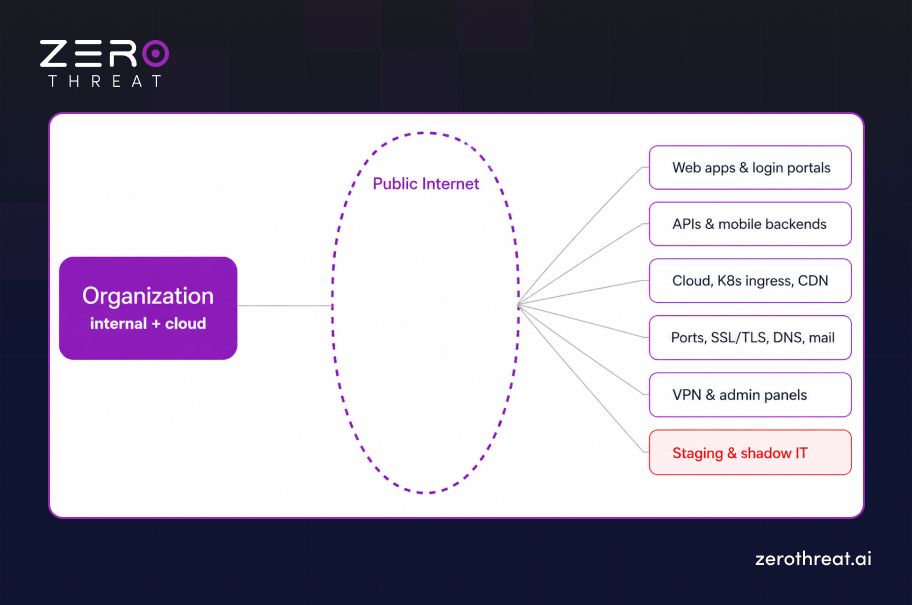
An external attack surface is the complete set of internet-facing assets an organization exposes that an attacker could reach and attempt to exploit, every domain, subdomain, API, service, port, and application reachable from outside the network perimeter. If a person or a bot on the public internet can send a packet to it, it belongs to your external attack surface, whether or not your security team knows it exists.
In practice, that surface is far broader than most inventories capture. It spans web applications and their login portals, REST and GraphQL APIs, mobile app backends, cloud workloads and Kubernetes ingress, CDN endpoints and load balancers, public object storage, VPN and remote-access gateways, mail and DNS infrastructure, development and staging environments, and internet-exposed admin panels. Each of these is a distinct doorway, and each behaves differently under attack.
The defining characteristic of the modern external attack surface is that it is dynamic and decentralized. It is created and changed by many teams (developers spinning up a preview environment, a marketing team standing up a landing page on a new subdomain, an integration that publishes a new API version) most of it happening without central security oversight. The surface an attacker sees today is not the surface they saw last month.
Why Modern Attack Surfaces Grow Faster Than Teams Can Track
The external attack surface expands because the way software is built now optimizes for speed and autonomy, not for centralized visibility. Cloud-first development, microservices, API-first architectures, multi-cloud deployments, CI/CD automation, third-party SaaS, and shadow IT each add exposed assets continuously, and the aggregate rate of change is faster than manual inventory processes can keep up with.
The data makes the scale concrete. Unit 42's research across hundreds of organizations found that the average enterprise adds more than 300 new internet-facing services every month, and that these routine changes alone account for roughly 32% of new high or critical cloud exposures. Their earlier study found that over 20% of externally accessible cloud services change every month, with the majority of security exposures living in cloud environments. A surface that turns over that quickly cannot be secured with a quarterly asset review.
The forces behind the sprawl
- Cloud-first & Multi-Cloud: Resources are provisioned in seconds by many teams, and misconfigured storage or exposed management planes appear as fast as they're created.
- Microservices & API-first Design: A single application becomes a constellation of loosely coupled services, each exposing its own endpoints, which dramatically multiplying entry points.
- CI/CD Automation: Continuous deployment ships change faster than documentation or inventory can track, producing preview and ephemeral environments that outlive their purpose.
- Third-party SaaS Integrations: Every connected platform introduces new API endpoints and trust relationships. SaaS supply-chain attacks have surged 3.8x since 2022.
- Shadow IT & Temporary Infrastructure: Assets stood up outside official governance are, almost by definition, never added to the inventory that security tools rely on.
The consequence shows up in incident data. There are around 90% of breaches to preventable gaps and found that 87% of intrusions now span multiple attack surfaces at once. Complexity itself has become the adversary's advantage, and visibility is the first thing to break under it.
The Hidden Assets Attackers Find Before You Do
Attackers rarely start with your flagship application. They start with reconnaissance, mapping your organization's entire internet-facing footprint and then targeting the weakest, least-monitored asset they can find. The assets that create breaches are usually the ones no one is watching:
- Staging.example.com: A pre-production environment with debug endpoints and weaker auth, standing in for the real thing
- old-api.example.com: A deprecated API version still accepting requests long after it should have been decommissioned
- Admin.internal.example.com: An administrative panel accidentally reachable from the public internet
- Beta portals, abandoned marketing microsites, and test environments seeded with real data
These are found through well-understood, largely passive techniques that require no interaction with your team: certificate transparency logs (which publish every TLS certificate you issue, subdomains included), passive DNS and DNS enumeration, ASN and IP-range discovery, search-engine indexing, and secrets or endpoints leaked in public GitHub repositories. None of this trip an alert. By the time an asset appears in an attacker's map, it may have been invisible to you for months.
APIs deserve special mention because they are both the largest and the least visible part of most attack surfaces. APIs now carry the majority of web traffic, yet 30–40% of an organization's real API footprint consists of shadow or zombie APIs, undocumented endpoints and deprecated versions still live in production. Only about 15% of organizations express strong confidence in the accuracy of their API inventories, and a majority of surveyed leaders don't know how many APIs they actually have. An endpoint you've forgotten is still an endpoint an attacker can call.
Finding assets is only the beginning. See how AI transforms discovered applications into validated attack paths. Scan Your Attack Surface
Why Traditional Scanners Miss Large Parts of Your Surface
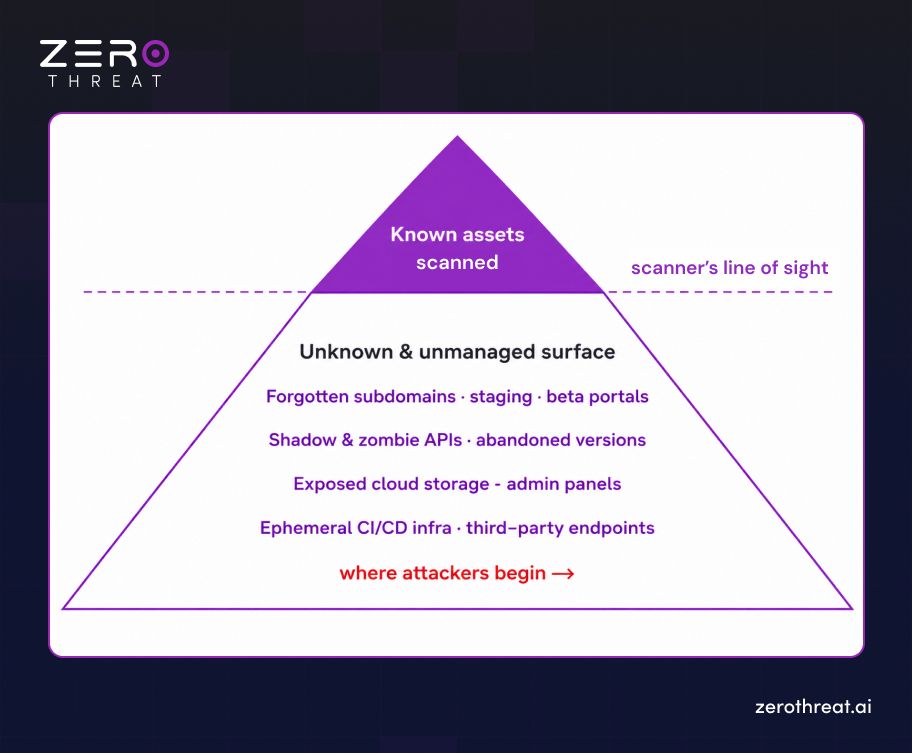
Traditional vulnerability scanners miss large parts of the attack surface because they only test what they're explicitly told to test, they require a target URL, an API specification, credentials, and a manually maintained asset inventory as inputs. Anything outside that list is, by design, never scanned. The scanner isn't wrong; it's just blind to everything you didn't already know about.
That input dependency creates predictable gaps. Unknown assets are never enumerated. APIs without a supplied OpenAPI spec go untested. Shadow applications and dynamically provisioned infrastructure never enter scope. And because the inventory is a static document while the surface changes by 20% a month, coverage drifts further from reality with every deployment. The result is a report that looks clean because it only ever examined the part of the surface you could already see.
| Dimension | Traditional Scanner Coverage | Actual External Exposure |
|---|---|---|
| Scope definition | Manually supplied targets & specs | Everything reachable from the internet |
| Unknown / shadow assets | Not tested (invisible to the tool) | Actively enumerated by attackers |
| APIs without a spec | Skipped or shallowly crawled | 30–40% undocumented, fully callable |
| Rate of change | Static inventory, periodic scans | 300+ new services/month, ~20% turnover |
| Discovery model | You tell it what exists | It has to find what exists |
This is the structural reason coverage which is the first thing to fix. AI-powered automated pentesting tools can validate findings perfectly and still leave you exposed if the surface it examined was incomplete. Effective automated penetration testing has to begin by discovering the full surface, not by asking you to describe it.
What Is Complete External Attack Surface Coverage?
Complete external attack surface coverage means continuously discovering, fingerprinting, and testing every internet-facing asset an organization exposes, with no dependency on a pre-supplied inventory. It is the difference between testing what you declared and testing what actually exists.
Concretely, complete coverage spans several layers that most tools treat separately or skip entirely:
- Domain & Subdomain Discovery: Enumerating the full DNS footprint, including subdomains surfaced through certificate transparency and passive DNS.
- Open ports & Internet-facing Services: Identifying exposed services, remote-access gateways, and management interfaces, which make up a large share of real-world exposures.
- SSL/TLS & Mail Infrastructure: Inspecting certificate posture, cipher configuration, and mail/DNS records that reveal both weaknesses and additional assets.
- Web Applications: Crawling authenticated and unauthenticated flows across modern JavaScript-heavy SPAs, not just static pages.
- API Endpoint Discovery: Surfacing REST and GraphQL endpoints, including shadow and undocumented APIs, whether or not a spec exists.
- Public Cloud Resources: Cloud workloads, Kubernetes ingress, CDN endpoints, load balancers, and exposed object storage.
- Third-party & Shadow Exposure: Connected SaaS surfaces, exposed development assets, and infrastructure standing outside central governance.
The key word is continuous. Because the surface changes by roughly a fifth every month, coverage is only meaningful if discovery runs constantly and re-maps the surface as it shifts. A complete map taken once is an incomplete map by next week.
From Asset Discovery to Attack Surface Intelligence
Discovery is necessary but not sufficient. Finding an asset tells you it exists; it doesn't tell you what it is, what it runs, how it authenticates, or what an attacker could do with it. A raw list of hostnames is an inventory. Understanding each asset well enough to attack it intelligently is attack surface intelligence, and that's what turns discovery into risk reduction.
Enrichment is what bridges the gap. For every discovered asset, the goal is to identify its technology stack and framework, programming language, CMS and JavaScript libraries, software versions, authentication mechanisms, exposed endpoints and parameters, cloud provider, and any WAF or CDN in front of it. This profiling is what lets testing become targeted rather than generic: a payload that makes sense for a GraphQL API behind a specific auth scheme is very different from one aimed at a legacy PHP application.
Context also drives prioritization. Two identical vulnerabilities on two different assets carry very different real-world risk depending on what the asset touches, what data it holds, and how it connects to the rest of the environment. Without profiling, everything looks like a flat list of findings. With it, you can reason about which exposures actually matter, the foundation for web application security testing that reflects business impact rather than raw severity counts.
How Complete Coverage Enables AI Pentesting & Attack Chains
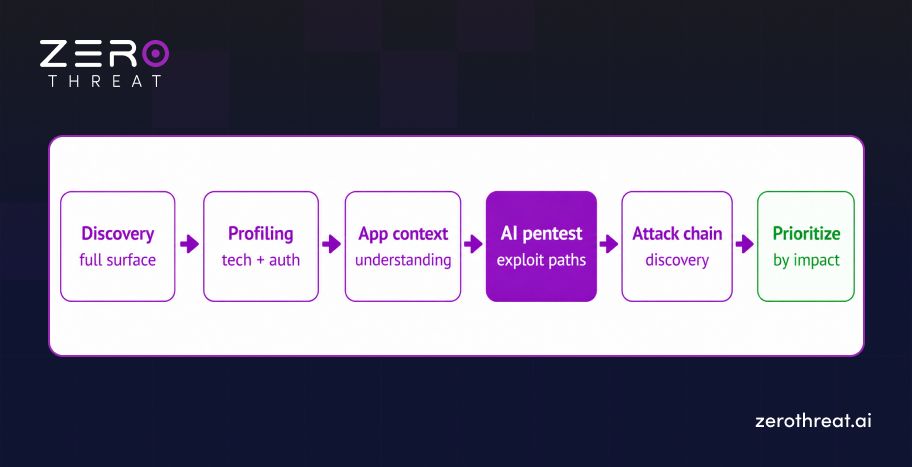
Complete coverage enables AI pentesting because an AI pentester can only test what it can reach, comprehensive discovery gives the engine the full application context it needs to crawl, understand, and attack every exposed asset, rather than a narrow slice of declared targets.
Without discovery, application-aware AI pentesting has nothing to reason about. With it, the engine can crawl applications, discover APIs, extract routes from JavaScript, map authentication flows, explore hidden endpoints, test business logic, and chain vulnerabilities across assets.
The relationship is a pipeline, and each stage depends on the completeness of the one before it:
Why complete coverage transforms attack chain discovery
Attackers rarely rely on a single critical vulnerability. They chain several lower-severity issues across different assets into one high-impact path. This is exactly where incomplete coverage does the most damage: miss one asset in the chain, and the entire path becomes invisible, even if you found every other link. Consider a realistic chain:
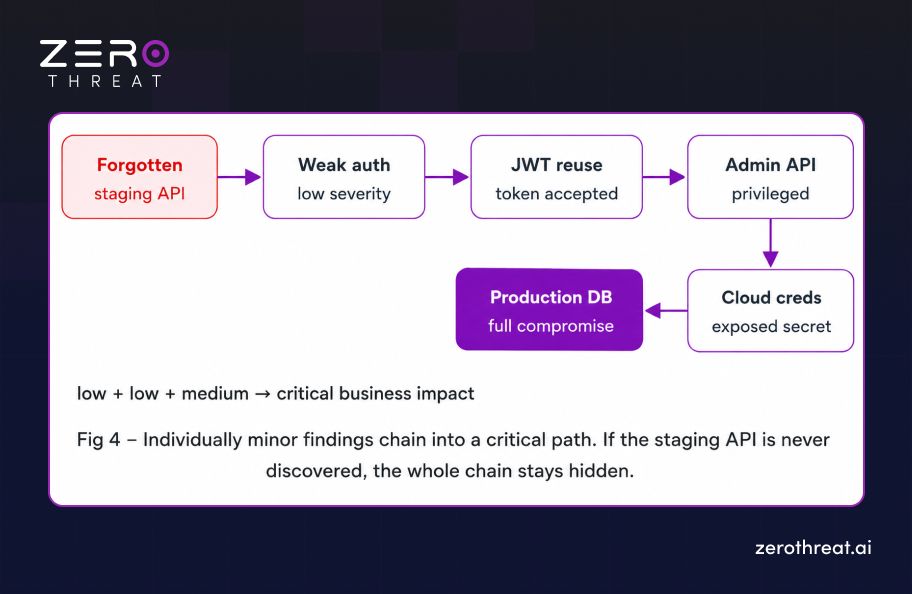
Any single scanner might have flagged the weak authentication as low severity and the exposed secret as medium, and moved on. It takes an engine that sees the whole surface and reasons about how assets connect to recognize that these combine into a path to the production database. That's the argument for complete coverage in one picture: it isn't about finding more issues, it's about seeing the paths that matter.
The cost of missing one exposed asset is often greater than continuously monitoring them all. Explore Pricing
The Business Risks of Incomplete Coverage
Blind spots don't stay technical, but they become business events. The assets that fall outside coverage are disproportionately the ones that turn into breaches, because they combine real exposure with zero monitoring. As per report, exploitation of edge devices and VPNs grew almost eight-fold to 22% of exploitation-based breaches, and for critical edge vulnerabilities the median time from disclosure to mass exploitation was effectively zero days. When the window to react is zero, only assets you already knew about and were already watching stand a chance.
Incomplete external coverage translates directly into elevated risk of:
- Data breaches through forgotten or unmonitored assets holding real data
- Shadow API abuse, with 43% of 2025 additions to CISA's Known Exploited Vulnerabilities catalog being API-related, and most exploitable in a single request
- Supply-chain and third-party exposure, which the DBIR found doubled to 30% of breaches
- Ransomware entry points via exposed remote-access services
- Credential theft and cloud compromise when exposed secrets bridge into privileged infrastructure
- Compliance failures where untested assets undermine OWASP, PCI DSS, HIPAA, GDPR, or ISO 27001 obligations
Best Practices for Complete Coverage
Achieving and maintaining complete external attack surface coverage is an operational discipline, not a one-time project. The practices that hold up against a surface changing by 20% a month are the ones that run continuously and combine breadth of discovery with depth of testing:
- Continuous Discovery: Treat asset discovery as an always-on process, not a scheduled scan, so new and ephemeral assets are caught as they appear.
- Passive + Active Reconnaissance: Combine certificate transparency, passive DNS, and search-engine data with active enumeration to see what attackers see.
- Certificate & DNS Monitoring: Watch CT logs and DNS changes to catch new subdomains and services the moment they go live.
- Cloud Asset Inventory: Reconcile discovered internet-facing assets against cloud accounts to surface unmanaged and misconfigured resources.
- API Discovery & JavaScript Route Extraction: Find shadow and undocumented endpoints by discovering APIs directly and extracting routes from client-side code, without depending on a supplied spec.
- Application-aware Crawling: Navigate modern SPAs and authenticated flows to reach the surface behind login walls and multi-step journeys.
- Continuous Pentesting: Re-test the surface as it changes, so coverage and validation stay in sync with reality.
The through-line is that discovery and testing must be a single continuous loop. Discovery without testing produces an inventory no one acts on; testing without discovery produces confident results about an incomplete picture. Complete coverage lives where the two operate together, continuously.
How ZeroThreat Delivers Complete External Attack Surface Coverage
ZeroThreat approaches external attack surface coverage as the foundation of application-aware AI pentesting rather than a bolt-on inventory feature. The engine is built to map the full funnel and then test everything it finds the way a real attacker would, closing the gap between what you've declared and what you actually expose.
- Full-funnel external surface coverage: From ports, SSL/TLS, DNS, and mail infrastructure up through web applications, APIs, authentication, and business workflows, mapped as one continuous surface rather than disconnected scans.
- Automatic asset & API discovery: Surfacing domains, subdomains, services, and REST/GraphQL endpoints, including shadow and undocumented APIs, with no requirement to supply an inventory or spec.
- Application-aware crawling: Navigating modern JavaScript SPAs and extracting routes from client-side code to reach endpoints static crawlers miss.
- Real-user workflow testing: Exercising complex, multi-step user journeys the way an actual user would, without hand-written test scripts, so authenticated and workflow-gated surface gets tested too.
- Application-aware attack chain discovery: Reasoning across assets to connect individually minor findings into the critical paths that create real business impact.
- Business-aware prioritization: Ranking validated findings by business impact, so teams fix the paths that matter first, with compliance mapping across OWASP, PCI DSS, HIPAA, GDPR, and ISO 27001.
- Continuous coverage: Re-mapping and re-testing the surface as it changes, keeping discovery and validation in lockstep with a moving target.
Complete coverage is also what makes the rest of the platform credible: reliable vulnerability scanning and API security testing only mean something once the surface being examined is actually complete. Discovery isn't a preliminary step you can skip — it's the thing everything else depends on.
Your next critical vulnerability may exist on an application you don't even know is exposed. See how ZeroThreat finds it. See ZeroThreat Live
Conclusion
Modern attacks begin with reconnaissance, not exploitation. Adversaries map an organization's entire internet-facing footprint, then target the weakest asset they can find, which often one the security team never knew was exposed. Organizations that only scan the assets they already know about are, by definition, operating with incomplete visibility against attackers who are working on the whole surface.
Complete external attack surface coverage changes the starting position. It enables deeper vulnerability discovery, more accurate AI pentesting, and the attack chain identification that flat vulnerability lists miss entirely. It reduces blind spots and turns security testing from a snapshot of the known into continuous validation of the real. The strongest security programs of AI pentesting all share the same first principle: they begin by knowing everything they expose to the internet, and they never assume that picture holds still.
Frequently Asked Questions
How do organizations know if they have complete external attack surface coverage?
No organization can assume its external attack surface is complete based on a manually maintained asset inventory. Continuous discovery using DNS enumeration, certificate transparency logs, cloud asset identification, API discovery, and application crawling is required to uncover newly exposed assets, forgotten environments, and shadow infrastructure. Regular validation ensures security teams maintain an accurate view of internet-facing assets.
What is the difference between asset inventory and external attack surface coverage?
Can complete attack surface coverage eliminate all security risks?
Does attack surface coverage include APIs that are not documented?
How does ZeroThreat discover internet-facing assets without relying solely on manual input?
Does ZeroThreat stop at asset discovery?


Explore ZeroThreat
Automate security testing, save time, and avoid the pitfalls of manual work with ZeroThreat.