 ZeroThreat Wins Bronze Stevie® Award in Tech Startup of the Year Read more

All Blogs
Quick Overview: This blog covers how AI driven pentesting discovers attack paths rather than just listing vulnerabilities. You will see what an attack path is, how AI handles the reasoning heavy stages of a pentest, how minor findings chain into critical breaches, and how ZeroThreat reaches the authenticated, authorization driven paths legacy scanners miss.
Attackers do not think of lists. They think of routes. A real adversary does not care that you have four hundred open findings; they care about the one sequence of steps that carries them from a public endpoint to your customer data. For most of the history of automated security testing, our tools have worked the opposite way, returning long inventories of isolated weaknesses while leaving the most important question unanswered: which of these can >actually be connected into a breach?
That gap has become impossible to ignore. Applications now expose most of their logic through JavaScript front ends and APIs, where the highest impact flaws are not malformed payloads but valid-looking requests sent by the wrong user. Authorization mistakes, business logic abuse, and multi-step chains live in exactly the blind spots that signature-based scanners were never built to see. Meanwhile, vulnerability exploitation has climbed to rival stolen credentials as the leading way attackers get in, and the window between a flaw becoming public and being mass exploited has collapsed toward zero. A flat vulnerability list simply cannot keep pace with that reality.
This is the problem attack path analysis solves, and it is the problem generative AI finally made solvable at scale. Instead of matching patterns, AI pentesting tool reasons for your application the way an attacker would: it maps the surface, hypothesizes the likely routes, plans the exploits, and validates which paths truly work before reporting them. The rest of this blog breaks down how that process happens stage by stage, walks through a worked attack chain, examines the authorization flaws scanners walk past, and shows how ZeroThreat puts depth of reach and exploit proof at the center of its AI Pentesting.
Don't wait for an incident to reveal hidden security gaps. Start validating real-world risks today. Test My Application
ON THIS PAGE
- Why Attack Paths Matter More Than Vulnerability Lists
- What Is an Attack Path?
- From Findings to Paths: Where Traditional Scanning Stops
- How AI Discovers Attack Paths, Stage by Stage
- Attack Chains: How Low Severity Findings Become Critical
- Authorization Logic: The Paths Scanners Walk Past
- How Zerothreat Discovers Attack Paths
- What This Means for Security Teams
- Conclusion
Why Attack Paths Matter More Than Vulnerability Lists
A scanner that returns four hundred findings has told you almost nothing about your real risk. It has told you what is technically wrong, not what an attacker can actually do with it. The gap between those two questions is exactly where breaches live.
The threat data makes the stakes concrete. The exploitation of vulnerabilities grew again as an initial access vector for breaches, reaching 20%, a 34% increase over the prior year and approaching credential abuse as the most common entry point. By the following year, Verizon reported that software vulnerabilities had overtaken stolen passwords as the most common way attackers first get in. Attackers are not waiting either. For critical flaws in internet facing edge devices, the median time between public disclosure and mass exploitation was effectively zero days, which breaks the traditional patch-when-you-can model.
When something does go wrong, the cost lands hard. The global average cost of a data breach was 4.44 million dollars in 2025, while the United States average rose to a record 10.22 million dollars, and organizations took a mean of 241 days to identify and contain a breach. A vulnerability list does not shorten that timeline. Knowing which specific path leads to your customer data does.
Attack path analysis is what turns raw findings into that knowledge. As the offensive security community frames it, attack path analysis produces a road map an attacker could take through a system to reach sensitive data or access, and exploitation planning determines the tools and techniques needed to simulate an attack along that road map.
What Is an Attack Path?
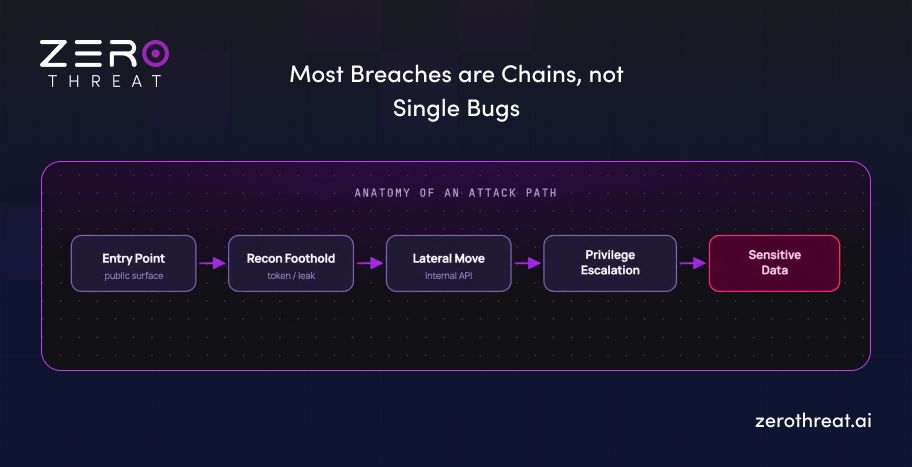
An attack path is the specific sequence of steps an adversary takes to move from an entry point to a goal, usually sensitive data, privileged access, or control of a critical workflow. It clarifies how attackers enter a system, move laterally, escalate privileges, and reach sensitive data, building on the discovery and reconnaissance phase that comes before it.
The important word is sequence. A single misconfiguration is rarely a breach on its own. A breach is usually a chain: an exposed endpoint reveals a token, the token unlocks an internal API, the API leaks an object identifier, and that identifier exposes another user's records. Each link might look minor in isolation. Connected, they form a path that ends in real impact.
A useful path also carries context the scanner cannot infer. Which assets are business critical? Which routes are reachable only after authentication? Which workflow, if abused, costs money rather than just leaking a stack trace? Attack path analysis answers those questions by connecting technical findings to how the application actually works.
From Findings to Paths: Where Traditional Scanning Stops
Legacy dynamic application security testing (DAST) and classic scanners are good at one job: matching patterns. They fire payloads, watch for signatures, and report what looks suspicious. That model has three structural limits when it comes to attack paths.
First, it produces volume without verdict. A pattern match flags a possible issue, but it does not prove the issue is reachable or exploitable in your context, which is how teams end up triaging hundreds of low confidence alerts.
Second, it tests in isolation. Each request is evaluated on its own. The scanner has no concept of obtaining a session here, then reusing it three steps later against a different endpoint, which is precisely how chained attacks work.
Third, and most damaging for modern apps, it misses authorization logic entirely. Consider Broken Object Level Authorization (BOLA), the flaw that has held the number one spot in the OWASP API Security Top 10 since 2019 and is present in roughly 40% of API attacks. The reason scanners miss it is structural: a BOLA request often looks identical to a legitimate one, with only a changed ID, so signature-based tools and API gateways see nothing out of the ordinary until the data has already left. Catching it requires understanding that the user in the session token and the object being requested should belong together, which is reasoning, not pattern matching.
This is the line that generative AI changed. Before it, fully automating pentesting was largely impossible, because the steps requiring logic and creativity, such as identifying viable attack paths and planning exploitation, could not be handled by rule-based code.
How AI Discovers Attack Paths, Stage by Stage
The shift is not that AI fires more payloads. It is that AI can perform the reasoning heavy stages of a pentest at machine speed. Rather than simply generating a list of vulnerabilities, AI driven pentesting thinks like an attacker, gathers data points to assemble an exploit path, and then validates whether it works, delivering truly exploitable findings instead of hypothetical ones. Here is what that looks like in practice.
1) Reconnaissance and Surface Discovery
You cannot map a path through a surface you have not seen. Modern applications hide most of their surface behind JavaScript. Routes, parameters, and API calls are generated at runtime inside single page applications, so a crawler that only reads server rendered HTML sees a fraction of the real attack surface.
AI-driven API discovery goes deeper. It parses JavaScript bundles to extract client-side routes, follows authenticated flows that only appear after login, and inventories the API endpoints those flows call. This matters because a platform that discovers API routes during crawling can then test them for injection, broken authentication, excessive data exposure, and business logic flaws across REST, SOAP, GraphQL, and gRPC. The endpoints you never knew existed are the ones attackers find first.
2) Mapping and Correlation
Once the surface is known, the raw data has to become a map. In this step, the data unearthed in discovery is aggregated and correlated to reveal connections between users, controls, systems, and vulnerabilities. Think of it as building a graph: nodes are endpoints, identities, tokens, and data stores; edges are the relationships and trust boundaries between them. AI is well suited here because it can hold and cross reference a large number of these relationships at once, far faster than a human working through them by hand.
Give your security team the context they need to prioritize what truly matters. Experience Smarter Testing
3) Hypothesis Generation
With a map in place, the engine reasons about likely routes. The mapping exercise leads to hypotheses about the most likely attacker paths through an environment, connecting the dots among vulnerabilities, misconfigurations, privilege escalation, and lateral movement. This is the creative core of pentesting, the part that used to require an experienced human asking what they would try next as the attacker. AI generates and tests many such hypotheses in parallel.
4) Ranking and Prioritization
Not every possible path deserves equal attention. The next step is to prioritize paths for testing, weighing which are most likely, which give an attacker the best return, which evade detection, and which can be tested with the least disruption. Done well; this is where business context enters. A path to a public marketing asset and a path to your billing system are not the same priority, even if the underlying technical flaw is identical.
5) Exploitation Planning
Now the engine decides how it will actually test the ranked paths. Exploitation planning covers payload creation, tool selection, evasion technique decisions, and how to minimize disruption. AI accelerates this by generating custom payloads tailored to each path and by mapping findings to established attack playbooks such as the MITRE ATT&CK framework. Tying activity to a shared taxonomy like MITRE ATT&CK is what makes results legible to a defending team rather than a pile of one-off scripts.
6) Validation
This is the stage that separates credible AI pentesting from noisy automation. After planning, the engine attempts the exploit in a controlled way and confirms whether it actually works. A validated finding comes with proof: the request that worked, the data or access it returned, and the steps to reproduce it. Everything that fails to validation gets filtered out, which is how false positives are driven down toward zero.
Attack Chains: How Low Severity Findings Become Critical
The single most important thing about attack path analysis surfaces is the chain, where individually minor issues combine into a serious breach. APIs make this worse because their flaws are, in the words of one practitioner's community, harder to detect, easier to chain, and increasingly targeted.
Consider a realistic, composite example.
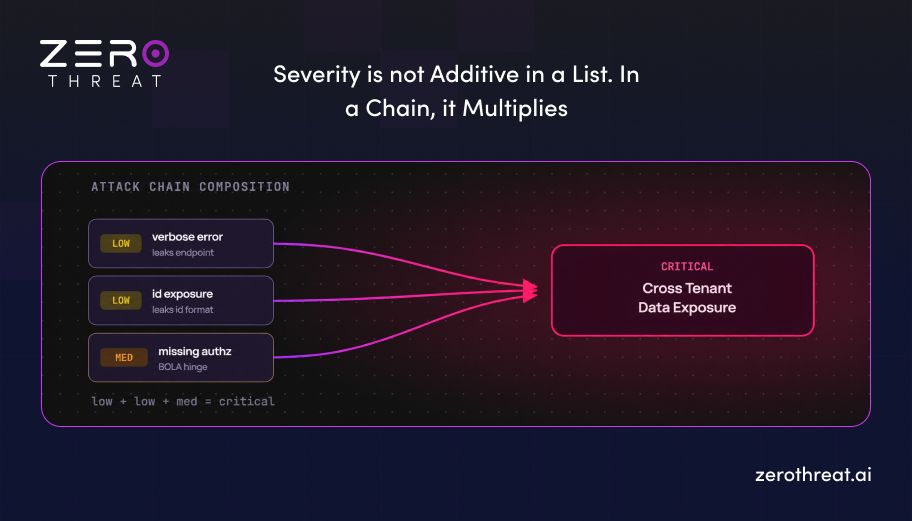
- A verbose error message (low). An unauthenticated endpoint returns a stack trace that leaks an internal API host and a parameter naming convention. On its own, an informational finding most teams would defer.
- An exposed object identifier (low to medium). One of those internal endpoints returns more fields than the UI uses, including the numeric account identifier of the requesting user. By itself, excessive data exposure.
- A missing authorization check (the hinge). That same endpoint accepts an account identifier as a parameter and does not verify ownership. This is BOLA, and the attacker only learned the parameter existed because of the first two findings.
Chained, an attacker reads the error to learn the endpoint, observes the response to learn the identifier format, then increments the identifier to pull other tenants' records. Three findings that a flat scanner would rank low, low, and medium add up to cross tenant data exposure, a critical breach. The danger compounds because a BOLA flaw can escalate into full account takeover, for example by compromising a password reset flow.
A vulnerability list shows these as three unrelated rows. Attack path analysis shows them as one exploitable route, which is the difference between a finding you defer and one you fix tonight.
Authorization Logic: The Paths Scanners Walk Past
\Authorization is where most of the real, modern attack paths hide, and it deserves its own section because it is the clearest example of reasoning beating pattern matching.
The defining property of a broken authorization request is that it is a valid request. Many API vulnerabilities involve perfectly valid requests that return correct HTTP 200 responses, which traditional web scanners simply do not detect. There is no malicious payload to signature. The attack is semantic: the right format, the wrong owner.
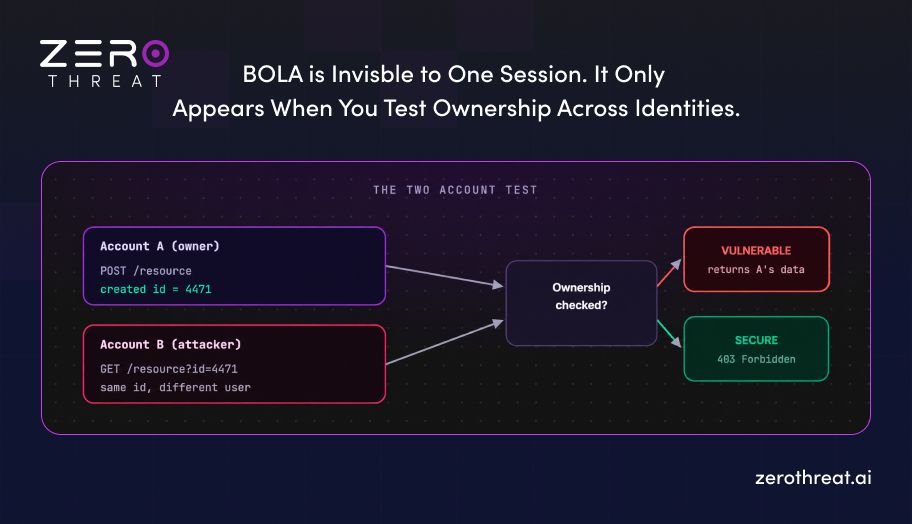
Detecting it requires multi-session, multi-role testing. The canonical method is the two account test: create a resource with Account A and record its identifier, then attempt to access that same identifier while authenticated as Account B; if Account A's data comes back, the endpoint is vulnerable.
Doing this well means an engine that can hold several authenticated identities at once, understand which objects belong to which identity, and reason about whether a given access should be allowed. That is exactly the kind of stateful reasoning that single session scanners and WAFs and API gateways cannot perform, because they do not understand API context or baseline normal usage.
The same logic extends across the authorization family: Broken Function Level Authorization (a standard user invoking an admin only function), Broken Object Property Level Authorization (reading or writing fields you should not), and abuse of sensitive business flows. None of these are caught by throwing payloads at a URL. All of them are caught by an engine that understands roles, ownership, and intended behavior.
Don't let budget decisions become security decisions. Find the plan that fits today. Find Your Plan
How ZeroThreat Discovers Attack Paths
ZeroThreat's AI pentesting tool is built around a simple principle: depth of reach decides what gets tested, and what gets tested decides what you find. The platform is engineered to reach the parts of modern apps and APIs where real attack paths live, and to prove each path before it reports it.
It sees more of the surface. A dedicated JavaScript route extractor parses client-side bundles to surface routes and parameters that server-side crawlers never render, so single-page applications and modern front ends are mapped rather than skimmed. For discovery scale, ZeroThreat has mapped over 2,000 URLs in roughly fifteen minutes, giving the path analysis a complete surface to reason over instead of a partial one.
It reaches authenticated and complex flows. Most high value paths sit behind login and inside multi step workflows. ZeroThreat tests authenticated journeys and complex UI flows, and it generates the browser automation needed to drive those flows automatically, so your team does not hand write and maintain Playwright specs for every journey. That saves both engineering time and scan budget while extending coverage into the areas attackers actually target.
It tests the logic, not just the payload. ZeroThreat performs authorization testing across object and function level access (the IDOR, BOLA, and BFLA family), the exact flaws that signature-based tools walk past. This is where chained, multi-step attack paths are uncovered, by reasoning about identity and ownership rather than matching strings.
It validates before it reports. Findings are confirmed with exploit proof and reproduction steps, which is how ZeroThreat reports 99.9% detection accuracy with near zero false positives across more than 130,000 vulnerability checks. Validation is the difference between a path you can act on and a maybe you have to investigate.
It prioritizes by business impact. Business-aware risk prioritization and risk-based reporting rank paths by what they actually threaten, not by raw CVSS alone, so the route to your billing system outranks a cosmetic issue even when the underlying weakness type is similar. The net effect for teams is roughly 90% less manual pentest effort and findings delivered around 10 times faster than traditional manual testing.
What This Means for Security Teams
A few practical takeaways follow all of this. Treat findings as inputs to paths, not as the deliverable; the question that matters is what an attacker can reach, not how many rows your scanner produced. Insist on validation, because a validated, reproducible path is worth more than a hundred unconfirmed alerts. Test authorization explicitly with multi role, multi session coverage, since that is where the highest impact and hardest to detect paths live. And keep humans in the loop for judgment: AI handles the relentless execution, while people focus on interpretation, prioritization, and the edge cases automation cannot resolve.
It is also worth being clear eyed about scope. AI pentesting augments and accelerates human testing; it does not retire from the discipline. The value is reaching more of the surface, reasoning about more paths, and proving more findings than a manual team could in the same window, so the experts spend their time on the problems that genuinely need them.
Your next release deserves more than another scan. See what intelligent security looks like See ZeroThreat Live
Conclusion
The industry is moving away from the era of the vulnerability list and toward the era of the attack path, because that is how breaches actually unfold. With vulnerability exploitation now rivaling stolen credentials as the top way in, breach costs at record highs, and authorization flaws sitting unseen behind valid looking requests, a flat list of findings is no longer a meaningful picture of risk.
AI changes the picture by performing the reasoning heavy work of a pentest at scale: it discovers the hidden surface, maps the relationships, hypothesizes the routes an attacker would take, ranks them by real impact, plans the exploits, and validates which ones truly work.
ZeroThreat applies that approach with a focus on depth of reach and proof, surfacing the authenticated, multi-step, authorization -riven paths that legacy scanners miss and confirming each one before it reaches your team. The result is fewer false alarms, faster answers, and a clear view of the paths that actually put your business at risk.
Frequently Asked Questions
Can AI discover attack paths in authenticated areas of an application?
Yes. Advanced AI pentesting platforms can test authenticated user sessions, role-based access controls, and multi-user workflows to identify risks that are invisible during unauthenticated scans. This helps uncover vulnerabilities within internal dashboards, customer portals, and administrative interfaces.
Does AI attack path discovery work for APIs as well as web applications?
How often should organizations perform AI-powered attack path discovery?
Does discovering an attack path mean an application has already been compromised?
How does AI reduce false positives during security testing?
Is AI-powered attack path discovery suitable for DevSecOps pipelines?
What should organizations look for in an AI attack path discovery platform?

Explore ZeroThreat
Automate security testing, save time, and avoid the pitfalls of manual work with ZeroThreat.