 ZeroThreat Wins Bronze Stevie® Award in Tech Startup of the Year Read more

All Blogs
Automated Pentesting vs Manual Penetration Testing: Which One is Better?
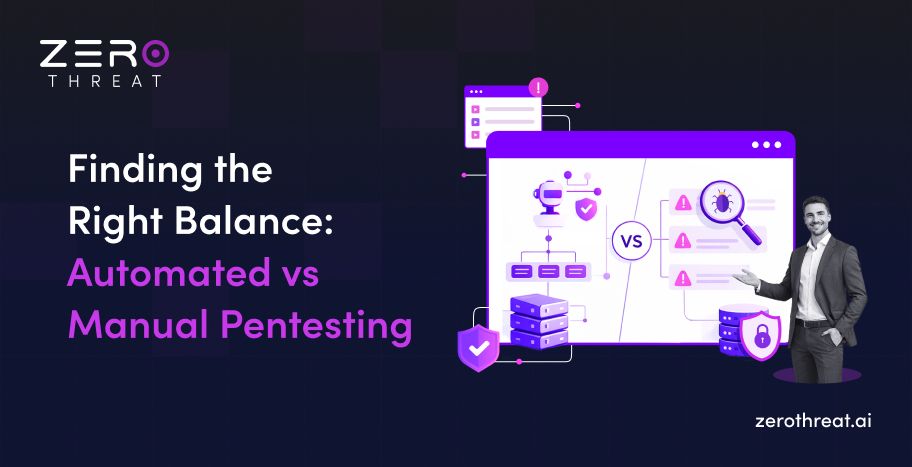
Quick Overview: Choosing between automated and manual pentesting is not always straightforward, especially as security requirements continue to evolve. This blog explains the key differences between automated and manual penetration testing, when to use each, how often to run them, and why a hybrid approach delivers the strongest security posture for modern teams.
When it comes to penetration testing, the real question is not whether you should test your applications. It is how you should test them.
For years, manual penetration testing has been considered the gold standard for uncovering security weaknesses. More recently, automated pentesting has gained momentum as organizations look for faster, more scalable ways to identify vulnerabilities across applications and APIs. Both approaches have clear advantages, but they solve different problems.
An automated pentesting tool help security teams continuously discover vulnerabilities, misconfigurations, and exposed attack paths. Manual pentesting goes further by validating exploitability, uncovering business logic flaws, and identifying complex attack scenarios that require human reasoning.
The difference matters because attackers do not follow predefined rules. They combine vulnerabilities, abuse business logic, and look for weaknesses that automated tools may not understand.
So, should you choose automated or manual penetration testing? The answer is not one or the other.
In this guide, we'll break down the clear difference between manual and automated penetration testing and when to use both approaches, so you can build a security testing strategy that matches your organization's risk, scale, and security goals.
Tired of testing your application manually? ZeroThreat’s automated pentest tool has got you covered. Begin Free Trial
ON THIS PAGE
- Automated Pentesting vs Manual Pentesting: Quick Comparison
- What is Automated Penetration Testing?
- What is Manual Pentesting?
- Automated Pentesting vs Manual Pentesting: Detailed Comparison
- When Should You Use Automated Pentesting?
- When Should You Use Manual Pentesting?
- Can Automated Pentesting Replace Manual Pentesting?
- Combining Manual and Automated Pentesting: Hybrid Security Testing Strategy
- How Often Should You Run Automated and Manual Pentests?
- Final Verdict: Automated vs Manual Pentesting
Automated Pentesting vs Manual Pentesting: Quick Comparison
| Criteria | Automated Pentesting | Manual Pentesting |
|---|---|---|
| Testing Approach | Tool-driven and automated | Human-led and expert-driven |
| Speed | Fast execution | Slower but more thorough |
| Testing Frequency | Continuous or on-demand | Periodic assessments |
| Scalability | High, suitable for large environments | Limited by available resources |
| Vulnerability Coverage | Excellent for known vulnerabilities | Effective for known and unknown vulnerabilities |
| Business Logic Testing | Limited capability | Strong capability |
| API Security Testing | Good for broad coverage | Better for complex API abuse cases |
| Attack Chain Validation | Limited | Strong |
| False Positives | May require validation | Lower due to human analysis |
| Context Awareness | Limited understanding of application behavior | Deep understanding of application context |
| CI/CD Integration | Easily integrated into pipelines | Not suitable for continuous deployment workflows |
| Compliance Support | Supports continuous monitoring | Often required for formal security assessments |
| Cost Per Assessment | Generally lower | Generally higher |
| Time to Results | Minutes to hours | Days to weeks |
| Best Use Case | Continuous security testing and attack surface monitoring | Deep security assessments and high-risk applications |
| Primary Strength | Speed, scale, and automation | Depth, creativity, and human expertise |
| Primary Limitation | May miss complex logic flaws | Less scalable and more resource-intensive |
| Recommended Usage | Ongoing security validation | Periodic in-depth security reviews |
What is Automated Penetration Testing?
Automated penetration testing is a security testing approach that uses software-driven tools to identify and validate exploitable vulnerabilities across applications, APIs, cloud environments, and network infrastructure. Instead of relying entirely on manual effort, automated pentesting continuously simulates attacker behavior to uncover security weaknesses before they can be exploited.
Modern security teams use automated penetration testing to improve testing frequency and maintain visibility across rapidly changing environments. It is particularly effective for web application penetration testing, API security testing, and continuous security testing within CI/CD pipelines. Automated assessments can run on a scheduled basis or whenever new code and infrastructure changes are introduced.
Unlike traditional point-in-time assessments, automated pentesting tools provide ongoing security validation and faster feedback. It helps organizations detect known vulnerabilities, security misconfigurations, weak authentication controls, and other common attack paths at scale.
What is Manual Pentesting?
Manual penetration testing is a human-led security assessment where experienced ethical hackers actively examine applications, APIs, and systems for vulnerabilities. Unlike automated penetration testing, manual testing relies on human expertise to identify complex attack paths, security flaws, and weaknesses that tools often overlook.
During a manual pentest, security professionals simulate real-world attacker behavior to evaluate authentication controls, authorization mechanisms, business logic, and application workflows. This approach helps uncover vulnerabilities that require contextual understanding, creative thinking, and deeper analysis beyond predefined scanning techniques.
Manual penetration testing is particularly valuable for identifying business logic vulnerabilities, chained exploits, and high-impact security risks. While it requires more time and expertise, it provides deeper insight into an application's security posture and remains an essential part of a comprehensive offensive security testing strategy.
Continuous threats need continuous testing.
Pentest your app in minutes with ZeroThreat. Run Automated Pentest Now!
Automated Pentesting vs Manual Pentesting: Detailed Comparison
The choice between these two methodologies depends on your specific security goals and the assets you need to protect. This detailed comparison breaks down the seven most critical factors that differentiate automated speed from human-led depth.
1. Speed and Testing Frequency
Automated penetration testing can assess applications, APIs, and infrastructure within minutes or hours. Because testing is software-driven, organizations can run assessments continuously, after deployments, or whenever code changes occur. This makes it ideal for continuous security testing and fast-moving development environments.
Manual penetration testing requires planning, execution, validation, and reporting by security professionals. Assessments often take days or weeks depending on scope. While slower, manual testing provides deeper analysis that cannot be achieved through frequent automated scans alone.
2. Vulnerability Detection Capabilities
Automated tools are highly effective at identifying known vulnerabilities, security misconfigurations, exposed services, weak configurations, and CVEs. They provide broad coverage across large environments but primarily rely on predefined testing logic and vulnerability databases.
Manual testing allows ethical hackers to investigate vulnerabilities beyond predefined checks. Security professionals can discover complex flaws, chained attack paths, and application-specific weaknesses that require reasoning, adaptability, and deeper analysis.
3. Accuracy and False Positives
Automated security testing tools often flood teams with theoretical issues and high false-positive rates, commonly in the 20 to 30 percent range. Every flagged issue still requires human validation before remediation begins, which adds time and effort.
Every finding in a manual test report has been validated by a human tester who confirms the vulnerability is truly exploitable, which eliminates alert fatigue and wasted developer hours caused by false positives.
4. Cost and Resource Requirements
Automated pentesting carries a lower per-engagement cost. It scales across large environments without increasing spend proportionally. For teams running continuous security testing, it is significantly more cost-effective than scheduling frequent manual assessments.
With a manual testing approach, the standard web application pentest costs between $3,000 and $50,000. Complex environments can easily exceed $100,000, and retest after fixing costs extra. The investment is justified for high-risk, high-stakes environments.
5. Scalability and Coverage
Automated tools scale effortlessly. They can test hundreds of endpoints, APIs, and environments simultaneously without additional resources. This makes them well-suited for large attack surfaces and fast-moving DevSecOps teams managing frequent deployments.
Human testers cannot test every major release in a modern DevOps pipeline. Manual testing is limited by tester availability and engagement scope. It works best when applied selectively to the highest-risk areas of your environment.
6. Business Logic and Contextual Understanding
Automated penetration testing tools struggle to understand business processes, user workflows, and application intent. As a result, they often miss business logic vulnerabilities where legitimate functionality can be abused in unintended ways. This is a hard limitation, not a gap that tool updates can fully close.
Manual testing allows ethical hackers to discover complex, unknown, and business logic vulnerabilities that automated tools are completely blind to. A manual tester can find a subtle flaw in application logic or exploit a custom protocol that has no predefined signatures for a scanner to check against.
7. Compliance and Reporting
Automated platforms generate structured, audit-ready reports with each scan cycle. These logs are useful for demonstrating continuous security testing practices under frameworks like SOC 2, PCI DSS, and ISO 27001. They are easy to produce and easy to schedule regularly.
Many organizations want manual testing as part of third-party vendor vetting processes because enterprise clients demand it. In such cases, the manual approach becomes non-negotiable as it provides the detailed, human-verified evidence needed to pass vendor security assessments.
When Should You Use Automated Pentesting?
You should use automated penetration testing if your environment changes frequently and requires continuous security validation. It is most effective for web applications, APIs, or securing DevSecOps workflows where speed, scalability, and ongoing testing are essential to reducing security risk.
| When to Use | Why Automation Helps |
|---|---|
| Frequent application releases | Automated pentesting keeps pace with rapid development cycles and identifies vulnerabilities before they reach production. |
| Continuous security testing | Automated assessments provide ongoing visibility into newly introduced vulnerabilities and attack surface changes. |
| API security testing at scale | Automation helps discover and test API endpoints consistently, even as services evolve and expand. |
| SaaS and cloud-native environments | Dynamic infrastructures require frequent validation that would be difficult to achieve through manual testing alone. |
| Large attack surface management | Automated testing can assess multiple applications, APIs, and assets simultaneously, improving coverage across environments. |
| Production-safe security validation | Modern automated pentesting platforms can safely validate exploitable risks in production environments without disrupting business operations. |
| DevSecOps and security automation | Automation integrates security into development workflows, making testing a continuous part of software delivery. |
| Compliance and security monitoring | Automated assessments help meet requirements under frameworks like GDPR, ISO 27001, and HIPAA by generating regular, auditable scan reports. |
When Should You Use Manual Pentesting?
You should use manual penetration testing when you need a deeper assessment of real-world attack scenarios, complex application behavior, or vulnerabilities that require human judgment. It is especially valuable for uncovering business logic flaws, privilege escalation paths, and high-impact security risks.
| When to Use | Why Manual Testing Helps |
|---|---|
| Business logic vulnerability testing | Security experts can analyze how users interact with workflows and identify flaws that automated tools typically miss. |
| Testing complex applications | Human testers can understand application context, user roles, and custom functionality that require deeper investigation. |
| Authentication and authorization reviews | Manual testing helps uncover privilege escalation issues, broken access controls, and account takeover risks. |
| Advanced API security assessments | Testers can analyze API behavior, chained requests, authorization weaknesses, and logic flaws across endpoints. |
| High-value or critical applications | Applications handling sensitive data often require in-depth validation beyond automated vulnerability detection. |
| Compliance-driven security assessments | Many compliance frameworks and customer security reviews expect expert-led penetration testing as part of risk management. |
| Validating attack chains | Manual pentesters can combine multiple low-risk findings into realistic attack paths that demonstrate actual business impact. |
| Post-remediation verification | Security professionals can confirm whether vulnerabilities have been fully resolved and whether new weaknesses were introduced. |
| Pre-production security reviews | Manual assessments provide additional confidence before major releases, infrastructure changes, or product launches. |
| Red team and adversary simulation exercises | Human testers can think like attackers, adapt tactics, and evaluate how effectively defenses respond to real-world threats. |
Note: Manual pentesting is most valuable when context, creativity, and human decision-making matter. While automated penetration testing provides broad and continuous coverage, manual testing remains essential for uncovering complex vulnerabilities that depend on business processes, application logic, and attacker ingenuity.
Get enterprise-grade automated penetration testing at a price you can’t believe. Check the Pricing List
Can Automated Pentesting Replace Manual Pentesting?
No, automated pentesting cannot fully replace manual pentesting. Automated tools excel at identifying known vulnerabilities, misconfigurations, and common attack paths at scale. However, they cannot reason, adapt, or understand your application's unique context the way a human tester can.
That’s the reason manual penetration testing remains essential for uncovering business logic vulnerabilities, privilege escalation paths, authentication weaknesses, and chained attacks, which require creative thinking. And only experienced ethical hackers can adapt their approach, test unexpected user behavior, and validate the real-world impact of findings. These are areas where automated security testing still faces significant limitations.
In simple terms, think of automation as your first line of defense, not your last. It handles coverage, and manual testing handles depth. Both are necessary for a complete offensive security assessment.
Combining Manual and Automated Pentesting: Hybrid Security Testing Strategy
Most mature security teams do not choose between automated and manual pentesting. They use both of them deliberately, at the right stage of their security program.
Here is how a hybrid approach works in practice:
Run Automated Pentesting Continuously
Integrate it into your CI/CD pipeline to catch known vulnerabilities, misconfigurations, and exposed endpoints on every build. This keeps your attack surface clean between manual assessments.
Use Manual Pentesting Periodically
Schedule it before major releases, after significant infrastructure changes, or when entering new compliance requirements. Focus your human testers on business logic, authentication flows, and chained exploit scenarios.
Let Each Method Cover What the Other Cannot
Automation gives you speed, consistency, and broad coverage. Manual testing gives you depth, context, and adversarial thinking. Together, they close the gap that either approach leaves open on its own.
This hybrid model is especially effective for SaaS companies, fintech platforms, and any product team operating under frameworks like SOC 2, ISO 27001, or PCI DSS.
How Often Should You Run Automated and Manual Pentests?
Testing frequency depends on your release velocity, risk exposure, and security compliance obligations. There is no universal answer, but there are clear patterns that work. Here is what security teams actually follow.
Frequency for Automated Pentesting: Continuous, Daily, or Weekly
- Run on every code deployment inside your CI/CD pipeline
- Schedule full environment scans weekly at minimum
- Trigger targeted scans after infrastructure or configuration changes
Frequency for Manual Pentesting: Quarterly, Biannually, or Annually
- Conduct a full assessment at least once a year
- Test before major product releases or architecture changes
- Retest after significant vulnerability remediation
Recommended Schedules by Risk Level:
- High-Risk (Fintech, Healthcare, SaaS, or highly regulated environments): Combine continuous automated testing with Quarterly manual pentests.
- Medium-Risk (Standard web applications, internal networks): Run automated checks weekly and Annual manual pentests.
- Low-Risk (Static informational sites): Run automated tests monthly and conduct manual pentests every 12 to 18 months.
Manual, automated, or hybrid? Get clarity on what your application actually needs. Contact Us
Final Verdict: Automated vs Manual Pentesting
Automated pentesting handles speed, scale, and continuous coverage. Manual pentesting handles depth, context, and adversarial thinking. Neither approach is complete without the other. The right question was never which one to choose, but how to use both effectively.
For most teams, the answer is a hybrid strategy. Run automated penetration testing continuously inside your pipeline. Bring in manual testers for high-risk assessments, pre-release validation, and anything involving complex business logic or sensitive data flows. That way, you can make sure to have continuous, broad vulnerability coverage while not missing out on complex flaws.
Frequently Asked Questions
Is continuous pentesting better than annual pentests?
Yes, for most organizations. Continuous pentesting helps identify vulnerabilities as applications, APIs, and infrastructure change, while annual pentests provide only a point-in-time assessment. The strongest approach combines continuous testing with periodic manual security reviews.
What are the biggest limitations of manual pentesting?
Is automated pentesting enough for compliance?
What’s the difference between vulnerability scanning and pentesting?
Is automated pentesting safe to run in production?


Explore ZeroThreat
Automate security testing, save time, and avoid the pitfalls of manual work with ZeroThreat.