 ZeroThreat Wins Bronze Stevie® Award in Tech Startup of the Year Read more

All Blogs
AI Pentesting Adoption Challenges: What Actually Blocks Enterprise Rollout
Quick Overview: AI pentesting adoption rarely fails on detection capability. It fails on trust, control, context, governance, integration, and scale. This blog breaks down the six barriers enterprise security teams hit between a successful pilot and a production rollout, the trust model that resolves them, and a practical way to evaluate and phase in a platform.
Applications ship weekly; attack surface grows with every new API, and vulnerability exploitation is now among the most common initial access vectors in breach data. AI penetration testing promises to close that gap by testing continuously instead of annually.
The capability is largely proven. Adoption is not. Most enterprises that run a successful proof of concept do not reach portfolio-wide rollout in the same quarter, and the reasons have little to do with whether the engine found real bugs.
That is because AI pentesting is not a faster scanner. A scanner sends a bounded payload set and reports what came back. An AI-driven pentesting engine decides what to test next based on what the application just did, drives multi-step workflows, and attempts to prove exploitability. That autonomy is the value, and it is the source of nearly every enterprise AI pentesting challenge below.
Finding vulnerabilities turns out to be the part that works. What slows AI pentesting implementation is everything wrapped around the finding: trusting it, controlling how it was produced, giving the engine enough context to be right, governing the data it touched, routing it into systems that already exist, and repeating that across hundreds of applications. And we are going to cover those six adoption barriers in this article.
Run governed AI pentesting with enforced scope, evidence-backed findings, and full execution visibility. Start for Free
On This Page
- Key AI Pentesting Adoption Challenges
- The Trust Model Enterprises Need
- Evaluating and Rolling Out a Platform
- Conclusion
Key AI Pentesting Adoption Challenges
The six barriers below appear in roughly this order during an enterprise evaluation. Teams hit trust first, usually within the first scan report, and hit scale last, usually after the security team has already decided they want the platform.
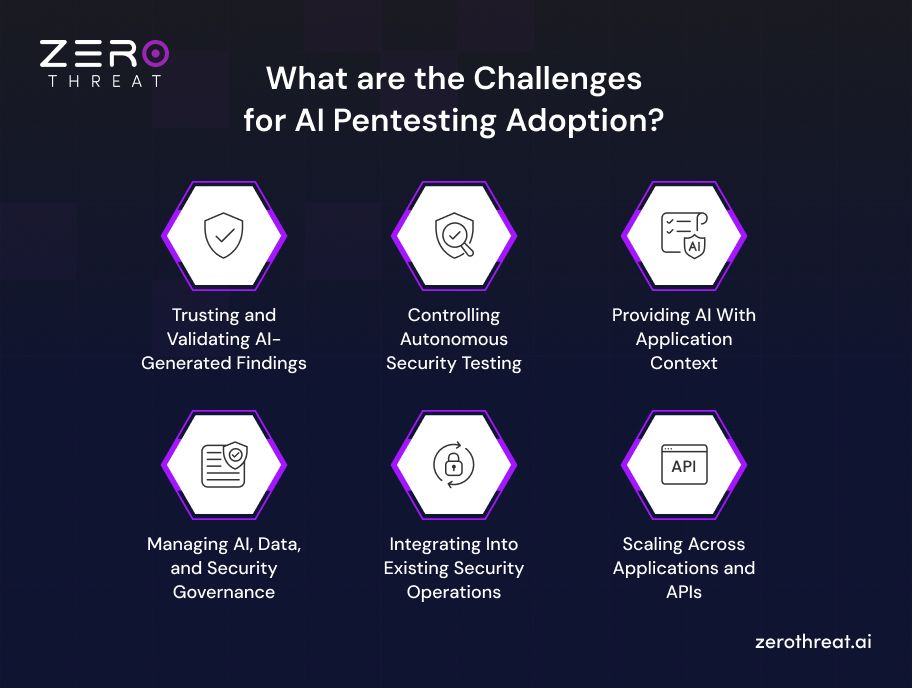
1) Trusting and Validating AI-Generated Findings
The first AI pentesting adoption barrier is trust, because a security team cannot act on a finding it cannot independently reproduce.
The primary difference that matters is between detection and exploit validation. Detection says a parameter looks injectable. Validation shows the exact request sent, the response returned, and the data retrieved. Only the second survives contact with an engineering team being asked to stop feature work and ship a fix.
AI-driven testing also introduces a failure mode that legacy scanners did not have. A signature-based scanner can flag issues that are clearly false positive when reviewed. A reasoning system can produce a finding that is fluent, plausible, internally consistent, and entirely fabricated. A confidence score does not resolve that. Evidence does.
The triage math turns it into an adoption blocker. If a run returns 300 findings, an engineer spends 15 to 20 minutes verifying each, and 15% are wrong, the team has absorbed roughly a working week per run just to establish what is real. Two or three rounds of that and the platform is quietly abandoned regardless of what it found.
What resolves it: every finding ships with raw request and response evidence, reproducible steps, and a one-click retest. Reporting also has to serve two audiences at once. Security teams need the attack path, business impact, and priority. Application teams need the endpoint, parameter, payload, evidence, and framework-specific fix.
2) Controlling Autonomous Security Testing
Autonomous testing becomes an adoption risk the moment an agent can take action nobody explicitly authorized.
This is the barrier that stops production rollout even when the security team is enthusiastic. A scanner's blast radius is knowable in advance because its payload set is fixed. An agent chooses its next action at runtime, which means the rules of engagement have to be enforced by the platform rather than assumed.
The controls enterprises ask for are specific:
- Scope definition that is enforced, not advisory: allowed domains, IP ranges, and endpoint allow and deny lists, with out-of-scope requests blocked rather than logged after the fact.
- Destructive action policy: no DELETE against production objects, no bulk export, no password resets or notification triggers against real user accounts.
- Rate and concurrency limits, so an exhaustive authorization test does not become a self-inflicted denial of service on a production tier.
- Credential boundaries per role, so a test account cannot reach data outside the environment it was provisioned for.
- Human-in-the-loop approval for high-impact action classes, plus a kill switch that halts an in-flight run.
- A complete audit log of every request the agent issued, which is also what makes an incident review possible if something does go wrong.
Test data pollution is the practical problem teams underestimate. Agents create accounts, submit orders, open tickets, and upload files. Across a few hundred runs that is a meaningful cleanup burden, and in a shared staging environment it breaks other people's testing.
AI pentesting is moving beyond automated scanning. See what autonomous security testing can actually do. See It in Action
3) Providing AI With Application Context
Most AI pentesting pilots hit this roadblock: the tool can access your endpoints, but it doesn’t understand the data, workflows, and business logic those endpoints are meant to protect.
Scanning individual endpoints isn’t enough to uncover the vulnerabilities that can lead to real breaches. The bigger risks often come from how users, data, and application workflows interact. To find them, a pentesting tool needs to understand four key types of context:
Authentication and Session State: MFA, SSO and SAML redirect chains, rotating bearer tokens, per-request CSRF tokens, and sessions that expire mid-run. An engine that cannot hold a valid authenticated session tests the marketing site and reports a clean bill of health for the product.
Roles and Privilege Context: Testing BOLA and BFLA requires at least two accounts at different privilege levels and a model of which objects belong to whom. Without it, the engine cannot distinguish a user reading their own record from a user reading someone else's.
Multi-step Workflows: Think about a flow like cart → checkout → refund, or application → approval → disbursement. Each step depends on what happened before it. You can build Playwright tests to handle these workflows, but they often break when the UI changes. Keeping them updated across multiple applications can quickly become a major maintenance burden.
Client-side Routes: In single-page applications, many important routes and API endpoints are hidden inside compiled JavaScript rather than exposed through a sitemap. A crawler that simply follows links can miss these paths entirely, leaving parts of the application untested.
The compounding cost is attack chain blindness. A low-rated information disclosure, a medium IDOR, and a weak function-level authorization check are unremarkable in isolation. Chained, they are a tenant data export. An engine without application context reports three mediums; an attacker reports one critical. This is the gap business logic and workflow-aware testing closes and why authenticated web application pentesting is a baseline requirement rather than an advanced option.
4) Managing AI, Data, and Security Governance
AI pentesting governance is an adoption barrier because the testing engine, by design, sees exactly the data an attacker would.
During authenticated security testing, the engine encounters credentials, session tokens, PII, PHI, and cardholder data. Procurement and legal will ask what happens to it: what leaves the network perimeter, what is sent to third-party model providers, whether any of it is retained or used for training, how long evidence is stored, how tenants are isolated, and which region processing occurs in. For regulated environments the answer often has to be on-premise or bring-your-own-model deployment, where application traffic never leaves controlled infrastructure.
A second governance question gets missed almost universally. The testing agent reads content from a target it has been told to treat as hostile. Page text, API responses, error messages, filenames, and uploaded document contents all flow into its reasoning loop. That is a prompt injection surface pointed at your own security tooling, exploitable by anyone who can write content into the application under test, including ordinary users of a multi-tenant product.
The solution starts with how the system is designed. Treat anything coming from the application as untrusted input, and limit what the AI agent is allowed to do. That way, even if an attacker tricks the agent with a prompt injection, it still cannot go beyond the scope it was given.
For audits, the logs should clearly show who approved the test, what was tested, and when it was run. The evidence should also be stored in a format that auditors can review and accept.
AI-driven testing can support compliance, but it does not replace every requirement for human-led testing. For example, PCI DSS Requirement 11.4 still requires a qualified, independent human tester for the annual penetration test used for compliance purposes.
5) Integrating Into Existing Security Operations
An AI pentesting platform that cannot feed the pipeline and vulnerability management stack a team already runs becomes one more isolated tool nobody opens.
Integration is where deals die after a technically successful POC. The security team liked it; the findings were real, and there is still no path from a finding to a merged fix without someone copying text between two systems.
The requirements are unglamorous and non-negotiable: CI/CD hooks that can gate or annotate a build, deduplication against findings the existing DAST and SAST tools already reported, ticket creation with the evidence attached to the ticket rather than linked from it, and a full API so results can be pulled into whatever the organization uses as its system of record.
Non-determinism is the integration problem specific to AI pentesting, and it is the one teams discover late. Because the engine selects its path at runtime, two runs against an unchanged target can return to different finding sets. The consequences show up immediately in a pipeline: build gates flap without any code change, and nobody can tell whether a finding that disappeared was fixed or simply not reached this time.
Three things make this approach work. First, findings should keep the same identity across different test runs, based on the endpoint, parameter, and vulnerability type, but not just the response content. Second, the platform should clearly show what is new, still present, or fixed. Finally, it should distinguish between “not tested this time” and “tested but not found.” Treating these as the same can cause real vulnerabilities to disappear from security dashboards without anyone noticing.
6) Scaling Across Applications and APIs
Scale is where AI pentesting adoption costs finally become visible, because a clean pilot on one application says very little about a portfolio of three hundred.
Enterprise portfolios are heterogeneous by default: different frameworks, different authentication models, different API styles across REST, GraphQL, and gRPC, and a long tail of applications nobody currently owns. If onboarding each one requires bespoke configuration, the effort scales linearly with the portfolio and the rollout stalls at whatever the AppSec team can personally absorb.
Three questions decide whether a platform scales:
- Discovery: Can it find shadow and undocumented APIs, or does coverage depend on an asset inventory that is already known to be incomplete?
- Policy Templating: Can scope, credentials, and guardrails be defined once and applied across many applications, or is every target configured by hand?
- Consumption: Agent-driven runs consume compute and model capacity, so cost scales with both depth and application count. Ask how per-run consumption is bounded before the invoice teaches you.
How much is your current pentesting process really costing you in time and security coverage? Calculate the Difference
The Trust Model Enterprises Need for AI Pentesting
Enterprises adopt AI pentesting when the platform can be governed, not simply when it can be accurate.
Every barrier above resolves the same requirement: autonomy that operates inside a structure the organization can inspect and constrain. Let’s understand five simple principles that describe structure.
- Bounded Autonomy: The agent can decide what to do next, but only from an action space the organization defined in advance. Scope is enforced by the platform, not requested by the model.
- Observable Execution: Security teams can see what was tested, in what order, and why, while a run is in progress and after it completes.
- Validated Outcomes: A finding is not reported until it has been proven with reproducible technical evidence, which makes hallucinated findings a structural impossibility rather than a tuning exercise.
- Human Governance: High-impact action classes remain gated on human approval, and any run can be halted in mid-execution.
- Auditability: Authorization, execution, and evidence are all logged and retained in a form that survives an internal review or an external audit.
Evaluating and Rolling Out an AI Pentesting Platform
Enterprises evaluate AI pentesting platforms by running them against their own applications rather than a vendor demo target, and scoring the results on evidence, control, context, governance, integration, and scale.
A demo environment is built to be found; your application is not. Use the criteria below as the POC scorecard and treat anything a vendor can only describe rather than demonstrate as unproven.
| Barrier | What to Verify During the POC |
|---|---|
| Evidence | Every finding includes raw request and response, reproducible steps, and a one-click retest. Ask for the false positive rate and then verify a sample yourself. |
| Control | Enforced scope, destructive action policy, rate limits, human approval gates, kill switch, and a per-request audit log. |
| Context | Sustains authenticated sessions through MFA and SSO, drives multi-step workflows without hand-written specs, tests BOLA and BFLA across roles, and reaches SPA and API routes. |
| Chaining | Reports multi-step attack paths, not just isolated findings, and ranks them by business impact rather than CVSS alone. |
| Governance | Data residency, retention, tenant isolation, training-data policy, on-premise or private model option, and defined handling of prompt injection from the target. |
| Integration | CI/CD hooks, stable finding IDs across runs, run-over-run diffing, deduplication against existing tooling, ticketing, and API access. |
| Scale | Shadow API discovery, templated policy across applications, and a bounded, predictable consumption model. |
Comparing vendors against this list is the point of a structured evaluation; our roundup of the best AI pentesting tools covers how the current market lines up on these axes.
Rollout should then move in phases rather than all at once:
- Define scope and the authorization model in writing before the first run, including who can authorize a run against which environment.
- Start in staging with a small set of applications the team owns end to end.
- Establish guardrails as enforced platform configuration, not documentation.
- Require validation before anything becomes a tracked finding.
- Wire findings into existing remediation workflows before expanding coverage, proving the pipeline at low volume.
- Increase autonomy as confidence accumulates, loosening approval gates for action classes that have proven safe.
- Expand to continuous testing across the portfolio, including production, once controls and integration are demonstrably held.
Think your application is fully tested? Put it to the test. Go On a Demo
Conclusion
AI pentesting adoption is not held up by whether the technology finds vulnerabilities. It is held up by whether an enterprise can trust the findings, constrain the testing, supply enough application context to make results meaningful, govern the data involved, integrate the output into systems that already exist, and repeat all of it at portfolio scale.
ZeroThreat’s AI penetration testing is built around reality rather than scanning speed alone. Its AI pentesting engine maps the full external attack surface, tests behind authentication, drives complex workflows without requiring Playwright specs, chains low-severity issues into validated attack paths, and ranks findings by business impact rather than CVSS alone.
If your team is working through these barriers now, the fastest way to test them is against your own application. Sign up for free and run your first pentest.
Frequently Asked Questions
What are the challenges of AI pentesting?
The main challenges of AI pentesting are validating that findings are real and reproducible, controlling what an autonomous agent is allowed to do, supplying enough application context to test authentication and business logic accurately, governing the sensitive data the engine encounters, integrating results into existing CI/CD and vulnerability management workflows, and scaling consistently across a large application and API portfolio.
Why are enterprises hesitant to adopt AI pentesting?
Can AI pentesting find business logic vulnerabilities?
How does AI pentesting handle sensitive data?
Can AI pentesting test APIs?
Explore ZeroThreat
Automate security testing, save time, and avoid the pitfalls of manual work with ZeroThreat.