 ZeroThreat Wins Bronze Stevie® Award in Tech Startup of the Year Read more

All Blogs
How AI Detects Business Logic Vulnerabilities in Modern Applications
Quick Overview: This blog explains how modern AI actually finds business logic vulnerabilities, the flaws that live in how an application behaves rather than in a single line of vulnerable code. You will see why signature-based scanners walk straight past these bugs, how an AI pentester builds a working model of your application's intended behavior, and the reasoning steps it uses to turn a hunch into a proven exploit. We close with the attack classes AI catches today, where a human still belongs in the loop, and how ZeroThreat's AI pentesting approaches the problem.
The vulnerabilities that cost companies the most are rarely the ones in a scan report. A SQL injection or an outdated library gets caught, ticketed, and patched. The findings that turn into headline breaches tend to be quieter: a checkout that can be driven to a price the server never recalculated, an invoice endpoint that forgets to ask who is asking, a refund flow that pays out twice when called twice. These are business logic vulnerabilities, and for most of the history of application security they have been the one class that automation could not reach.
The reason that matters more now than it did five years ago is surface area. Applications have splintered into APIs, single page front ends, and webs of microservices, and every new workflow is a new set of rules an attacker can try to bend. OWASP reflected this shift directly: Broken Object Level Authorization has held the top of the OWASP API Security Top 10 since 2019, and the 2023 edition added a category specifically for the abuse of legitimate business flows. Manual penetration testing is the traditional answer to logic flaws, but a skilled tester cannot review every release of every application, and the gap between what ships and what gets tested keeps widening.
What has changed is that AI can now reason about an application rather than merely scan it. It can learn how a workflow is supposed to behave, form a theory about how that behavior could be abused, and prove the abuse with a working exploit. That capability, breadth and depth at machine scale paired with something close to a tester's judgment, is what finally puts business logic Flaw detection within automation's reach. The rest of this post breaks down exactly how that detection works, the bugs it surfaces, and where a human still belongs in the loop.
Stop relying on periodic assessments to uncover risks hiding in everyday user actions. Get Started Now
ON THIS PAGE
- Why Business Logic Is The Hardest Class of Bug to Find
- What A Business Logic Vulnerability Actually Is
- Why Traditional Scanners Miss Them
- How AI Detects Business Logic Vulnerabilities, Step by Step
- The Attack Classes AI Catches in Practice
- Where AI Still Needs a Human in The Loop
- How Zerothreat Detects Business Logic Vulnerabilities
- Key Takeaways
Why Business Logic Is The Hardest Class of Bug to Find
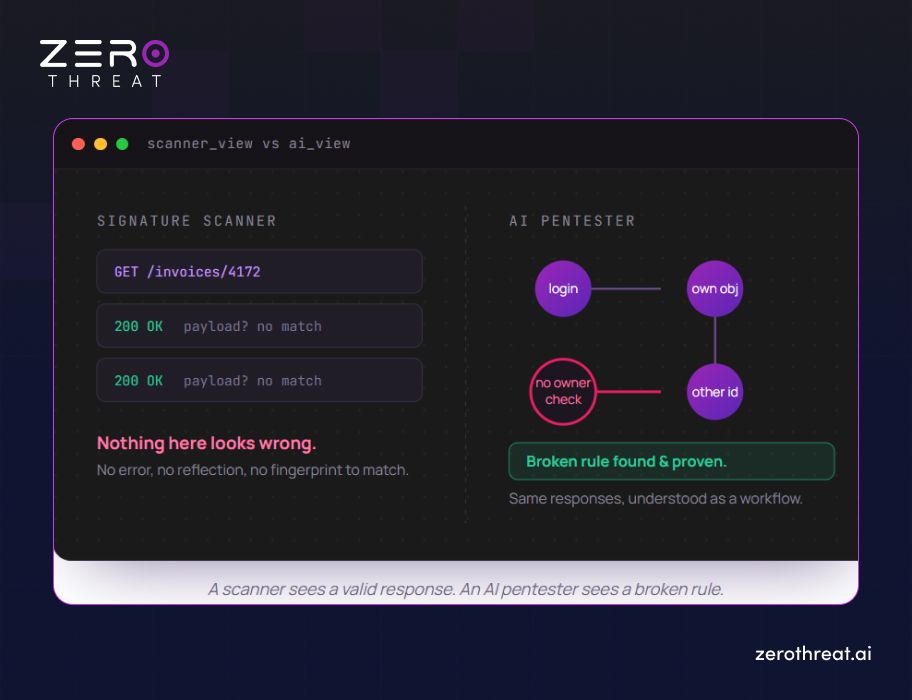
Most application security testing tools are built to answer one question: is this input handled unsafely? Send a payload, watch the response, flag the anomaly. That model has worked well for injection, cross site scripting, and misconfiguration for two decades because those flaws leave a fingerprint. A reflected <script> tag, a database error, a stack trace. Something measurable comes back.
Business logic flaws leave no such fingerprint. The request is well-formed. The server returns a clean 200 OK. Nothing crashes, nothing reflects, nothing errors. The application does exactly what its code tells it to do. The problem is that what the code was told to do was wrong for the situation, and only someone who understands the purpose of the workflow can see it.
This is why business logic bugs remain the last category that automation has struggled to reach. The OWASP API Security Top 10 puts Broken Object Level Authorization at number one, where it has sat since 2019, and adds a brand new category, Unrestricted Access to Sensitive Business Flows, specifically to capture attacks where the API works as designed and the attacker simply abuses that design at scale. These are not coding mistakes in the classic sense. They are reasoning gaps. And reasoning, until recently, was the one thing scanners could not do.
What is a Business Logic Vulnerability?
A business logic vulnerability is a flaw in the rules that govern how an application is supposed to behave, not in how it parses or sanitizes data. The code runs correctly. The logic it enforces is incomplete, inconsistent, or trusts the client when it should not
A few concrete shapes this takes:
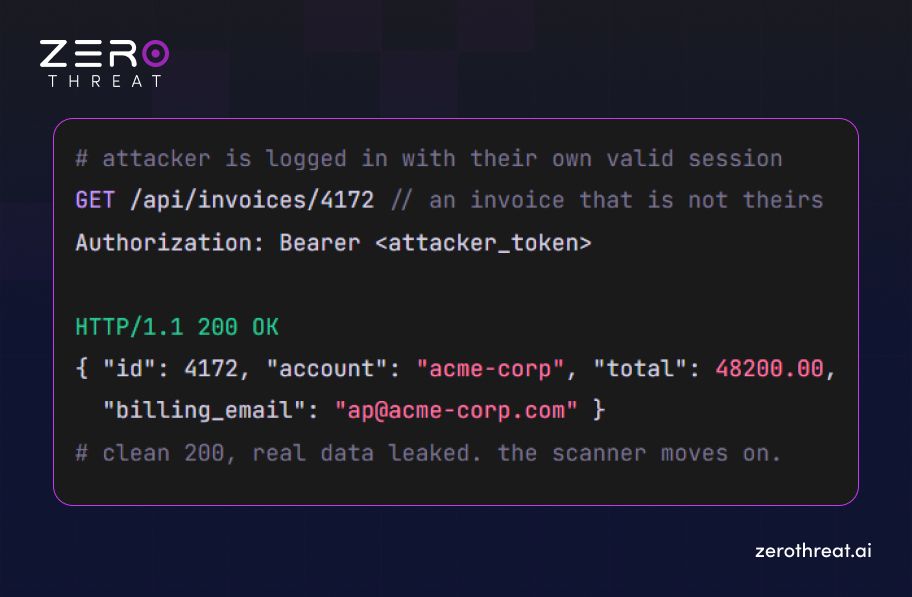
Object ownership that is never checked: An API exposes /api/invoices/{id}. Your session is valid, the endpoint is one you are allowed to call, but the server never verifies that invoice 4172 actually belongs to you. Change the ID and you read someone else's invoice. This is IDOR at the web layer and Broken Object Level Authorization (BOLA) at the API layer, and per OWASP it accounts for a large share of real world API attacks while remaining one of the hardest classes to catch automatically.
State that can be reached out of order: A checkout flow assumes step one (set price) always precedes step three (confirm payment). Skip to step three with a crafted request and you confirm an order at a price the server never recalculated. No payload, no injection, just a sequence the developer assumed could not happen.
Properties the client should never control: A profile update endpoint accepts a JSON body and binds every field to the user object. The UI only ever sends name and email, but the API quietly accepts role: admin because nobody allowlisted the fields. This is mass assignment, now folded into OWASP's BOLA.
Quantities and prices that go negative or fractional: Apply a coupon, then apply it again, then apply a quantity of -1. The arithmetic is valid. The outcome is theft.
Races between two requests that should be serialized: Submit a withdrawal twice in the same 50 milliseconds and both reads see the same balance before either write lands. The classic race condition in a payment workflow.
What unites all of these is intent. There is a correct way the workflow is meant to run, and a deviation an attacker can drive it into. ZeroThreat covers this category in depth on its business logic security testing, and our introduction to business logic vulnerabilities breaks the taxonomy down further.
From checkout bypasses to privilege abuse, uncover the vulnerabilities hidden in your business processes. Test Business Workflows
Why Do Traditional Scanners Miss Business Logic Vulnerabilities?
To understand what AI adds, it helps to be precise about why the previous generation of tooling fails here. It is not a tuning problem. It is structural.
Scanners test inputs, not intent. A signature based DAST tool has a library of payloads and a library of response patterns that indicate a hit. It has no concept of what your application is for. It cannot know that an invoice belongs to one tenant and not another, because that fact lives in your business domain, not in any HTTP response.
A valid response looks like success. The single biggest reason logic flaws evade automation is that exploiting them often produces a perfectly normal response. There is no error to match on. The tool sees 200 OK and a JSON body and moves on. The attack succeeded precisely because nothing looked broken.
Workflows are stateful, payloads are not. Most scanners fire requests in isolation. Business logic abuse usually requires a sequence: authenticate as user A, capture a token, replay it in user B's session, observe the effect three steps later. A stateless fuzzer has no memory of what it did two requests ago, so the chain never assembles.
Modern front ends hide the real surface. Single page applications build their routes and API calls in JavaScript at runtime. A crawler that only follows server rendered links never discovers half the endpoints, which means it never tests the flows where the logic actually lives.
Academic work has put numbers to the gap. In the widely cited study LLM Agents can Autonomously Exploit One-day Vulnerabilities (Fang et al., 2024), a GPT-4 based agent given a CVE description exploited 87% of a set of real, critical severity vulnerabilities, while conventional open-source vulnerability scanners such as OWASP ZAP and Metasploit exploited none of them in the same setting. The agents succeeded not because they had better payloads, but because they could plan, reason about the target, and chain steps together. That is the exact capability business logic testing demands.
How AI Detects Business Logic Vulnerabilities
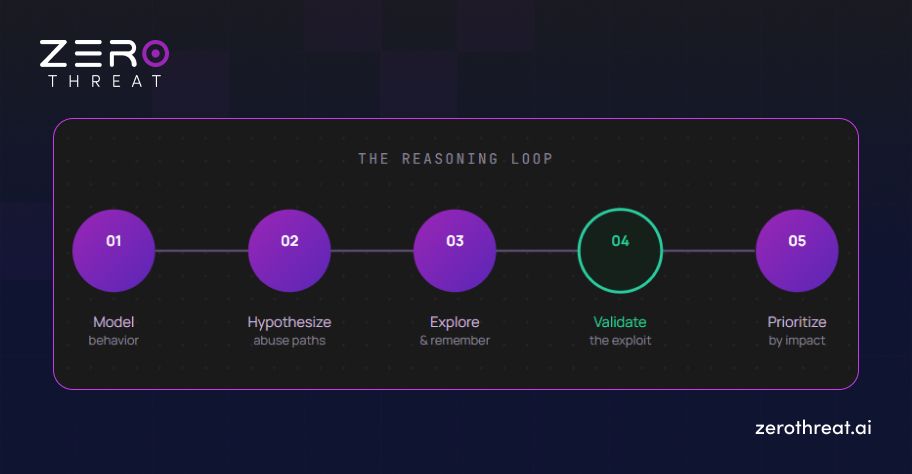
Detecting a logic flaw is not pattern matching. It is closer to how a human pentester works: understand the application, form a theory about how it could be abused, test the theory, and prove the result. Modern AI pentesting reproduces that loop in five stages.
1) Build a Model of Intended Behavior
Before it can find a broken rule, the AI has to learn the rules. It crawls the application the way a user would, including the JavaScript driven routes and API calls that a SPA only reveals at runtime, and assembles a map of endpoints, parameters, object identifiers, roles, and the transitions between states. The output is not a list of URLs. It is a working model of what the application is supposed to do: which user can reach which object, which step is meant to precede which, which fields the client is allowed to set.
This modeling step is what makes everything downstream possible. You cannot detect a deviation from intended behavior until you have inferred what the intended behavior was.
2) Generate Hypotheses, The Way a Pentester Would
With a model in hand, the AI reasons about where that model could fail. If invoice IDs are sequential integers and the endpoint never checks ownership, then incrementing the ID should expose another user's data. If this field is set on server side everywhere in the UI, what happens when the client sends it directly? If this discount is meant to apply once, what does the cart do when it is applied twice?
Each of these is a falsifiable hypothesis tied to the specific application, not a generic payload from a list. This is the step the Shinobi research community describes well in their write up on using AI to find logic flaws: the agent forms a theory about how the system might fail, then goes looking for evidence.
3) Explore, Pivot, and Remember
A single hypothesis rarely lands on the first try. The AI tests, observes, and adjusts, and crucially it remembers what it learned along the way. It might notice that a public share link and a private edit page use the same object identifier format, file that detail away, and only later combine it into an attack that reuses one ID in the other context. That ability to hold context across many steps and join distant observations into a single chain is what separates reasoning from scanning.
4) Validate the Exploit, Do Not Just Flag It
This is the stage that earns trust with a security engineer. Rather than reporting "this endpoint may be vulnerable to IDOR," the AI proves it: it carries out the access with a second, controlled account and confirms that data which should be private was returned. The finding ships with the exact request, the evidence, and a reproduction path. Validation is also what collapses false positives, because a flaw that cannot be reproduced never becomes a finding in the first place.
5) Reason About Business Impact, Not Just Severity
Two IDORs are not equal. One exposes a public display name. The other exposes payment details across tenants. A generic CVSS score treats inputs the same way a scanner does, mechanically. Business aware prioritization weighs what the exploited object actually means in your application, so the report leads with the finding that would hurt the business, not the one that happens to score a 7.5 by default.
The Attack Classes AI Catches in Practice
The theory is only useful if it maps to bugs that matter. Here is what AI driven business logic testing surfaces on real applications.
Cross-Tenant Object Access (IDOR / BOLA)
The AI enumerates object identifiers it should not be able to reach, requests them from a controlled second identity, and confirms when ownership is never enforced. Because BOLA sits at the top of the OWASP API list and is famously hard to detect automatically, validating it with a real second account is where AI clearly outperforms signature scanning.
Privilege and Role Escalation Through Workflow Abuse
By comparing what each role is supposed to do against what the API actually permits, the AI finds Broken Function Level Authorization, the standard tier user who can call an admin only endpoint simply because the server never checked the role on that route.
Property Level Manipulation and Mass Assignment
The AI submits fields the UI never sends, like isAdmin, verified, or balance, and watches whether the server binds them. When it does, an ordinary update endpoint becomes a privilege grant.
Price, Quantity, and Coupon Abuse
It probes the arithmetic of commerce flows: negative quantities, repeated discounts, currency rounding, replayed promo codes. These are pure logic bugs with direct financial impact and no payload signature at all.
Sequence and State Manipulation
It tests whether multi step flows can be entered out of order, whether a step can be skipped, and whether a value set early can be tampered with before a later step trusts it.
Race Conditions in Sensitive Workflows
By issuing tightly timed parallel requests against balance, inventory, or redemption logic, the AI surfaces time of check to time of use of flaws that only appear under concurrency.
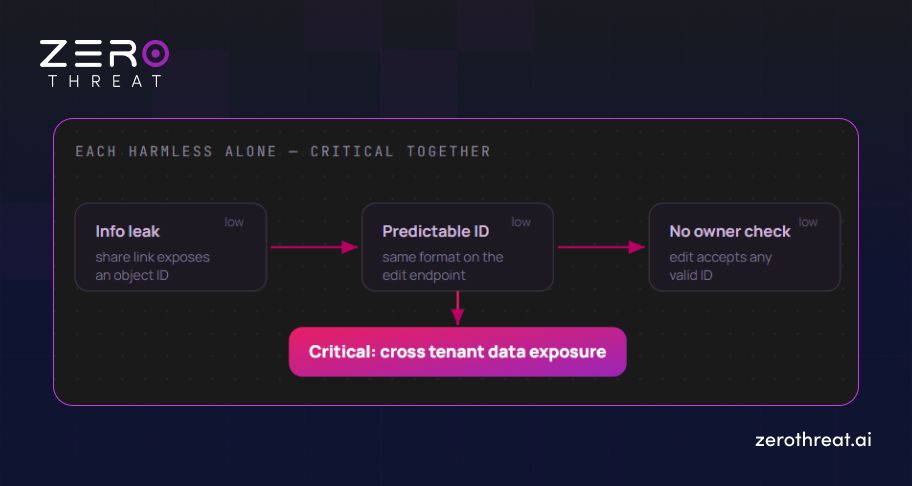
The most valuable findings are usually chains. A low-risk information leak plus a permissive identifier plus a missing ownership check, each harmless alone, combined into cross tenant data exposure. Holding all three in context and assembling the chain is precisely what the reasoning loop is built for. Our deeper write-ups on preventing business logic flaws with a web app security tool and SaaS business logic flaws walk through several of these end-to-end.
When security depends on application behavior, AI provides the context traditional scanners lack See AI Think Like an Attacker
Where AI Still Needs a Human in The Loop
Credibility with a security engineer depends on being honest about the edges. AI does not replace the pentester. It removes the bottleneck, then hands the hardest judgment calls to a human.
A few places where that handoff matters:
- Domain meaning the model cannot infer. Whether a particular data exposure is catastrophic or trivial, sometimes depends on a regulatory or contractual context that lives outside the application. AI can prove access; a human decides what it costs.
- Destructive or ambiguous actions. Some workflows cannot be safely exercised by an automated agent without risk of real data. A "delete account" or "issue refund" path needs scoping, a controlled environment, or an explicit human to go ahead. Good AI pentesting asks for that boundary rather than barreling through it.
- Novel logic with no analog. When a workflow is genuinely unusual, the hypothesis space gets large. AI is strong at breadth and tireless iteration; a senior tester is still better at the rare leap of intuition on a one-of-a-kind flow. The strongest programs pair the two.
How Does ZeroThreat Detects Business Logic Vulnerabilities?
ZeroThreat's AI pentesting is built around the reasoning loop above, with engineering choices aimed squarely at the parts of business logic testing that break other tools.
Reach the Surface Other DAST Tools Never Crawl
Logic lives in flows, and modern flows live in JavaScript. ZeroThreat's JS route extractor pulls API routes and endpoints straight out of single page application bundles, and its handling of complex UI flows means authenticated, multi-step journeys get tested rather than skipped. You cannot find a logic flaw in a workflow you never reached.
Drive Real Journeys without Writing the Scripts
Exercising a multi-step flow normally means hand-writing browser automation. With ZeroThreat’s Playwright security testing, it generates the Playwright automation for those journeys automatically, so testing authenticated, stateful flows does not cost your team a library of hand-maintained specs.
Agents Built from the Ground Up
ZeroThreat’s AI penetration testing runs a fleet of purpose-built AI agents designed for offensive reasoning, the hypothesis, explore, and chain steps that complex multi-step attacks require, rather than a single model bolted onto a legacy scanner.
Authorization Testing as a First-class Capability
IDOR, BOLA, BFLA, and property level authorization are tested by comparing what each role and identity is supposed to access against what the application actually allows, using controlled identities to confirm cross object and cross tenant access.
Validation First, So Findings are Real
ZeroThreat proves exploitability rather than guessing it, which is what drives its 99.9% detection accuracy across more than 130K vulnerability checks and keeps false positives out of the report.
Business-aware Risk Prioritization and Risk-based Reporting
Findings are ranked by what the exploited object means in your application, not by a default score, so the report opens with the issue that actually threatens the business.
The result is the speed of automation with the judgment that business logic demands: teams report up to 10X faster testing and around 90% less manual pentest effort, with the deep, reasoning driven coverage that logic flaws require. For environments that need it, production safe testing is available on ZeroThreat's Enterprise tier, so live systems can be assessed without disruption.
Sign up for free now and experience business-aware testing before it’s too late.
If your app handles payments, approvals, onboarding, or sensitive transactions, it's time to validate the logic behind them. Schedule a Security Review
Key Takeaways
Business logic vulnerabilities are the flaws that survive every automated scan because exploiting them produces a normal response, requires a sequence rather than a payload, and depends on understanding what the application is for.
Detecting Business logic vulnerabilities is a reasoning task: model the intended behavior, hypothesize where the rules break, explore and remember across steps, validate the exploit with proof, and rank by real business impact. AI now performs that loop at a scale no human team can match, and research shows reasoning agents finding exploitable flaws where signature scanners find nothing. The right deployment keeps a human on the judgment calls and lets the AI carry out the relentless, scalable work.
Frequently Asked Questions
Does AI business logic testing need my OpenAPI spec or API documentation to work?
It helps but it is not required. The modeling stage discovers endpoints, parameters, and object identifiers by exercising the application directly, including the JavaScript defined routes that never appear in documentation. A spec improves coverage and speed; the absence of one does not stop the test. In practice the AI often finds undocumented or shadow endpoints that the spec never listed, which are exactly where logic flaws tend to hide.
Won't an AI that actively tries to break workflows corrupt or pollute real data?
Can AI catch a logic flaw that only appears across two different microservices?
How should results from AI business logic testing feed into a development pipeline?
Is a logic flaw found by AI still worth a manual pentest afterward?

Explore ZeroThreat
Automate security testing, save time, and avoid the pitfalls of manual work with ZeroThreat.