 ZeroThreat Wins Top InfoSec Innovators 2026 Award for Penetration Testing Read more


All Blogs
The 7 Pillars of API Security: A Complete Guide to Securing Modern APIs
Quick Overview: This blog explains the seven pillars needed to secure modern APIs, including governance, secure development, visibility, testing, validation, remediation, and monitoring. It breaks down how each pillar helps identify real risks, reduce attack surfaces, and prevent exploitation. Plus, it provides a practical framework to strengthen API security and explains how leveraging ZeroThreat's AI pentesting tool helps organizations build a resilient defense against evolving threats.
APIs have become the most targeted entry point in modern applications, and attackers know it well. Recent industry reports show that over 99% of organizations experienced an API-related security issue, with many breaches directly linked to exposed or poorly secured APIs.
As businesses shift to API-first architectures, they expose sensitive data, core logic, and critical services through endpoints that are often overlooked or poorly monitored. Traditional security tools struggle to keep up, especially with the speed at which APIs are developed and deployed.
This is where a structured approach becomes essential. The seven pillars of modern API security provide a clear framework to design, test, validate, and protect APIs continuously. Instead of reacting to threats, this strategy helps teams stay ahead by focusing on real risk, visibility, and ongoing security validation.
Stop guessing and start protecting your APIs with a free, no-config AI penetration testing trial. Get Started FREE
On This Page
- TL;DR: 7 Pillars of API Security
- Why is API Security Critical for Modern Applications?
- What are the Seven Pillars of Modern API Security?
- Best Practices to Implement Effective API Security
- How ZeroThreat's AI Pentesting Helps Strengthen API Security
- Final Thoughts
TL;DR: 7 Pillars of API Security
Modern API security requires a continuous, structured approach, not one-time testing. Here are the seven pillars that help teams reduce real risk, improve visibility, and stay ahead of evolving API threats.
- Governance & Design: Shift security left into the design phase using standardized protocols and strict documentation.
- Secure Development: Empower developers with secure coding practices to avoid introducing vulnerabilities in the first place.
- Inventory & Visibility: Eliminate blind spots by continuously discovering shadow, zombie, and legacy API endpoints.
- Testing & Assessment: Use an advanced API security testing tool to find risks such as BOLA and business logic flaws early.
- Security Validation: Leverage AI pentesting to adapt attack paths and prove the real-world exploitability of flaws.
- Remediation & Reporting: Accelerate fixes with AI-powered remediation guidance and high-signal reports that prioritize critical risks.
- Monitoring & Response: Track live traffic patterns to detect anomalies and trigger instant incident response playbooks.
Why is API Security Critical for Modern Applications?
APIs power modern applications by connecting services, apps, and users in real time. They expose sensitive data and core business logic, making them a prime target for attackers looking to exploit weak authentication or misconfigured endpoints.
Unlike traditional web apps, APIs have a larger and often hidden attack surface. Shadow APIs, frequent updates, and complex integrations increase risk. A single vulnerable endpoint can expose entire systems, leading to data breaches and service disruption.
Strong API security helps prevent unauthorized access, data leaks, and abuse of business logic. It ensures continuous protection as applications evolve, making it essential for maintaining trust, compliance, and the overall security of modern digital ecosystems.
What are the Seven Pillars of Modern API Security?
The seven pillars of API security provide a clear strategy to protect data throughout the API lifecycle. This strategy integrates governance, continuous testing, and real-time monitoring to neutralize evolving cyber threats.
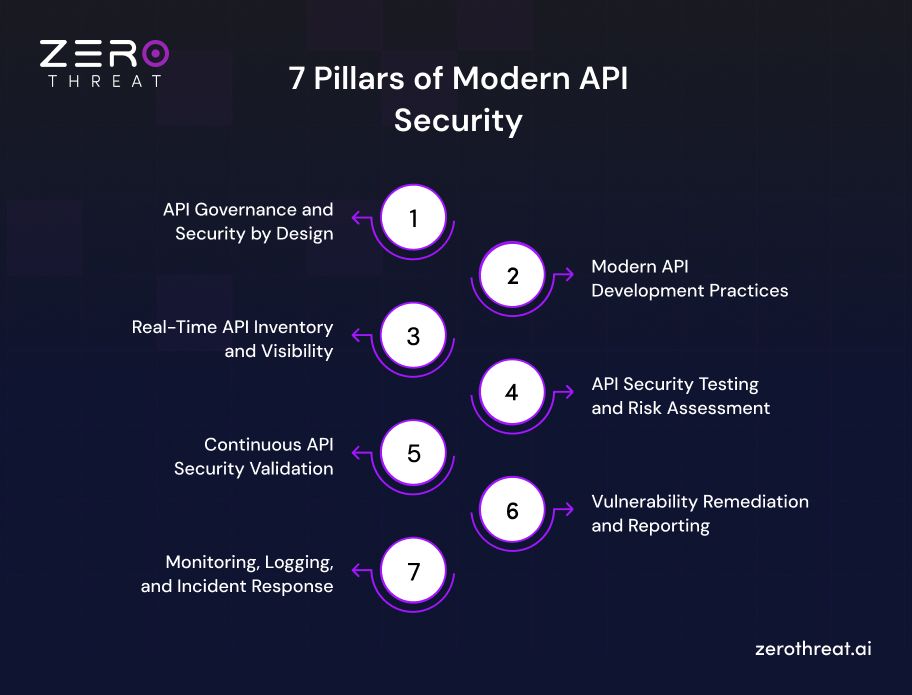
Pillar 1: API Governance and Security by Design
API governance and security by design ensure that security is built into APIs from the very beginning, not added later. It focuses on defining standards, enforcing policies, and aligning development with security requirements to reduce risks early in the API lifecycle.
Key Practices for Effective Governance and Design:
- Implement an API Design-First Approach: Use standardized formats like OpenAPI contracts to define security requirements and business logic before development begins.
- Establish Security Standards: Define uniform protocols for authentication, authorization, and data encryption from the ground up to ensure every API meets a high security bar.
- Maintain Comprehensive Documentation: Detailed documentation helps developers build securely and ensures that organizational security practices are followed consistently.
- Enforce Policies and Regular Audits: Use a "trust but verify" model by actively monitoring the API estate and conducting regular reviews of configurations to ensure policy compliance.
- Prioritize Cost-Effective Security: Addressing potential flaws during the design phase is significantly more efficient than attempting to patch vulnerabilities after an API is live.
Pillar 2: Modern API Development Practices
Modern API development is where security strategy meets execution. It focuses on empowering developers to write secure code by default rather than fixing bugs later. By integrating security standards into the daily workflow, teams can prevent vulnerabilities like SQL injection and business logic flaws from ever entering the codebase.
Security Best Practices for API Development:
- Prioritize Developer Training: Teams should be well-versed in API-specific threats, such as the OWASP API Top 10, to avoid introducing common vulnerabilities during the coding phase.
- Enforce Input Validation: Never trust incoming data. Rigorous input validation and sanitization are essential to prevent injection attacks and ensure business logic is correctly implemented.
- Apply Strong Access Controls: Implement robust authentication and authorization protocols to ensure only verified users can access sensitive endpoints.
- Integrate Security into CI/CD: Automate security checks within your development pipeline. This allows for real-time testing of every code change before it ever reaches production.
- Minimize Data Exposure: Ensure APIs only return the specific data requested. Avoid sending entire objects to the client, which helps prevent accidental leaks of sensitive information.
- Follow Consistent Standards: Adhere to organizational methodologies and security policies to maintain a uniform security posture across the entire API estate.
Pillar 3: Real-Time API Inventory and Visibility
You cannot protect what you do not know exists. Real-time API inventory and visibility are essential for mapping your entire attack surface. By maintaining an accurate, up-to-date list of every endpoint, organizations can identify hidden risks and ensure that no part of their digital ecosystem remains unmonitored or vulnerable.
How a Clear Inventory Adds Value:
- Discover Shadow APIs: These are undocumented APIs created without the security team's knowledge. Real-time discovery finds these hidden endpoints before they can be exploited.
- Remove Zombie APIs: Deprecated APIs that are still running often lack the latest security patches. Keeping a close watch helps you decommission these "zombies" to close easy backdoors for hackers.
- Map Your Attack Surface: An accurate inventory gives you a clear, centralized view of all entry points. This helps you understand exactly where your organization is exposed.
- Identify Sensitive Data Paths: Visibility allows you to see which APIs handle critical information, such as banking or healthcare data. This lets you prioritize protection for your highest-risk areas.
- Move Beyond Manual Lists: Static spreadsheets are outdated the moment they are saved. Automated, real-time inventory ensures your security posture keeps pace with rapid development and deployment cycles.
Is your BOLA protection working? Prove it with ZeroThreat's advanced autonomous API pentest. Pentest My APIs
Pillar 4: API Security Testing and Risk Assessment
API security testing and risk assessment are critical for identifying vulnerabilities before they can be exploited by attackers. By integrating testing throughout the SDLC, organizations ensure their endpoints are resilient against sophisticated attacks. This proactive approach protects sensitive data by catching flaws early, well before they reach production.
Why Continuous Testing and Assessment Matter
- Automating Security Scans: Integrating automated testing directly into the CI/CD pipeline ensures that every code change is vetted for flaws in real-time.
- Leveraging Advanced Pentesting Tools: Using an advanced automated penetration testing tool allows you to simulate complex attacks and uncover hidden weak points that traditional scanners miss.
- Prioritizing High-Risk Vulnerabilities: Systematic assessments help identify critical issues like Broken Object Level Authorization (BOLA), which is often the gateway for massive data breaches.
- Testing Beyond Functionality: While functional tests check if the API works, security-focused testing verifies that it cannot be manipulated to perform unauthorized actions.
- Reducing Risk Exposure: API security testing early and often across every environment significantly lowers the chance of deploying insecure APIs to production.
Pillar 5: Continuous API Security Validation
Continuous security validation moves beyond static scanning by constantly testing your APIs against real-world attack scenarios. This proactive approach ensures that your defenses remain effective as threats evolve and your application changes. By validating security in real-time, you can confirm that your protection layers are actually stopping sophisticated exploits.
The Role of Continuous Validation
- Proving Real-World Exploitability: Use an agentic AI pentesting tool to go beyond simple vulnerability lists and actually demonstrate how a flaw can be compromised.
- Adapting Attack Paths: Modern validation tools can adapt attack paths dynamically, mimicking the creative techniques used by human hackers to find hidden entry points.
- Reducing False Positives: By focusing on proven exploitability, security teams can prioritize fixing high-signal risks instead of chasing "potential" vulnerabilities that aren't reachable.
- Validation Across Environments: Ensure your security posture is consistent by validating APIs in staging, pre-production, and live environments.
- Feedback Loops for Developers: Provide clear, validated evidence of security gaps to development teams, making it easier and faster to implement effective patches.
Pillar 6: Vulnerability Remediation and Reporting
Identifying a security flaw is only half the work; the real value lies in how quickly and effectively you can fix it. Efficient remediation and clear reporting bridge the gap between security teams and developers. By turning complex scan data into actionable insights, organizations can prioritize critical risks and maintain a clean, resilient API ecosystem.
Streamlining the Path to API Security
- Generate Actionable Insights: Move beyond simple bug lists. Provide the specific context and documentation developers need to understand and resolve the underlying issue.
- Leverage AI-Powered Remediation: To speed up fixes, use platforms that provide AI-powered remediation steps. These tools can suggest specific code changes or configuration updates, allowing teams to resolve vulnerabilities almost instantly.
- Deliver Reports Where Developers Work: Integrate security reporting directly into IDEs and CI/CD pipelines. This ensures that remediation becomes a natural part of the daily workflow rather than a separate, disruptive task.
- Prioritize Based on Exploitability: Not every flaw is a priority. Use risk assessments to focus on critical threats, like Broken Object-Level Authorization (BOLA) that pose the greatest danger to sensitive data.
- Create a Continuous Feedback Loop: Use your reporting data to update your governance and design standards. This helps prevent the same types of vulnerabilities from being introduced in future development cycles.
Pillar 7: Monitoring, Logging, and Incident Response
Real-time monitoring and detailed logging serve as the final line of defense, providing the visibility needed to detect and stop active attacks. By tracking every API call and response, organizations can identify anomalous patterns and react instantly to breaches. A strong incident response plan ensures that threats are contained before they cause widespread damage.
Building a Resilient Response Framework
- Behavioral Traffic Analysis: Monitor API traffic for unusual spikes or sequences that suggest a bot or attacker is attempting to scrape data or bypass authorization.
- Detailed Audit Logging: Maintain comprehensive logs of all API interactions, including user IDs, timestamps, and resource access, to enable thorough forensic investigations.
- Automated Threat Alerts: Set up real-time alerts for critical events, such as multiple failed authentication attempts or access requests to sensitive administrative endpoints.
- Centralized Security Dashboarding: Consolidate logs into a single view to help security teams quickly correlate signals and identify the root cause of an incident.
- Incident Response Playbooks: Develop pre-defined steps for containing and neutralizing API-specific threats, such as revoking compromised tokens or temporarily blocking malicious IPs.
- Post-Incident Analysis: Use logged data to perform a "lessons learned" review after any security event, ensuring that the same vulnerability cannot be exploited again.
Ready to secure your APIs at scale? Find the flexible security plan that fits your team. View Pricing Plans
Best Practices to Implement Effective API Security
Implementing a robust API security strategy requires moving beyond basic perimeter checks to a comprehensive, lifecycle-based approach. By adopting these industry-standard best practices, you can proactively defend your data and ensure your application remains resilient against evolving threats.
- Implement Strong Authentication and Authorization: Use modern standards like OAuth2 and OpenID Connect to verify identities. Ensure you define granular permissions to prevent unauthorized access to sensitive resource IDs.
- Maintain an Accurate API Inventory: You cannot protect what you don’t see. Continuously discover and track all endpoints, including legacy and "shadow" APIs, to minimize your overall attack surface.
- Adopt a Shift-Left Testing Approach: Integrate automated security testing directly into your CI/CD pipeline. This helps catch critical vulnerabilities like BOLA or injection flaws early in the development cycle.
- Enforce Strict Governance and Documentation: Use OpenAPI specifications to define a clear contract for your APIs. Regularly audit these configurations to ensure development follows your organization's security policies.
- Deploy Runtime Threat Protection: Use WAAP or API gateways to monitor live traffic for anomalies. This "shield-right" layer detects persistent adversaries and blocks sophisticated exploits in real-time.
- Prioritize Continuous Validation: Don't rely on one-time scans. Use ongoing, automated testing to proactively verify security postures and identify misconfigurations before they can be exploited by attackers.
How ZeroThreat's AI Pentesting Helps Strengthen API Security
ZeroThreat is an AI pentesting platform that helps organizations identify and validate vulnerabilities across web applications and APIs. It goes beyond traditional scanning to uncover exploitable security weaknesses.
Using an advanced AI engine, ZeroThreat simulates real-world attacks, analyzes complex API workflows, and proves exploitability. It helps security teams prioritize genuine risks, fix vulnerabilities faster, and strengthen API security continuously.
- Detects Known and Zero-Day Vulnerabilities: Identifies common API security flaws and zero-day vulnerability patterns through AI-driven testing, helping teams uncover weaknesses that traditional scanners may overlook.
- Tests Complex API Workflows: Understands multi-step workflows, authentication states, and user roles to identify business logic flaws and authorization weaknesses across interconnected API endpoints.
- Validates Real Exploitability With Proof: Uses agentic AI to simulate attack paths, adapt to application responses, and capture evidence that confirms whether identified vulnerabilities can actually be exploited.
- Enables Continuous API Security Testing: Integrates with CI/CD pipelines to test APIs during development and deployment, helping teams identify vulnerabilities before they reach production.
- Supports Production-Safe Penetration Testing: Uses controlled, non-destructive testing techniques to validate API vulnerabilities in live environments without disrupting application performance or business operations.
- Provides AI-Driven Remediation Guidance: Generates actionable, code-level remediation suggestions and prioritizes findings based on severity, exploitability, and business impact, helping developers resolve critical issues faster.
- Simplifies Security Workflows and Reporting: Offers zero-configuration setup and integrates with tools like Jira, GitHub, Azure Boards, and Slack to streamline vulnerability tracking, reporting, and remediation.
Don’t let shadow APIs haunt you. Get full visibility of security flaws at zero cost with ZeroThreat. Try for $0
Final Thoughts
Modern API security is no longer about isolated fixes. It requires a complete approach built on governance, secure development, visibility, testing, continuous validation, remediation, and real-time monitoring to reduce actual risk.
Each pillar plays a role in helping teams move from surface-level scanning to understanding real attack paths. When combined, they create a strong, continuous security layer that evolves with your APIs and threat landscape.
For seamless protection, ZeroThreat offers an advanced API penetration testing tool that uncovers hidden vulnerabilities. Its AI-powered remediation guidance helps your team fix flaws almost instantly, significantly strengthening your overall API security posture.
Frequently Asked Questions
How does API security governance differ from traditional application governance?
API security governance specifically emphasizes a "shift-left" strategy, ensuring security is integrated into the initial design using OpenAPI/Swagger contracts. Unlike traditional models, it focuses on enforcing standardized policies for authentication and encryption across the entire API estate to mitigate the risks of unmanaged "shadow" or deprecated "zombie" endpoints.
Why is continuous API discovery critical for a robust API security program?
How does automated API security testing support continuous validation?
Why is runtime API protection considered a key pillar of modern API security?
What industries require the strongest API security framework


Explore ZeroThreat
Automate security testing, save time, and avoid the pitfalls of manual work with ZeroThreat.