 ZeroThreat Wins Top InfoSec Innovators 2026 Award for Penetration Testing Read more

All Blogs
Global Cybercrime Costs in 2026: Key Numbers and Industry Impact
Quick Overview: Cybercrime is evolving faster than most organizations can defend against. This article analyzes the most important cybercrime statistics for 2026, highlighting trends in ransomware, data breaches, AI-driven attacks, and financial losses. It explores how the threat landscape is changing and what security leaders must prioritize to reduce risk and strengthen modern cybersecurity strategies.
Every two seconds, somewhere in the world, a ransomware attack strikes. That's not a prediction for the distant future; it's the reality of 2026. As organizations accelerate digital transformation, attackers are evolving even faster, leveraging automation, ransomware ecosystems, and AI-powered attacks to exploit vulnerabilities at unprecedented speed.
The scale of cybercrime today is staggering. Global cybercrime damages are estimated to reach $10.5 trillion annually, making cybercrime one of the largest economic forces in the world, larger than many national economies. In practical terms, that represents roughly $26 billion lost every day to cyber-attacks across businesses, governments, and individuals.
Data breaches alone continue to create a massive financial impact. The average global cost of a data breach is about $4.4 million, with significantly higher costs in regions such as the United States, where breaches can exceed $10 million. Meanwhile, ransomware remains one of the fastest-growing cybercrime categories. In 2025, ransomware attacks increased dramatically while the median ransom payment jumped nearly 368% year-over-year, highlighting the increasing profitability of cyber extortion.
At the same time, the cybercrime landscape is rapidly increasing. Attackers are now leveraging AI, credential theft, and cybercrime-as-a-service platforms, enabling even low-skilled actors to launch sophisticated attacks at scale. Security researchers warn that vulnerabilities are often exploited within hours of disclosure, shrinking the window for defenders to respond.
The result is a high-speed cyber threat economy where attackers continuously innovate while organizations struggle to keep pace.
In this article, we will break down the most important cybercrime statistics for 2026, including attack trends, financial losses, emerging threats, and what these numbers mean for modern security teams and business leaders.
Every minute without security testing increases your risk. Start scanning now. Run My First Scan FREE
On This Page
- What is Included in the Global Cost of Cybercrime?
- Factors Contributing to The Rise in Cybercrime Costs
- The Rise in Cost of Cybercrime (2015 → 2026)
- Global Cybercrime Damage Costs 2026: Complete Breakdown
- The Cost of a Cybercrime by Industry
- Strategies to Minimize Cybercrime Costs
- Summing Up
What is Included in the Global Cost of Cybercrime?
When we talk about the cost of cybercrime, it's so much more than just stolen credit card numbers. The actual cost of cybercrime is massive, with the biggest parts hidden beneath the surface. Let's break down where all that money really goes.
Financial Theft
This is the most direct and visible part of the cost of cybercrime. The attackers steal money through fraudulent transfers, phishing attacks, or compromised financial systems. For many organizations, this is just the starting point because for them, financial impact often runs much higher than the stolen amount.
Data Loss and Recovery
When cybercriminals breach a network, data is often stolen, corrupted, or wiped out completely. The recovery process is expensive and time-consuming, especially for companies dealing with sensitive customer or healthcare data. The global cost of cybercrime spikes when you factor in the hours and resources spent trying to restore what was lost.
Business Downtime
Every minute of downtime costs money. When systems are locked or taken offline due to an attack, operations stop. For SaaS companies and digital businesses, this means lost revenue and missed service commitments, all of which add to the growing cybercrime cost worldwide.
Ransomware Payments
Ransomware has become a multi-billion-dollar industry in itself. Companies under pressure often pay to regain access to critical systems or data. But paying doesn’t guarantee full recovery, and it often invites repeat attacks. These payouts form a large part of the annual cost of cybercrime that continues to rise globally.
Brand Damage
The hidden costs of cybercrime are often tied to reputation. A single breach can destroy years of trust with customers, investors, and partners. Even if systems are restored, rebuilding brand credibility takes time, and that lost trust has a real monetary value that’s hard to measure but impossible to ignore.
Legal and Compliance Fines
After a breach, security compliance penalties can quickly add up. Non-compliance with data protection laws like GDPR or HIPAA can cost millions. Add class-action lawsuits and settlement costs, and the total impact becomes a major contributor to the overall damage caused by cybercrime.
Factors Contributing to The Rise in Cybercrime Costs
Cybercrime is fueled by how fast we’ve gone digital and how slow we’ve been to secure it. Here are the main factors driving up the global cost of cybercrime today.
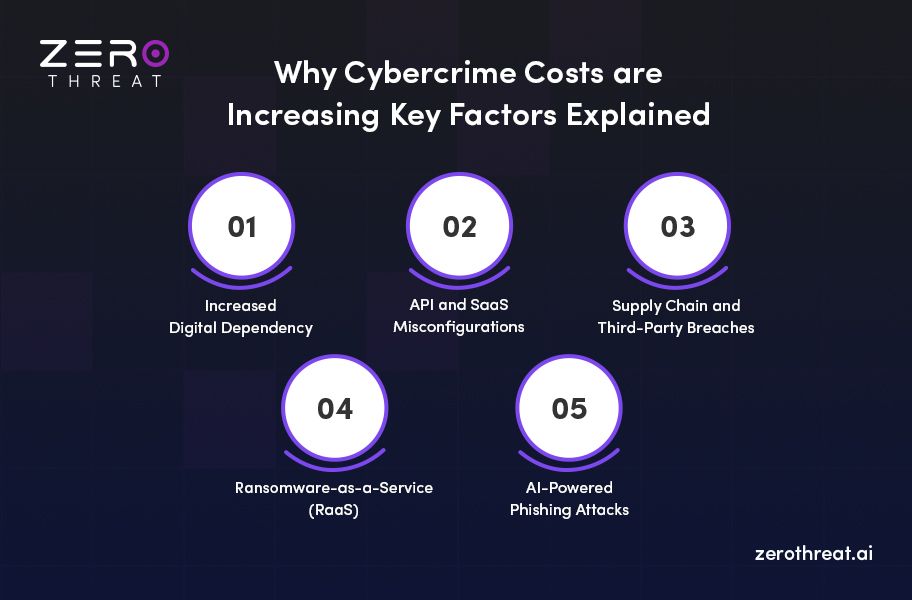
Increased Digital Dependency
Every part of modern business now runs on digital systems. Cloud storage, remote work tools, and connected devices have expanded our attack surface like never before. The World Economic Forum notes that our growing digital dependency is a major driver of global cyber risk.
API and SaaS Misconfigurations
As more companies rely on SaaS platforms and APIs, security misconfigurations have become one of the biggest causes of data exposure. In 2025, a report found that 99% of organizations experienced API-related security incidents within the past year. If you want to prevent security misconfigurations, keep every API discovered and ensure that they have the correct access controls.
Supply Chain and Third-Party Breaches
A breach in one partner’s system can easily cascade through an entire network. In fact, around 35.5% of all breaches in 2024 were linked to third-party access. When a supplier or vendor is compromised, it can cause downtime, customer data loss, and regulatory fines. That means third-party risk management is now just as important as securing internal systems.
Ransomware-as-a-Service (RaaS)
Nowadays, ransomware has evolved into commercial operations. RaaS platforms make it easy for anyone to launch attacks without deep technical skills. According to Cybersecurity Ventures, the RaaS model is one of the top cyber threats shaping 2025. The result is a surge in frequency and sophistication of attacks, which continues to push up the cost of cybercrime every year.
AI-Powered Phishing Attacks
Attackers are now using AI to craft more convincing deepfake attacks and phishing scams. These tactics exploit human trust and are increasingly hard to detect. Also, reports show that social engineering contributes to more than 60% of breaches worldwide. With AI improving the precision, this number will rise, leading to major attacks.
The Rising Cost of Cybercrime (2015 → 2026)
The global cost of cybercrime has surged dramatically over the past decade. In 2015, cybercrime damages were estimated at $3 trillion annually. By 2025, that number reached $10.5 trillion per year, making cybercrime one of the largest economic threats in the world.
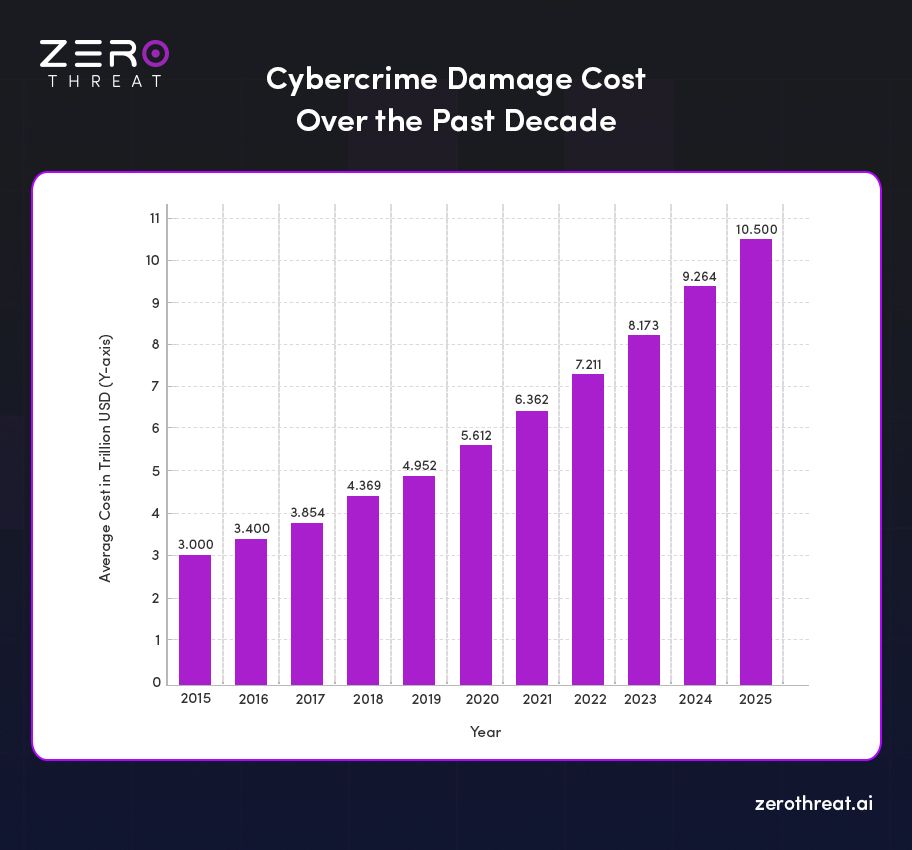
The growth has been fueled by ransomware, data breaches, supply chain attacks, and increasingly automated cybercrime operations. Experts estimate cybercrime has been growing at roughly 15% annually, far outpacing global GDP growth.
Looking ahead, forecasts suggest the damage could reach around $11.9 trillion in 2026, with long-term projections exceeding $12.2 trillion annually by 2031 if the current trajectory continues.
If cybercrime were measured as a national economy, it would rank among the largest economies in the world, highlighting how digital attacks have evolved from isolated incidents into a massive global criminal industry.
This steady surge reflects how deeply digital systems are now tied to every part of business and society. Each year, new technologies bring speed and convenience, but they also create more entry points for attackers. As organizations digitize faster than they can secure, cybercrime continues to grow into one of the world’s largest economic threats.
Manual pentests take weeks. Automated pentesting finds critical vulnerabilities in minutes. Run Security Scan
Global Cybercrime Damage Costs 2026: Complete Breakdown
The global cost of cybercrime reached approximately $10.5 trillion annually in 2025, and current projections indicate it will exceed $11–12 trillion per year in 2026 as ransomware, data theft, and AI-driven attacks continue to scale.
To put this into perspective, the cybercrime economy would rank among the largest economies in the world if it were measured as a country. The financial impact spans data breaches, ransomware attacks, business email compromise (BEC), intellectual property theft, and digital fraud.
Here’s how that $10.5 trillion breaks down from yearly damage to losses per minute and second.
| Time Period | Cost |
|---|---|
| Year | $10.5 trillion a year |
| Month | $875 billion a month |
| Week | $201.9 billion a week |
| Day | $28.8 billion a day |
| Hour | $1.2 billion an hour |
| Minute | $20 million a minute |
| Second | $333 thousand a second |
Now that we’ve seen how massive the total impact is, let’s look closer at where this cost actually comes from. Below is a breakdown of the most common and costly attack types driving these global losses, from phishing scams to large-scale data breaches.
Phishing & Spoofing
Phishing remains one of the most common ways attackers infiltrate organizations. Recent industry reports show that the average cost of a phishing-related data breach reached about $4.88 million, making it one of the most expensive initial attack vectors for organizations.
Phishing has also become the leading initial attack vector, responsible for roughly 16% of all data breaches globally. The scale of the threat is enormous: billions of phishing emails are sent every day, many now generated or enhanced using AI to make them more convincing and harder to detect.
Ransomware Attacks
Ransomware has grown from high-profile incidents to a near-industrial scale threat. In 2024, the average ransom demand exceeded US $2.5 million. One source reports that in 2025, the average cost to recover from a ransomware incident (excluding the ransom itself) was around US $1.53 million. A report also shows that ransomware accounted for 35 % of all attacks in a given period, with an 84 % increase year-over-year in that slice.
Data Breaches
Data breaches remain one of the most damaging forms of cybercrime. Verizon’s 2023 DBIR reported 5,199 confirmed breaches and 16,312 incidents worldwide, with the MOVEit breach alone exposing millions of records. IBM’s report found that the average cost of data breach was $4.45 million, up 15% in three years. Healthcare saw the highest impact at $10.93 million per breach, followed by finance at $5.9 million, with most breaches taking over 200 days to detect.
Business Email Compromise
Business Email Compromise (BEC) remains one of the costliest forms of cybercrime globally. In these attacks, criminals impersonate executives or trusted vendors to deceive employees into transferring funds or sharing sensitive information. According to the FBI’s Internet Crime Complaint Center (IC3), global BEC losses have surpassed $50.5 billion, making it the most expensive fraud type reported.
Malware (Non-Ransomware)
Malware beyond ransomware continues to play a major role in cyberattacks. While exact dollar figures for non-ransomware malware in 2026 are less publicized, it's clear this category remains deeply embedded in attack chains. For example, phishing is noted as delivering malware in up to 94 % of cases in some reports. Plus, non-ransomware malware often leads to data theft or system compromise, contributing to the global cost of cybercrime.
Here is the estimated average cost of the top attacks that add to the global cybercrime cost.
| Name of the Attack | Average Cost of an Attack (USD) in 2025 |
|---|---|
| Phishing & Spoofing | $4.88 million |
| Ransomware Attacks | $5.5 million |
| Data Breaches | $4.44 million |
| Business Email Compromise (BEC) | $4.89 million |
| Malware (Non-Ransomware) | $807,506 average cost (2021 data) |
Note: These numbers are approximate and can vary based on the source.
The Cost of a Cybercrime by Industry
Cybercrime does not impact every industry the same way. Some sectors face higher risks and heavier financial losses because of the type of data they handle or the systems they run. Here’s a quick look at the industries that bear the largest share of global cybercrime costs.
Healthcare
The healthcare sector continues to experience the highest average cost per data breach across all industries. According to the IBM Security Cost of a Data Breach Report, the average healthcare breach cost reached about $10.93 million in 2023 and remained above $10 million through 2024–2025, making it consistently the most expensive sector for cyber incidents.
Finance
Financial services remain a prime target, and for good reason. The average cost of a data breach in the financial services sector reached about $6.08 million in 2024 and remained around $6.1 million in 2025, making it one of the most expensive industries for cyber incidents. Banks, fintech firms, and insurers hold high-value financial data and operate under strict regulatory scrutiny, so even small security failures can escalate into costly breaches.
Government & Critical Infrastructure
Government agencies and critical infrastructure operators face attacks that impact several companies. For instance, IBM reports that breaches in critical infrastructure industries often exceed US $5 million on average.
Manufacturing
The manufacturing sector has its own cyber-risk profile, particularly due to IT/OT convergence, supply-chain exposure, and production downtime. One report shows the average cost of a data breach in manufacturing is about US $4.24 million.
Strategies to Minimize Cybercrime Costs
You can reduce the cost of cybercrime by taking a few practical, proactive steps. Here are some proven strategies that help teams stay ahead of threats before they turn into losses.
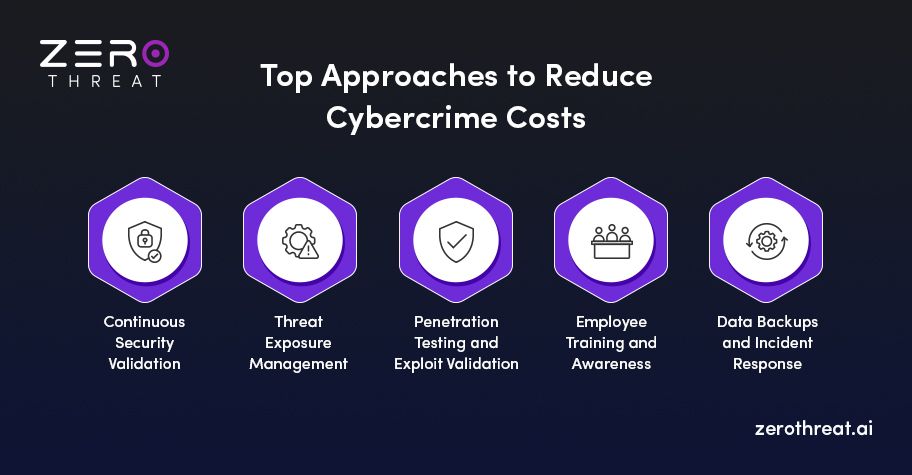
Continuous Security Validation
Security isn’t something you check once a year. Continuous security validation helps organizations test and confirm their defenses in real time. By simulating real-world attacks, teams can identify gaps before attackers do. It’s one of the most effective ways to reduce the overall cost of cybercrime, as it prevents small vulnerabilities from turning into million-dollar breaches.
Threat Exposure Management
Managing your threat exposure means knowing exactly what attackers can see and fixing it fast. Modern threat exposure management combines vulnerability scanning, prioritization, and continuous monitoring to minimize blind spots. Instead of reacting after an incident, organizations can proactively measure and reduce their risk surface, keeping both security and cost under control.
Penetration Testing and Exploit Validation
Traditional vulnerability scanner can only detect known vulnerabilities. An automated penetration testing tool goes a step further by showing how real those risks actually are. This approach helps separate critical threats from false positives, ensuring security teams focus where it matters. Regular testing also strengthens compliance posture and prevents the kind of vulnerabilities that lead to cyberattacks.
Employee Training and Awareness
Even the best technology can’t protect against human errors. Most breaches begin with a simple mistake, like clicking on a phishing email. Therefore, continuous employee training builds security awareness across teams and reduces the risk of cybercrime. Investing in this layer not only prevents incidents but also saves huge recovery and downtime costs over time.
Data Backups and Incident Response
When a breach or ransomware attack happens, quick recovery is everything. Secure, isolated data backups and a tested incident response plan can mean the difference between hours of downtime and total data loss. Organizations that prepare for the “what if” minimize damage, recover faster, and keep the financial impact of cybercrime well below industry averages.
Don’t wait until a vulnerability becomes a breach. Speak with our team now. Schedule a Call
Summing Up
The $12 trillion cybercrime forecast for 2026 is not just another number. It reflects how deeply technology and risk are now intertwined. Every industry, from healthcare to finance, is under high risk, as attackers grow faster, smarter, and more organized.
The only way to keep your software product or organization secure is by taking preventive measures. You can do that by performing continuous pentesting and fixing the issues on a priority basis.
Identifying and fixing security gaps in web apps and APIs before attackers exploit them can prevent major losses. ZeroThreat uses Agentic AI pentesting to detect and validate 130K+ vulnerabilities, including OWASP, CWE, and zero-day CVEs. It provides proof-based validation, remediation guidance, and CI/CD integrations, helping teams continuously secure applications, maintain compliance, and reduce cyber risk.
Frequently Asked Questions
How much will cybercrime cost in 2026?
Cybercrime is expected to exceed $11–12 trillion annually in 2026, continuing the rapid growth from $10.5 trillion in 2025. This makes cybercrime one of the largest economic threats worldwide.
How much does cybercrime cost grow each year?
What is the average cost of a cyber incident?
Which industries lose the most money to cybercrime?
What types of cyber attacks contribute most to cybercrime losses?
How much does a typical data breach cost in 2026?
How does cybercrime impact businesses beyond financial loss?
How can organizations reduce cybercrime risk?

Explore ZeroThreat
Automate security testing, save time, and avoid the pitfalls of manual work with ZeroThreat.