 ZeroThreat Wins Bronze Stevie® Award in Tech Startup of the Year Read more

All Blogs
The Cost Economics of AI Pentesting Without a Dedicated Red Team
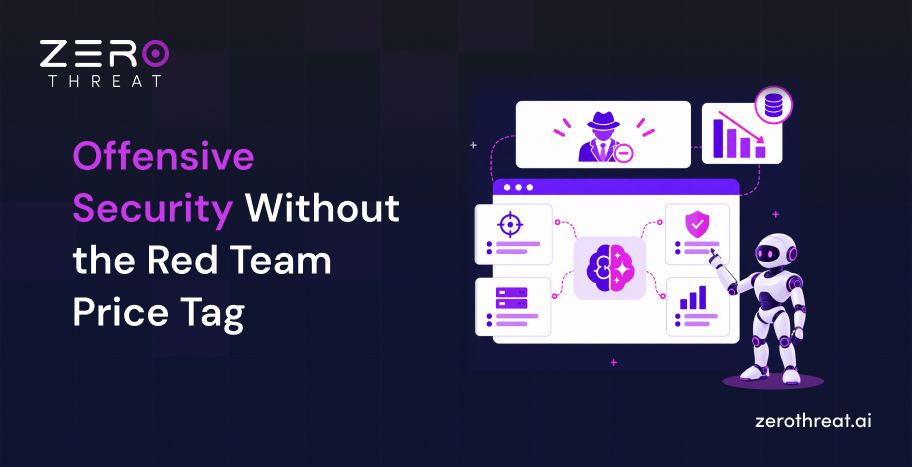
Quick Overview: Offensive security often becomes more expensive as applications, APIs, and attack surfaces grow, while security headcount remains limited. AI pentesting changes this model by automating more of the testing and validation workload. This blog explores the economics of AI pentesting, its impact on attack-path coverage and continuous testing, and how teams can measure its ROI against traditional pentesting and dedicated red teams.
An attacker does not wait for your next penetration test. They can discover an overlooked staging subdomain, exploit a weak password reset flow, and chain an authorization flaw to access sensitive tenant data. By the time your next assessment begins, your application may have changed, introducing new risks that the previous report never covered.
The problem is not always a lack of security expertise. It is the cost of scaling that expertise. Traditional penetration testing depends heavily on human effort to map attack surfaces, validate vulnerabilities, investigate false positives, and document findings. That model becomes harder to sustain when an organization moves from a handful of applications to dozens of services and APIs with frequent releases.
The resource gap makes this challenge harder. The 2025 IANS Research and Artico Search Security Budget Benchmark Report found that only 11% of surveyed CISOs considered their teams adequately staffed, while security budget growth slowed to just 4%, its lowest rate in five years.
AI pentesting offers a different way to approach the problem. By automating repeatable testing tasks, it can reduce dependence on manual effort and make more frequent assessments economically practical. The advantage is not simply a lower cost per test. It is the ability to increase testing frequency without increasing costs at the same rate.
This article examines where traditional penetration testing budgets go, how AI-driven testing changes the cost structure, and how to evaluate the trade-offs using numbers that stand up to scrutiny from a CFO.
Scale your offensive-security coverage without waiting for your team or budget to grow. Start Finding Gaps
On This Page
- Why Offensive Security Costs Scale with Applications, Not Headcount?
- What You are Actually Paying For: The Cost Anatomy of a Traditional Pentest?
- How AI Pentesting Changes the Cost Model?
- Why Attack Path Coverage Matters More Than Finding Volume?
- The Economics of Exploit Validation
- Why Continuous Pentesting Becomes Economically Viable?
- AI Pentesting vs Hiring a Dedicated Red Team
- A Practical ROI Model for AI Pentesting
- Conclusion
Why Offensive Security Costs Scale with Applications, Not Headcount?
The structural problem for small security teams is that offensive security workload grows along a different curve than the team does. Headcount grows in steps, usually one hires every year or two, and each hire is subject to a hiring market where experienced offensive engineers are among the hardest roles to fill and retain. Application count, meanwhile, grows continuously: new services, new integrations, new third-party dependencies, new customer-facing APIs.
Worse, the workload is not a function of application count alone. It is a function of applications multiplied by environments multiplied by release frequency. Ten services across staging and production, shipping biweekly, produce roughly 520 meaningful change events a year. A two-person security team is not going to test 520 change events with manual offensive techniques, and no realistic hiring plan closes that gap.
This is why AI pentesting for small security teams is best understood as a capacity question. The relevant constraint is not whether your team knows how to test authorization logic. It is how many times per year they can afford to do it, across how much of the portfolio, and what fraction of the attack surface goes unexamined in between.
What You are Actually Paying For: The Cost Anatomy of a Traditional Pentest?
To reason for economics, you have to decompose the engagement. A pentest invoice looks like a single number, but it is really seven distinct cost centers, each with a different automation profile. This decomposition matters, because the sections that follow map directly onto it.
| Phase | What Consumes the Time | Repeats Every Engagement? |
|---|---|---|
| Scoping and rules of engagement | Contracting, asset lists, authorization, safe-testing constraints | Yes, largely unchanged |
| Reconnaissance and surface mapping | Subdomain and port enumeration, endpoint and parameter discovery, API inventory | Yes, highly repetitive |
| Vulnerability discovery | Injection, access control, misconfiguration, exposure testing across endpoints | Yes, highly repetitive |
| Exploit development and validation | Building working proof of exploitability, confirming impact | Partly repetitive |
| Business-logic and authorization testing | Multi-step workflow abuse, BOLA and BFLA, state manipulation | Partly repetitive |
| Attack-path analysis | Chaining individual weaknesses into a route to real impact | Judgment-heavy |
| Evidence, reporting, and retest | Write-up, remediation guidance, verification round, often billed separately | Yes, and retest is often extra |
Here are two observations we follow. First, the majority of engagement hours sit in phases that are repetitive across every single test cycle. Reconnaissance against the same application produces broadly the same map each quarter, with deltas. Those hours are being re-purchased at full human rates every time.
Second, and less visible on any invoice, the engagement generates internal cost. Your engineers lose hours to triaging findings that turn out to be non-exploitable, reproducing issues the report described ambiguously, and re-testing fixes. That labor never appears in the vendor’s quote, but it is real work that teams have to absorb, often those least equipped to handle the additional burden.
How AI Pentesting Changes the Cost Model?
AI-driven penetration testing is offensive security testing in which autonomous agents perform reconnaissance, generate and execute attacks, and validate exploitability across an application or API, replacing per-test human hours with compute. The role of AI in offensive security is therefore not to invent new attack techniques, but to execute known offensive workflows repeatedly, in parallel, and at a marginal cost that approaches zero.
Map that against the seven phases above, and the economic picture becomes concrete. Reconnaissance and surface mapping, vulnerability discovery, exploit validation, evidence collection, and retesting are all workflows an agent can execute autonomously. Scoping and high-level risk judgment are not. The spend that shifts is the repetitive majority, which is exactly the spend you were re-purchasing every cycle.
From Human-hours-per-test To Compute-per-test
Traditional pentesting has a high fixed cost per engagement and effectively no economies of repetition. Testing the same application twice costs roughly twice as much. Automated offensive security testing inverts that: the setup cost is incurred once, and each subsequent run costs compute time rather than consultant days.
Parallelism Across the Portfolio
A human tester works through applications sequentially. An agentic system does not. Forty services can be tested concurrently, which means portfolio-wide coverage no longer requires portfolio-wide scheduling. For a lean team, this is often the difference between testing the two applications leadership cares about and testing everything you own.
What Does Not Change
Scoping still requires a human. Deciding which findings matter to the business still requires a human. Authorizing testing against production still requires a human. The cost floor does not go to zero, it goes to the cost of judgment, which is a much smaller number than the cost of execution. This is the mechanism behind AI penetration testing as a budget line: you stop paying for execution and start paying only for direction.
Go beyond periodic pentests with AI that continuously tests your applications and APIs. See AI Pentesting in Action
Why Attack Path Coverage Matters More Than Finding Volume?
Here is where most economic analyses of security tooling go wrong. They measure cost per finding. That metric rewards the wrong thing, because finding volume and offensive security coverage are not the same variable, and optimizing for the first actively degrades the second.
A vulnerability scanner that returns 4,000 findings across your portfolio has not given you offensive security coverage. It has given you a queue. Coverage means knowing which sequences of weaknesses combine into a route from unauthenticated access to material business impact. That is what an attacker builds, and it is what a red team's engagement produces.
Chaining is Where the Value Sits
Consider a chain that appears constantly in real assessments. A verbose error message discloses an internal user's identifier format, rated low. A profile endpoint accepts that identifier without verifying ownership, a classic BOLA issue, rated medium in isolation. A support-role flag is settable through an unfiltered mass-assignment path on the same object, rated medium. Individually, three unremarkable findings that a triage queue would deprioritize. Chained, they produce full account takeover across tenants.
Finding volume misses this entirely, because the criticality is a property of the sequence, not of any individual weakness. Realizing AI offensive security without a red team means the system has to reason across findings, not just enumerate them, which is the practical distinction between a scanner and agentic AI pentesting.
The Metric That Actually Prices the Purchase
Replace cost per finding with cost per validated attack path. It is harder to compute and vastly more honest. A platform surfacing 400 issues of which 6 form confirmed attack chains has told you where to spend Monday morning. A platform surfacing 4,000 unranked issues has transferred its work to your engineers and billed you for the privilege.
The Economics of Exploit Validation
Yes, AI penetration testing can validate exploitability, and validation is where most of the hidden cost in offensive security actually lives. An unvalidated finding is not a result, but it is a work order issued to your engineering team, and at scale those work orders cost more than the testing that generated them.
Let’s calculate it. Suppose a scan across your portfolio returns 400 findings, and confirming or dismissing each one takes an engineer 25 minutes of reading the request, reproducing the condition, checking whether the code path is reachable, and writing up a conclusion. That is roughly 167 hours, over four full engineer-weeks, spent per cycle on determining what is real. Move that cycle monthly, and the triage of labor alone exceeds the cost of the tooling by a wide margin.
This is why false positive rates are not a quality metric. They are a pricing term. Every unvalidated finding transfers labor from the vendor to your team, and lean teams have the least slack to absorb it.
What Validation Has to Produce to Remove That Cost
- Reproduction, not inference: The system executed the attack and observed the outcome, rather than pattern-matching a response signature.
- Request and response evidence: The exact payload, headers, and server response, so an engineer confirms in one minute rather than twenty-five.
- Proof of reachability: Evidence that the vulnerable path is exercisable in the deployed configuration, not merely present in code.
- Business impact framing: What an attacker obtains at the end of the chain: which data, which accounts, which privilege level.
Applied consistently, this reorders priorities on verified risk rather than on severity labels. AI penetration testing without a red team is only economically viable if validation happens before the finding reaches a human. Otherwise, you have not removed the labor, you have relocated it.
Why Continuous Pentesting Becomes Economically Viable?
Continuous offensive security validation is the practice of re-running full offensive tests against applications and APIs on every meaningful change, rather than at fixed calendar intervals. It becomes economically viable only when the marginal cost of an additional test run is low enough that frequency is no longer a budget decision.
Under an engagement model, testing frequency is capped by procurement. You buy two assessments a year because that is what the budget supports, and the interval between them is pure exposure. Every deployment in that window ships untested. Once marginal cost collapses, frequency becomes a technical decision instead: test when something changes.
The change events worth triggering on are specific:
- Application deploys that touch authentication, session handling, or authorization logic
- Schema and contract changes on APIs, where a new field can silently widen data exposure
- Infrastructure and configuration changes that alter what is externally reachable
- Post-remediation verification, which under a consulting model is frequently a separately billed retest
That last one deserves attention as a line item. Retest fees mean the act of fixing a vulnerability generates additional cost, which creates a quiet incentive to batch fixes and delay verification. When retesting is automatic, that incentive disappears and the remediation loop tightens. The same logic applies to API security testing, where contract drift between releases is common and periodic assessment is structurally poorly suited to catching it.
More attack coverage doesn’t have to mean more headcount. See what AI pentesting costs
AI Pentesting vs Hiring a Dedicated Red Team
AI pentesting and a dedicated red team solve different problems: AI pentesting delivers continuous, validated coverage of known attack classes across the whole portfolio, while a red team delivers adversarial creativity, novel technique development, and full-spectrum campaigns against people and process. For most organizations the practical question is not which to choose, but what the AI-powered red team alternative category can cover so that scarce human offensive hours go to work only humans can do.
| Dimension | Dedicated Red Team | AI Pentesting |
|---|---|---|
| Cost structure | Fixed and high: salaries, tooling, training, retention | Subscription plus compute, largely independent of run count |
| Testing frequency | Campaign-based, weeks to months apart | Continuous, triggered by change events |
| Portfolio coverage | Deep on selected targets, narrow overall | Broad and uniform across all applications and APIs |
| Scalability | Linear with headcount | Parallel, largely decoupled from headcount |
| Attack-path discovery | Creative chaining, including novel techniques | Systematic chaining across known and discovered weaknesses |
| Exploit validation | Manual, high confidence, low throughput | Automated, high confidence, high throughput |
| Human expertise required | Specialist offensive engineers | Generalist security engineer to direct and interpret |
| Business-context analysis | Strong when the team knows the business deeply | Strong on technical impact, needs human framing on business criticality |
| Social engineering and physical | In scope | Out of scope |
| Operational overhead | Hiring, retention, career pathing, tooling budget | Integration and scope maintenance |
The honest reading of that table is that AI pentesting does not eliminate the need for human offensive expertise. It changes what you need. Novel research, adversary emulation against detection and response, social engineering, physical access, and business-logic abuse requiring deep domain context all remain human work.
The economic consequence is that human engagement gets rescoped and re-priced. If the commodity surface is already covered continuously and validated, the engagement you buy stops being a broad sweep and becomes a targeted exercise against the systems that carry the most business risk. That is a smaller, cheaper, and considerably more valuable purchase than a general assessment that spends its first week rediscovering your attack surface.
A Practical ROI Model for AI Pentesting
The economics of AI pentesting come down to a single ratio: validated attack-path coverage achieved per security dollar spent, measured across the whole application portfolio rather than per engagement. Any model that measures cost per test or cost per finding will produce a misleading answer.
Below is a comparison structure you can populate with your own numbers. Every input marked as an assumption should be replaced with your actual figures before it goes anywhere near a budget conversation. The rate variables in particular vary widely by region, scope, and vendor, and no honest model hard-codes them.
| Input | Traditional Engagement Model | Continuous AI Pentesting Model |
|---|---|---|
| Applications and APIs in scope | 3 of 20 assets, budget-limited (15% coverage) | 20 of 20 assets (100% coverage) |
| Test cycles per year | 3 | 26, one per release |
| Cost per cycle | $14,167 average ($42,500 total across 3 engagements) | $923 ($24,000 annual subscription across 26 runs) |
| Marginal cost of one more run | $12,500 to $15,000, a full additional engagement | Compute time only, approaching zero |
| Retest cost | $8,500 per year, billed separately | $0, included in the run |
| Validation labor per finding | 25 min x 135 findings = 56 hours = $4,700 | Approximately 6 hours = $470 on pre-validated evidence |
| Untested exposure window | Approximately 4 months between cycles | Hours to days after a change |
| Primary output metric | 135 findings across 3 reports | Validated attack paths across 26 cycles |
| Total annual cost | $55,700 | $24,470 |
| Cost per asset actually tested | $18,567 | $1,224 |
Basis: Engagement costs use midpoints of published 2026 market ranges ($5,000 to $30,000 per web application, $5,000 to $20,000 per API). Per-finding validation time uses the low end of the published 15-minute-to-several-hours range. Asset counts, release cadence, finding volume, retest rate at 20%, and the subscription figure are stated assumptions, not vendor pricing. Replace all figures with your own before use.
Read across the bottom two rows and the argument resolves. Total spending falls by roughly 56%, but that’s not the most important takeaway. Coverage rises from 15% of the portfolio to 100%, and the cost of testing an asset that actually gets tested falls by about 93%. The budget did not just shrink. It started buying a different quantity of coverage.
Three metrics are worth tracking once the model is running, because they are the ones that hold up under scrutiny:
- Coverage ratio. Applications and APIs tested in the last 30 days, divided by total in the portfolio. Most teams are surprised by this number the first time they compute it.
- Mean exposure window. Average time between a change shipping and that change being offensively tested. This is the number that most directly maps to breach risk.
- Validation labor per cycle. Engineer hours spent confirming findings. If this is not falling, the tooling is relocating cost rather than removing it.
To reduce offensive security costs with AI pentesting in a way that survives budget review, present the case as coverage economics rather than tool substitution. The argument is not that testing got cheaper. It is that the same budget now buys continuous coverage of the full portfolio instead of periodic coverage of a fraction of it. For a deeper evaluation framework, our AI pentesting platform buyer's guide covers what to verify during vendor assessment.
Think you need a dedicated red team? See what AI pentesting can cover before you hire. See It Live
Conclusion: Make Offensive Security a Capacity Problem, Not a Headcount Problem
The teams that solve this well stop asking how to afford more pentests and start asking how much validated coverage they get per security dollar. That reframing is what makes the math work without a dedicated red team. You are not trying to replicate an offensive security function. You are trying to make offensive testing a continuous property of your delivery pipeline, with human judgment reserved for the decisions that need it.
ZeroThreat was built around that economic argument. Its AI penetration testing tool performs application-aware reconnaissance and attack-chain discovery across web applications and APIs, tests authenticated multi-step workflows the way a real user moves through them without requiring scripted specs, and validates exploitability before a finding ever reaches your queue.
The result is what this article has been describing in the abstract: continuous automated penetration testing across the full portfolio, findings that arrive pre-validated with request and response evidence, attack paths prioritized by business impact, and compliance mapping to OWASP, PCI DSS, HIPAA, GDPR, and ISO 27001 as a byproduct rather than a separate project.
If your team is carrying a portfolio that outgrew its testing budget, the fastest way to find out what continuous coverage looks like against your own applications is to run it. Sign up and start a scan.
Frequently Asked Questions
What is AI pentesting without a dedicated red team?
AI pentesting without a dedicated red team is an offensive security model in which autonomous agents perform reconnaissance, attack execution, exploit validation, and retesting across applications and APIs, allowing a small security team to achieve continuous offensive coverage without employing specialist offensive engineers. The security team directs scope and interprets business risk, while the system handles execution.
Can AI pentesting replace a dedicated red team?
Can AI pentesting test authenticated user journeys?
What is the difference between AI pentesting and traditional penetration testing?
How does AI pentesting reduce offensive security costs?
Explore ZeroThreat
Automate security testing, save time, and avoid the pitfalls of manual work with ZeroThreat.